Artículos Relacionados con Forecasting

El Centro de Noticias de HTX ofrece los artículos más recientes y un análisis profundo sobre "Forecasting", cubriendo tendencias del mercado, actualizaciones de proyectos, desarrollos tecnológicos y políticas regulatorias en la industria de cripto.

Tiger Research: Zuckerberg Begins Betting on Prediction Markets, While Asian Nations Still View Them as Gambling

This article examines the rise of prediction markets, contrasting their growing institutional acceptance in the West with their restrictive regulation in Asia. It details how prediction markets, which originated from informal political betting and academic experiments like the Iowa Electronic Market, aggregate crowd wisdom into probabilistic prices through binary contracts. Their growth accelerated around 2020, reaching over $14 billion in monthly volume. A key driver is the "skin in the game" principle, where users risk their own capital, leading to high accuracy in predicting events like Fed rate decisions and elections, as demonstrated by platforms like Polymarket. Meta's entry, with Mark Zuckerberg reportedly leading the development of the Arena app, signals the market's maturation. In the U.S., court rulings have distinguished prediction markets from gambling, facilitating entry by traditional financial institutions. However, most Asian jurisdictions still classify them as gambling, focusing on social control rather than financial innovation. The article argues this stance creates three problems for Asia: 1) regulatory arbitrage pushes users to riskier offshore platforms, 2) loss of sovereign information infrastructure as valuable social sentiment data accumulates abroad, and 3) abandonment of user protection. It concludes that Asia needs a policy shift from prohibition to constructive regulation, integrating these markets into the formal system to harness their data as a national asset, as initiatives like Limitless Research are beginning to do.

marsbit07/11 10:43

Tiger Research: Zuckerberg Begins Betting on Prediction Markets, While Asian Nations Still View Them as Gambling

marsbit07/11 10:43

a16z Crypto's Latest Article: Why Do We Need Prediction Markets?

Prediction markets allow people to trade on the outcome of future events. They function as markets that aggregate dispersed information into a price signal, which represents the collective probability of an event occurring. By creating assets that pay out only if a specific outcome happens, these markets enable participants to bet based on their knowledge and beliefs. These markets have historical precedents, like 16th-century papal selection bets, and modern foundations in economics and market design. They offer advantages over traditional forecasting tools like polls: they provide direct probability estimates, update in real-time, and incentivize participants with real financial stakes to contribute accurate information. This can lead to more informed predictions, even for highly specific questions—such as which AI model performs best on certain tasks—that aren't covered by traditional commodity or stock markets. However, prediction markets face challenges. Infrastructure is needed to verify outcomes and ensure transparent, auditable operations. Market design must encourage participation from diverse, informed individuals while mitigating issues like insider trading or manipulation attempts aimed at distorting public perception. Despite these hurdles, with proper design focusing on transparency and participation management, prediction markets have significant potential as a core tool for forecasting the future.

marsbit06/02 14:34

a16z Crypto's Latest Article: Why Do We Need Prediction Markets?

marsbit06/02 14:34

If We Gathered the Most Accurate Gold Forecasters in History, Could We Crack the Future Price of Gold?

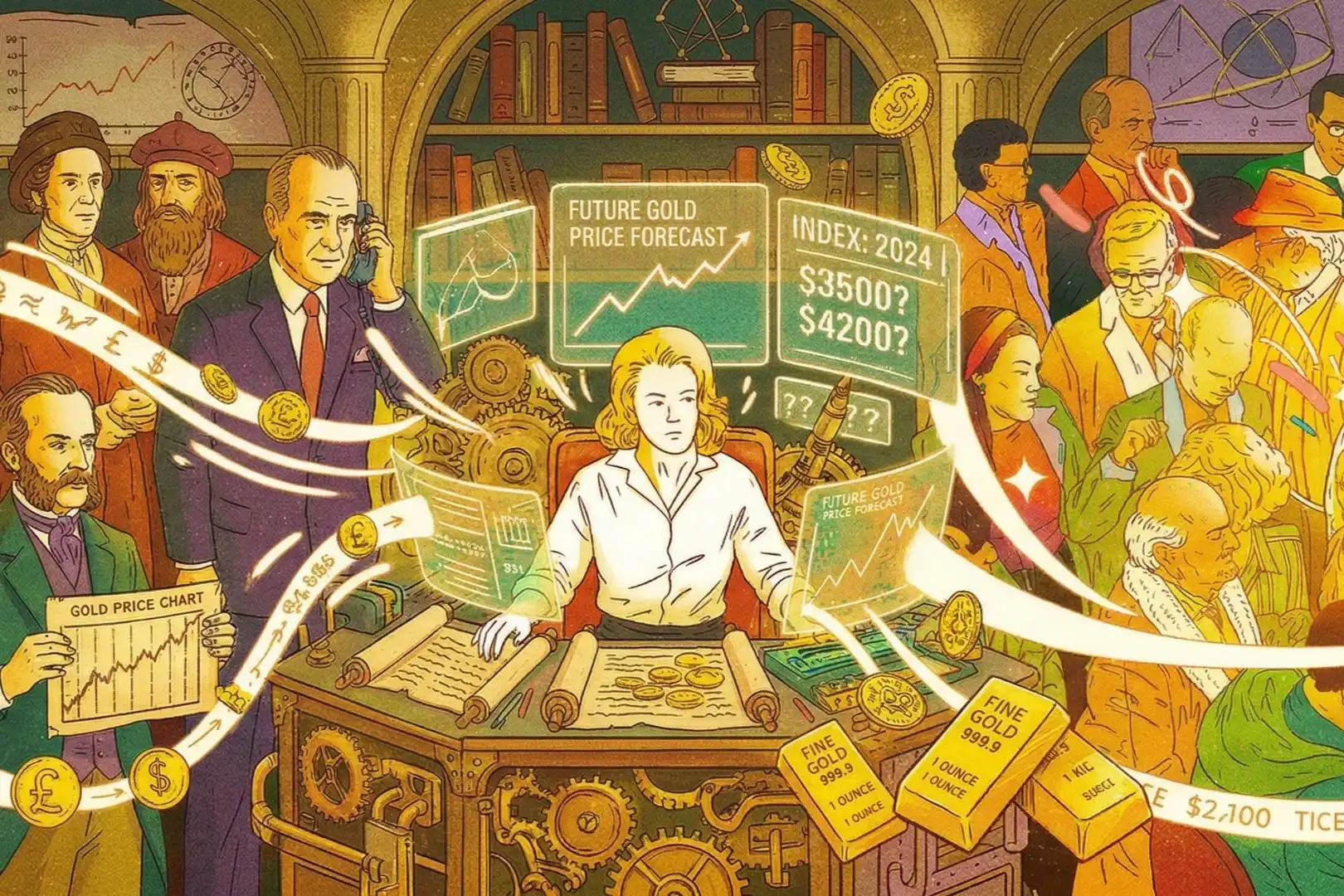
The article investigates whether assembling the most historically accurate gold price forecasters could unlock future price movements. The author analyzes three groups: top Wall Street institutions (e.g., LBMA, Goldman Sachs, JPMorgan), prominent gold bulls (e.g., Peter Schiff, Jim Rickards), and analysts famed for precise calls (e.g., Nouriel Roubini, Ben McMillan). The findings reveal significant flaws. Institutions consistently exhibit "lagging predictions," adjusting forecasts too slowly and underestimating bull market magnitudes. Pundits perpetually predict extreme price targets (e.g., $35,000) without precise timing, often being early or wrong. Even "prophetic" forecasters have mixed records; Roubini missed the entire 2009-2012 bull market, and Ray Dalio has a history of erroneous crisis predictions. The analysis notes that the current environment mirrors 2011, where extreme predictions clustered near the market top. Today, forecasts from the same experts range wildly from $5,400 to $35,000. The conclusion is that no consistently accurate forecaster exists. Predictions are often right by chance, not skill. The author ultimately rejects seeking a "wealth password" and instead advocates for a Dalio-inspired approach: avoiding precise price predictions, acknowledging uncertainty, and using portfolio allocation (e.g., 5-15% in gold) for long-term risk management.

marsbit04/03 10:26

If We Gathered the Most Accurate Gold Forecasters in History, Could We Crack the Future Price of Gold?

marsbit04/03 10:26

If We Gathered the Most Accurate Gold Forecasters in History, Could We Crack the Future Price of Gold? I've Compiled a Decade of the Most Accurate Gold Analysis

This analysis investigates whether compiling the most accurate historical predictions on gold prices from top analysts, institutions, and famed forecasters can unlock future price movements. After examining over a decade of data, the findings reveal that no single expert or entity consistently predicts gold prices accurately. Key observations include: - **Wall Street institutions** (e.g., LBMA, Goldman Sachs, JPMorgan) often exhibit "lagging predictions," adjusting targets only after trends are established, frequently underestimating actual price moves. - **Prominent gold bulls** (e.g., Peter Schiff, Jim Rogers) persistently advocate for higher prices over long horizons but lack timing precision, leading to extended periods of underperformance. - **"Prophetic" forecasters** (e.g., Nouriel Roubini, Ben McMillan) have moments of accuracy but also significant misses or limited track records, undermining their reliability. The study notes a pattern similar to the 2011 gold peak: extreme bullish predictions often cluster near market tops, followed by sharp corrections. Current forecasts for gold range widely from $5,400 to $35,000, reflecting high disagreement even among experts. The conclusion is that there is no consistent "most accurate" predictor for gold prices. Relying on expert consensus or individual forecasts proves chaotic and unreliable. Instead, the author advocates for a strategy akin to Ray Dalio’s: avoiding precise price predictions, embracing uncertainty, and using portfolio allocation (e.g., 5-15% in gold) for long-term risk management.

marsbit04/02 12:42

If We Gathered the Most Accurate Gold Forecasters in History, Could We Crack the Future Price of Gold? I've Compiled a Decade of the Most Accurate Gold Analysis

marsbit04/02 12:42

Kalshi's First Research Report Released: How Collective Intelligence Outperforms Wall Street Think Tanks in Predicting CPI

Kalshi Research's inaugural report demonstrates that prediction markets consistently outperform Wall Street consensus forecasts in predicting the U.S. year-over-year CPI inflation rate. The study, covering over 25 monthly CPI releases from February 2023 to mid-2025, shows Kalshi’s market-implied forecasts had a 40.1% lower mean absolute error (MAE) than consensus predictions across all environments. The advantage was most pronounced during economic "shocks." For large surprises (over 0.2 percentage points), Kalshi's forecasts were 50% more accurate a week before the data release, improving to 60% more accurate the day before. For medium surprises (0.1-0.2 percentage points), the advantage was similarly 50%, rising to 56.2% closer to the release. Crucially, a divergence of over 0.1 percentage points between the market forecast and consensus served as a strong signal, with an 81.2% probability that a shock would occur. When the two forecasts disagreed, the market prediction was more accurate 75% of the time. The report attributes this "Shock Alpha" to three factors: the "wisdom of crowds" aggregating diverse information, superior incentive structures that reward accuracy over conformity, and more efficient information synthesis, even with the same public data. This suggests prediction markets provide a valuable, differentiated signal for investors and policymakers, especially during periods of high uncertainty.

Odaily星球日报12/24 04:00

Kalshi's First Research Report Released: How Collective Intelligence Outperforms Wall Street Think Tanks in Predicting CPI

Odaily星球日报12/24 04:00

活动图片