Strategy Watch #2

insights.glassnodePublicado a 2026-03-24Actualizado a 2026-03-24

Resumen

Strategy Watch #2 provides institutional analysis of digital asset fund performance and allocation trends. The report covers six key areas: institutional capital flows, fund performance, macro strategies, on-chain vault returns, manager sentiment, and allocation updates. In February and early March, Bitcoin and Ethereum saw significant net outflows (-$9.6B and -$3.2B respectively), while stablecoins attracted inflows (+$6.2B), suggesting a defensive shift toward lower-risk assets. BTC ETF flows turned positive in March, though institutional conviction remains cautious. DeFi Total Value Locked (TVL) on Ethereum declined sharply, with peak outflows of -$23.7B in February, indicating reduced participation in on-chain yield strategies. CME basis yields continued to tighten, reflecting lower institutional leverage and softer derivatives demand. The report also highlights performance trends, with only one strategy type generating positive returns in February. Over 300 managers shared their three-month market outlook, and a new $750M fund of funds was announced.

The full report is freely available in PDF format.

Download PDF version

Welcome to Strategy Watch #2

Strategy Watch was built to address a clear demand for high-signal, impartial analysis of fund-level performance and allocation trends in digital assets.

The inaugural edition confirmed this demand, reaching a broad audience of key decision makers, from leading global asset managers, hedge funds, major investment banks, top-tier crypto-native funds and Fund of Funds.

Building on this early momentum, our objective is straightforward — to make Strategy Watch a must-read monthly publication for the digital asset investment community.

This publication is strengthened by direct input from market participants. Funds and allocators that contribute data and insights help shape a more complete and valuable view of the landscape.

If you have insights, data, or allocation updates worth sharing, we welcome your contribution.

Present your latest initiatives and updates to a curated audience of institutional allocators.

Share updates ↗

Inside the Latest Strategy Watch

The report is structured across six core sections, each focused on a distinct dimension of institutional activity in digital assets:

01 Institutional Flow Monitor |

02 Fund and SMA Performance | February was a bloodbath, check this section to see the only strategy type that returned positively last month.

03 Strategy Deep Dive: Macro Strategies | Hear firsthand from a macro portfolio manager on how they are navigating the current geopolitical challenges. 

04 On-chain Vault Performance | Are ETH curators underperforming ETH staking yield?

05 Manager Monitor | Find out how more than 300 managers are expecting the crypto market to perform over the next three months.

06 Allocation Updates | New USD 750m Fund of Funds is launching. Check this section to learn more.

in partnership with

The Premier Digital Assets Allocator Platform. Learn more


Institutional Flow Monitor

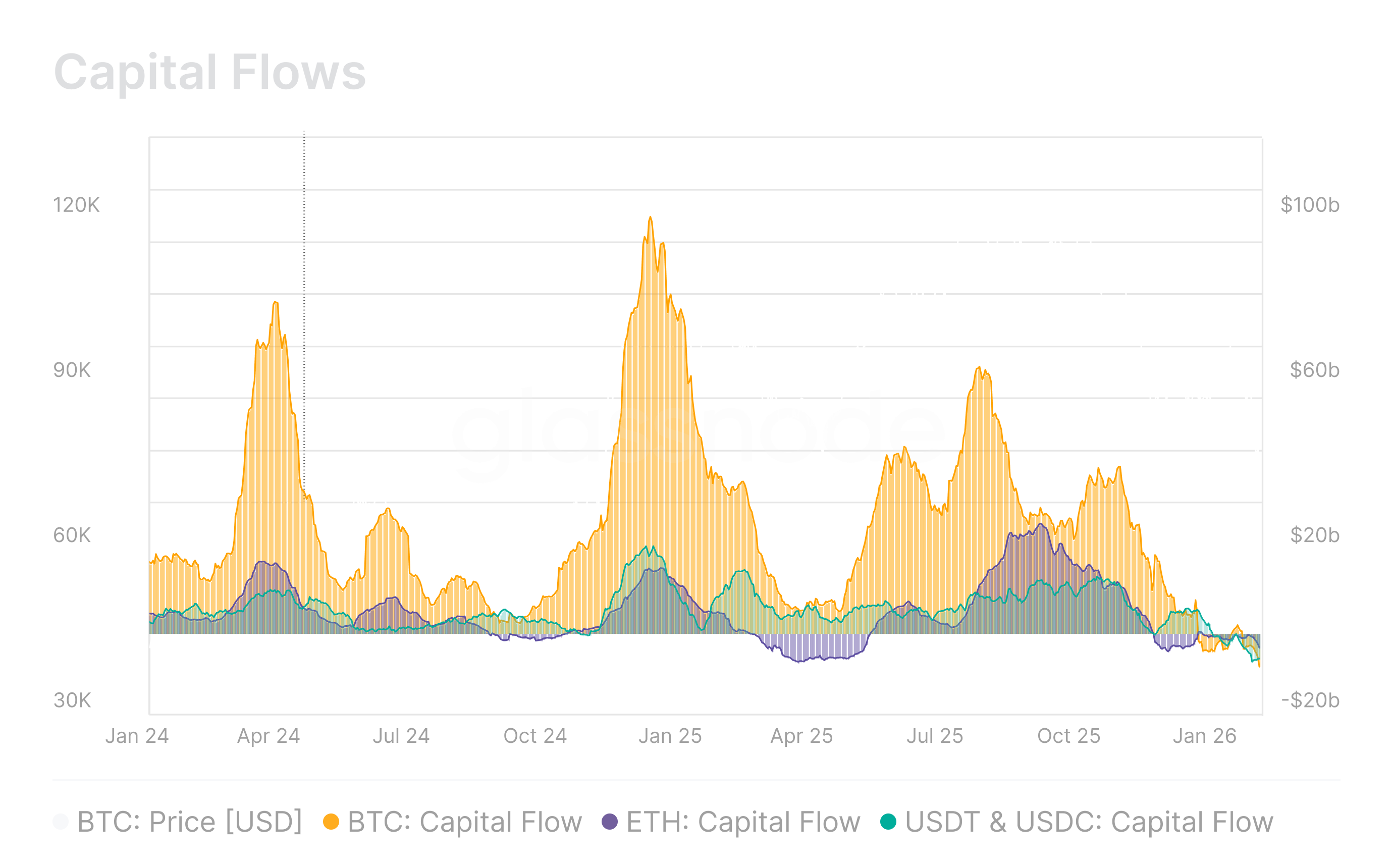
Capital flows into BTC and ETH remained deeply negative through February and into March, with stablecoins turning net positive in early March as investors rotated toward lower-risk positioning.

Bitcoin and Ethereum continued to experience sustained net outflows, with BTC and ETH capital flows registering -$9.6B and -$3.2B. However, stablecoins broke from the broader negative trend, flipping to +$6.2B in net inflows. Rather than signaling a broad return of risk appetite, this rotation likely reflects a defensive repositioning, with capital migrating into dollar-denominated on-chain instruments while conviction in spot crypto assets remains under pressure heading into mid-Q1 2026.
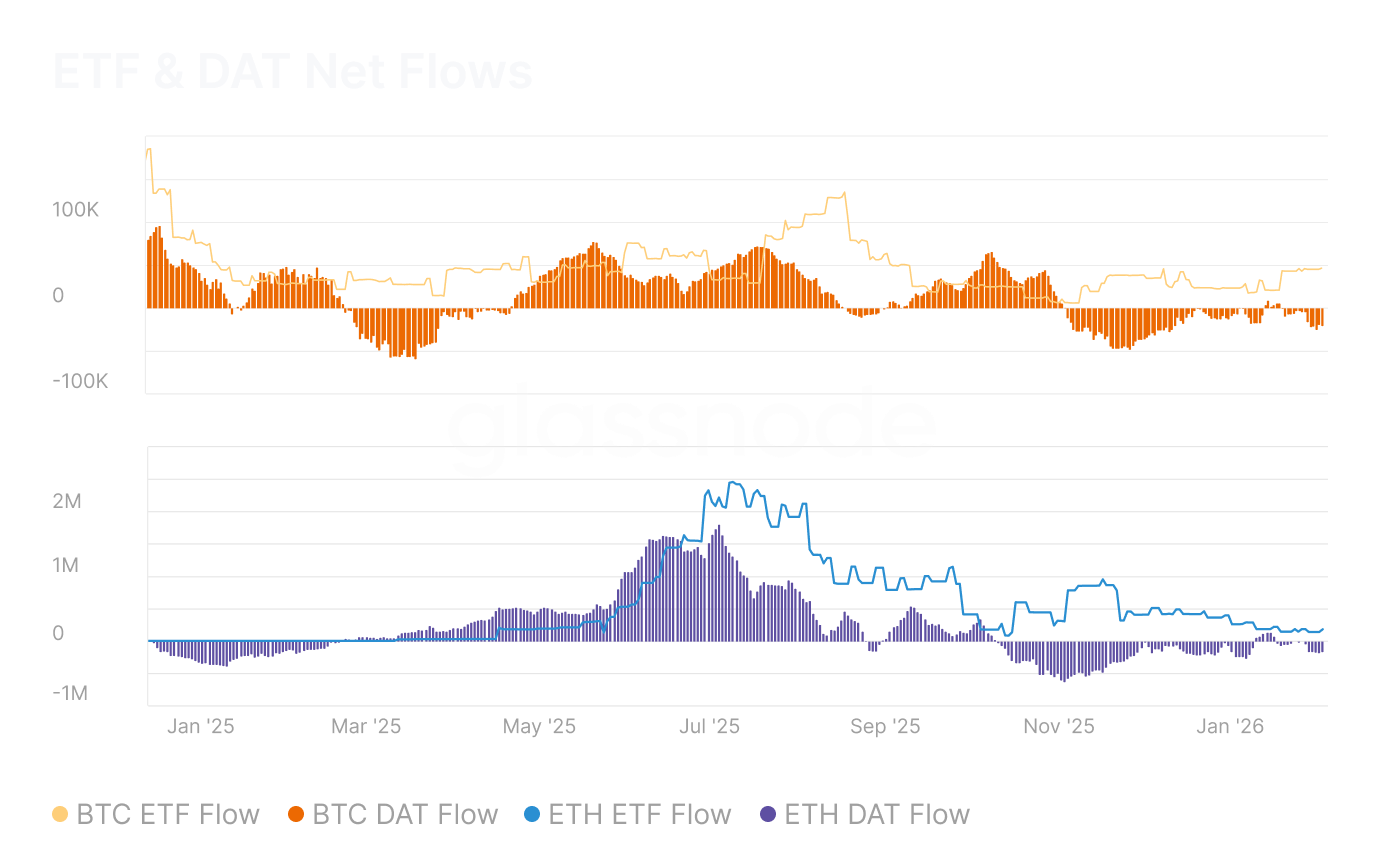
ETF & DAT Net Flows

After sustained February outflows, BTC ETF and DAT flows returned to positive, while ETH institutional flows showed early signs of stabilization.

After sustained February outflows, Bitcoin ETF and DAT flows returned to positive territory, recovering to +28k BTC and +46.8k BTC respectively. Ethereum flows were more measured, with ETF flows near neutral at +46.5k ETH and DAT flows stabilizing at +295.8k ETH. While the directional shift is encouraging, the recovery remains early-stage and uneven, and it would be premature to characterize this as a broad resumption of institutional conviction.
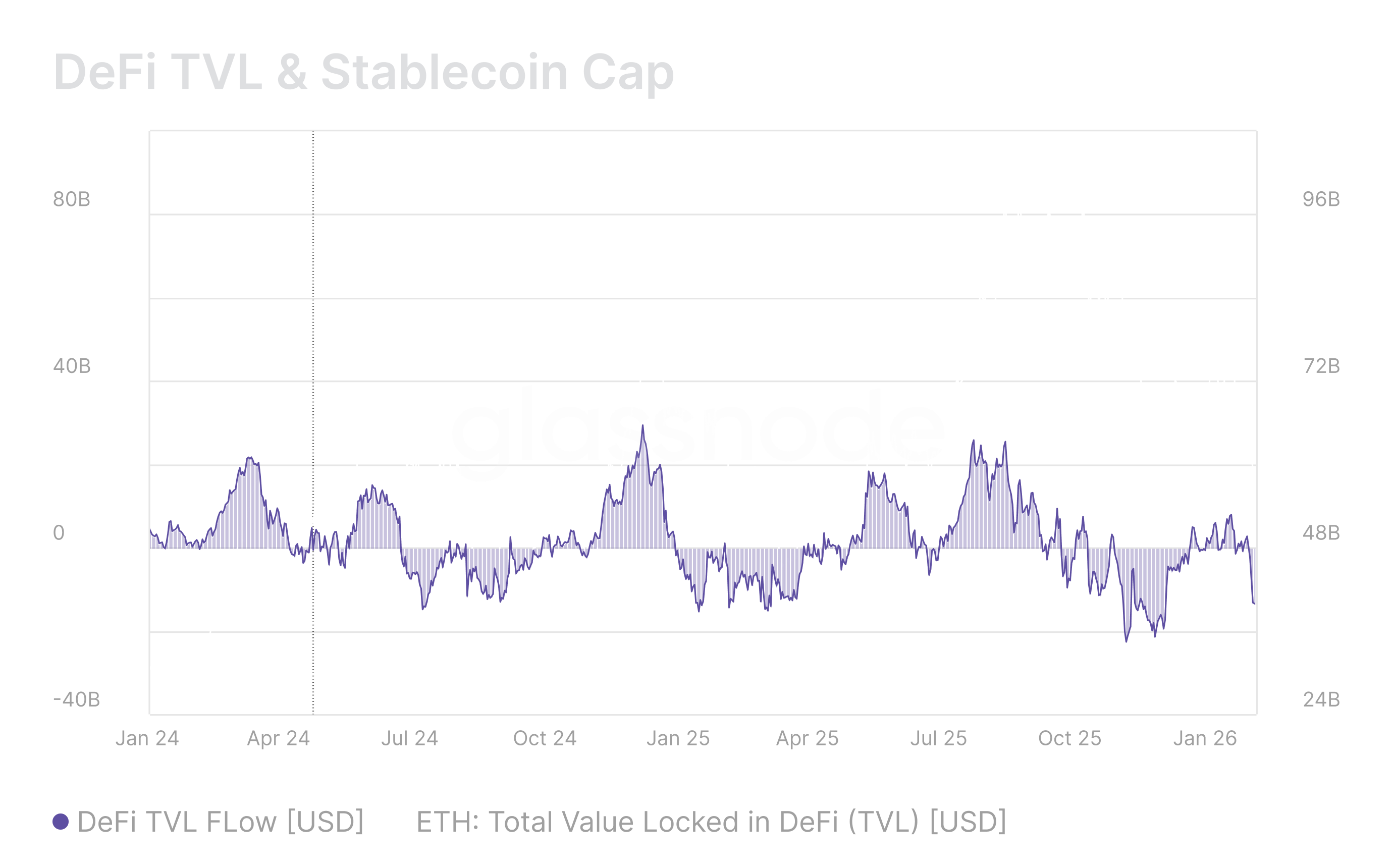
DeFi TVL & Stablecoin Cap

DeFi TVL on Ethereum saw sharp contraction through February before showing early signs of stabilization in March, though the broader declining trend since August 2025 remains intact.

Total Value Locked on Ethereum recorded peak outflows of -$23.7B per month in February, implying sustained withdrawal by larger allocators from on-chain activities such as liquidity provisioning and yield strategies. This slowdown alone is insufficient to signal a reversal, and diminished conviction in DeFi risk-adjusted returns continues to point to shallower liquidity depth across the ecosystem.
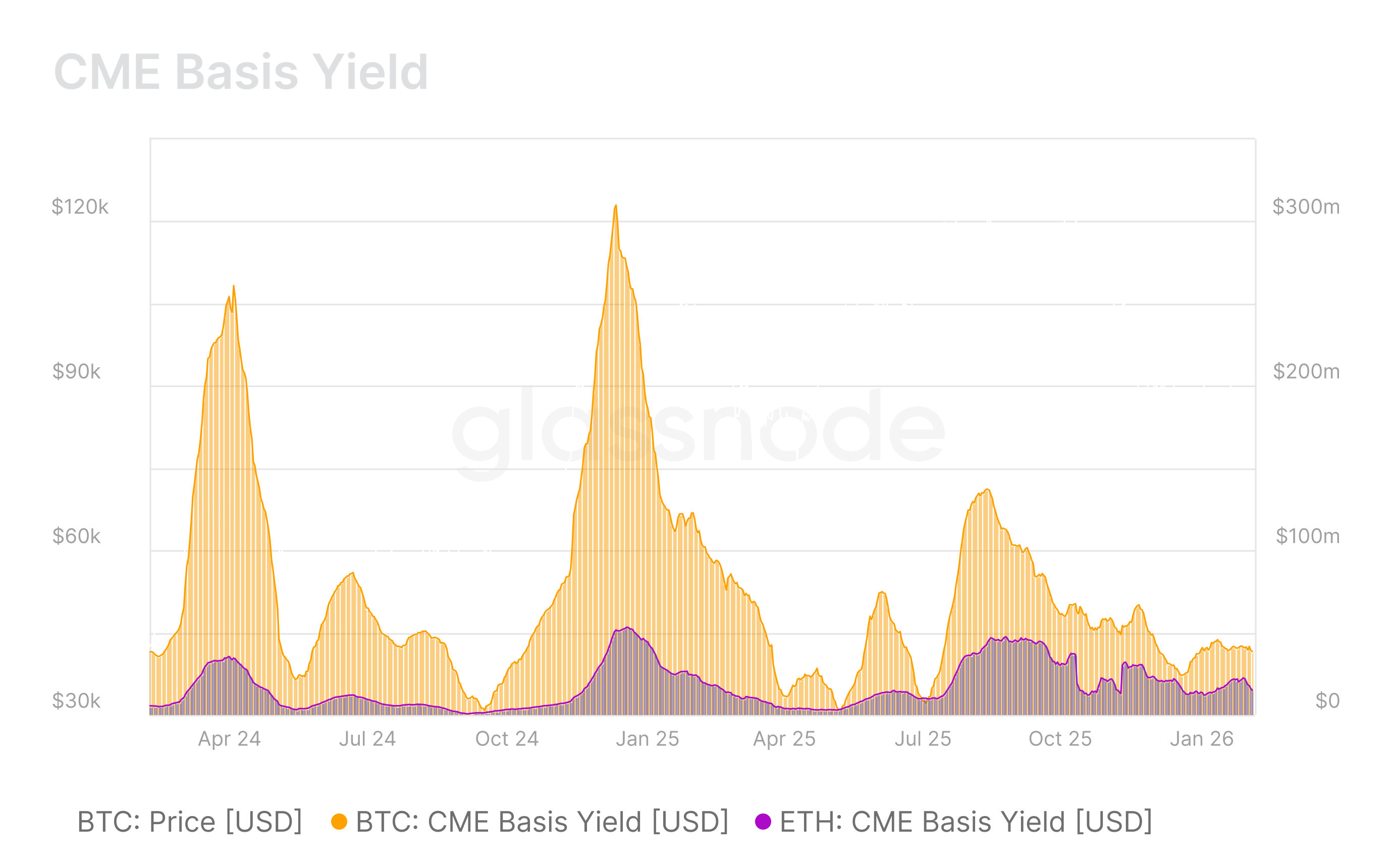
CME Basis Yield

CME Basis Yield compressed even further in February, reinforcing waning incentives for market-neutral strategies compared to January.

The monthly dollar value captured by institutions via cash-and-carry trades declined notably for both Bitcoin and Ethereum, building on the sharp compression seen since August 2025. This tightening basis reflects reduced leverage deployment, softer futures demand, and continued pullback in balance-sheet commitment amid tighter liquidity conditions persisting from January into early March 2026.


Disclaimer: This report does not provide any investment advice. All data is provided for information and educational purposes only. No investment decision shall be based on the information provided here and you are solely responsible for your own investment decisions.
Exchange balances presented are derived from Glassnode’s comprehensive database of address labels, which are amassed through both officially published exchange information and proprietary clustering algorithms. While we strive to ensure the utmost accuracy in representing exchange balances, it is important to note that these figures might not always encapsulate the entirety of an exchange’s reserves, particularly when exchanges refrain from disclosing their official addresses. We urge users to exercise caution and discretion when utilizing these metrics. Glassnode shall not be held responsible for any discrepancies or potential inaccuracies. Please read our Transparency Notice when using exchange data.

Preguntas relacionadas

QWhat is the primary purpose of the Strategy Watch publication?

AStrategy Watch was built to address a clear demand for high-signal, impartial analysis of fund-level performance and allocation trends in digital assets, aiming to be a must-read monthly publication for the digital asset investment community.

QWhich was the only strategy type that returned positively in February according to the report?

AThe report indicates that readers should check the 'Fund and SMA Performance' section to see the only strategy type that returned positively in February, though the specific strategy name is not stated in the provided text.

QWhat was the trend in capital flows for Bitcoin (BTC) and Ethereum (ETH) through February and into March?

ACapital flows into BTC and ETH remained deeply negative, with BTC and ETH capital flows registering -$9.6B and -$3.2B, respectively.

QHow did stablecoin capital flows behave in contrast to BTC and ETH in early March?

AStablecoins broke from the broader negative trend, flipping to +$6.2B in net inflows, which likely reflects a defensive repositioning into lower-risk, dollar-denominated on-chain instruments.

QWhat does the sharp compression in CME Basis Yield indicate about market conditions?

AThe compression in CME Basis Yield reflects reduced leverage deployment, softer futures demand, and a continued pullback in balance-sheet commitment amid tighter liquidity conditions, indicating waning incentives for market-neutral strategies.

Lecturas Relacionadas

¿Por qué vendió Strategy 32 Bitcoins? El CEO revela la verdadera razón

El CEO de Strategy, Phong Le, explicó que la venta de 32 Bitcoin por parte de la empresa no se debió a necesidades de liquidez, sino a un esfuerzo deliberado para mostrar al mercado que la firma puede vender BTC cuando sea necesario y para probar su proceso interno de ejecución. Estas declaraciones se produjeron después de que Strategy comprara más de 1.500 BTC aproximadamente una semana después de esa pequeña venta, su primera enajenación desde 2022. En una entrevista con CNBC, Le rechazó la idea de que la venta marcara un cambio en su estrategia de acumulación a largo plazo. Subrayó que la empresa sigue siendo un comprador neto de Bitcoin, como lo demuestra la adquisición de unos 1.500 BTC en el último mes. Le detalló las dos razones principales para la venta: "inocular" al mercado haciéndole ver que están dispuestos a vender si es necesario, y realizar una prueba operativa de sus sistemas, ya que vender es operativamente más complejo que comprar. También aclaró que la venta no fue para financiar dividendos, ya que pueden cubrirlos con otras actividades. Reconoció que la transacción causó frustración entre algunos inversores minoristas que adhieren a una postura de "nunca vender", pero argumentó que Strategy debe responder a un conjunto más amplio de partes interesadas, incluidos accionistas comunes, preferentes y tenedores de deuda. Concluyó que los accionistas institucionales no se mostraron perturbados por la venta, y que la compañía, como el mayor tenedor y comprador mundial de Bitcoin, mantiene su compromiso con el activo.

bitcoinistHace 7 min(s)

¿Por qué vendió Strategy 32 Bitcoins? El CEO revela la verdadera razón

bitcoinistHace 7 min(s)

¿Cuánto tiempo puede sostenerlo el último gran comprador de Ethereum?

A medida que el mercado de criptomonedas continúa cayendo, Bitmine se mantiene como el comprador marginal más constante y agresivo de ETH, a pesar de sufrir pérdidas no realizadas de más de 10.000 millones de dólares. La empresa planea alcanzar su objetivo de poseer el 5% del suministro total de ETH para fines de 2026, faltando menos de 400.000 ETH. Para financiar sus compras, Bitmine emitió acciones preferentes perpetuas con un dividendo del 9,5%. Su ventaja clave sobre competidores como Strategy es el ingreso por staking de ETH, que actualmente genera entre 230 y 296 millones de dólares anuales, suficiente para cubrir los dividendos de la emisión inicial. Sin embargo, si la emisión de acciones preferentes se expande, este rendimiento del ~3-4% del staking no podrá cubrir el dividendo del 9,5%, dependiendo entonces del aumento del precio del ETH. El análisis plantea tres escenarios: pesimista (caída a 1.000 USD si se detienen las compras), base (consolidación entre 1.500-2.000 USD) y optimista (recuperación impulsada por inclusión en índices y adopción institucional, con precio objetivo a largo plazo de 40.000 USD para 2030 según Standard Chartered). La pregunta central es quién sostendrá el precio del ETH una vez que Bitmine complete su objetivo del 5% y reduzca sus compras, dado el flujo saliente de los ETF y la retirada de algunas instituciones, mientras que la demanda incremental de stablecoins y RWA es aún un factor a largo plazo.

marsbitHace 4 hora(s)

¿Cuánto tiempo puede sostenerlo el último gran comprador de Ethereum?

marsbitHace 4 hora(s)

Trading

Spot
Futuros
活动图片