Strategy Watch #2

insights.glassnodePublicado a 2026-03-24Actualizado a 2026-03-24

Resumen

Strategy Watch #2 provides institutional analysis of digital asset fund performance and allocation trends. The report covers six key areas: institutional capital flows, fund performance, macro strategies, on-chain vault returns, manager sentiment, and allocation updates. In February and early March, Bitcoin and Ethereum saw significant net outflows (-$9.6B and -$3.2B respectively), while stablecoins attracted inflows (+$6.2B), suggesting a defensive shift toward lower-risk assets. BTC ETF flows turned positive in March, though institutional conviction remains cautious. DeFi Total Value Locked (TVL) on Ethereum declined sharply, with peak outflows of -$23.7B in February, indicating reduced participation in on-chain yield strategies. CME basis yields continued to tighten, reflecting lower institutional leverage and softer derivatives demand. The report also highlights performance trends, with only one strategy type generating positive returns in February. Over 300 managers shared their three-month market outlook, and a new $750M fund of funds was announced.

The full report is freely available in PDF format.

Download PDF version

Welcome to Strategy Watch #2

Strategy Watch was built to address a clear demand for high-signal, impartial analysis of fund-level performance and allocation trends in digital assets.

The inaugural edition confirmed this demand, reaching a broad audience of key decision makers, from leading global asset managers, hedge funds, major investment banks, top-tier crypto-native funds and Fund of Funds.

Building on this early momentum, our objective is straightforward — to make Strategy Watch a must-read monthly publication for the digital asset investment community.

This publication is strengthened by direct input from market participants. Funds and allocators that contribute data and insights help shape a more complete and valuable view of the landscape.

If you have insights, data, or allocation updates worth sharing, we welcome your contribution.

Present your latest initiatives and updates to a curated audience of institutional allocators.

Share updates ↗

Inside the Latest Strategy Watch

The report is structured across six core sections, each focused on a distinct dimension of institutional activity in digital assets:

01 Institutional Flow Monitor |

02 Fund and SMA Performance | February was a bloodbath, check this section to see the only strategy type that returned positively last month.

03 Strategy Deep Dive: Macro Strategies | Hear firsthand from a macro portfolio manager on how they are navigating the current geopolitical challenges. 

04 On-chain Vault Performance | Are ETH curators underperforming ETH staking yield?

05 Manager Monitor | Find out how more than 300 managers are expecting the crypto market to perform over the next three months.

06 Allocation Updates | New USD 750m Fund of Funds is launching. Check this section to learn more.

in partnership with

The Premier Digital Assets Allocator Platform. Learn more


Institutional Flow Monitor

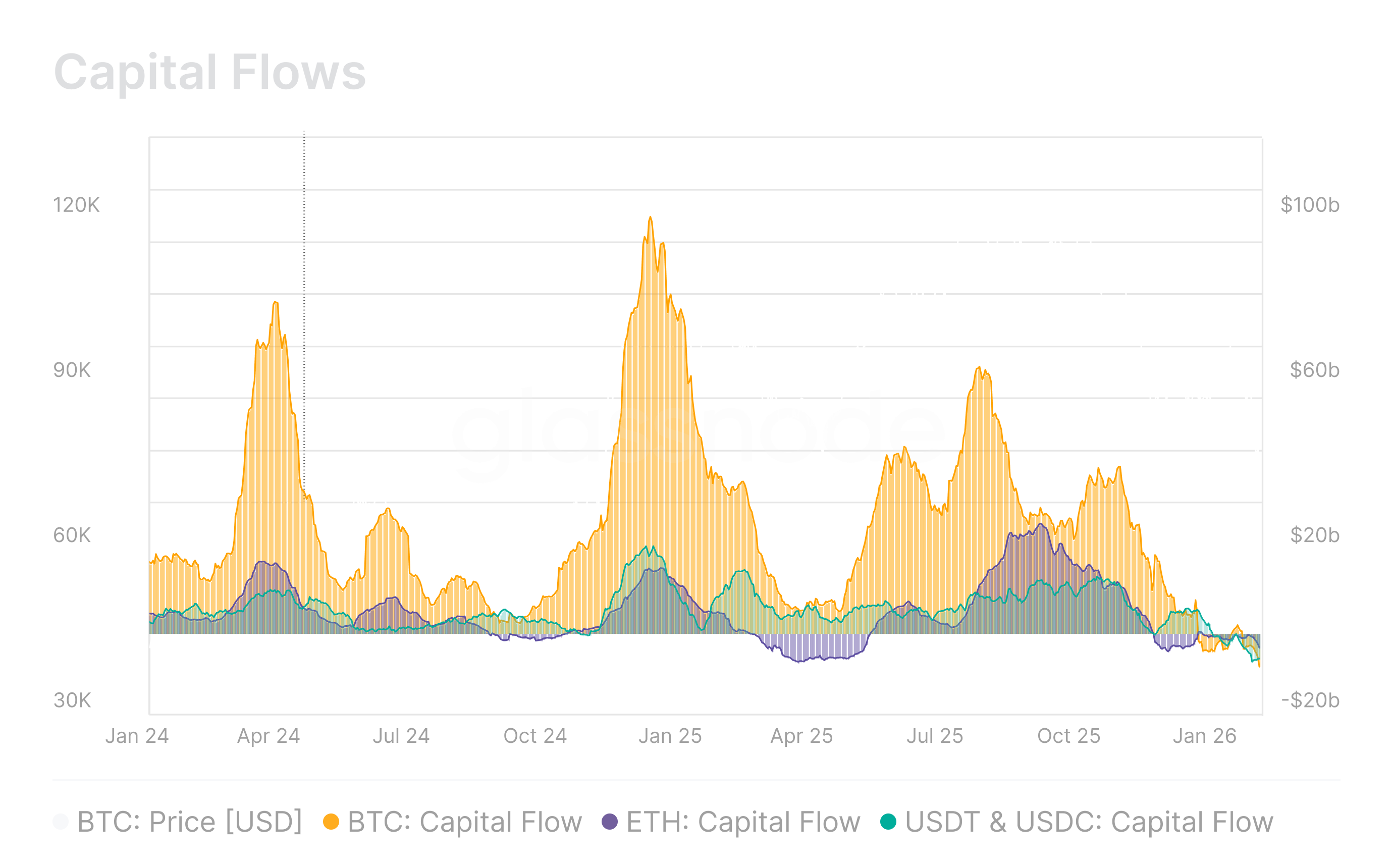
Capital flows into BTC and ETH remained deeply negative through February and into March, with stablecoins turning net positive in early March as investors rotated toward lower-risk positioning.

Bitcoin and Ethereum continued to experience sustained net outflows, with BTC and ETH capital flows registering -$9.6B and -$3.2B. However, stablecoins broke from the broader negative trend, flipping to +$6.2B in net inflows. Rather than signaling a broad return of risk appetite, this rotation likely reflects a defensive repositioning, with capital migrating into dollar-denominated on-chain instruments while conviction in spot crypto assets remains under pressure heading into mid-Q1 2026.
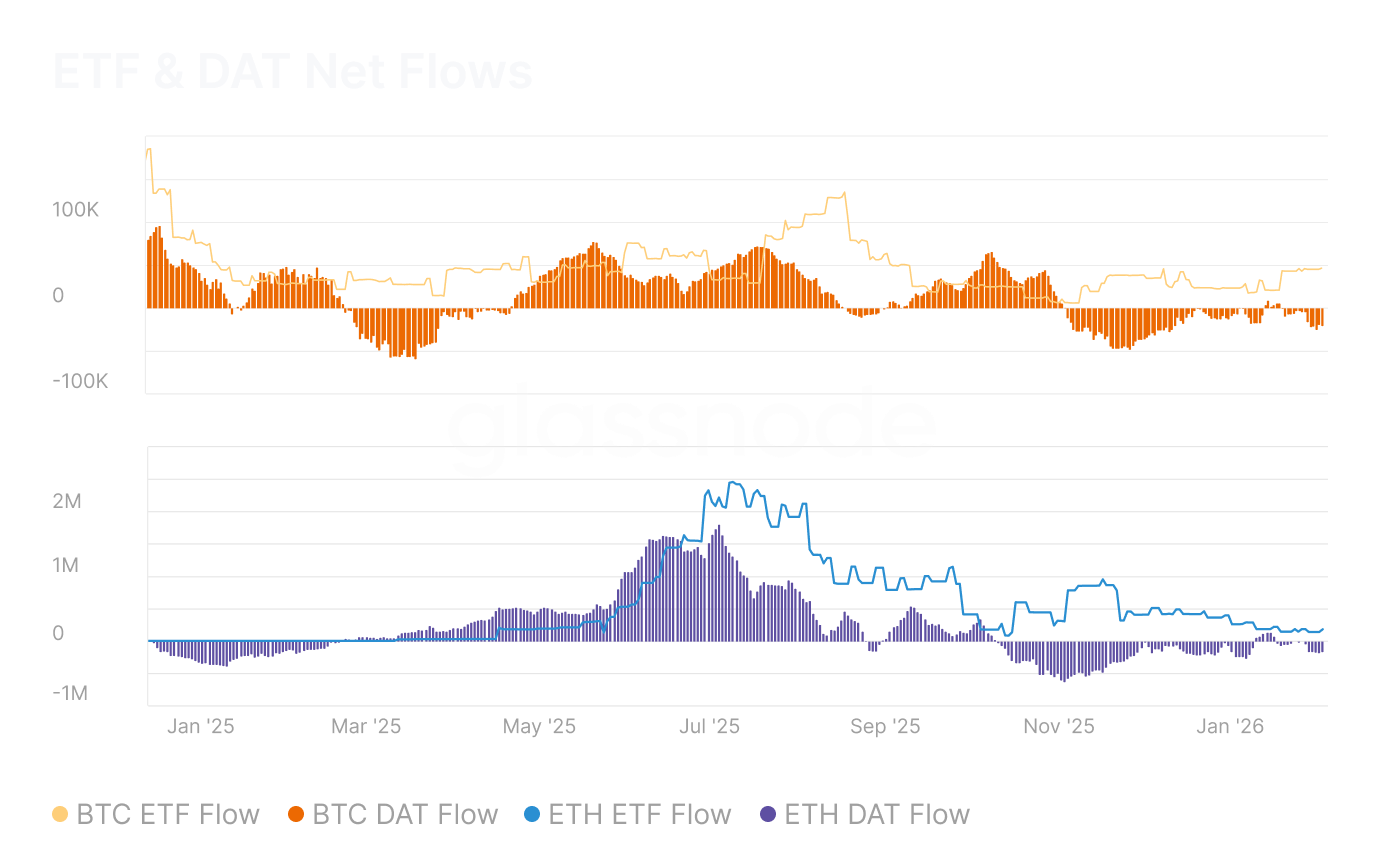
ETF & DAT Net Flows

After sustained February outflows, BTC ETF and DAT flows returned to positive, while ETH institutional flows showed early signs of stabilization.

After sustained February outflows, Bitcoin ETF and DAT flows returned to positive territory, recovering to +28k BTC and +46.8k BTC respectively. Ethereum flows were more measured, with ETF flows near neutral at +46.5k ETH and DAT flows stabilizing at +295.8k ETH. While the directional shift is encouraging, the recovery remains early-stage and uneven, and it would be premature to characterize this as a broad resumption of institutional conviction.
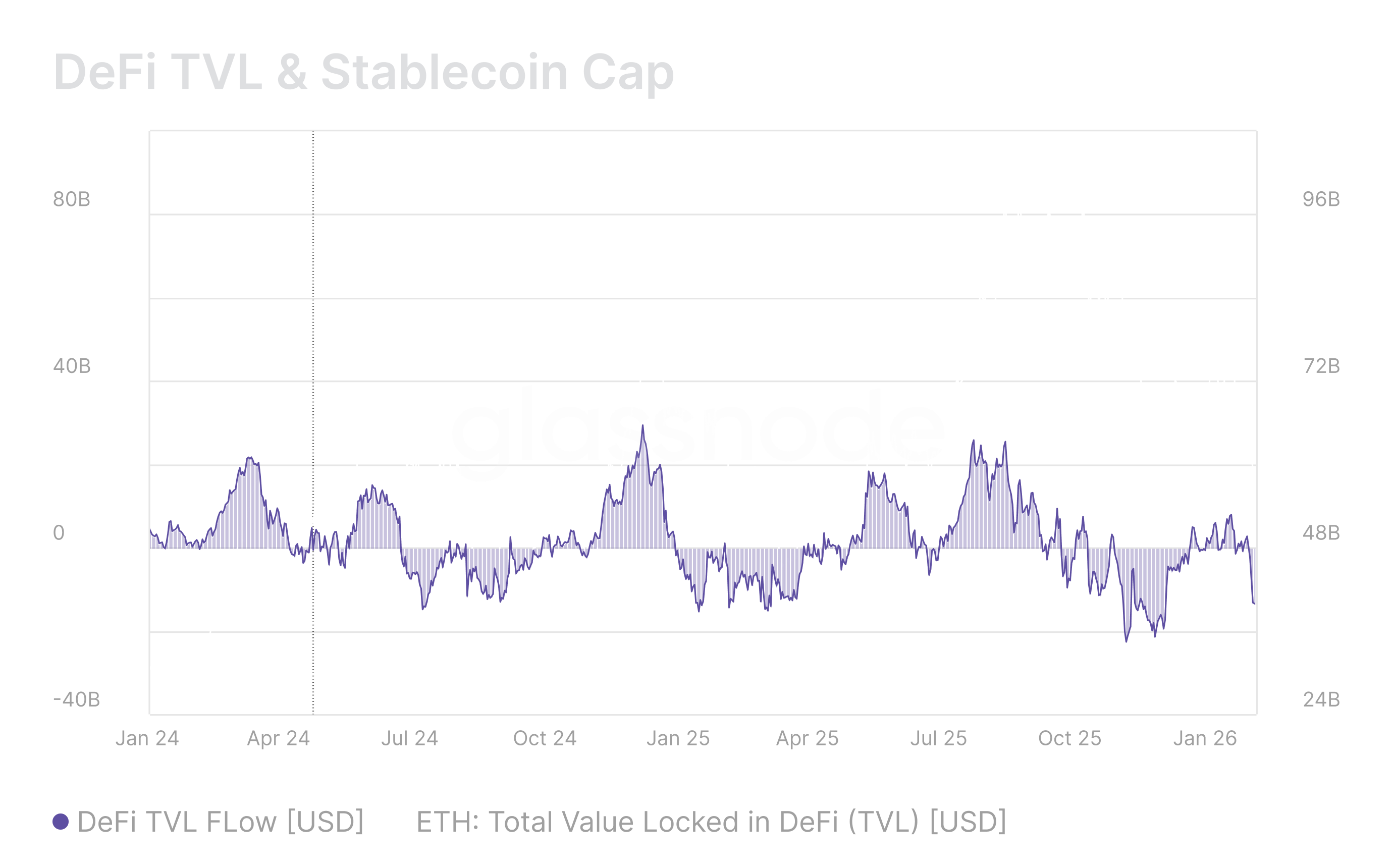
DeFi TVL & Stablecoin Cap

DeFi TVL on Ethereum saw sharp contraction through February before showing early signs of stabilization in March, though the broader declining trend since August 2025 remains intact.

Total Value Locked on Ethereum recorded peak outflows of -$23.7B per month in February, implying sustained withdrawal by larger allocators from on-chain activities such as liquidity provisioning and yield strategies. This slowdown alone is insufficient to signal a reversal, and diminished conviction in DeFi risk-adjusted returns continues to point to shallower liquidity depth across the ecosystem.
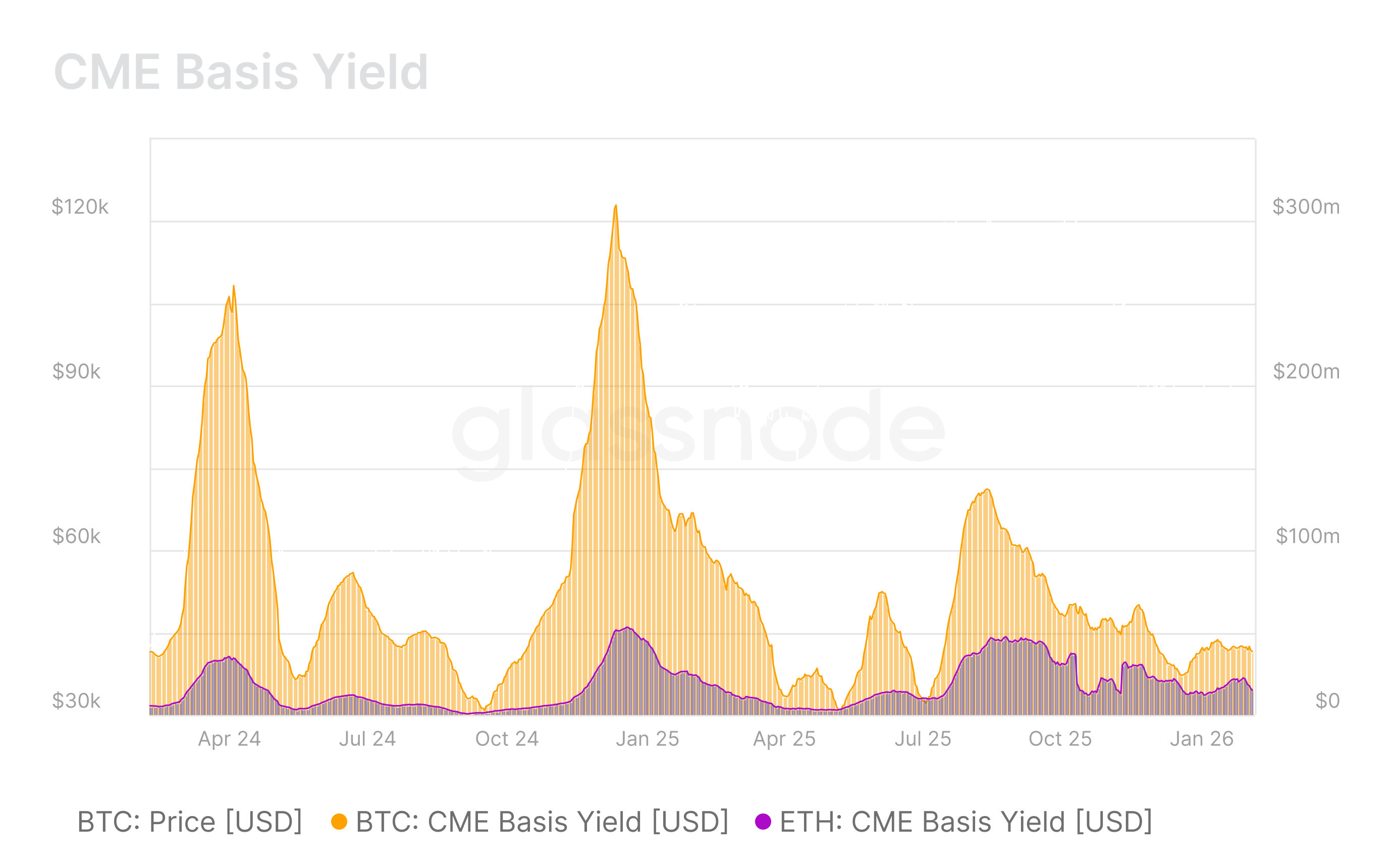
CME Basis Yield

CME Basis Yield compressed even further in February, reinforcing waning incentives for market-neutral strategies compared to January.

The monthly dollar value captured by institutions via cash-and-carry trades declined notably for both Bitcoin and Ethereum, building on the sharp compression seen since August 2025. This tightening basis reflects reduced leverage deployment, softer futures demand, and continued pullback in balance-sheet commitment amid tighter liquidity conditions persisting from January into early March 2026.


Disclaimer: This report does not provide any investment advice. All data is provided for information and educational purposes only. No investment decision shall be based on the information provided here and you are solely responsible for your own investment decisions.
Exchange balances presented are derived from Glassnode’s comprehensive database of address labels, which are amassed through both officially published exchange information and proprietary clustering algorithms. While we strive to ensure the utmost accuracy in representing exchange balances, it is important to note that these figures might not always encapsulate the entirety of an exchange’s reserves, particularly when exchanges refrain from disclosing their official addresses. We urge users to exercise caution and discretion when utilizing these metrics. Glassnode shall not be held responsible for any discrepancies or potential inaccuracies. Please read our Transparency Notice when using exchange data.

Preguntas relacionadas

QWhat is the primary purpose of the Strategy Watch publication?

AStrategy Watch was built to address a clear demand for high-signal, impartial analysis of fund-level performance and allocation trends in digital assets, aiming to be a must-read monthly publication for the digital asset investment community.

QWhich was the only strategy type that returned positively in February according to the report?

AThe report indicates that readers should check the 'Fund and SMA Performance' section to see the only strategy type that returned positively in February, though the specific strategy name is not stated in the provided text.

QWhat was the trend in capital flows for Bitcoin (BTC) and Ethereum (ETH) through February and into March?

ACapital flows into BTC and ETH remained deeply negative, with BTC and ETH capital flows registering -$9.6B and -$3.2B, respectively.

QHow did stablecoin capital flows behave in contrast to BTC and ETH in early March?

AStablecoins broke from the broader negative trend, flipping to +$6.2B in net inflows, which likely reflects a defensive repositioning into lower-risk, dollar-denominated on-chain instruments.

QWhat does the sharp compression in CME Basis Yield indicate about market conditions?

AThe compression in CME Basis Yield reflects reduced leverage deployment, softer futures demand, and a continued pullback in balance-sheet commitment amid tighter liquidity conditions, indicating waning incentives for market-neutral strategies.

Lecturas Relacionadas

Por qué el Bitcoin se mantiene en $64,000 tras la dura pausa de la Fed

Bitcóin cierra julio cerca de los 64.000 dólares tras una volátil reacción a la decisión de la Fed de mantener las tasas sin cambios, aunque sin indicar un pronto aflojamiento monetario. Esto ha provocado una rotación de capital hacia los ETF de Bitcoin, que registraron una entrada neta de 32,1 millones de dólares, mientras que los fondos de Ethereum experimentaron salidas. El mercado de criptomonedas, con una capitalización de unos 2,29 billones de dólares, se mantiene en un rango lateral, con Bitcoin encontrando soporte en 63.000-63.500 dólares y resistencia en 66.000 dólares. La Fed mantuvo su tasa clave, pero tres miembros votaron a favor de un aumento, señalando una postura más dura de lo esperada. En este entorno macroeconómico incierto, los inversores institucionales parecen favorecer a Bitcoin como activo principal, aunque persiste el interés selectivo en activos como Solana. Mientras, la aprobación de la ley CLARITY en EE.UU. se retrasa hasta después del receso de agosto. Para el último día de julio, el enfoque estará en los datos macro de EE.UU. El escenario base para Bitcoin es la consolidación entre 63.000 y 66.000 dólares, con su ruptura superior dependiendo de nuevos flujos institucionales. La estabilidad por encima de 63.000 dólares para BTC, el mantenimiento de Ethereum sobre 1.860 dólares y las entradas continuas en ETF son claves para una posible base de recuperación en la segunda mitad del año.

cryptonews.ruHace 1 hora(s)

Por qué el Bitcoin se mantiene en $64,000 tras la dura pausa de la Fed

cryptonews.ruHace 1 hora(s)

Parker Lewis responde por qué bitcoin sigue siendo el mejor dinero

El influyente analista de Bitcoin, Parker Lewis, critica las estrategias de marketing de corporaciones que actúan como tesorerías cripto. Advierte que la venta de "crédito digital" mediante acciones preferentes perpetuas distorsiona la esencia de la criptomoneda. Lewis enfatiza que Bitcoin no genera rendimiento fiduciario por diseño y que las promesas de dividendos son riesgosas, dependiendo de nuevos inversores. Destaca el riesgo de estos derivados, señalando que el mercado de acciones preferentes perpetuas es minúsculo comparado con el crédito global, lo que demuestra que los grandes actores evitan estos riesgos, trasladándolos a minoristas. Rechaza la idea de que Bitcoin es "demasiado volátil", argumentando que la volatilidad es una consecuencia natural de la adopción masiva de un activo con oferta fija e inelástica. En lugar de comprar derivados corporativos como acciones de MicroStrategy, recomienda adquirir Bitcoin directamente, considerándolo más seguro. Lewis alerta que este enfoque distrae de la verdadera amenaza: la rápida devaluación del dinero fiduciario. Ilustra la inflación real con su "Índice Ribeye", mostrando un aumento del 90% en el precio de un filete desde 2020, muy superior a las cifras oficiales. Concluye que la estrategia más prudente es la posesión directa de Bitcoin y el control total de las claves privadas, protegiendo así los ahorros de la inflación y los riesgos sistémicos de los derivados corporativos.

cryptonews.ruHace 1 hora(s)

Parker Lewis responde por qué bitcoin sigue siendo el mejor dinero

cryptonews.ruHace 1 hora(s)

Arrestados participantes en esquema fraudulento con XRP, que robaron 9 millones de dólares a 71 inversores

El periódico surcoreano "Chosun" informa que la Policía Metropolitana de Seúl detuvo a tres personas acusadas de operar una plataforma de inversión fraudulenta utilizando XRP. Según las autoridades, entre el 16 y el 23 de octubre, el grupo recaudó aproximadamente 3,4 millones de XRP (equivalentes a unos 9 millones de dólares) de 71 inversores, tras lo cual cerró el sitio web y desapareció. Los sospechosos promovían el sitio Fxrpntwork.com a través de blogs, artículos en línea y vídeos de YouTube, prometiendo la garantía del capital y un rendimiento mensual del 1,5% al 1,8%. Instruyeron a los inversores a transferir XRP desde intercambios surcoreanos a través de plataformas extranjeras y luego a carteras controladas por el grupo. La policía advirtió a los inversores que verifiquen fuentes oficiales antes de transferir activos a carteras o plataformas no verificadas, destacando el peligro de dejarse engañar por información no contrastada en YouTube u otras plataformas. Los estafadores copiaron el branding de "Flare Network" y "FXRP" para que su plataforma pareciera legítima. Ripple advierte que tales esquemas suelen imitar nombres, logotipos y sitios web de organizaciones confiables para crear una falsa apariencia de seguridad. Este caso ilustra cómo las promesas de rendimiento garantizado siguen siendo una señal común de fraude en criptomonedas. Las autoridades surcoreanas congelaron activos virtuales por valor de 17.300 millones de wons tras detectar el esquema, y el análisis de carteras reveló transferencias adicionales por 27.300 millones de wons, lo que sugiere que podría haber más víctimas y cómplices sin identificar.

cryptonews.ruHace 1 hora(s)

Arrestados participantes en esquema fraudulento con XRP, que robaron 9 millones de dólares a 71 inversores

cryptonews.ruHace 1 hora(s)

Trading

Spot
活动图片





