Stock Price Surges Over 35%! Circle's Earnings Report Exceeds Expectations: USDC Circulation Soars 72%

marsbitPublicado a 2026-02-26Actualizado a 2026-02-26

Resumen

Circle (CRCL) reported strong Q4 and full-year 2025 financial results, with total revenue and reserve income reaching $770 million in Q4, up 77% year-over-year, exceeding expectations. This drove a 35% surge in its stock price. Key highlights include a 72% YoY increase in USDC circulation to $75.3 billion and a 247% rise in on-chain transaction volume to $11.9 trillion in Q4. Reserve income remained the core revenue driver at $733 million, while non-interest income reached $37 million. For the full year, total revenue grew 64% to $2.7 billion. Although the company reported a net loss of $70 million due to a one-time $424 million stock-based compensation expense from its IPO, adjusted EBITDA doubled to $582 million, indicating profitable core operations. Strategic developments include the stable testnet performance of its Arc blockchain, expansion of the Circle Payments Network with 55 financial institutions onboarded, and a key partnership with Polymarket to use native USDC. Regulatory progress includes conditional approval for a national trust bank. Looking ahead, Circle targets a 40% compound annual growth rate for USDC circulation. CEO Jeremy Allaire emphasized AI-driven payment demand, with 99% of agent-based payments currently using USDC. Despite challenges like declining yields and new competitors like USAT, Circle continues to execute its strategy as a growing internet financial infrastructure provider.

Author:Zhou, ChainCatcher

On February 25, stablecoin issuer Circle (NYSE code: CRCL) released its 2025 fiscal year fourth quarter and full-year financial report.

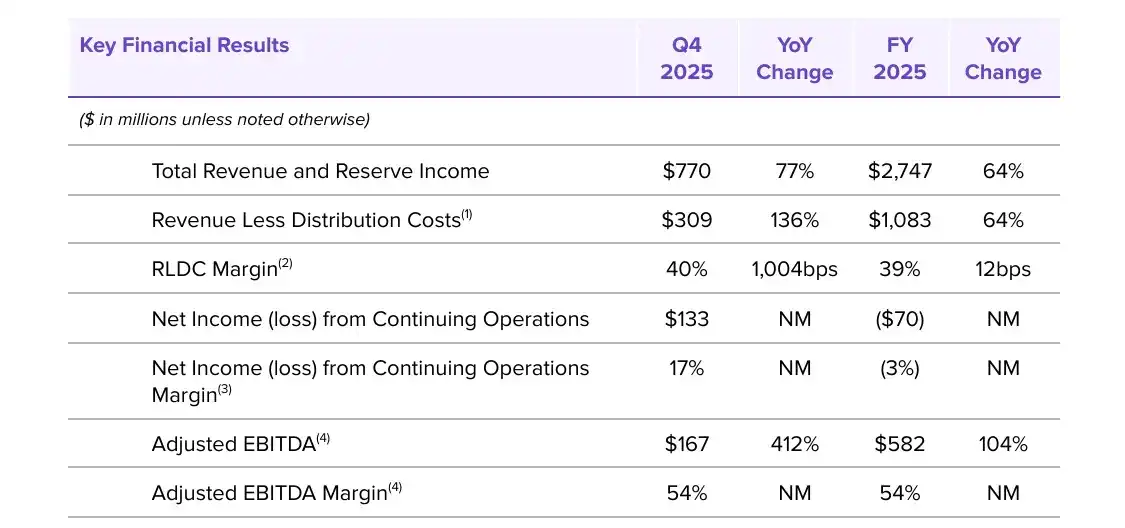
The report shows that the company's total revenue and reserve income for the fourth quarter reached $770 million, a year-on-year increase of 77%, exceeding market expectations.

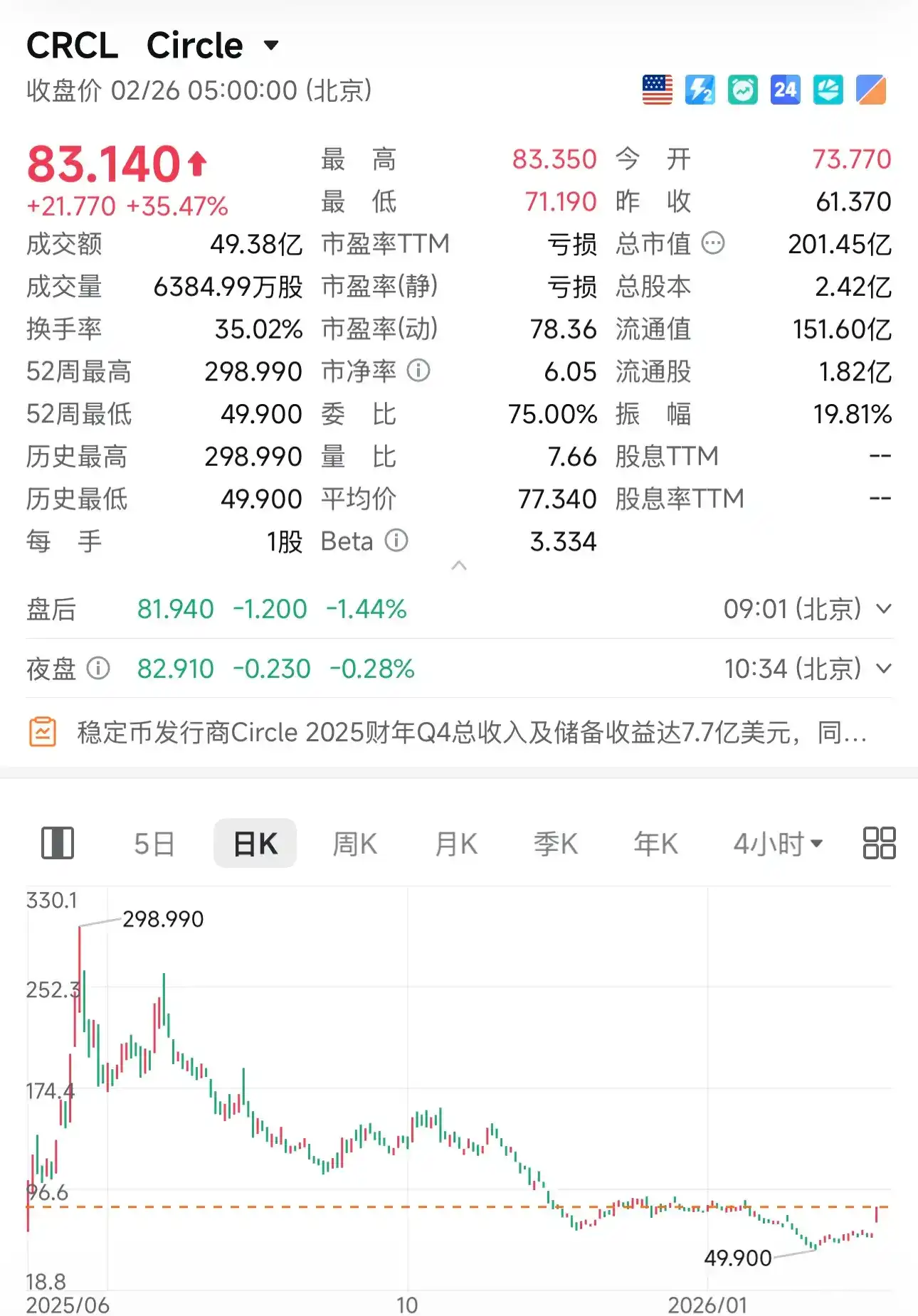
Driven by this, CRCL stock price rose over 35% at Wednesday's close.

Specifically, the growth of its stablecoin USDC was the core highlight of this earnings report. As of year-end, the circulation of USDC reached $75.3 billion, a year-on-year increase of 72%.

Meanwhile, network activity showed explosive growth, with on-chain transaction volume in the fourth quarter reaching $11.9 trillion, a year-on-year increase of 247%.


In terms of revenue composition, reserve income remains the company's main revenue pillar, contributing $733 million in Q4, a year-on-year increase of 69%.

Although market yields decreased by 68 basis points during the period, this pressure was offset by the significant expansion of USDC's average circulation scale.

At the same time, non-interest income reached $37 million, mainly due to the steady accumulation of subscription services and transaction fees.

Looking at the full-year performance, the company's total revenue and reserve income was $2.7 billion, a year-on-year increase of 64%.

Although continuing operations recorded a net loss of $70 million, this was mainly affected by the one-time inclusion of $424 million in stock-based compensation expenses during the IPO process.

As this expense is non-cash in nature, the company's core business is profitable after exclusion. Adjusted EBITDA reached $582 million, doubling year-on-year, showing that operating leverage is gradually emerging.
极

In terms of strategic layout, Circle is gradually transforming from a pure stablecoin issuer to an internet financial infrastructure provider, strengthening its underlying position in the real-time transaction field through various technological initiatives.

The report shows that the Arc public blockchain testnet is running stably, with transaction finality time shortened to about half a second, and total transactions have exceeded 166 million. The mainnet is expected to be officially launched within the year.

In terms of the payment network, the ecosystem of the Circle Payments Network continues to expand. Currently, 55 financial institutions have officially joined, with another 74 in the qualification review stage. The annualized transaction volume over the past 30 days has reached $5.7 billion.

It is worth mentioning that the strategic cooperation with Polymarket further highlights the value of USDC in emerging fields. As one of the world's largest prediction market platforms, Polymarket will gradually switch all betting and settlement to native USDC.

This cooperation not only eliminates bridging risks and improves capital efficiency but also directly converts the user growth of the prediction market into long-term increments in USDC circulation and transaction volume.

In addition, Circle is also gradually penetrating the traditional financial ecosystem. The company has not only achieved all-day settlement cooperation with Visa but also broadened application scenarios through platform integration with Intuit.

At the regulatory compliance level, the company received conditional approval from the U.S. Office of the Comptroller of the Currency to establish a national trust bank in December 2025, and further consolidated its first-mover advantage in compliance under the GENIUS Act framework.

The secondary market has given a relatively positive response. Technically, before the earnings release, the company's stock price had rebounded from its low and stabilized above the 7-day and 30-day moving averages.

On the institutional side, ARK Invest, under Cathie Wood, increased its holdings of Circle stock multiple times during market corrections. The latest holdings are about 4.14 million shares, worth approximately $261 million.

Mizuho Securities upgraded CRCL's rating from underweight to neutral at the end of January, setting a target price of $77. The institution believes that the growth of Polymarket will directly drive the expansion of USDC scale and revenue.

However, Circle still needs to deal with potential headwinds in the future.

On the one hand, the downward trend in interest rates may continue to put pressure on reserve income, which has been reflected in the decline in yield in the fourth quarter.

On the other hand, the stablecoin competitive landscape is changing. The USAT stablecoin, launched by Tether and issued by Anchorage Digital, is targeting the U.S. institutional market and is regarded as the first substantive compliant competitor for USDC domestically. This competition may lead to some diversion in the compliant institutional share.

In addition, overall cryptocurrency market volatility and macro cycles will still create uncertainty for circulation growth. According to Coinglass data, the current total stablecoin market capitalization is about $264 billion, with USDC accounting for about 28.5%. Although USDC leads the industry in growth rate, Tether still dominates.


Worthy of special attention from investors is Circle management's expectations and execution plans for the future. The company provided clear guidance for the 2026 fiscal year:

  • USDC circulation targets a compound annual growth rate of 40% over a multi-year cycle;
  • Other income (subscription, service, and transaction fees) is expected to be $150 to $170 million;
  • RLDC margin (revenue minus distribution and transaction cost margin) remains in the high range of 38% to 40%;
  • Adjusted operating expenses are expected to be $570 to $585 million.

These guidelines also reflect management's confidence in continued scale expansion, cost control, and accelerated growth in non-interest income.

Furthermore, Circle CEO Jeremy Allaire repeatedly mentioned AI agents and their payment needs during the earnings call.

He said, we are about to enter a world where there may be billions or even hundreds of billions of AI agents interacting on the internet and performing economic functions.

These AI agents need programmable digital dollars and open infrastructure to enable autonomous transactions, and Circle's products are built for this.

Specifically, Circle is heavily investing in agent-based payment infrastructure.

Currently, Circle Gateway has entered the test network phase, supporting AI agents to autonomously initiate cross-chain USDC transactions, with a single transaction cost as low as $0.00001 (extremely low fees, suitable for micro-payments and high-frequency machine-to-machine transactions).

It was also mentioned in the meeting that currently about 99% of agent-based payments use USDC, thanks to Circle's cross-chain deployment and participation in agent payment standards (such as the x402 standard, in cooperation with Google etc.).

Overall, this earnings report validates Circle's strategic execution capability in a complex regulatory environment, and the new story of AI+ payments has expanded the company's valuation imagination space. Despite facing yield fluctuations and emerging competitive challenges, Circle continues to exert efforts on the track of "financial infrastructure-ization" and "compliant expansion".

Preguntas relacionadas

QWhat was the percentage increase in Circle's total revenue and reserve income in Q4 2025, and what was the exact figure?

ACircle's total revenue and reserve income increased by 77% in Q4 2025, reaching $770 million.

QBy what percentage did the circulating supply of USDC grow year-over-year, and what was its total value at the end of the period?

AThe circulating supply of USDC grew by 72% year-over-year, reaching a total value of $75.3 billion.

QWhat was the main reason for Circle's net loss from continuing operations, and what was the adjusted EBITDA figure that showed core profitability?

AThe net loss was primarily due to a one-time, non-cash stock-based compensation expense of $424 million related to its public listing. The adjusted EBITDA, which excludes this, was $582 million, showing core profitability.

QName one new significant competitor for USDC in the U.S. institutional market mentioned in the article and which company is behind it.

AA new significant competitor is the USAT stablecoin, which is issued by Anchorage Digital and backed by Tether, targeting the U.S. institutional market.

QWhat future technology trend did CEO Jeremy Allaire highlight as a major growth driver for USDC, and what specific infrastructure is Circle building for it?

ACEO Jeremy Allaire highlighted AI agents and their payment needs as a major future growth driver. Circle is building 'agentic payment infrastructure,' including the Circle Gateway currently in testnet, to support autonomous, low-cost USDC transactions for AI.

Lecturas Relacionadas

¿Rubin Ultra recorta especificaciones? ¿Ni siquiera NVIDIA puede soportar el aumento del precio de la memoria?

El informe de SemiAnalysis ha desencadenado un intenso debate en la industria de la IA al revelar posibles ajustes importantes en las especificaciones de Rubin Ultra, la próxima GPU flagship de NVIDIA para IA. Según el informe, Rubin Ultra mantendría el mismo pico teórico de potencia computacional (35 PFLOPs) que Rubin, pero sufriría una reducción significativa en la memoria: se especificaría con 192GB HBM apilado en 8 capas (8-Hi), incluso menos que los 288GB (12-Hi) de Rubin. El ancho de banda de memoria solo aumentaría ligeramente (1 TB/s), y el consumo energético sería similar o ligeramente superior. La mejora principal se centraría en la capacidad de interconexión a escala, soportando clusters de hasta 576 GPUs unidas mediante NVLink (frente a 72 en Rubin), creando un "super-GPU lógico". La causa principal de esta revisión sería el rápido aumento del precio de la memoria HBM, cuyo costo se habría triplicado desde 2025, impactando fuertemente el costo total de los sistemas. Al reducir la cantidad de HBM (bajando su participación en el costo del ~40% al ~28%) e invertir más en la interconexión (subiendo del 4% al 12%), NVIDIA optimizaría la relación costo-rendimiento del sistema completo. Esta noticia provocó una caída de aproximadamente el 8% en las acciones de los principales fabricantes de HBM, SK Hynix y Samsung, reflejando la preocupación del mercado sobre un posible punto de inflexión en la demanda de memoria de alta gama por parte del mayor comprador, NVIDIA, y el fin de una era de expansión sin restricciones en la infraestructura de IA.

Odaily星球日报Hace 53 min(s)

¿Rubin Ultra recorta especificaciones? ¿Ni siquiera NVIDIA puede soportar el aumento del precio de la memoria?

Odaily星球日报Hace 53 min(s)

¿Los modelos generativos también pueden entrenarse de extremo a extremo? El núcleo es un bucle for

El entrenamiento de modelos generativos siempre ha sido un reto debido a la "desviación por exposición" (exposure bias): durante el entrenamiento solo se aprenden pequeños pasos, mientras que la generación requiere cientos de iteraciones, lo que causa acumulación de errores. Esto ha impedido que los modelos generativos sean entrenados de extremo a extremo (end-to-end), a diferencia de otras tareas de aprendizaje profundo. Un reciente artículo de la Universidad de Illinois y Harvard introduce "Explorative Modeling (XM)", un nuevo paradigma que resuelve este problema mediante un bucle simple (for). La idea clave es que, en cada paso de entrenamiento, el modelo genera K candidatos y solo retropropaga el gradiente a partir del candidato más cercano a los datos reales. Este enfoque evita que el modelo converja a un promedio borroso entre múltiples modos (mode blurring), un problema inherente a las funciones de pérdida de reconstrucción típicas. XM identifica una tercera dimensión escalable, además de los parámetros y los datos: la "expresividad generativa". Los experimentos en imágenes, video y lenguaje muestran que aumentar la exploración (K) mejora monótonamente el rendimiento, con ganancias de eficiencia en FLOPs, muestras y parámetros. En tareas de control robótico, una política exploratoria XM iguala o supera a políticas de difusión que requieren 100 veces más cómputo en inferencia. El trabajo sugiere que, a gran escala, la expresividad generativa se convierte en el cuello de botella principal, y XM ofrece un camino para modelos generativos verdaderamente end-to-end, generando muestras de alta calidad en una sola pasada hacia adelante.

marsbitHace 1 hora(s)

¿Los modelos generativos también pueden entrenarse de extremo a extremo? El núcleo es un bucle for

marsbitHace 1 hora(s)

¿Máximo de 20 artículos por persona? La nueva norma de ICLR recibe una «petición» sarcástica de un investigador de DeepMind

Un investigador de DeepMind satiriza la nueva norma de ICLR que limita a 20 artículos por autor. La conferencia de IA ICLR 2027 ha establecido una nueva regla: cada autor solo puede figurar en un máximo de 20 trabajos enviados. Los que excedan este límite serán advertidos y, de no corregirse, algunos serán rechazados aleatoriamente. La justificación es la enorme presión sobre el sistema de revisión, tras un aumento del 68% en los envíos para ICLR 2026 (19,525 trabajos). Dan Roy, investigador de Google DeepMind, respondió con una "petición" irónica en X, pidiendo que se elimine el límite. Su mensaje, cargado de sarcasmo, sugiere que los agentes de IA ahora pueden producir investigaciones incrementales y que, "dado que todo el trabajo de revisión ya lo hacen los grandes modelos de lenguaje", debería animarse a enviar más trabajos, no menos. Su sátira apunta a un problema real: el uso de IA tanto en la autoría como en la revisión. Un análisis de 2025 detectó que aproximadamente el 21% de las revisiones de ICLR 2026 eran probablemente generadas completamente por IA. La broma de Roy plantea una pregunta seria: en un entorno donde agentes generan artículos, autores los envían en masa y revisores potencialmente usan IA, ¿limitar el número de envíos es la solución adecuada? El debate sobre la calidad versus la cantidad, y el papel de la IA en la academia, continúa.

marsbitHace 1 hora(s)

¿Máximo de 20 artículos por persona? La nueva norma de ICLR recibe una «petición» sarcástica de un investigador de DeepMind

marsbitHace 1 hora(s)

Trading

Spot
活动图片