Predicting 'When Will Trump End the War'? Here Are the Five Key Points

marsbitPublicado a 2026-03-27Actualizado a 2026-03-27

Resumen

Based on a Barclays Capital analysis, the article outlines five key factors that will determine the end of the Iran war and its critical impact on global energy markets. Since the conflict began on February 26, 2026, oil prices have surged, with Brent crude up 44%. The war's duration will dictate if oil prices return to a base case of $85/barrel or surpass $110. The five catalysts are: 1. **Military Objectives:** The US aims to destroy Iran's missile capabilities and secure the Strait of Hormuz. The timeline remains uncertain as Iran retains some offensive capacity. 2. **Congressional Funding:** The War Powers Act sets a hard deadline of May 31, 2026, for ending hostilities without congressional authorization, which is unlikely to be granted. 3. **US Casualties:** Rising casualties could further erode the war's already fragile public support, currently at a 41% approval rating. 4. **Gasoline Prices:** The key political threshold is the national average of $5/gallon, a peak seen under President Biden. Exceeding it would increase pressure to end the war. 5. **Trump's Personal Decision:** The President could unilaterally declare victory and end the conflict, but this timing is highly unpredictable. Barclays concludes that the risk to oil prices is skewed to the upside, as current market reactions are less panicked than in previous crises, and the situation reflects a genuine physical supply disruption.

Author: Wall Street Insights

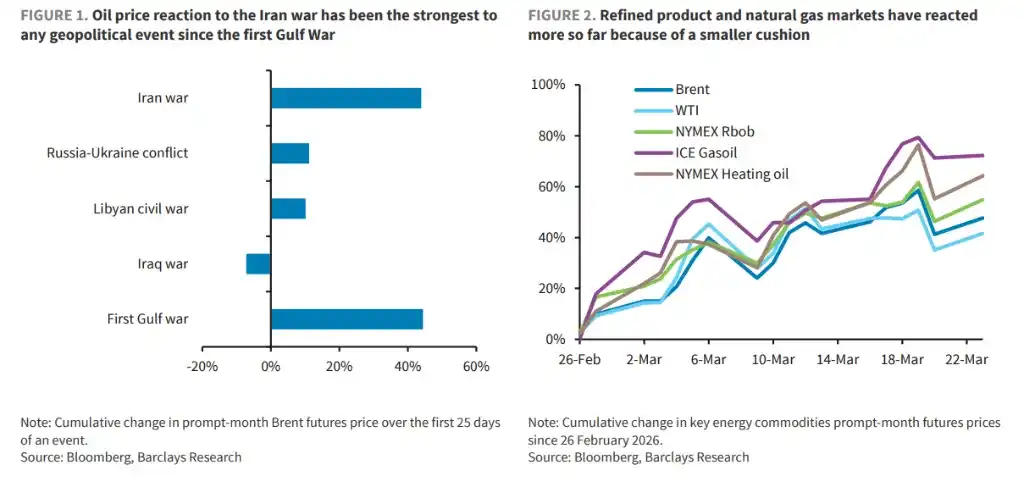
The Iran War has become the strongest geopolitical shock to the global energy market since the 1990 Gulf War.

Since the outbreak of the Iran War on February 26, 2026, Brent crude has surged 44% in just 25 days, U.S. gasoline wholesale prices (Rbob) have risen 48%, U.S. diesel prices have increased 51%, and European diesel prices have jumped 58%.

Barclays Capital's latest research report warns: When the war ends will directly determine whether oil prices return to the baseline scenario of $85 per barrel or break through $110 per barrel. For investors, five key catalytic factors—military objective progress, congressional funding battles, U.S. military casualty numbers, retail gasoline prices, and Trump's personal judgment—are the critical variables for current energy market pricing.
Barclays believes that oil price trends will diverge at three key time nodes: If the Strait of Hormuz returns to normal passage by early April, Barclays maintains its baseline forecast of an average Brent crude price of $85 per barrel for 2026; if delayed until late April, the average price may be repriced to around $98 per barrel; if prolonged until the end of May, the average price could reach $111 per barrel. Each day of delay causes the accumulated inventory shortfall to snowball, pushing the price center higher.
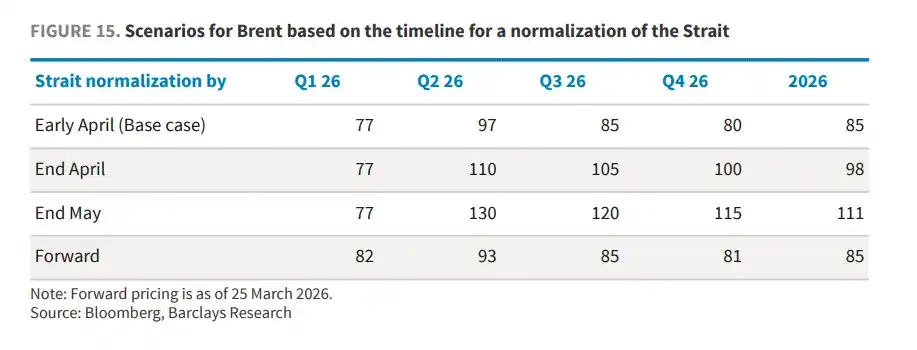
Five Key Factors: Core Variables Determining the War's Endgame

Barclays public policy analyst Michael McLean identifies five potential catalysts that could end the Iran War:

Key Point One: Achievement of Military Objectives

According to CCTV News, the U.S. previously defined three objectives for Iran: destroy Iran's ballistic missile and drone capabilities; strike the Iranian navy to maintain passage through the Strait of Hormuz; and destroy Iran's military and industrial base, rendering it incapable of external attacks for years. Notably, the objectives do not include regime change or Iran's nuclear program.

President Trump initially estimated the operation would last "four to five weeks." The war is now in its third week, and according to the White House's stance, it may be at the midpoint.

However, judging by the number of targets struck, the U.S. Central Command has not yet shown a clear inflection point of action contraction, with additional forces continuing to be deployed. Although the frequency of Iranian ballistic missile and drone attacks on the UAE, Kuwait, Saudi Arabia, and Bahrain has significantly decreased, they have not completely ceased, indicating Iran still retains some offensive capability. Barclays believes that until these indicators decrease further, it cannot be determined that the objectives have been achieved.

Key Point Two: Congressional Constraints—The War Powers Act Sets a Hard Deadline of May 31

The War Powers Act stipulates that within 60 days of deploying armed forces and submitting a report to Congress, the President must obtain congressional authorization (AUMF). The President can extend this by an additional 30 days. After 90 days, military operations must be terminated. Trump submitted the report on March 2, making the 90-day hard deadline May 31.

An AUMF requires 60 votes to pass in the Senate, and Republicans currently hold only 53 seats. Democrats have already expressed their stance through two opposing resolution votes—therefore, an AUMF is highly unlikely to pass. May 31 is the institutional hard boundary for the war's end.

The economic cost of the war is also accumulating rapidly: the first week cost approximately $11 to $12 billion, the current daily operational cost has dropped to about $500 million, and the total cumulative expenditure to date is estimated at around $21 billion.

For comparison, the nominal cost of the 13-year Iraq War was $815 billion; the total discretionary defense expenditure for fiscal year 2026 is $839 billion. Additionally, the "One Big Beautiful Bill" has pre-allocated $150 billion to the Department of Defense, providing some temporary financial buffer.

Key Point Three: Rising U.S. Military Casualties Will Further Erode Public Support

Barclays states that domestic support for this war in the U.S. is fragile and shows clear partisan division.

As of March 22, the RealClearPolitics poll average shows: support rate is only 41%, opposition rate is 49%. President Trump's overall approval rating has slightly decreased from 43% to 42%, the lowest record of his second term (the lowest of his first term was 37% in December 2017).

Thirteen U.S. military personnel have been killed so far.

Historical experience shows that wars usually bring a "rally-around-the-flag" effect, giving the president a short-term boost in support, but Trump has not gained this effect. The general rule is: the longer the war, the higher the casualties, and the more pessimistic the public is about the prospect of victory, the stronger the anti-war sentiment becomes.

Key Point Four: Gasoline Prices Hitting the "Political Red Line"—$5/Gallon is the Key Threshold

In July 2022, during the Biden administration, the national average gasoline price peaked at $5.01 per gallon.

For Republicans, not exceeding this "Biden peak" is a psychological political defense line, corresponding to a WTI oil price of about $120 per barrel, more than 20% above the current oil price.

Currently, Republican officials remain relatively optimistic, believing that even if oil prices are under short-term pressure, there is enough time for them to fall back by Labor Day (before investors truly start paying attention to the midterm elections) as the war ends. The administration has also taken a series of measures to try to alleviate oil price pressures, including releasing strategic reserves and exempting related sanctions.

Key Point Five: Trump "Declaring Victory" and Proactively Shifting Course

Barclays believes that, regardless of the actual progress on the battlefield, there is always the possibility that Trump may proactively declare victory and end the war at some point. Previously, when asked how he would judge when the war should end, Trump's answer was intriguing—"when I feel it in my bones".

Barclays clearly states that the timing of this catalytic factor is almost completely unpredictable.

In communications with clients, a mainstream analogy suggests: Trump's previous policy U-turn after "Liberation Day" (the tariff announcement on April 2, 2025) has conditioned investors to reflexively believe that a market plunge can drive Trump to shift course.

However, Barclays believes the market's reaction so far is not "panicked" enough: the S&P 500 fell about 12% after Liberation Day, while it has only fallen about 5% since this war began; the 10-year Treasury yield jumped 60 basis points after Liberation Day, but has only risen about 40 basis points this time; investment-grade credit spreads widened 26 basis points after Liberation Day, with a peak widening of only 9 basis points this time. More importantly, pausing a tariff executive order is far easier than ending a real war.

Significant Upside Risk Skew in Oil Prices

Barclays' core judgment is: the current oil price increase is not a speculative bubble, but a reflection of real supply-demand imbalance.

Before the war, Brent crude was undervalued by about 19% relative to the historical fair value implied by OECD inventory levels, and undervalued by about 15% relative to the replacement cost model; the net speculative long positions for Brent and WTI were at the 2nd percentile of historical extremes since 2014 at the end of 2025.

The dynamic evolution of the five catalytic factors—military objective progress, congressional funding battles, U.S. military casualty numbers, retail gasoline prices, and Trump's personal judgment—will be the most important high-frequency tracking dimensions for judging the direction of the energy market going forward. Barclays clearly states that, given the uncertainties, the risk to its 2026 Brent crude forecast of $85 per barrel is skewed to the upside.


Criptos en tendencia

Preguntas relacionadas

QAccording to Barclays, what are the five key catalysts that could end the Iran war and are critical for energy market pricing?

AThe five key catalysts are: 1. Achievement of military objectives, 2. Congressional funding battles and the War Powers Act deadline, 3. Rising US military casualties, 4. Gasoline retail prices hitting a political red line, and 5. Trump's personal judgment to declare victory.

QWhat is the hard institutional deadline for the war to end as mandated by the War Powers Act, and why is it significant?

AThe hard institutional deadline is May 31, 2026. It is significant because the War Powers Act requires the President to terminate military operations after 90 days from reporting to Congress unless authorized by an Authorization for Use of Military Force (AUMF), which is highly unlikely to pass the Senate.

QWhat is the political red line for US gasoline prices mentioned in the article, and what WTI oil price does it correspond to?

AThe political red line for US gasoline prices is $5 per gallon, which corresponds to a WTI oil price of approximately $120 per barrel.

QHow does Barclays' oil price forecast change based on when the Strait of Hormuz reopens?

ABarclays forecasts that if the Strait of Hormuz reopens in early April, the average price for Brent crude in 2026 will be $85/barrel. If it reopens in late April, the average price will be around $98/barrel. If the reopening is delayed until late May, the average price could reach $111/barrel.

QWhy does Barclays believe that the current market reaction to the war is not 'panicked' enough to force a policy reversal from Trump, compared to the 'Liberation Day' event?

ABarclays states that the market reaction is less severe than during the 'Liberation Day' event. The S&P 500 fell about 12% then but only about 5% in this war; the 10-year Treasury yield jumped 60 bps then but only rose about 40 bps now; investment-grade credit spreads widened 26 bps then but only 9 bps at their peak now. Furthermore, pausing a tariff executive order is far easier than ending an actual war.

Lecturas Relacionadas

La cesta más grande de Robinhood

Hace unas semanas, llamé a Robinhood un supermercado financiero por integrar todas las necesidades financieras de un estadounidense en una plataforma. Su estrategia no depende solo de atraer nuevos clientes, sino de profundizar la relación con los existentes. Esto se refleja en sus resultados del Q2 de 2026, donde el ingreso promedio por usuario (ARPU) creció un 24%, triplicando la tasa de crecimiento de la base de clientes pagantes. El motor clave es su suscripción Gold, cuyo número de miembros casi se duplicó en dos años, alcanzando el 17% de los usuarios. Un miembro Gold tiene 4.2 veces más activos custodiados y es 3.1 veces más propenso a usar productos de jubilación. La mitad de los nuevos clientes se suscriben a Gold, mostrando una poderosa capacidad de venta cruzada. Dos catalizadores futuros son Robinhood Chain (su cadena de bloques nativa) y la próxima función Social. La cadena permite composabilidad entre productos (ej. tokenizar acciones, usarlas como garantía para un préstamo e invertir en futuros), integrando la venta cruzada en la infraestructura. El flujo social interno pretende capturar el proceso de descubrimiento de ideas de inversión, aumentando la confianza y la actividad dentro del ecosistema. Con 13 líneas de negocio que generan más de $100M en ingresos anuales recurrentes, Robinhood mitiga la ciclicidad. La diversificación (transacciones, suscripciones, márgenes, cuentas de ahorro, etc.) estabiliza los ingresos generales. Su ventaja única es transformar una relación con el cliente en un nodo de ingresos diversificado y compuesto, que abarca finanzas tradicionales y cripto, potenciado por su cadena de bloques.

marsbitHace 2 hora(s)

La cesta más grande de Robinhood

marsbitHace 2 hora(s)

Alemania ha perdido el primer lugar que mantuvo durante décadas, China se ha convertido silenciosamente en el número uno mundial en máquinas herramienta

China alcanzó el primer lugar mundial en exportaciones de máquinas-herramienta en 2025, con un volumen de 86.000 millones de euros, superando por primera vez a Alemania. Este hito marca un giro significativo para una industria que históricamente dependió de importaciones de alta gama y enfrentó restricciones tecnológicas. El camino estuvo plagado de desafíos técnicos fundamentales, como el control de la precisión bajo efectos térmicos, la vibración y el desgaste en componentes clave como husillos, tornillos de bolas y sistemas de control numérico (CNC). Durante años, la dependencia de estos componentes de alta gama superó el 90%. El cambio comenzó con el "Proyecto Nacional 04" (2009-2020), que elevó la tasa de localización de sistemas CNC de gama alta del 1% al 31,9% y mejoró la confiabilidad de las máquinas. El impulso decisivo vino del dinámico mercado local, especialmente de la industria de vehículos de nueva energía. Esta demandó soluciones nuevas, como centros de mecanizado de gran formato para carrocerías de fundición a presión integral y equipos especializados para carcasas de baterías, creando una oportunidad de innovación en igualdad de condiciones para los fabricantes chinos. Aunque la exportación total es ahora la mayor del mundo, dominada por máquinas de mecanizado especial (como por electroerosión o láser) y con destino principal a mercados asiáticos, el sector reconoce que la competitividad técnica integral aún no está a la par con los líderes tradicionales. Retos persistentes incluyen una baja tasa de localización en máquinas-herramienta de precisión para automoción y, crucialmente, la construcción de una red global de servicios postventa que genere la misma confianza a largo plazo que tienen las marcas establecidas. El verdadero éxito se medirá cuando los clientes globales confíen plenamente en equipos "Made in China" para sus líneas de producción críticas durante la próxima década.

marsbitHace 3 hora(s)

Alemania ha perdido el primer lugar que mantuvo durante décadas, China se ha convertido silenciosamente en el número uno mundial en máquinas herramienta

marsbitHace 3 hora(s)

Trading

Spot

Artículos destacados

Cómo comprar WAR

¡Bienvenido a HTX.com! Hemos hecho que comprar WAR (WAR) sea simple y conveniente. Sigue nuestra guía paso a paso para iniciar tu viaje de criptos.Paso 1: crea tu cuenta HTXUtiliza tu correo electrónico o número de teléfono para registrarte y obtener una cuenta gratuita en HTX. Experimenta un proceso de registro sin complicaciones y desbloquea todas las funciones.Obtener mi cuentaPaso 2: ve a Comprar cripto y elige tu método de pagoTarjeta de crédito/débito: usa tu Visa o Mastercard para comprar WAR (WAR) al instante.Saldo: utiliza fondos del saldo de tu cuenta HTX para tradear sin problemas.Terceros: hemos agregado métodos de pago populares como Google Pay y Apple Pay para mejorar la comodidad.P2P: tradear directamente con otros usuarios en HTX.Over-the-Counter (OTC): ofrecemos servicios personalizados y tipos de cambio competitivos para los traders.Paso 3: guarda tu WAR (WAR)Después de comprar tu WAR (WAR), guárdalo en tu cuenta HTX. Alternativamente, puedes enviarlo a otro lugar mediante transferencia blockchain o utilizarlo para tradear otras criptomonedas.Paso 4: tradear WAR (WAR)Tradear fácilmente con WAR (WAR) en HTX's mercado spot. Simplemente accede a tu cuenta, selecciona tu par de trading, ejecuta tus trades y monitorea en tiempo real. Ofrecemos una experiencia fácil de usar tanto para principiantes como para traders experimentados.

865 Vistas totalesPublicado en 2024.12.11Actualizado en 2026.06.02

Cómo comprar WAR

Discusiones

Bienvenido a la comunidad de HTX. Aquí puedes mantenerte informado sobre los últimos desarrollos de la plataforma y acceder a análisis profesionales del mercado. A continuación se presentan las opiniones de los usuarios sobre el precio de WAR (WAR).

活动图片