Plummeting Around 12%, Duan Yongping's Bottom-Fishing CoreWeave Turns into a Fierce Battlefield Between Bulls and Bears

marsbitPublicado a 2026-05-09Actualizado a 2026-05-09

Resumen

On May 8th, AI cloud computing provider CoreWeave (CRWV) plunged 11.4% following its Q1 2026 earnings report, intensifying the polarized market view on the stock. While revenue doubled year-over-year to $2.08B and its Remaining Performance Obligations (RPO) surged to nearly $100B, its net loss also widened to $740M. The key trigger was a weaker-than-expected Q2 revenue forecast, coupled with rising costs that compressed adjusted operating margin to just 1%. The bull thesis centers on CoreWeave's massive order backlog, deep strategic ties with NVIDIA as a key customer and investor, and client diversification with major names like Anthropic and Meta. Supporters point to its 'hyperscale' status and over $20B in recent financing. Bears highlight the "growth at all costs" model: despite soaring revenue, losses are expanding, capital expenditures are massive (~$6.8B in Q1), and total debt has ballooned to around $25B. Significant insider selling by executives adds to skepticism. This contrast is embodied by investor Duan Yongping (known as "China's Buffett"), who initiated a small, exploratory position (~0.12% of his portfolio) in Q4 2025 near the stock's lows, viewing it as a speculative bet on the AI infrastructure chain. The upcoming Q2 report is seen as a critical test for management's promise of a profit margin rebound. CoreWeave remains a battleground stock where long-term narrative clashes with near-term financial reality.

Author: Deep Tide TechFlow

On May 8, AI cloud computing provider CoreWeave (CRWV) plummeted 11.4% in a single day, closing at $114.15. This marks another instance of "earnings day decline" for the company since its IPO in March of last year. However, unlike previous times, this sell-off is compounded by a more dramatic contrast: Duan Yongping, widely known in Chinese circles as a disciple of Warren Buffett, just established a new position in CoreWeave in Q4 2025, amounting to approximately $20 million. Based on the position size and the Q4 average price, his entry point was close to CoreWeave's lowest range for the year in December 2025.

CoreWeave is currently one of the most divisive AI assets in the US stock market. On one side is the narrative of being a "pick-and-shovel seller" deeply tied to Nvidia, backed by nearly $100 billion in order backlog; on the other side is the financial reality of expanding losses with scale, alongside continuous insider selling. The Q1 earnings report acted like a prism, refracting this divide with stark clarity.

Q1 Earnings: Revenue Doubles but Losses Widen, Q2 Guidance Punctures Valuation

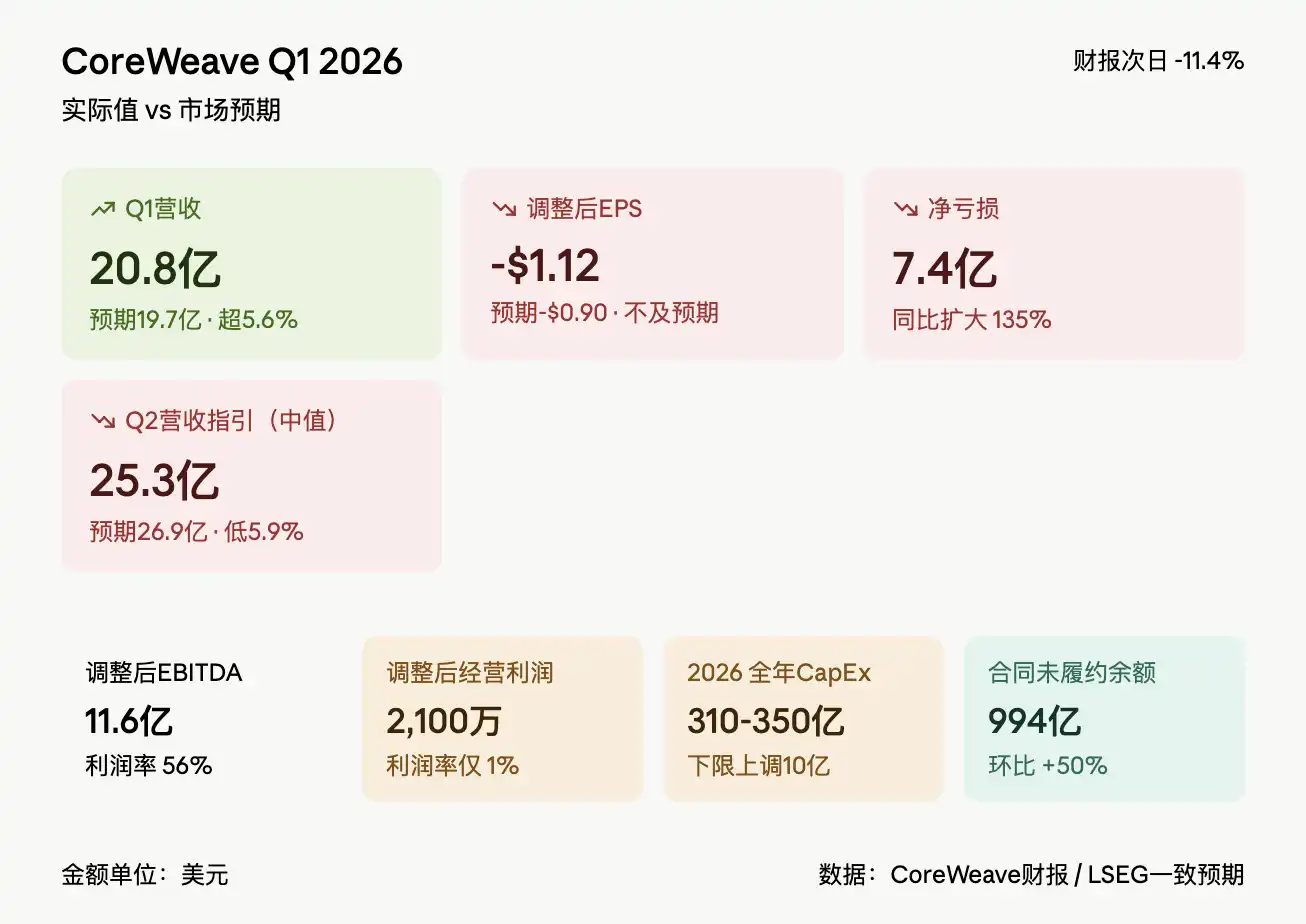
CoreWeave's Q1 revenue reached $2.08 billion, a 112% year-over-year increase and a 32% sequential increase, surpassing the LSEG market consensus of $1.97 billion. However, adjusted earnings per share loss was $1.12, worse than the expected loss of $0.90; the net loss widened to $740 million, more than doubling from $315 million a year ago.

The forward guidance is what truly ignited the sell-off. The company provided a Q2 revenue range of $2.45 billion to $2.6 billion, with a midpoint of $2.53 billion, significantly lower than the market expectation of $2.69 billion. Concurrently, the lower limit for the full-year 2026 capital expenditure was raised from $30 billion to $31 billion, with CFO Nitin Agrawal attributing the increase to rising component costs.

The fragility of the profit structure was laid bare. While Q1 adjusted EBITDA reached $1.16 billion (a 56% margin), which appeared impressive; adjusted operating profit was merely $21 million, compressing the operating margin to just 1%. The reason lies in the 127% year-over-year surge in technology and infrastructure costs to $1.27 billion, and sales and marketing expenses skyrocketing over sixfold to $69 million. Revenue is growing, but costs are growing faster.

CEO Michael Intrator emphasized on the earnings call: "We have reached hyperscale." He disclosed that the company now has 10 clients committed to spending over $1 billion each, a significant improvement in concentration risk compared to 2024 when 62% of revenue relied on a single customer, Microsoft. Intrator also projected that CoreWeave's annualized revenue should exceed $30 billion by the end of 2027.
The Bull Narrative: $100 Billion Order Backlog, Deep Ties with Nvidia

The core supporting the bull case is the order backlog. As of the end of Q1, CoreWeave's remaining performance obligations (RPO) stood at $99.4 billion, a net increase of approximately $33 billion sequentially and nearly quadrupling year-over-year. Intrator stated that new contracts signed in Q1 alone exceeded $40 billion.

The client roster is also reshaping market perception. In Q1, CoreWeave added Anthropic as a client, providing computing power for its Claude series models; signed a $2.1 billion AI cloud agreement with Meta; trading firm Jane Street committed to roughly $6 billion in orders and separately completed a $1 billion equity investment. Nvidia purchased an additional $2 billion worth of CoreWeave Class A common stock this quarter. This global largest GPU supplier is simultaneously an investor and a significant customer of CoreWeave, a tripartite relationship dubbed Nvidia's "favored son."

Regarding financing structure, CoreWeave completed an $8.5 billion investment-grade HPC (High-Performance Computing) secured delayed draw term loan (DDTL) in Q1, priced below 6%, hailed by management as "groundbreaking." Year-to-date, the company has raised over $20 billion in debt and equity financing, with the weighted average cost of debt decreasing by approximately 80 basis points. S&P Global Ratings concurrently upgraded CoreWeave's credit rating outlook from "stable" to "positive."

The Bear Logic: Bigger Scale, Less Profit, Debt Snowball Grows Larger

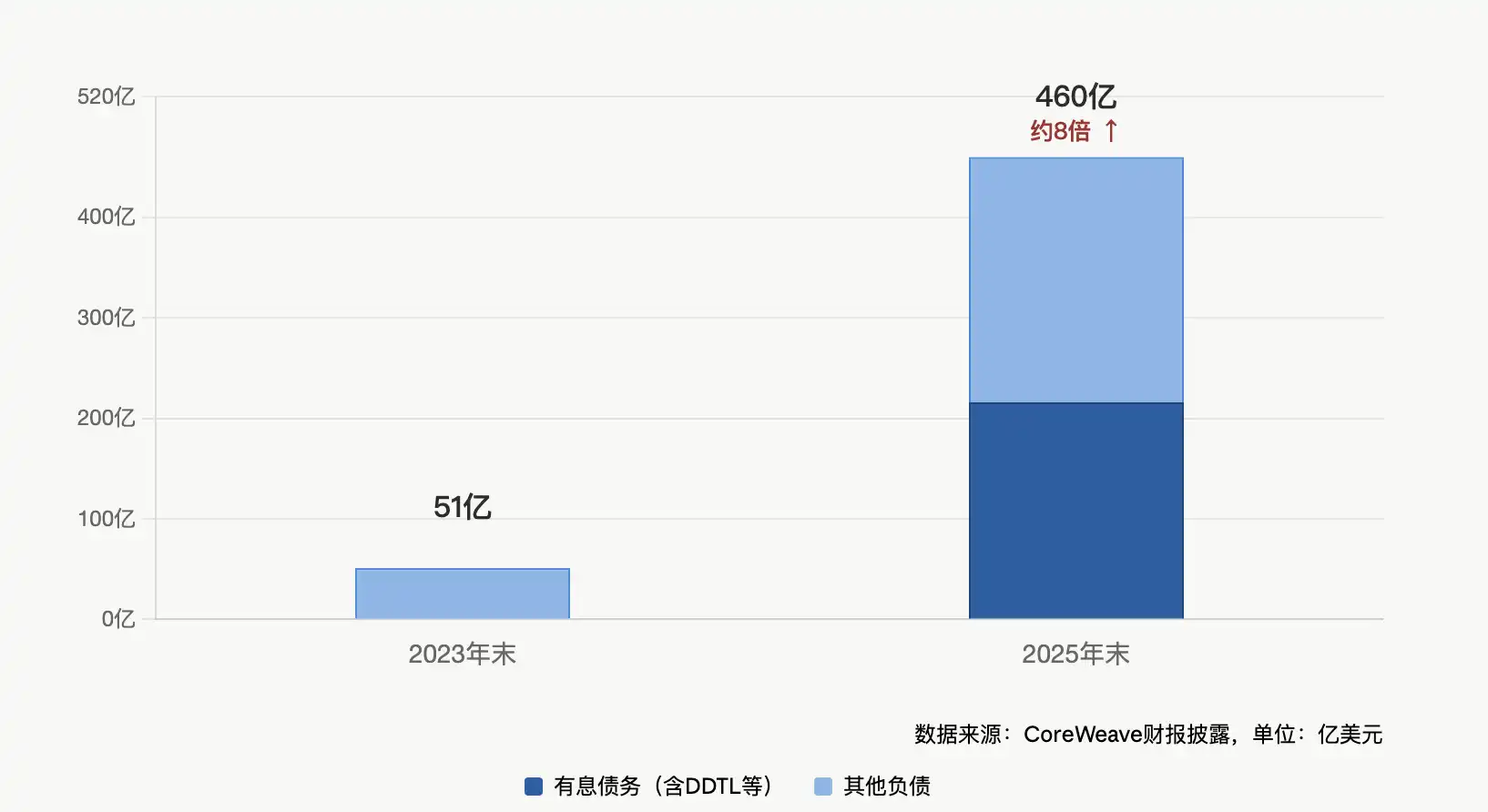
However, another set of numbers in the earnings report is causing anxiety. Q1 capital expenditure reached $6.8 billion, and the company expects Q2 capital expenditure to further climb to between $7 billion and $9 billion. The Q2 interest expense guidance range is $650 million to $730 million, reflecting the rapid expansion of the debt pile.

The total debt burden is already staggering. As of the end of Q1, CoreWeave's total debt was approximately $25 billion. Relative to the company's current annualized revenue scale, this leverage level is significantly higher than that of traditional cloud service providers. Morgan Stanley data shows that CoreWeave's debt financing for the full year 2025 reached about $11.8 billion, far exceeding the approximately $1.5 billion in equity financing during the same period. The company's core expansion tool is the DDTL, a "book-then-fund" model where it secures bank financing to purchase GPUs, using order contracts as collateral.

The sharpest criticism stems from profit quality. Although management repeatedly highlights the 56% EBITDA margin, the adjusted operating margin is only 1%, and the "real" gross margin after deducting technology and infrastructure costs is about 4%, showing compression both sequentially and against market expectations. On the call, Intrator attributed this to the phased effects of scaling, where the dilution effect on margins from adding new capacity is immense when expanding rapidly from a 1-gigawatt operational scale. He promised this was the "low point for margins," which would gradually rebound in future quarters.

However, the market is currently unwilling to pay for that promise. While analysts from Morgan Stanley and Jefferies issued positive evaluations, CoreWeave has experienced short-term pullbacks after every previous earnings report, with this decline being one of the steeper ones.
Ongoing Insider Selling, Mirroring Duan Yongping's Bottom Fishing

Around the earnings release, CoreWeave insiders continued their selling. CEO Mike Intrator sold 307,693 shares in late April; co-founders Brian Venturo and Chen Goldberg also recorded sales; institutional shareholder Magnetar Financial had previously offloaded over $300 million worth. The latest disclosures show another major shareholder recently sold approximately 1.2 million shares.

This forms a stark contrast with Duan Yongping's Q4 position building. According to a 13F filing by H&H International Investment in February 2026, Duan Yongping initiated a position in CoreWeave of 299,900 shares in Q4 2025, when the company's stock price had retreated over 65% from its highs, and market concern over its debt structure peaked.

It is noteworthy that CoreWeave constitutes only 0.12% of Duan Yongping's total H&H portfolio, a "light test" position. During the same period, Duan aggressively increased his Nvidia stake by over 1110% and initiated new positions in Credo Technology (high-speed connectivity) and Tempus AI (AI healthcare), with these three new AI positions combined accounting for less than 0.3%. This suggests Duan's real heavy bet is on Nvidia itself, with CoreWeave resembling a small, extended bet on the downstream AI computing supply chain.

The Key Question Now: Inflection Point or Trap?

During the Q&A session of the earnings call, Intrator posed an emotionally charged rhetorical question: "I've always felt like everyone is staring at the stock price tree and missing the whole forest."

This statement aptly summarizes the current bull-bear standoff. The bulls see the forest: the nearly $100 billion contract backlog, diversified customer base, tripartite Nvidia ties, and the credit rating upgrade. The bears see the tree: the 1% operating margin, widening net loss, aggressive capital expenditure, and continuously selling insiders.

CoreWeave's stock price is still up nearly 80% year-to-date and over 200% since its IPO. However, when a stock's bull case relies on long-term narratives while the bear case rests on current numbers, every earnings report becomes a battleground for these two narratives. In a previous interview with Fang Sanwen, Duan Yongping stated: "AI is a massive revolution brought about by qualitative changes in computing power, potentially exceeding the impact of the internet and industrial revolutions. There is a clear AI bubble currently; 90% of companies may be eliminated, but the survivors will become the next generation of giants." His 0.12% light position itself acknowledges the uncertainty of this gamble.

The next test point is already clear: the Q2 earnings report. If the operating margin fails to rebound as promised by management by then, the credibility of the "forest" narrative will face a real stress test.

Preguntas relacionadas

QWhy did CoreWeave's stock price drop sharply on May 8th?

ACoreWeave's stock price dropped 11.4% on May 8th primarily due to disappointing Q2 revenue guidance. The company forecast Q2 revenue between $2.45 and $2.6 billion, with a midpoint of $2.53 billion, which was significantly below market expectations of $2.69 billion. Additionally, the company's Q1 net loss widened to $740 million, more than double the loss from a year ago, and its adjusted operating margin was compressed to just 1%, fueling investor concerns about profitability despite rapid revenue growth.

QWhat are the main arguments of CoreWeave's bullish investors?

ABullish investors focus on CoreWeave's massive backlog of nearly $100 billion in Remaining Performance Obligations (RPO), which grew significantly in Q1. They highlight its deep ties with Nvidia, which is an investor, customer, and key GPU supplier. The company has diversified its client base, securing major agreements with companies like Meta and Anthropic, and improving its reliance on a single customer (previously Microsoft). Strong financing, including low-cost debt, and an 'investment-grade' credit rating upgrade from S&P also support the positive long-term narrative.

QWhat are the main concerns of CoreWeave's bearish investors?

ABearish investors point to CoreWeave's deteriorating profitability as scale increases. Key concerns include a net loss that more than doubled year-over-year, a razor-thin 1% adjusted operating margin, and capital expenditures that are soaring ($6.8B in Q1). The company's massive and growing debt load (approximately $25B) and high interest expense are seen as significant risks. Furthermore, the ongoing insider selling by executives and major shareholders contrasts with the bullish public narrative, raising questions about internal confidence.

QWhat was Duan Yongping's investment action regarding CoreWeave, and what does it signify?

ADuan Yongping, through his investment firm H&H International, initiated a position in CoreWeave in Q4 2025, purchasing approximately 299,900 shares worth around $20 million when the stock was near its yearly low. However, this position represents a very small 0.12% of his total portfolio. His much larger bet is on Nvidia itself. The CoreWeave investment is viewed as a minor, exploratory allocation to the downstream AI infrastructure sector, acknowledging both the sector's potential and its high uncertainty, rather than a strong conviction bet on the company.

QWhat is the key upcoming test for CoreWeave's investment thesis according to the article?

AThe next crucial test for CoreWeave will be its Q2 2026 earnings report. CEO Michael Intrator has promised that Q1 represented a 'low point' for margins and that profitability would improve in subsequent quarters. If the Q2 report fails to show a meaningful rebound in the operating margin from the current 1% level, the credibility of the company's long-term growth and profitability narrative ('the forest') will face severe pressure, potentially leading to further investor skepticism and stock price volatility.

Lecturas Relacionadas

GensynAI : Que la IA no repita los errores de Internet

En los últimos meses, el auge de la IA ha atraído talento del sector cripto. Muchos proyectos exploran cómo la blockchain puede integrarse en la infraestructura de IA, pero pocos logran un modelo de negocio cerrado. Gensyn se distingue al enfocarse en el núcleo más costoso: el entrenamiento de modelos. Su propuesta es organizar recursos de GPU dispersos globalmente en una red abierta para entrenamiento de IA. Los desarrolladores pueden enviar tareas, los nodos aportan capacidad de cálculo, y la red verifica los resultados y distribuye incentivos. Esto aborda un problema crítico: la creciente centralización del poder de cálculo en grandes tecnológicas, donde el acceso a GPUs como la H100 se ha convertido en una barrera clave para la innovación. Gensyn destaca por cuatro razones: 1. Ataca la capa de infraestructura central de la IA (entrenamiento), no solo aplicaciones. 2. Ofrece un modelo de colaboración abierto que puede optimizar costes y eficiencia para equipos más pequeños. 3. Su principal barrera tecnológica y ventaja es la capacidad de verificar resultados y garantizar fiabilidad en un entorno distribuido. 4. Responde a una demanda real y creciente en un mercado ya validado, más allá de la narrativa cripto. En conclusión, la frontera entre cripto e IA se desdibuja. La IA necesita coordinación de recursos e incentivos para la colaboración global, áreas donde la tecnología blockchain puede aportar soluciones. Gensyn representa un paso hacia una infraestructura de IA más abierta y accesible, no solo controlada por unos pocos gigantes.

marsbitHace 8 hora(s)

GensynAI : Que la IA no repita los errores de Internet

marsbitHace 8 hora(s)

¿Por qué el desarrollo de la IA en China es tan rápido? La respuesta está dentro de sus laboratorios

El artículo explora las razones del rápido desarrollo de la IA en China, centrándose en la cultura organizativa de sus laboratorios. A diferencia del ecosistema estadounidense, que prioriza la innovación disruptiva, el capital y las "estrellas" científicas individuales, el enfoque chino se caracteriza por un pragmatismo basado en la ejecución en equipo, la ingeniería eficiente, la rápida iteración y un fuerte deseo de controlar la pila tecnológica clave. Los laboratorios chinos sobresalen como "seguidores rápidos", optimizando direcciones ya establecidas. Una cultura que valora menos el ego individual y más el trabajo en equipo, combinada con una gran afluencia de jóvenes investigadores y estudiantes integrados en proyectos centrales, facilita una adaptación ágil y un enfoque en tareas prácticas de mejora de modelos. Existe un respeto general dentro del ecosistema, que se percibe más como una comunidad que como tribus en competencia. En el ámbito industrial, se observa una mentalidad de "construir, no comprar", con muchas grandes empresas tecnológicas desarrollando sus propios modelos LLM fundamentales para mantener la soberanía tecnológica. El apoyo gubernamental existe pero es descentralizado. La demanda interna de IA está creciendo, potencialmente similar al mercado de la nube, y los desarrolladores muestran una fuerte admiración por herramientas como Claude. Aunque hay una gran necesidad de chips de Nvidia, también se utilizan alternativas locales como Huawei para inferencia. El ecosistema de datos es menos maduro que en Occidente, lo que fomenta soluciones internas. En conclusión, se están formando dos trayectorias distintas: una carrera impulsada por el capital y el prestigio en EE.UU. frente a una competencia industrial impulsada por la capacidad de ejecución, el ecosistema de código abierto y la autonomía tecnológica en China. El autor destaca la calidez y el enfoque pragmático de los investigadores chinos, subrayando que la competencia futura dependerá no solo de los modelos, sino también de las capacidades organizativas y la fuerza del ecosistema.

marsbitHace 10 hora(s)

¿Por qué el desarrollo de la IA en China es tan rápido? La respuesta está dentro de sus laboratorios

marsbitHace 10 hora(s)

3 años, 5 veces: el renacimiento de una fábrica de vidrio centenaria

Según CRU, la demanda de fibra óptica en centros de datos de IA creció un 75,9% anual, ampliando el déficit de oferta del 6% al 15%. Los precios de la fibra se triplicaron en meses. NVIDIA invirtió en Corning, Lumentum y Coherent (total 45 mil millones USD) para asegurar la cadena de suministro óptica. Corning, fundada en 1851, ve su valor subir un 316,81% en el último año, alcanzando 160 mil millones USD. Su crecimiento se debe a dos factores clave: la rigidez de la oferta (el proceso de fabricación de preformas es complejo y lento) y la transición forzada de cobre a fibra en infraestructuras de IA para mayor eficiencia y menor consumo energético. La fibra es crucial para la IA: su uso en bastidores de IA es 5-10 veces mayor que en centros tradicionales. Se espera que la demanda de fibra para IA represente el 35% del mercado total para 2027. Corning lidera en fibra especializada de baja pérdida, alta densidad y resistencia a la curvatura, esencial para transmisiones de 800G a 1,6T. Sus ingresos en comunicación óptica para empresas se duplicaron en dos años, superando los 30 mil millones USD en 2025, respaldados por acuerdos a largo plazo con Meta, NVIDIA y otros grandes clientes. Aunque no es el mayor fabricante global, Corning destaca en I+D (más de 10 mil millones USD anuales) y en su enfoque en el segmento premium de centros de datos de IA. El aumento de precios beneficia a toda la industria, como muestran los resultados de empresas chinas. El despliegue de Óptica de Co-Embalaje (CPO) y la posible adopción de fibra hueca son variables futuras clave. Sin embargo, la rápida apreciación de las acciones de Corning (multiplicando por 3 su relación P/E) ya refleja grandes expectativas, lo que podría aumentar la volatilidad si los pedidos no cumplen con el ritmo esperado.

marsbitHace 10 hora(s)

3 años, 5 veces: el renacimiento de una fábrica de vidrio centenaria

marsbitHace 10 hora(s)

Trading

Spot
Futuros
活动图片