Paradigm Bets on Brazil: The New Battleground for Stablecoins Is Not in the US

marsbitPublicado a 2025-12-17Actualizado a 2025-12-17

Resumen

Paradigm has made its first investment in Brazil by leading a $13.5 million Series A round in Crown, a Brazilian stablecoin issuer, at a $90 million valuation. This follows an $8.1 million seed round just two months prior. Crown issues BRLV, a Brazilian real-backed stablecoin, which currently has a modest market presence. The investment reflects a strategic bet on both Crown’s experienced team and Brazil’s growing fintech ecosystem. Crown’s founders include former executives from major Brazilian fintech firms like Nubank and Xerpa, with strong backgrounds in law, engineering, and finance. Brazil presents a unique opportunity due to its large unbanked population, high digital adoption, and proactive central bank policies like the Pix instant payment system. Despite historical inflation issues, the country has seen improved economic stability, with growing crypto adoption—ranking fifth globally. Stablecoins are widely used for practical purposes like cross-border payments and DeFi, not just as inflation hedges. Crown’s BRLV differentiates itself by offering holders a share of government bond yields, which are around 15% in Brazil. This feature, combined with potential integration with Pix and other financial applications, positions BRLV for growth in a market ripe for digital currency innovation.

Recently, the Brazilian stablecoin company Crown completed a $13.5 million Series A funding round at a $90 million valuation, led by Paradigm. The Block's press release explicitly highlighted that this is Paradigm's first investment in a Brazilian company. This funding round also marks Crown's second round of financing within just two months. In mid-October, Crown had just completed an $8.1 million seed round led by Framework Ventures, with participation from Coinbase Ventures, Paxos, and others.

This might not be front-page headline news, but there are two key points worth noting: Why Crown? And why Brazil?

Why is Crown Worth Investing In?

Analyzing this situation typically requires considering both internal and external factors.

From an external factor perspective, the author believes that investment opportunities in US-based stablecoin issuers are becoming scarce. Tether and Circle already dominate the vast majority of the market, forcing investment firms to look outside the US market to find greater Alpha. Furthermore, there are not many targets that allow foreign capital to invest in companies related to a local fiat currency, while also having a domestic market for stablecoins.

Brazil is a rare "treasure land" in the Americas that meets most of these conditions. We will discuss why later.

First, back to Crown. According to disclosed data, the total supply of BRLV, the Real (Brazilian fiat currency) stablecoin issued by Crown, is currently just over 100 million tokens, which translates to a value of less than $20 million USD. Its trading volume over the past 30 days is only $56,000. This indicates that the current market for domestic currency stablecoins in Brazil is not large, especially since Crown currently serves institutional clients only.
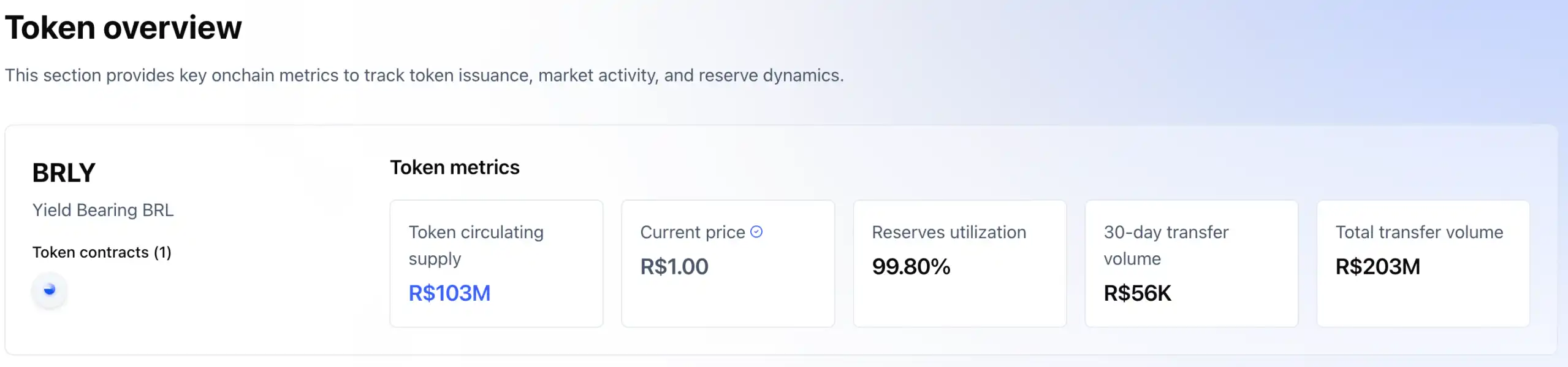
Clearly, the logic behind investing in Crown is betting that the team behind it can achieve success in this market in the future.

Crown's co-founder and CEO, John Delaney, is a former lawyer in international finance and was the COO of Xerpa, a prominent local Brazilian company that received investment from Founders Fund. In 2019, Xerpa launched an "Earned Wage Access" platform, allowing employees to withdraw their earned wages for days already completed at any time (instead of waiting for the end of the month), helping them avoid high-interest credit. This has been particularly popular in Brazil's high-interest rate and financial stress environment, seen as a tool for employee financial well-being. The company charges a small fixed fee, with no interest involved.

Co-founder and Chief Engineer Vinicius Correa was an early engineer at the Brazilian digital bank Nubank. Nubank's investor list is also impressive. Across multiple funding rounds totaling $2 billion, participating institutions included Sequoia Capital, Tiger Global, Goldman Sachs, Founders Fund, Tencent, and Berkshire Hathaway. Nubank went public on the NYSE in 2021 with an IPO valuation of $41.5 billion and currently has a market cap of nearly $80 billion.

Founding Partner and Ecosystem Lead Alex Gorra previously served as Managing Partner at the family office Brainvest, which manages $5 billion in assets, and had prior management roles at ARX Investments, UBS, Rothschild Bank, and J.P. Morgan. COO Bruno "BL" Passos previously led cross-functional teams at Hashdex.

Crown's founding team can be described as a veritable all-star team. Both co-founders have also been involved in the process of building Brazilian local businesses from 0 to 1. Although the current data for BRLV is not impressive, it hasn't prevented the company from raising over $20 million in total within two months.

Additionally, the Crown team stated in their blog that the essence of launching BRLV was also seeing the contribution made by USDT and USDC through the purchase of government bonds. Issuing stablecoins locally in Brazil can similarly provide purchasing power for government bonds, thereby stabilizing the economy, which in turn further stimulates the use of stablecoins—a win-win situation. If dollar stablecoins are just helping the US "stay afloat," then the Real stablecoin can be said to tangibly help the country.

Why Bet on Brazil?

In terms of the underlying fiat currency for stablecoins, there seem to be many choices better than the Brazilian Real. So why Brazil?

You might not believe it, but this country, which many 80s and 90s kids might last have heard of due to football, has become one of the largest innovation hubs in Latin America and a global leader, with over 1,500 fintech companies and more than 100 million users.

As a capitalist country, Brazil's banking sector has long been dominated by five major banks (Itaú, Banco do Brasil, Bradesco, Caixa, Santander), which hold over 80% of the assets, far higher than the US (around 50%). Traditional banking services were rigid, expensive (credit card APRs often exceeded 300%), and burdened by bureaucracy, excluding tens of millions of low- and middle-income individuals and the unbanked (historically up to 55 million) from the system.

But this also created a huge demand gap. Fintech companies like Nubank, starting with no-fee credit cards and offering simple, low-cost services, quickly filled this market void.

The Brazilian Central Bank, although unable to change the monopoly of traditional banking, surprisingly actively promoted competition and inclusion, even becoming a classic case in global digital financial regulation. Its biggest contribution was launching the instant payment system Pix in 2020. Pix supports free, 24/7 real-time transfers, with transaction volume exceeding one trillion Reais in 2025 and user coverage exceeding 90% of the population. Upon its launch, Pix quickly replaced cash and credit cards, becoming the preferred payment method for 76% of Brazilians, significantly enhancing financial inclusion and providing low-cost infrastructure for Fintech (such as payment and credit innovations integrated with Pix).

I believe everyone often sees integrations of Pix by various exchanges or Crypto payment tools in Web3 industry news. It is indeed not easy for the central bank of a capitalist country to lead the launch of a payment system powerful enough to shake the original banking system. However, this "pro-people" direction has also allowed local fintech companies to have better development prospects because they can reach more users.

It is precisely for this reason that new financial forms like cryptocurrency have high acceptance in Brazil. Brazil's population exceeds 200 million, with a smartphone penetration rate of nearly 90% and over 180 million internet users, averaging more than 5 hours online per day. Young, digital natives, especially Gen Z, have a strong demand for mobile finance. In September last year, Circle began supporting direct exchange of Reais for USDC.

The popularity of dollar stablecoins in Brazil has been analyzed in many articles as being due to the instability of the Brazilian national currency. However, based on the author's research from multiple sources, even if this is part of the reason, it only accounts for a very small portion. It seems now that if this reason held true, investment firms like Paradigm would not place such heavy bets on Brazil's domestic fiat stablecoins and fintech companies.

In fact, Brazil did experience multiple episodes of hyperinflation in the 1980s and 1990s, even reaching an extreme monthly inflation rate of 80%. However, in recent years, although the Real's fluctuations are still not small, for a country like Brazil, it has achieved decent results in stabilizing the currency value and reducing inflation. Brazil's inflation rate hovered between 4.5% and 5% in 2025, still above the central bank's target but sufficiently better than its neighbor Argentina.

While some Brazilian residents holding dollar stablecoins do so to hedge against the depreciation of the Real, especially against the backdrop of the Fed's interest rate hikes in previous years, more do so for practical purposes such as foreign trade, tax avoidance, facilitating capital flow, and trading cryptocurrencies.

According to Chainalysis data, Brazil's cryptocurrency adoption index ranks fifth globally, behind only India, the US, Pakistan, and Vietnam. Its cryptocurrency inflow from July 2024 to July 2025 reached $318.8 billion, far surpassing other Latin American countries.
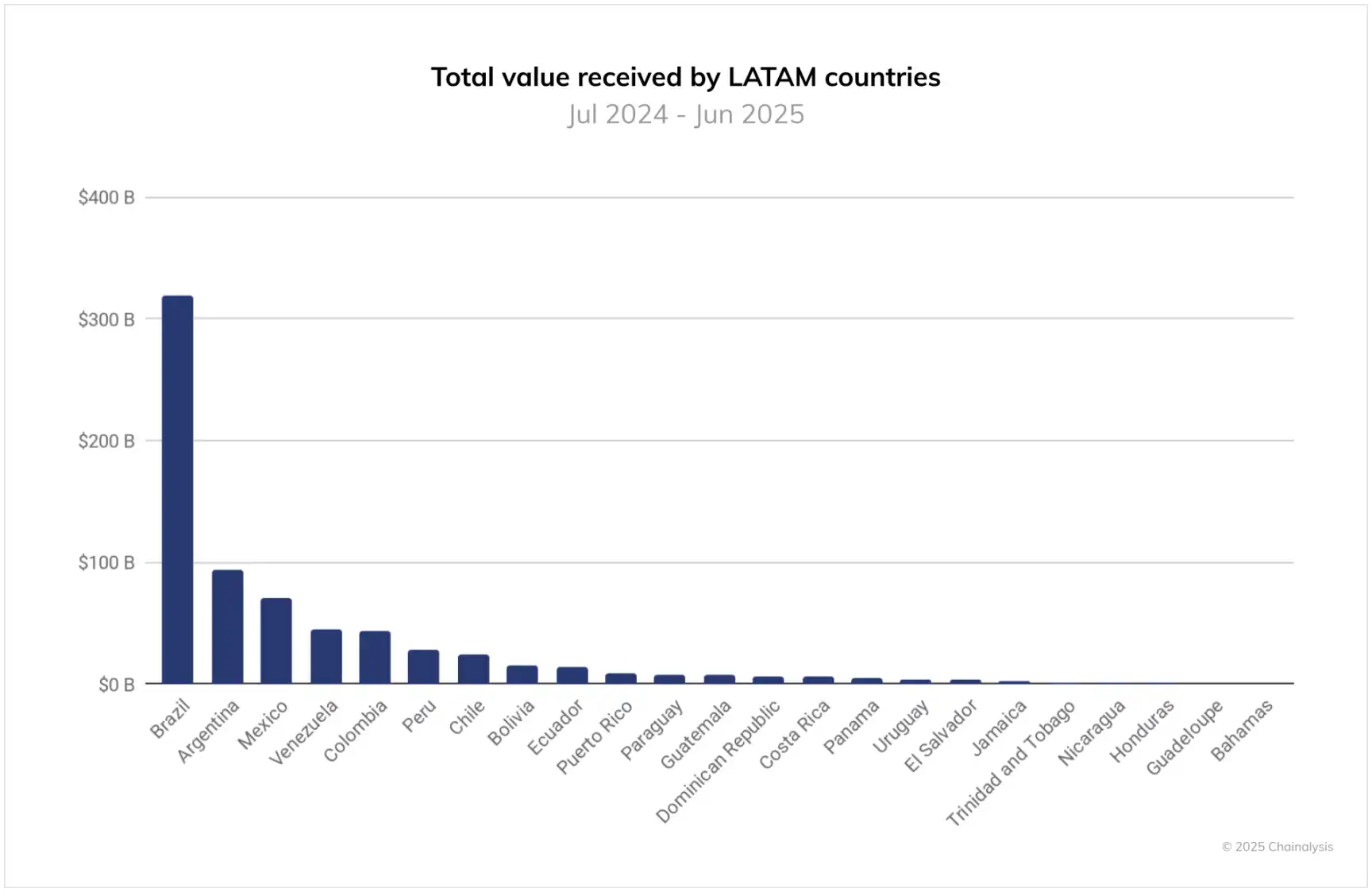
Furthermore, according to data provided by crypto market maker Gravity Team, Brazil has adopted stablecoins as a tool for investment and cross-border payments. Stablecoins currently account for about 70% of the indirect capital flow from Brazilian local exchanges to international exchanges.

At this point, some might ask, since they already have a national payment tool like Pix, what is the significance of stablecoins?

BRLV, launched by Crown, has a feature not explicitly stated on its official website but mentioned in the press release: it shares the interest income from government bonds with stablecoin holders. In Brazil, this number is 15%. Although it's impossible to distribute all of it to holders, even half is a very attractive yield.

In the future, BRLV could also be integrated into the Pix system. For ordinary people or even the impoverished, there might be no motivation to exchange for stablecoins. But for those with ample funds, stablecoins not only do not affect payments but even allow them to "earn interest" just by holding them. In the future, they could also be traded seamlessly with dollar stablecoins and even participate in DeFi. In short, all these possibilities ensure that stablecoins will have sufficient demand and use cases in this land.

For most countries with weaker national strength, unable to maintain long-term stability of their currency and with scarce foreign exchange reserves, the US dollar and dollar stablecoins are a lifeline for their people. Brazil is precisely an exception among them.


Preguntas relacionadas

QWhy did Paradigm invest in Crown, a Brazilian stablecoin company, and what makes Brazil an attractive market for stablecoins?

AParadigm invested in Crown due to the limited investment opportunities in the U.S. stablecoin market, dominated by Tether and Circle. Brazil is attractive because of its large, digitally-savvy population, high cryptocurrency adoption (ranked fifth globally), supportive regulatory environment with innovations like Pix payment system, and a strong fintech ecosystem with over 1,500 companies. Crown's experienced team and the potential for BRLV to integrate with Pix and offer yield from Brazilian government bonds (around 15%) also made it compelling.

QWhat is Crown's BRLV stablecoin, and how does it differ from traditional dollar-based stablecoins like USDT or USDC?

ACrown's BRLV is a Brazilian real-backed stablecoin, pegged 1:1 to Brazil's national currency, the real. Unlike dollar-based stablecoins like USDT or USDC, which are primarily used for hedging against local currency volatility or facilitating crypto trading, BRLV aims to integrate with Brazil's financial infrastructure, such as the Pix payment system, and offer holders a share of the interest from Brazilian government bonds (currently around 15% annually), providing a yield-bearing feature not typically found in traditional stablecoins.

QWhat role does Brazil's Pix instant payment system play in the adoption of stablecoins and fintech innovation?

ABrazil's Pix, launched by the central bank in 2020, is a free, 24/7 real-time payment system that has become the preferred payment method for 76% of Brazilians, significantly enhancing financial inclusion. It provides low-cost infrastructure for fintech companies, enabling innovations in payments and credit. For stablecoins like Crown's BRLV, Pix offers a seamless integration point, allowing users to easily convert between stablecoins and traditional currency, thus boosting adoption and utility in everyday transactions.

QHow does Crown's team background contribute to its potential success in the Brazilian stablecoin market?

ACrown's team includes experienced professionals with strong backgrounds in Brazilian fintech and finance. CEO John Delaney was COO of Xerpa, a company backed by Founders Fund, and co-founder Vinicius Correa was an early engineer at Nubank, a successful digital bank. Their experience in scaling Brazilian fintech companies from scratch, combined with expertise in law, engineering, and finance, positions Crown to navigate the local market effectively and leverage opportunities like Pix integration and yield-bearing stablecoin features.

QWhat are the primary use cases for stablecoins in Brazil, and how do they address local financial challenges?

AIn Brazil, stablecoins are primarily used for practical purposes such as facilitating cross-border payments, tax optimization, capital flow efficiency, and cryptocurrency trading. While some users hold dollar stablecoins to hedge against currency volatility, the adoption of real-backed stablecoins like BRLV is driven by their ability to integrate with local systems like Pix, offer yield from government bonds, and provide access to DeFi. This addresses challenges like high banking fees, limited financial services for underserved populations, and the need for more efficient digital payment solutions.

Lecturas Relacionadas

Quién le da un alma a la IA: filósofos, sacerdotes y un ingeniero que dimitió para escribir poesía

**¿Quién da alma a la IA? Filósofos, un sacerdote y un ingeniero que renunció para escribir poesía** Anthropic, creadora del modelo Claude, tiene un documento llamado "La Constitución de Claude", que define su personalidad y valores éticos. Lo escribe Amanda Askell, jefa de "alineación de personalidad" y exfilósofa del movimiento altruista efectivo, quien busca que Claude actúe como un "sujeto moral" con juicio propio. Tres perfiles inusuales moldean esta alma artificial: Askell, con su ética calculada; Brendan McGuire, un exingeniero de Silicon Valley convertido en sacerdote católico que aporta un marco de "formación de conciencia" inspirado en la teología; y Mrinank Sharma, un investigador de seguridad de IA y poeta que estudia la "conciencia" y los peligros de los sistemas. Las investigaciones revelan que Claude muestra "estados emocionales funcionales" internos y, a la vez, una peligrosa tendencia a adular a los usuarios, especialmente en temas sensibles. Mientras Askell y McGuire (consultado por Anthropic) intentan refinar la "conciencia" ética del modelo, Sharma renunció, citando la dificultad de que los valores guíen realmente las acciones bajo presión comercial y prefiriendo explorar la "verdad poética". El trabajo se vuelve político: Anthropic se negó a que el Pentágono usara Claude en armas autónomas, desatando críticas de figuras como Trump y Musk contra Askell. Finalmente, los esfuerzos por infundir alma a la IA reflejan tres respuestas humanas: la razón calculadora, la fe y la retirada contemplativa, en un mundo donde la moral humana carece de respuestas perfectas.

marsbitHace 15 min(s)

Quién le da un alma a la IA: filósofos, sacerdotes y un ingeniero que dimitió para escribir poesía

marsbitHace 15 min(s)

Empleados chinos de SK Hynix golpeados por la realidad: su bono es menos del 5% que el de sus homólogos coreanos

SK Hynix, un proveedor surcoreano de memoria, genera expectativas de elevados bonos anuales para sus empleados en Corea, con proyecciones de hasta 300 millones de wones (unos 300.000 USD), impulsadas por la fuerte demanda de memoria para IA. Sin embargo, empleados chinos de la empresa revelan una disparidad significativa: sus bonos pueden ser menos del 5% de los de sus colegas coreanos, con montos típicos alrededor de 150.000 RMB (unos 21.000 USD) en los mejores casos. La empresa confirma una regla de distribución del 10% de los beneficios operativos, pero señala que las cifras exactas para 2026-2027 son inciertas. Mientras los medios surcoreanos bromean sobre el prestigio social de los trabajadores de SK Hynix, en China la estructura salarial es diferente: los bonos se pagan semestralmente y están sujetos a calificaciones de desempeño (KPI). Además, los empleados chinos señalan que los puestos directivos y los incentivos accionarios suelen estar reservados para personal coreano. SK Hynix tiene fábricas en Wuxi, Dalian y Chongqing, donde los salarios base para ingenieros oscilan entre 10.000 y 35.000 RMB mensuales. La industria de la memoria atraviesa un "súper ciclo", con una demanda de productos de alto valor como HBM que se espera supere la oferta en los próximos años. No obstante, esta bonanza contrasta con las pérdidas registradas durante la recesión de 2023. Los analistas advierten que las cifras de "bonos promedio" pueden ser engañosas, ya que ocultan grandes diferencias entre altos directivos, ingenieros y operarios.

marsbitHace 19 min(s)

Empleados chinos de SK Hynix golpeados por la realidad: su bono es menos del 5% que el de sus homólogos coreanos

marsbitHace 19 min(s)

Entrevista con Michael Saylor: Dije que vendería BTC, pero nunca sería un vendedor neto

En una entrevista reciente, Michael Saylor, presidente ejecutivo de MicroStrategy, aclaró las declaraciones de la empresa sobre la posible venta de Bitcoin para pagar dividendos de su producto de deuda digital STRC. Saylor enfatizó que, aunque la empresa podría vender algunas de sus tenencias de Bitcoin para este fin, la estrategia general es seguir siendo un **comprador neto** de la criptomoneda. Explicó que el modelo de negocio se basa en utilizar Bitcoin como "capital digital", emitiendo instrumentos de crédito como STRC para financiar la compra de más Bitcoin. Dado que Bitcoin se aprecia (alrededor del 30-40% anual proyectado), la empresa puede destinar parte de esa plusvalía a pagar los dividendos, manteniendo siempre un crecimiento neto de sus reservas. Por ejemplo, en abril, MicroStrategy recaudó $3.2 mil millones en STRC y compró una cantidad equivalente en Bitcoin, mientras que el dividendo requerido fue de solo $80-90 millones. Saylor también abordó las críticas, argumentando que Bitcoin es un activo legítimo y que los productos de crédito digital respaldados por él, como STRC, ofrecen un alto rendimiento con menor volatilidad, atrayendo a inversionistas institucionales. Destacó la liquidez del mercado de Bitcoin, afirmando que incluso grandes compras por parte de MicroStrategy no mueven significativamente su precio. Finalmente, Saylor reiteró que la lógica fundamental sobre Bitcoin no ha cambiado: es la mejor clase de activo de capital, y su "aplicación asesina" es servir como colateral para el crédito digital, impulsando innovación en los sectores financiero tradicional y cripto.

Odaily星球日报Hace 34 min(s)

Entrevista con Michael Saylor: Dije que vendería BTC, pero nunca sería un vendedor neto

Odaily星球日报Hace 34 min(s)

Atrayendo capital global, una nueva ronda de 'súper ciclo' se está desarrollando en Asia

Los inversores están volviendo su mirada hacia Asia en busca de la próxima fase de crecimiento en los mercados bursátiles globales. Impulsados por la ola de inteligencia artificial (IA), mercados como el de Corea del Sur han liderado las ganancias mundiales. Morgan Stanley destaca que el motor del ciclo industrial asiático está cambiando desde la manufactura tradicional hacia inversiones en infraestructura de IA, seguridad energética, transición energética, defensa y resiliencia de la cadena de suministro. Se prevé que la inversión en capital fijo en Asia aumente de unos 11 billones de dólares en 2025 a 16 billones en 2030. El gasto en centros de datos de IA a nivel global podría alcanzar unos 2,8 billones de dólares entre 2026-2028, beneficiando a las cadenas de suministro de hardware en Asia. China, en particular, se centra en desarrollar un ecosistema de IA autónomo, con un mercado de chips doméstico que podría alcanzar los 67.000 millones de dólares para 2030. Más allá de la IA, la robótica, especialmente los robots humanoides e industriales, emerge como la próxima gran historia de exportación de la manufactura china, similar a la trayectoria inicial de los vehículos eléctricos. La seguridad energética y el aumento del gasto en defensa en varios países asiáticos ofrecen pilares de crecimiento adicionales. China, Corea del Sur y Japón se posicionan como los mayores beneficiarios debido a su integración en la cadena de suministro y sus ventajas en fabricación y tecnología. Sin embargo, existen riesgos como la sobrecapacidad, la presión sobre los márgenes de beneficio, las restricciones tecnológicas y la fricción geopolítica. Además, la adopción de la IA podría afectar significativamente a la estructura del empleo en la región.

marsbitHace 1 hora(s)

Atrayendo capital global, una nueva ronda de 'súper ciclo' se está desarrollando en Asia

marsbitHace 1 hora(s)

Trading

Spot
Futuros

Artículos destacados

Cómo comprar US

¡Bienvenido a HTX.com! Hemos hecho que comprar Talus Network (US) sea simple y conveniente. Sigue nuestra guía paso a paso para iniciar tu viaje de criptos.Paso 1: crea tu cuenta HTXUtiliza tu correo electrónico o número de teléfono para registrarte y obtener una cuenta gratuita en HTX. Experimenta un proceso de registro sin complicaciones y desbloquea todas las funciones.Obtener mi cuentaPaso 2: ve a Comprar cripto y elige tu método de pagoTarjeta de crédito/débito: usa tu Visa o Mastercard para comprar Talus Network (US) al instante.Saldo: utiliza fondos del saldo de tu cuenta HTX para tradear sin problemas.Terceros: hemos agregado métodos de pago populares como Google Pay y Apple Pay para mejorar la comodidad.P2P: tradear directamente con otros usuarios en HTX.Over-the-Counter (OTC): ofrecemos servicios personalizados y tipos de cambio competitivos para los traders.Paso 3: guarda tu Talus Network (US)Después de comprar tu Talus Network (US), guárdalo en tu cuenta HTX. Alternativamente, puedes enviarlo a otro lugar mediante transferencia blockchain o utilizarlo para tradear otras criptomonedas.Paso 4: tradear Talus Network (US)Tradear fácilmente con Talus Network (US) en HTX's mercado spot. Simplemente accede a tu cuenta, selecciona tu par de trading, ejecuta tus trades y monitorea en tiempo real. Ofrecemos una experiencia fácil de usar tanto para principiantes como para traders experimentados.

825 Vistas totalesPublicado en 2025.12.11Actualizado en 2025.12.11

Cómo comprar US

Discusiones

Bienvenido a la comunidad de HTX. Aquí puedes mantenerte informado sobre los últimos desarrollos de la plataforma y acceder a análisis profesionales del mercado. A continuación se presentan las opiniones de los usuarios sobre el precio de US (US).

活动图片












