OpenAI Launches Workflow Agent, GPTs Begin Countdown

marsbitPublicado a 2026-04-24Actualizado a 2026-04-24

Resumen

OpenAI has launched Workspace Agents, an evolution of GPTs designed for teams. This new feature allows users to create reusable, shareable agents that automate repetitive workflows. Driven by Codex, these agents operate within their own workspace, can access files, call tools, and run continuously in the background. Users describe a workflow—such as collecting information, making judgments, generating results, and sending outputs—to ChatGPT, which then builds the agent. The entire team can use and refine the agent via ChatGPT or Slack. Once set up, the agent runs autonomously. Workspace Agents are team-shared, code-free, and manageable with predefined permissions and controls. They are suitable for structured, repeatable tasks involving multiple tools and continuous operation, such as software review, feedback整理, report generation, sales follow-up, and risk assessment. The system operates within clear rules, with sensitive actions requiring human confirmation. It aims to transform workflows from being person-dependent to being documented, executable, and reusable—akin to scientific management principles. Competing solutions from Microsoft and Google are also emerging in this space.

OpenAI released Workspace Agents in the early hours, marking the beginning of the countdown for GPTs.
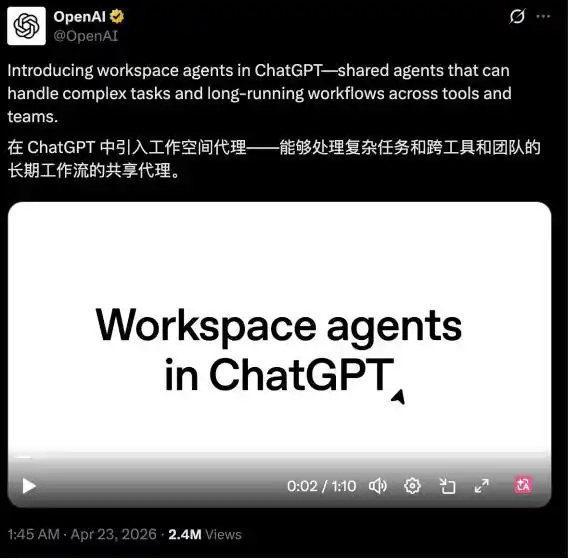
This new product is introduced as an evolved form of GPTs, with a clear positioning: team-oriented, turning a repeatable workflow into a shareable, executable agent.

It is powered by Codex, has its own workspace, can access files, call tools, and execute tasks continuously in the background.

You describe a repetitive workflow to ChatGPT, such as collecting information, making judgments, generating results, and then sending the results out. ChatGPT will then build this process into an Agent, which your entire team can use in ChatGPT or Slack, making adjustments while using it.

Once set up, it will continue running in the background, even when people are away.

It sounds familiar, like OpenClaw · Team Edition.

01 Team-Shared Agent

As the name suggests, Workspace Agents are for work teams.

This new feature is placed in the sidebar of ChatGPT as a separate entry. Clicking on it reveals a space to build workflows.
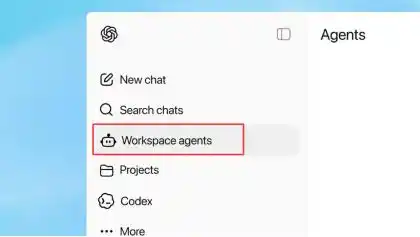
You can create an agent from scratch or modify it based on official templates. The entire process requires no coding; simply describe the workflow in plain language, and the system will break it down step by step: what steps are needed, what tools are used, and what results are output.

The created agent will appear in the team directory, where other members can directly call the same agent or adjust and supplement the workflow during use.
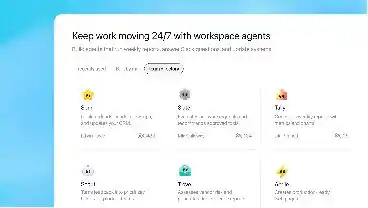
In other words, the workflow becomes a reusable tool for the team. Moreover, it is not fixed; it can be continuously refined during use.

Additionally, Workspace Agents have their own workspace, allowing them to read and save files, call connected tools such as email, calendars, document systems, or other business systems, and execute code when needed.

They can also run continuously, either manually triggered or scheduled. Once the process starts, it will execute step by step without requiring human intervention at each step. As long as the entire process is feasible, you can let it run on its own.

The execution process is controllable. Workspace Agents follow pre-set permissions and control rules.

Each agent's accessible tools and data can be set in advance; operations involving content modification or sending information can require prior approval; administrators can monitor its usage and pause or adjust it when necessary.

Looking back at previous generations of products, this change becomes clearer.

The earliest GPTs were essentially prompt + knowledge base + Actions, configured once for single-user use, without true long-process execution capabilities.

Later, ChatGPT Agent could execute tasks but was more like a one-time call. It ended after completion, with no continuous operation or stable identity.

With Workspace Agents, this type of product has stabilized: it is team-shared, can run long-term, has its own context and memory, executes continuously according to preset processes, and includes permission and management mechanisms.

Based on the official description, this product is suitable for structured, repeatable tasks that rely on multiple tools and require continuous operation. For one-time conversations or temporary tasks, such complexity is likely unnecessary.

Workspace Agents are now available in research preview for ChatGPT Business, Enterprise, Education, and Teacher plans. For Enterprise and Education plans, administrators can manage these agents through role permissions.

02 Simplifying Processes Under Clear Rules

OpenAI provided five typical scenarios covering IT, product, operations, sales, and risk control functions.

None of these scenarios require coding. They share a commonality: the tasks themselves are not complex, but the information is scattered across different places, requiring people to search and organize repeatedly.

The first is software review: after an employee submits a software use or procurement request, the agent checks it against the company's existing tool list and security rules to determine whether the request can be approved, how to proceed, and, if necessary, directly submits the ticket.

The second is product feedback organization: the agent simultaneously checks Slack, customer service channels, and public forums to collect scattered user feedback, categorizes it briefly, identifies which are more important, organizes it into tickets, and outputs a阶段性 summary.

The third is weekly report generation: the agent pulls business data at fixed times, creates charts, writes a summary, and compiles a complete report for the team.

The fourth is sales lead follow-up: the agent checks new customer information, judges whether the customer is worth following up based on team rules, drafts a follow-up email, and syncs relevant content back to the CRM system.

The fifth is third-party risk assessment: the agent checks various information about suppliers, such as whether they are sanctioned, their financial status, and any negative news, then compiles a report according to the company's standards.

These five scenarios point to the same type of task, which is the primary use of Workspace Agents: if a process already exists but requires constant switching between different tools during execution, with results pieced together at the end, Workspace Agents can connect these steps and let them run sequentially.

The question then arises: while it's fine to let it collect information and organize processes, is it appropriate to leave judgment to it?

According to the official design, this issue has not been overlooked.

The "judgment" in Workspace Agents is not free rein; it operates within a set of rules.

For example, in the software review scenario, it checks against the company's existing list and security rules to decide whether to use a certain tool; in the sales lead scenario, it doesn't randomly pick customers but scores them based on pre-set team standards.

For more sensitive actions, such as modifying data, sending external messages, or creating schedules, the system can add a confirmation step by default. The process can run automatically, but critical nodes can still pause for human final decisions.

This actually defines a boundary.

Workspace Agents are more suitable for tasks where the rules are clear and the judgment criteria are already written.

If a task itself requires extensive ad-hoc judgment and constant adjustment based on context, it still needs human leadership.

03 Management Lessons from OpenClaw

From a management perspective, Workspace Agents solve not an efficiency problem but the organizational method of the process itself.

In many teams, workflows exist but are not fully documented.

They are scattered in different places: part in documents, part in systems, and part in the minds of those executing them.

The same task handled by different people may follow different sequences and judgment standards.

This is why many tasks seem simple but are difficult to stabilize.

In the late 19th century, Taylor proposed scientific management, whose core was transforming work from "relying on personal experience" to "steps that can be split, recorded, and repeatedly executed."

First, break down a task: how each step should be done, what standards to judge by, then fix these steps so different people can execute them in the same way.

What Workspace Agents do is very similar to this logic. A process must first be clearly written: when it starts, what data is used, what steps are involved, and what results are produced.

This content directly becomes an executable process. During execution, it no longer relies on someone remembering the next step but follows the defined sequence.

The change is that the process can be separated from people.

In the past, the "most familiar person" in a team often determined whether the process could run smoothly; now, this experience can be written into the process, and other team members can directly use the same approach.

Another important point is that the process must have boundaries: which parts can be automated, which must stop for confirmation, which data can be used, and which cannot—all must be set from the beginning.

From this perspective, Workspace Agents do not change the content of work; they change how the process exists.

The process is no longer just described; it can be run, reused, and continuously adjusted.

Tools like OpenClaw initially followed this direction: they attempted to let systems take over entire operational processes, turning actions that required step-by-step human completion at a computer into automatically executable workflows.

The difference is that Workspace Agents place this in a team environment and add layers of permissions, approvals, and management, making work more controllable.

Similar attempts are not unique to OpenAI.

Microsoft is advancing its Copilot Agents, embedding this capability into Microsoft 365, covering environments employees use daily, from email and documents to collaboration tools.

Google also launched an enterprise-side Agent platform today, focusing on how to manage and schedule large numbers of agents, allowing them to collaborate across different systems.

However, for enterprises, the difference is not just in functionality. The real cost lies in usage: whether employees need to learn new tools and whether processes need to be rebuilt determines whether these systems can truly operate.

The competition continues, but the direction is clear.

This article is from the WeChat public account "Letter AI", author: Yuan Xinyue

Preguntas relacionadas

QWhat is the main purpose of OpenAI's newly released Workspace Agents?

AWorkspace Agents are designed for teams to create shareable, executable agents that automate repetitive workflows, allowing them to run continuously in the background with access to files, tools, and predefined rules.

QHow do Workspace Agents differ from previous GPTs and ChatGPT Agents?

AUnlike earlier GPTs (prompt + knowledge base + Actions for single users) and ChatGPT Agents (one-time execution without persistence), Workspace Agents are team-shared, have long-running capabilities, stable identities, context memory, and built-in permission management.

QWhat are some typical use cases for Workspace Agents mentioned in the article?

ATypical use cases include software compliance checks, product feedback aggregation, weekly report generation, sales lead follow-ups, and third-party risk assessments—all involving structured, repeatable tasks across multiple tools.

QHow does Workspace Agents handle decision-making and ensure control?

ADecision-making is rule-based, relying on predefined company standards (e.g., security rules or sales criteria). Sensitive actions like data modification or external communications can require human confirmation, and administrators can monitor, pause, or adjust agents.

QWhat management philosophy does Workspace Agents align with, according to the article?

AIt aligns with Taylor's scientific management principles, breaking down workflows into documented, repeatable steps that are detached from individual experience, making processes executable, shareable, and adjustable within teams.

Lecturas Relacionadas

¿Fracaso de DAT? Empresas cotizadas que apuestan por HYPE obtienen ganancias flotantes de 12.500 millones de dólares

La estrategia de tesorería en cripto que imitaba a MicroStrategy (referida como "Strategy") enfrenta dificultades, con pérdidas netas de 125 mil millones de dólares en el Q1 de 2026 y una alta probabilidad de venta de BTC. En contraste, varias empresas públicas que apostaron por HYPE, el token de Hyperliquid, han obtenido ganancias significativas, con plusvalías no realizadas que superan los 12.5 mil millones de dólares. Se destacan tres empresas: 1. **Hyperliquid Strategies Inc. (PURR):** La más grande, con una tenencia de aproximadamente 22.3 millones de HYPE valorada en 16.36 mil millones y ganancias de 12.2 mil millones. Completamente transformada en una empresa de tesorería nativa en cripto. 2. **Hyperion DeFi (HYPD):** Mantiene unos 2 millones de HYPE y se centra en una participación profunda en el ecosistema, operando nodos validadores y construyendo productos DeFi. 3. **Lion Group Holding (LGHL):** La más pequeña, con una tenencia de aproximadamente 194,000 HYPE. A diferencia de la estrategia de MicroStrategy basada en apalancamiento, estos "tesoros de HYPE" obtienen rendimiento mediante la participación en la red (staking, nodos validadores) y el crecimiento del ecosistema Hyperliquid, combinado con la apreciación del precio del token. Con HYPE siendo un activo resistente, se considera que estas compañías, especialmente PURR, podrían beneficiarse aún más si el token alcanza precios más altos.

Odaily星球日报Hace 1 min(s)

¿Fracaso de DAT? Empresas cotizadas que apuestan por HYPE obtienen ganancias flotantes de 12.500 millones de dólares

Odaily星球日报Hace 1 min(s)

Nvidia desmonta un nuevo nicho de mercado con su bastidor: el valor de los MLCC se dispara un 182%

El suministro de infraestructuras para la IA se enfrenta a un nuevo cuello de botella: los condensadores cerámicos multicapa (MLCC, por sus siglas en inglés). Goldman Sachs y Morgan Stanley señalan que este componente, clave para estabilizar la corriente y filtrar el ruido en servidores de IA, está entrando en un ciclo de crecimiento sin precedentes impulsado por la demanda. El uso de MLCC se dispara con las nuevas arquitecturas de bastidores de Nvidia. Morgan Stanley desvela que el valor de los MLCC en el bastidor Vera Rubin (VR200) es de unos 4.320 dólares, un 182% más que en la generación anterior. Goldman Sachs prevé que el mercado de MLCC para servidores de IA se multiplique por más de cuatro entre 2025 y 2030, con una tasa de crecimiento anual compuesto del 34%. Este crecimiento choca con una oferta limitada. La capacidad de producción del sector solo crece algo más de un 10% anual, incapaz de asumir la demanda exponencial de servidores de IA y la ya sólida demanda de automoción eléctrica. Este desequilibrio ha activado el ciclo de precios: los líderes japoneses Murata y Taiyo Yuden ya han subido precios entre un 15% y un 35%. Los datos de exportación de Japón en abril confirman la tendencia, con un aumento del precio medio del 16% interanual. La elasticidad de los beneficios es significativa. Según Goldman Sachs, una subida de precios del 5% podría aumentar el beneficio operativo de Taiyo Yuden hasta un 37% en el año fiscal 2027. La firma mantiene su recomendación de "comprar" para Murata, Taiyo Yuden y TDK. En resumen, los MLCC, un componente antes discreto, se han convertido en un elemento crítico y escaso en la cadena de suministro de la IA. Con una demanda en fuerte crecimiento y una oferta rígida, todos los indicadores apuntan a que este superciclo impulsado por la inteligencia artificial acaba de comenzar.

marsbitHace 14 min(s)

Nvidia desmonta un nuevo nicho de mercado con su bastidor: el valor de los MLCC se dispara un 182%

marsbitHace 14 min(s)

¿Aumento del 134% y PER de 75 veces? ¿Por qué el mercado paga por Murata, con 'crecimiento cero'?

El fabricante líder mundial de componentes pasivos, Murata Manufacturing, experimentó un fuerte aumento del 12,36% en su acción el 28 de mayo, alcanzando un máximo histórico. Esto ocurre a pesar de que su último informe financiero mostró un crecimiento plano: los ingresos del año fiscal 2026 crecieron solo un 5% y las ganancias operativas un 0,8%. La clave de esta disparidad entre el desempeño y la valoración (PER de ~75x) radica en las perspectivas futuras. El catalizador fue una reunión con analistas el 27 de mayo, donde la gerencia revisó al alza el pico de inversión en IA de "alrededor de 2028" a "hasta alrededor de 2030", y señaló una fuerte demanda que duplica la capacidad disponible ("los clientes priorizan el volumen sobre el precio"). El mercado está valorando la guía para el año fiscal 2027: Murata proyecta un salto del 34,8% en las ganancias operativas, hasta 3800 mil millones de yenes. Este crecimiento se espera que sea impulsado por sus negocios relacionados con IA/centros de datos, cuyos ingresos podrían casi duplicarse, pasando de ~1700 mil millones a ~3250 mil millones de yenes, representando alrededor del 17% de los ingresos totales. El crecimiento no se basa en aumentos cíclicos de precios, sino en una mejora estructural hacia productos MLCC más avanzados y de mayor valor, donde Murata posee una participación de mercado superior al 70%. Esto otorga a la empresa un poder de fijación de precios sostenible, lo que justifica la prima de valoración. Sin embargo, el alto PER también conlleva riesgos si la demanda de IA se desacelera o las expectativas no se materializan.

marsbitHace 38 min(s)

¿Aumento del 134% y PER de 75 veces? ¿Por qué el mercado paga por Murata, con 'crecimiento cero'?

marsbitHace 38 min(s)

a16z: ¿Por qué son importantes los mercados de predicción?

Los mercados de predicción permiten a los usuarios comerciar sobre los resultados de diversos eventos, desde geopolítica hasta premios de entretenimiento. Estos mercados, que han ganado popularidad recientemente, funcionan como cualquier otro mercado: agregan información dispersa entre los participantes y la convierten en señales de precios, que en este caso representan la probabilidad percibida de que ocurra un evento. A diferencia de las encuestas estáticas, los mercados de predicción ofrecen probabilidades cuantificadas y en tiempo real. Su principal ventaja es el mecanismo de incentivos: los participantes arriesgan su propio capital, lo que les motiva a actuar solo cuando tienen información valiosa o conocimientos específicos, mejorando así la precisión de la predicción. Además, pueden cubrir una gama de eventos mucho más amplia que los mercados tradicionales. Sin embargo, estos mercados enfrentan desafíos significativos. En la infraestructura, destacan la necesidad de un mecanismo fiable para determinar resultados y resolver disputas. En el diseño del mercado, es crucial asegurar la participación de agentes informados sin caer en el uso de información privilegiada o en la manipulación de precios para influir en la percepción pública. Si la industria logra superar estos obstáculos mediante mejores reglas y diseños, los mercados de predicción podrían convertirse en una herramienta fundamental para anticipar el futuro y gestionar la incertidumbre.

marsbitHace 48 min(s)

a16z: ¿Por qué son importantes los mercados de predicción?

marsbitHace 48 min(s)

Trading

Spot
Futuros
活动图片