MoveBit Research Release | Belobog: A Move Fuzzing Framework for Real-World Attacks

marsbitPublicado a 2025-12-16Actualizado a 2025-12-16

Resumen

MoveBit introduces Belobog, a novel fuzzing framework designed specifically for Move smart contracts to address security challenges beyond syntax and type errors. Unlike traditional fuzzing methods that struggle with Move’s strong type system and resource semantics, Belobog leverages type-guided input generation and mutation. It constructs a type graph to produce semantically valid and executable transaction calls, significantly improving the efficiency and depth of state exploration. The framework integrates concolic execution (combining concrete and symbolic execution) to penetrate complex constraints and branch conditions, enabling deeper coverage of potential vulnerabilities. Evaluated on 109 real-world Move contracts, Belobog detected 100% of Critical and 79% of Major vulnerabilities confirmed by manual audits. It also demonstrated the ability to reproduce full exploit paths without prior knowledge of vulnerabilities. Designed to be developer-friendly, Belobog will be released as open-source to encourage community adoption and extension. The work is currently under peer review for PLDI’26. Preprint: https://arxiv.org/abs/2512.02918

Move, as a language that Web3 developers cannot afford to ignore, is particularly "hardcore" in its strong type system and resource semantics, especially regarding asset ownership, illegal transfers, and data races. Ecosystems like Sui and Aptos place increasingly important assets and core protocols on Move precisely because of its core language features, which enable the creation of more secure and lower-risk smart contracts.

However, the reality we've observed through long-term auditing and offensive/defensive practices is that a significant portion of thorny issues often do not occur in obvious places like "syntax errors" or "type mismatches," but rather at more complex, real-world levels—cross-module interactions, permission assumptions, state machine boundaries, and those call sequences that seem reasonable step-by-step but can be exploited when combined. Precisely because of this, even though the Move language has more robust security paradigms, there have still been significant attack incidents within its ecosystem. Clearly, security research for Move needs to go further.

We identified a core problem: the lack of an effective fuzzing tool for the Move language. Because Move has stronger constraints, traditional smart contract fuzzing faces a tricky pain point in the Move context: generating transaction sequences that are both "type-correct" and "semantically reachable" is very complex. If the input isn't precise enough, the call cannot be completed; if the call cannot be made, it fails to cover deep branches and reach critical states, making it easier to miss the paths that can truly trigger vulnerabilities.

Based on this long-standing pain point, we collaborated with a university research team to jointly complete and publish our research findings:

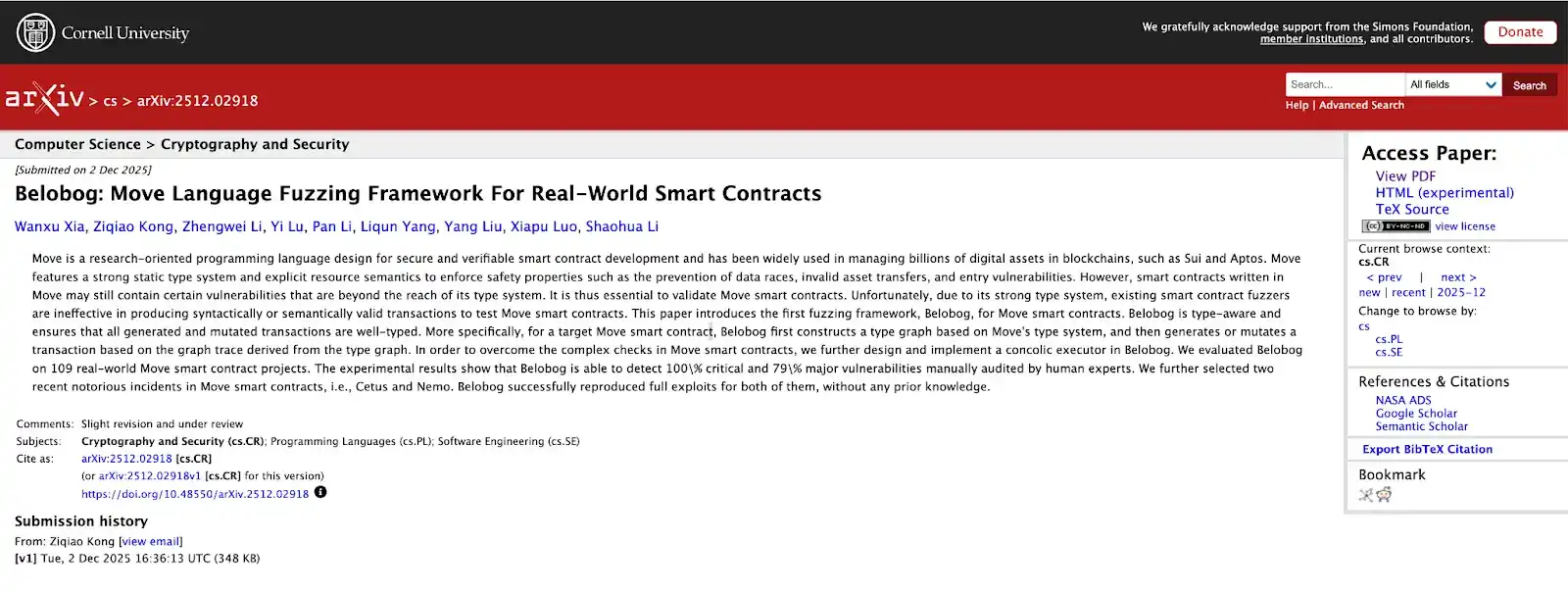
《Belobog: Move Language Fuzzing Framework For Real-World Smart Contracts》

arXiv:2512.02918 (Preprint)

Paper Link:https://arxiv.org/abs/2512.02918

This paper is currently published on arXiv as a preprint, its significance is to allow the community to see research progress faster and receive feedback. We are submitting this work to PLDI’26 and awaiting the peer review process. After the submission result is confirmed and peer review is completed, we will also share relevant updates promptly.
Making Fuzzing Truly "Run Into" Move: From Random Trial and Error to Type-Guided Exploration

Belobog's core idea is straightforward: since Move's type system is its fundamental constraint, fuzzing should use types as a guide, not an obstacle.

Traditional approaches often rely on random generation and mutation, but on Move, this quickly produces a large number of invalid samples: type mismatches, unreachable resources, parameters that cannot be correctly constructed, call chains with blocking points—what you end up with is not test coverage, but a pile of "failures at the starting line."

Belobog's method is more like giving the Fuzzer a "map." It starts from Move's type system, constructs a type graph based on type semantics for the target contract, and then uses this graph to generate or mutate transaction sequences. In other words, it doesn't blindly stitch calls together but constructs more reasonable, more executable, and更容易深入状态空间的调用组合 (easier to深入 state space call combinations) along type relationships.

For security research, the benefit this change brings is not a "fancier algorithm," but a very simple yet crucial gain:
Higher proportion of valid samples, higher exploration efficiency, and a better chance of reaching the deep paths where real vulnerabilities often appear.

Facing Complex Constraints: Belobog Introduces Concolic Execution to "Push Open the Door"

In real Move contracts, critical logic is often surrounded by layers of checks, assertions, and constraints. If you only rely on traditional mutation, you easily keep bumping at the door: the conditions are never met, the branches are never entered, the state is never reached.

To solve this problem, Belobog further designed and implemented concolic execution (a hybrid of concrete execution + symbolic reasoning). Simply put:

It maintains concrete execution that "can run," while on the other hand, it uses symbolic reasoning to more directionally approximate those branch conditions, thereby more effectively penetrating complex checks and advancing coverage depth.

This is particularly important for the Move ecosystem because the "sense of security" in Move contracts is often built on multiple layers of constraints, and the real problems often hide in the gaps after these constraints intersect. What Belobog wants to do is push testing near these gaps.

Aligning with the Real World: Not Just Running Demos, But Approaching Real Attack Paths

We don't want this kind of work to stop at "being able to run demos." Belobog's evaluation directly targets real projects and real vulnerability findings. According to the experimental results in the paper: Belobog was evaluated on 109 real-world Move smart contract projects. The experimental results show that Belobog was able to detect 100% of the Critical vulnerabilities and 79% of the Major vulnerabilities confirmed by manual security expert audits.

More notably: Without relying on prior vulnerability knowledge, Belobog was able to reproduce full exploits in real on-chain incidents. The value of this capability lies in the fact that it更接近我们在现实攻防里面对的情况 (closer to the situations we face in real-world offense/defense): attackers succeed not through "single-point function errors" but through complete paths and state evolution.

What This Work Aims to Express is Not Just "Making a Tool"

This paper is worth reading not only because it proposes a new framework, but because it represents a more pragmatic direction: abstracting frontline security experience into reusable methods and落地 (grounding) it with verifiable engineering implementations.

We believe the significance of Belobog lies not in being "yet another Fuzzer," but in making Fuzzing on Move closer to reality—able to run in, go deep, and align more closely with real attack paths. Belobog is not a closed tool designed for a few security experts, but a developer-friendly framework: it strives to lower the barrier to entry, allowing developers to continuously integrate security testing into their familiar development workflow, rather than making Fuzzing a one-time, after-the-fact task.

We will also release Belobog as open source, hoping it becomes infrastructure that the community can collectively use, extend, and evolve, rather than remaining an experimental project at the "tool level."

Paper (Preprint):https://arxiv.org/abs/2512.02918
(This work is also currently submitted to PLDI’26, awaiting peer review.)

About MoveBit

MoveBit (Mobi Security), a sub-brand under BitsLab, is a blockchain security company focused on the Move ecosystem, aiming to make the Move ecosystem the most secure Web3 ecosystem by pioneering the use of formal verification. MoveBit has successively cooperated with many well-known global projects and provided partners with comprehensive security audit services. The MoveBit team consists of security experts from academia and industry leaders with 10 years of security experience, having published security research results at top international security academic conferences such as NDSS and CCS. Moreover, they are early contributors to the Move ecosystem, working with Move developers to establish standards for secure Move applications.


Preguntas relacionadas

QWhat is the main challenge that traditional fuzzing tools face when applied to Move smart contracts?

ATraditional fuzzing tools struggle with generating transaction sequences that are both 'type-correct' and 'semantically reachable' in Move. Due to Move's strong type system and resource semantics, random generation and mutation produce a high volume of invalid samples, such as type mismatches, unreachable resources, and incorrectly constructed parameters. This results in many calls failing immediately, preventing deep branch coverage and making it difficult to reach critical states where real vulnerabilities often lie.

QHow does Belobog's approach differ from traditional fuzzing methods for smart contracts?

ABelobog uses Move's type system as a guide rather than an obstacle. It constructs a type graph based on the semantic relationships within the target contract and uses this graph to generate or mutate transaction sequences. This approach ensures that calls are constructed along type relationships, making them more reasonable, executable, and capable of penetrating deeper into the state space, unlike traditional methods that rely on blind, random splicing of calls.

QWhat technique does Belobog employ to handle complex constraints and branch conditions in Move contracts?

ABelobog employs concolic execution (a hybrid of concrete execution and symbolic reasoning). It maintains concrete execution to keep the program running' while using symbolic derivation to directionally approach branch conditions. This allows it to more effectively penetrate complex checks, such as assertions and constraints, and advance coverage depth, which is crucial for uncovering vulnerabilities hidden behind layered security checks in Move contracts.

QWhat were the key results of Belobog's evaluation on real-world Move smart contracts?

AIn an evaluation on 109 real-world Move smart contract projects, Belobog was able to detect 100% of the Critical vulnerabilities and 79% of the Major vulnerabilities that were confirmed by manual security audits. Notably, without relying on prior vulnerability knowledge, Belobog could also replicate full attack exploits (full exploits) from real on-chain incidents, demonstrating its ability to uncover complex attack paths that involve state evolution and multiple steps.

QHow does the Belobog team plan to release the framework, and what is its intended impact on the community?

AThe Belobog team plans to release the framework as open source. The goal is to make it a developer-friendly infrastructure that the community can collectively use, extend, and evolve, rather than keeping it as an experimental tool. By lowering the barrier to entry, it aims to integrate security testing seamlessly into developers' familiar workflows, promoting continuous security assessment rather than one-off, post-development audits.

Lecturas Relacionadas

El precio del token se dispara un 300% en 2 semanas, ¿en qué está apostando Backpack?

**Backpack lanza servicios de corretaje de acciones y tokenización, impulsando el precio de BP.** El token BP de Backpack Exchange ha experimentado un aumento del 300% en dos semanas, alcanzando un máximo de 0,48 USD. Este repunte está respaldado por el lanzamiento de **Backpack Securities**, una plataforma que ofrece servicios de corretaje de acciones estadounidenses regulados y permite la tokenización de activos tradicionales en Solana. Un hito clave fue la introducción de **SPCX**, un producto tokenizado vinculado 1:1 con acciones de SpaceX, que generó un volumen de operaciones en cadena superior a 86 millones de USD en su primer día. La iniciativa conecta los mercados de acciones tradicionales con DeFi en Solana, alineándose con la narrativa de RWA (activos del mundo real). La economía del token BP incluye un suministro total de 1.000 millones, distribuido en tres fases. La emisión inicial se asignó íntegramente a la comunidad mediante airdrops, sin asignaciones para el equipo o inversores. Los usuarios que hacen staking de BP durante al menos un año obtienen derechos para convertir tokens en acciones de la empresa en caso de una OPI o adquisición. Actualmente, alrededor del 66% de los tokens en circulación están en staking. A pesar de algunas críticas iniciales sobre la distribución de airdrops, el enfoque se ha desplazado hacia la expansión real de la plataforma. Los activos bajo custodia de Backpack han vuelto a alcanzar los 390 millones de USD, reflejando una creciente confianza en su modelo híbrido entre finanzas tradicionales y cripto.

Foresight NewsHace 17 min(s)

El precio del token se dispara un 300% en 2 semanas, ¿en qué está apostando Backpack?

Foresight NewsHace 17 min(s)

Cuatro preguntas sobre la vulnerabilidad de Zcash Orchard: ¿Fue explotada? ¿Se pueden recuperar los fondos? ¿Es verificable la oferta? ¿Hay otras?

El reciente fallo en el protocolo Orchard de Zcash ha planteado cuatro cuestiones clave sobre la seguridad y la integridad de la red. En primer lugar, aunque no se puede descartar por completo, se considera improbable que la vulnerabilidad haya sido explotada debido a su detección proactiva por investigadores especializados y la rápida respuesta de los desarrolladores. En segundo lugar, se cree que los fondos legítimos en Orchard son recuperables, aunque los usuarios más cautelosos pueden optar por trasladarlos, asumiendo riesgos adicionales como la pérdida de privacidad o dependencia de configuraciones de confianza. Actualmente, los usuarios no pueden verificar de forma independiente si el suministro total de ZEC ha sido manipulado. Sin embargo, la próxima actualización de red, Ironwood, solucionará este problema al sellar el grupo Orchard, impidiendo nuevas entradas y permitiendo solo salidas controladas. Esto restaurará la capacidad de cualquier nodo para verificar que se cumple el límite de suministro del protocolo. Por último, revisiones exhaustivas continuas por múltiples equipos, asistidas por herramientas de IA avanzadas, no han detectado otras vulnerabilidades de falsificación similares, lo que aumenta la confianza en la solidez del sistema. En conclusión, aunque se evalúa que los fondos y el suministro actuales son seguros, la actualización Ironwood es crucial para devolver a los usuarios la capacidad de verificación autónoma, fundamento de la credibilidad a largo plazo de Zcash.

marsbitHace 26 min(s)

Cuatro preguntas sobre la vulnerabilidad de Zcash Orchard: ¿Fue explotada? ¿Se pueden recuperar los fondos? ¿Es verificable la oferta? ¿Hay otras?

marsbitHace 26 min(s)

¿Una 'crisis de las hipotecas subprime' de la IA? Una deuda oculta de 1,8 billones de dólares se acumula en la sombra bajo la ola de euforia

En medio del frenesí por la infraestructura de IA, se está acumulando una deuda oculta de 1,8 billones de dólares en compromisos fuera de balance, según un informe de Morgan Stanley. Esto incluye cerca de 1 billón en compromisos de compra, más de 800.000 millones en contratos de arrendamiento no activados y acuerdos de financiación a proveedores. El apalancamiento de los grandes hyperscalers (Amazon, Meta, Google, Microsoft, Oracle) se ha disparado de 0,9x a 1,8x en dos trimestres, superando al sector energético. Su gasto de capital crece más rápido que los ingresos y el flujo de caja libre, que para algunos se acercará a cero en 2026. Además, estructuras financieras opacas mediante vehículos de propósito especial (SPV) trasladan el riesgo a la cadena de suministro y al crédito privado. Un riesgo clave es el "acantilado de depreciación": más de 520.000 millones de dólares en depreciación acumulada en tres años para cuatro grandes tecnológicas, una vez que los activos en construcción entren en operación. El informe concluye que el riesgo inmediato no es de insolvencia, sino de desfases temporales entre la inversión y la monetización, y una falta de transparencia. Si la demanda de IA no cumple las expectativas o los clientes migran a alternativas más baratas, todo el sistema financiero construido a su alrededor afrontará una prueba de resistencia extrema.

marsbitHace 37 min(s)

¿Una 'crisis de las hipotecas subprime' de la IA? Una deuda oculta de 1,8 billones de dólares se acumula en la sombra bajo la ola de euforia

marsbitHace 37 min(s)

Trading

Spot
Futuros

Artículos destacados

Cómo comprar BILL

¡Bienvenido a HTX.com! Hemos hecho que comprar Billions Network (BILL) sea simple y conveniente. Sigue nuestra guía paso a paso para iniciar tu viaje de criptos.Paso 1: crea tu cuenta HTXUtiliza tu correo electrónico o número de teléfono para registrarte y obtener una cuenta gratuita en HTX. Experimenta un proceso de registro sin complicaciones y desbloquea todas las funciones.Obtener mi cuentaPaso 2: ve a Comprar cripto y elige tu método de pagoTarjeta de crédito/débito: usa tu Visa o Mastercard para comprar Billions Network (BILL) al instante.Saldo: utiliza fondos del saldo de tu cuenta HTX para tradear sin problemas.Terceros: hemos agregado métodos de pago populares como Google Pay y Apple Pay para mejorar la comodidad.P2P: tradear directamente con otros usuarios en HTX.Over-the-Counter (OTC): ofrecemos servicios personalizados y tipos de cambio competitivos para los traders.Paso 3: guarda tu Billions Network (BILL)Después de comprar tu Billions Network (BILL), guárdalo en tu cuenta HTX. Alternativamente, puedes enviarlo a otro lugar mediante transferencia blockchain o utilizarlo para tradear otras criptomonedas.Paso 4: tradear Billions Network (BILL)Tradear fácilmente con Billions Network (BILL) en HTX's mercado spot. Simplemente accede a tu cuenta, selecciona tu par de trading, ejecuta tus trades y monitorea en tiempo real. Ofrecemos una experiencia fácil de usar tanto para principiantes como para traders experimentados.

266 Vistas totalesPublicado en 2026.05.07Actualizado en 2026.06.02

Cómo comprar BILL

Qué es ATWO

I. Introducción al ProyectoArena Two es una plataforma interactiva descentralizada que permite a los aficionados desempeñar un papel activo y tokenizado en los resultados de eventos en tiempo real. A diferencia de los modelos de transmisión tradicionales que reducen a los aficionados a espectadores pasivos, Arena Two aprovecha la tecnología blockchain para permitir que los aficionados voten directamente en tiempo real e influyan en los resultados en el campo.II. Información del TokenNombre del token: ATWO (Arena Two)III. Enlaces RelacionadosSitio web: https://arenatwo.com/Exploradores: https://basescan.org/token/0x499D35eBE6cEe9B2Ac35Fd003fcBbeeB9CFc7B32Twitter: https://x.com/arenatwoXNota: La introducción al proyecto proviene de los materiales publicados o proporcionados por el equipo oficial del proyecto, que es solo para referencia y no constituye asesoramiento de inversión. HTX no se hace responsable de ninguna pérdida directa o indirecta resultante.

215 Vistas totalesPublicado en 2026.05.18Actualizado en 2026.06.02

Qué es ATWO

Cómo comprar ATWO

¡Bienvenido a HTX.com! Hemos hecho que comprar Arena Two (ATWO) sea simple y conveniente. Sigue nuestra guía paso a paso para iniciar tu viaje de criptos.Paso 1: crea tu cuenta HTXUtiliza tu correo electrónico o número de teléfono para registrarte y obtener una cuenta gratuita en HTX. Experimenta un proceso de registro sin complicaciones y desbloquea todas las funciones.Obtener mi cuentaPaso 2: ve a Comprar cripto y elige tu método de pagoTarjeta de crédito/débito: usa tu Visa o Mastercard para comprar Arena Two (ATWO) al instante.Saldo: utiliza fondos del saldo de tu cuenta HTX para tradear sin problemas.Terceros: hemos agregado métodos de pago populares como Google Pay y Apple Pay para mejorar la comodidad.P2P: tradear directamente con otros usuarios en HTX.Over-the-Counter (OTC): ofrecemos servicios personalizados y tipos de cambio competitivos para los traders.Paso 3: guarda tu Arena Two (ATWO)Después de comprar tu Arena Two (ATWO), guárdalo en tu cuenta HTX. Alternativamente, puedes enviarlo a otro lugar mediante transferencia blockchain o utilizarlo para tradear otras criptomonedas.Paso 4: tradear Arena Two (ATWO)Tradear fácilmente con Arena Two (ATWO) en HTX's mercado spot. Simplemente accede a tu cuenta, selecciona tu par de trading, ejecuta tus trades y monitorea en tiempo real. Ofrecemos una experiencia fácil de usar tanto para principiantes como para traders experimentados.

212 Vistas totalesPublicado en 2026.05.18Actualizado en 2026.06.02

Cómo comprar ATWO

Discusiones

Bienvenido a la comunidad de HTX. Aquí puedes mantenerte informado sobre los últimos desarrollos de la plataforma y acceder a análisis profesionales del mercado. A continuación se presentan las opiniones de los usuarios sobre el precio de A (A).

活动图片