Lighter TGE Imminent: Full Overview of Timeline, On-Chain Signals, and Market Pricing

Odaily星球日报Publicado a 2025-12-24Actualizado a 2025-12-24

Resumen

Lighter, a perpetual contract trading platform built on Ethereum L2, is expected to undergo its Token Generation Event (TGE) soon, with market speculation pointing to a window between December 24 and January 1. Key signals include its recent addition to Coinbase's listing roadmap, a Binance perpetual futures pre-market listing, and on-chain movements of 250 million LIT tokens (25% of total supply) suspected to be for airdrop distribution. Data from DeFiLlama shows Lighter leading the Perp DEX sector with $232.3B in trading volume over the past 30 days and a TVL exceeding $1.4B. The project distinguishes itself by leveraging Ethereum's ecosystem rather than building an independent L1, aiming to combine CEX efficiency with DEX security. Pre-market trading on Binance values LIT at around $3.2, implying a fully diluted valuation (FDV) of approximately $3.2B. Market analysts project a range of potential valuations: a bear case of $1.5B FDV ($1.5 per token), a base case of $3B–$4.2B FDV, and a bullish scenario of $7.5B–$12.5B FDV. Users are advised to monitor official announcements closely, as the team is currently reviewing Sybil and wash-trading activities before final airdrop distribution.

Original | Odaily Planet Daily (@OdailyChina)

Author | Asher (@Asher_ 0210)
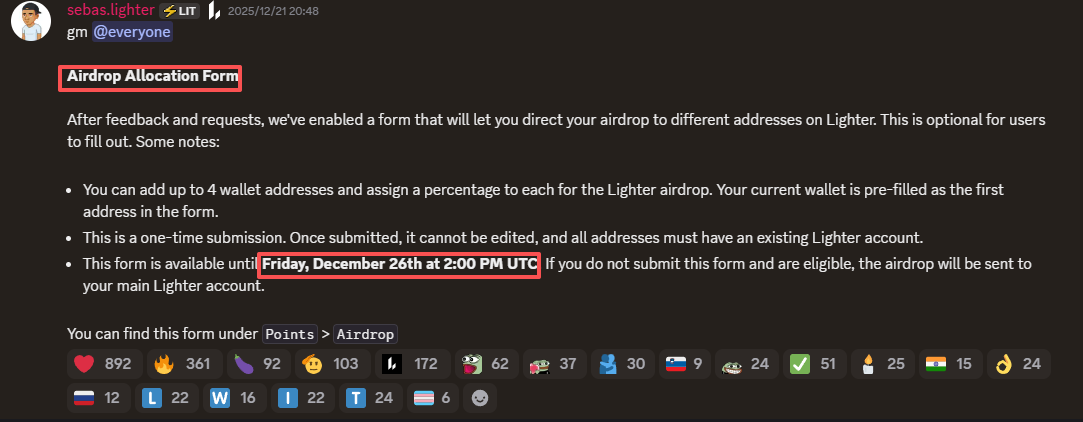
On December 13, Coinbase Markets announced on platform X that Lighter had been added to its listing roadmap; On December 21, Lighter officially announced on Discord, requiring users to complete airdrop address registration by December 26; On December 23, Binance launched Lighter (LIT) perpetual contract pre-market trading. With multiple key milestones landing in quick succession, market expectations for Lighter's imminent Token Generation Event (TGE) have rapidly heated up.
On-chain data further confirms this judgment. On December 20, the Lighter token contract transferred 250 million LIT to a new address (0x98e7769167194A8Cf272B649319676bE84052b5f); This morning, this address has already distributed varying amounts of tokens to 20 addresses, with the highest single transaction being approximately 3.1 million tokens and the lowest about 9,820 tokens. It currently still holds about 230 million LIT. Although the official use of this batch of tokens has not been disclosed, the community widely speculates it may be for airdrop-related distribution.

It is worth noting that 250 million LIT恰好 exactly accounts for 25% of the total token supply,高度 consistent with the community's previous猜测猜测 about "25% allocated for airdrops," further strengthening the market's judgment that Lighter is about to complete its TGE.

Lighter token contract transfers 250 million LIT to a new address

Regarding the timeline expectation, feedback from participants of the previous Lighter Japan AMA suggests the TGE might occur in the window from December 24 to January 1 next year; On the prediction event "When will Lighter conduct its TGE?" on Polymarket, December 29 has the highest probability, currently around 75%.
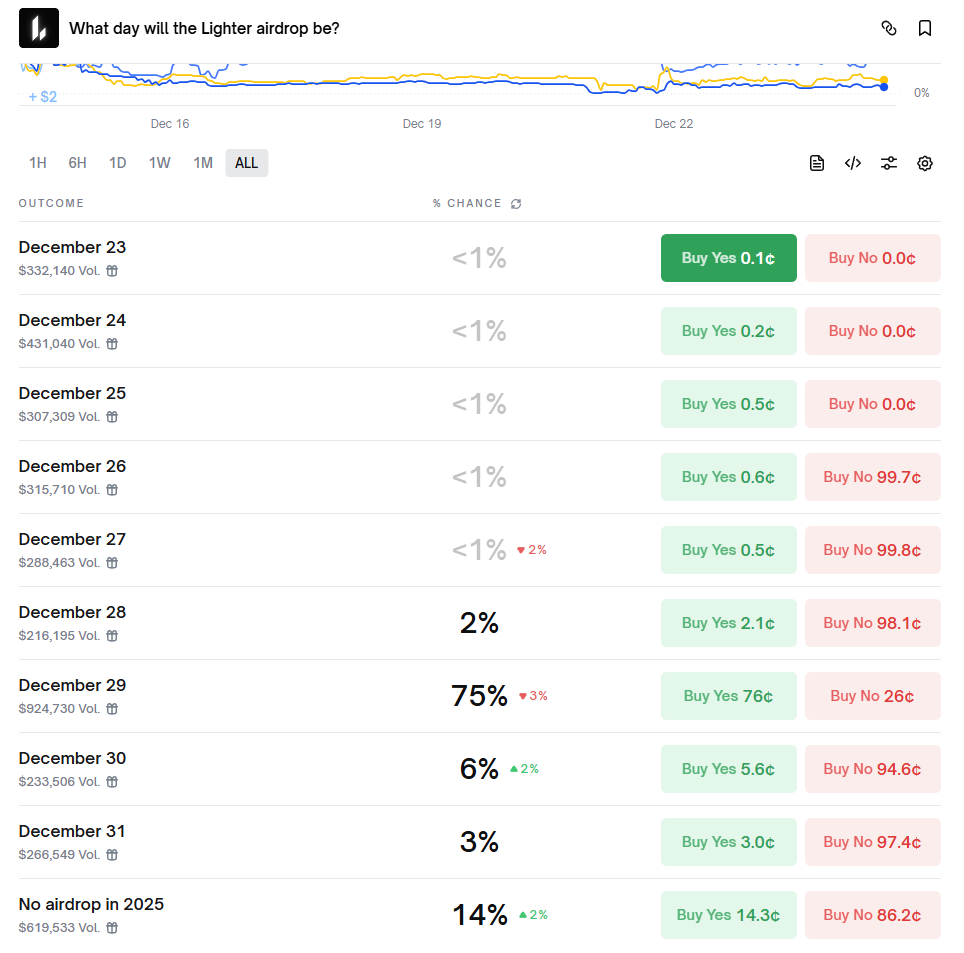
Polymarket prediction event: "On which day will Lighter conduct its TGE?"

Lighter Ranks First in Perp Dex Sector by Perpetual Contract Volume Over Past 30 Days

Lighter is a perpetual contract trading platform built on Ethereum Layer 2 (L2), aiming to combine the speed and liquidity of centralized exchanges (CEX) with the security and transparency of decentralized exchanges (DEX).

According to DeFiLlama data, over the past 30 days, Lighter led the Perp Dex sector with approximately $232.3 billion in perpetual contract trading volume, ahead of Aster ($195.5 billion) and Hyperliquid ($182 billion).

Perp Dex sector perpetual contract trading volume ranking

Furthermore, Lighter's TVL has continued to rise in recent months, currently surpassing $1.4 billion, exceeding Aster's ($1.27 billion).
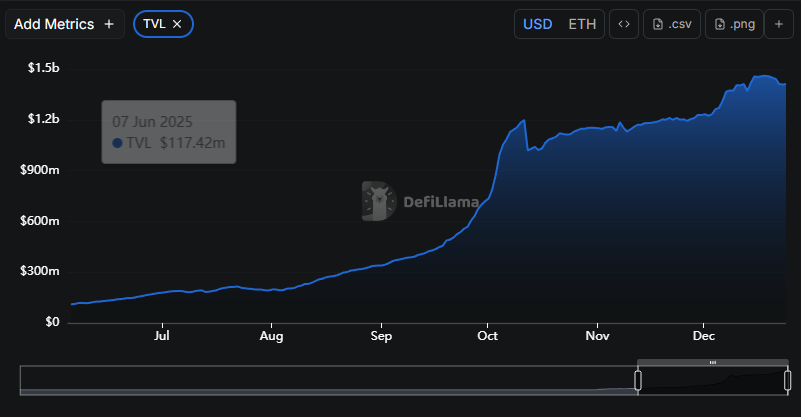
Lighter TVL Data

If Aster's backer is Binance, then Lighter's backer is Ethereum. As Lighter CEO Vladimir Novakovski previously commented on platform X, “Being an L1 is a bug, not a feature.”
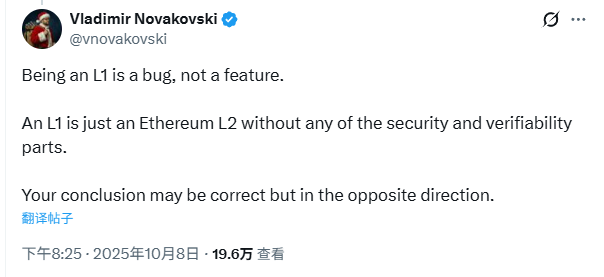
Lighter CEO comments on Lighter's choice of a modular L2 route

Instead of choosing a closed architecture like HyperLiquid's self-built L1, Lighter adopts a core route of "Ethereum-native composability": LLP Tokens can circulate on the mainnet and synergize with DeFi protocols like Aave, thus enjoying a low-cost, low-latency, verifiable execution environment within an open ecosystem. In other words, Lighter's goal is to allow any protocol to reuse its matching engine and capital system. Lighter is not meant to replace Ethereum, but to evolve with Ethereum, becoming the underlying engine for high-performance on-chain finance.

Lighter Valuation and Pre-Market Pricing

Based on Binance's perpetual contract pre-market trading, the LIT price has slowly declined from an initial $3.9 to a current quote of $3.2. At the current price, Lighter's Fully Diluted Valuation (FDV) is approximately $3.2 billion.

If 25% of the total token supply is entirely used for future airdrops, and given a total of 12 million points, then each point corresponds to approximately 20.8 LIT. Estimated at the current pre-market price, each point is worth about $66.

Market Participants' Valuation Range Estimates

Crypto KOL ingalvarez.sol (@ingalvarezsol) predicted Lighter's valuation by combining factors from Polymarket, OTC point prices, and the pre-market LIT token price:

  • $1.5 billion Minimum valuation under pessimistic conditions, corresponding to a token price of ~$1.5;
  • $3–4.2 billion: Bear market benchmark range, corresponding to a token price of ~$3 to $4;
  • $7.5–12.5 billion: Optimistic scenario, corresponding to a token price of ~$7.5 to $12.5;

Another early Lighter user, Chuk (@chuk_xyz), also made predictions based on Lighter's TVL, trading volume, revenue, and other data:

  • Bear Market Range ($1.5B–$4.2B FDV): If the price operates within this range post-TGE, it can be seen as an opportunity zone. The psychological pressure on airdrop holders is lowest, and the risk-reward ratio is clearest.
  • Benchmark Range ($4.2B–$7.5B FDV): If Lighter can stabilize its TVL and maintain a top-tier operational scale, this range can be considered fair value. After the price enters this range, it is suitable to take staged profits to break even while retaining some position.
  • Bull Market Range ($7.5B–$12.5B+ FDV): This range意味着 core catalysts have been fully priced in by the market, including strengthened RWA momentum and consensus formed around the distribution narrative (fintech/broker alignment). This stage is more suitable for continuously reducing positions during the upward trend.

On the Polymarket prediction event "Lighter FDV one day after opening," the probability of exceeding $1 billion FDV is as high as 88%, and the probability of exceeding $2 billion FDV is also 83%.
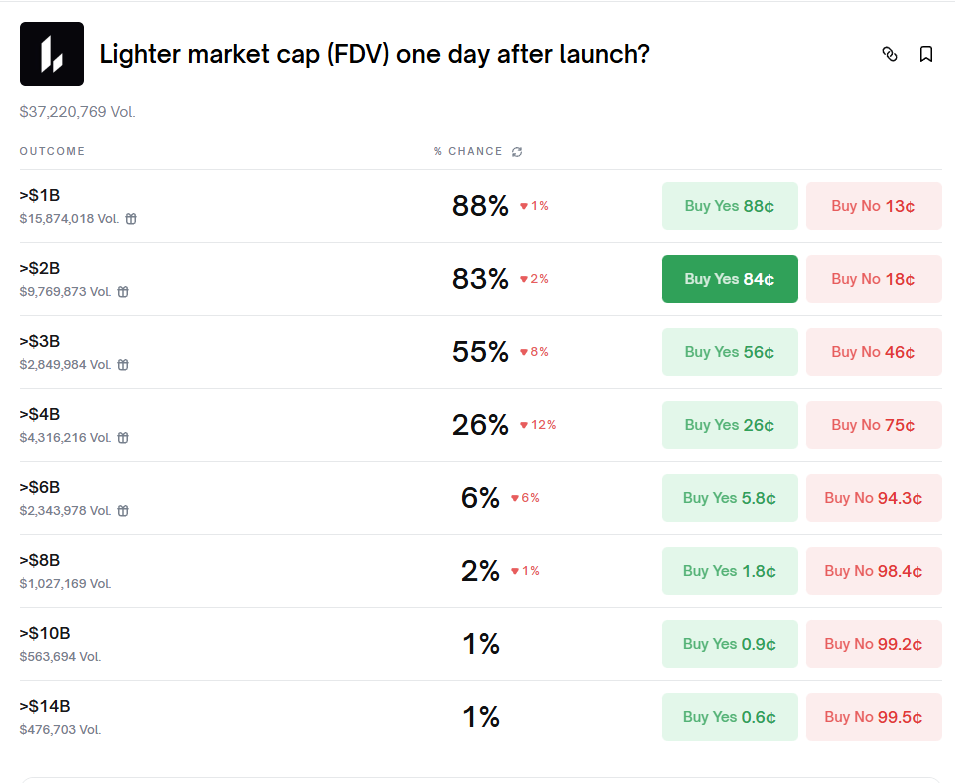
Polymarket event: "Lighter FDV one day after opening"

In summary, the market's minimum expectation for Lighter's opening valuation is an FDV of $1.5 billion, corresponding to a token price of $1.5. Therefore, if the opening price pulls back, $1.5 is an ideal short-term entry price.

Do Not "Celebrate at Halftime," Closely Monitor Official Announcements

Early participants in Lighter interactions must not "celebrate at halftime"; points cannot be considered profit until they are converted into actual LIT tokens. According to the latest announcement from Lighter on their official Discord, "We have entered the final stage of the second season points event. Data analysis is currently underway to remove points obtained by sybil addresses, self-trading, and wash trading. All slashed points (including portions already removed) will be redistributed to the community."

Latest announcement from Lighter on official Discord


Preguntas relacionadas

QWhat is the expected TGE (Token Generation Event) date for Lighter based on market predictions?

ABased on Polymarket predictions, the highest probability (around 75%) is for the TGE to occur on December 29th. Other community feedback suggests a window between December 24th and January 1st.

QWhat is the significance of the 250 million LIT tokens transferred to a new address on December 20th?

AThe transfer of 250 million LIT tokens, which is 25% of the total supply, is widely speculated by the community to be for airdrop distribution, aligning with previous rumors about the airdrop allocation.

QHow does Lighter's trading volume rank in the Perp DEX sector over the past 30 days?

AAccording to DeFiLlama data, Lighter ranked first in the Perp DEX sector for perpetual contract trading volume over the past 30 days, with approximately $232.3 billion, ahead of Aster and Hyperliquid.

QWhat is the current pre-market price of LIT on Binance and what is the corresponding Fully Diluted Valuation (FDV)?

AThe pre-market price of LIT on Binance is currently around $3.2, which corresponds to a Fully Diluted Valuation (FDV) of approximately $3.2 billion.

QWhat is the core architectural philosophy behind Lighter, as stated by its CEO?

ALighter's CEO, Vladimir Novakovski, stated that 'Being an L1 is a bug, not a feature.' Lighter is built as a modular Layer 2 on Ethereum, aiming to combine CEX-like speed and liquidity with DEX-like security and transparency, and to integrate natively with the Ethereum ecosystem.

Lecturas Relacionadas

Near vuelve al escenario de la IA: la transformación en cadena pública por problemas para pagar salarios, y los agentes y la privacidad como nueva narrativa de crecimiento

**Resumen: Near regresa a la IA: De una cadena de bloques por problemas de pago a Agentes y privacidad como nueva narrativa** Near, fundada por Illia Polosukhin, coautor del influyente artículo "Transformer" de IA, nació de manera inesperada en 2017. La razón original fue pragmática: una startup de IA que Polosukhin cofundó tuvo que pausar su trabajo en "síntesis de programas" (enseñar a máquinas a escribir código) debido a la dificultad de pagar a desarrolladores remotos en todo el mundo. Ante sistemas de pago transfronterizos ineficientes, él y su cofundador decidieron construir su propia cadena de bloques escalable y de bajo costo: Near. Aunque Near ganó tracción como cadena de alto rendimiento, su momento crucial llegó con el auge actual de la IA. La participación de Polosukhin en eventos como el GTC de Nvidia volvió a poner el foco en su legado en IA. Near ha reposicionado su tecnología hacia dos áreas clave: 1. **Near Intents (Intenciones):** Este sistema abstrae la complejidad de las transacciones entre cadenas. Los usuarios (o futuros Agentes de IA) solo declaran su objetivo (ej. "intercambiar BTC por ETH"), y una red de "solvers" (solucionadores) encuentra y ejecuta la mejor ruta, manejando los costos de gas de fondo. Esta capa ha procesado más de **200.000 millones de dólares** en volumen y generado **más de 34 millones** en tarifas, integrada en 25 cadenas. 2. **Transacciones Privadas:** Near ha lanzado funciones de "Intenciones Confidenciales" e "Intercambios Confidenciales" que ocultan los detalles de las operaciones (monto, dirección) hasta su liquidación. Esto protege a los grandes traders del "MEV" y del deslizamiento. Sorprendentemente, este tipo de transacciones ya representa **más del 40%** del volumen reciente en Near, mostrando una fuerte demanda, pero también planteando posibles desafíos regulatorios en el futuro. En resumen, Near ha vuelto a sus raíces en IA, aprovechando su tecnología de cadena abstracta para facilitar la economía de los Agentes de IA y abordando la creciente demanda de privacidad en DeFi, mientras navega por las oportunidades y riesgos de este nuevo capítulo.

marsbitHace 46 min(s)

Near vuelve al escenario de la IA: la transformación en cadena pública por problemas para pagar salarios, y los agentes y la privacidad como nueva narrativa de crecimiento

marsbitHace 46 min(s)

De Ethereum a la IA, 'CROPS': ¿Qué son estas 'variables lentas' que Vitalik enfatiza repetidamente?

En las últimas semanas, Vitalik Buterin ha destacado repetidamente el concepto CROPS, definido en el mandato de la Fundación Ethereum (EF Mandate) como los principios rectores fundamentales para Ethereum: Resistencia a la Censura, Resistencia a la Captura, Código Abierto, Privacidad y Seguridad. Más que un lema, CROPS constituye un marco estratégico que orienta el desarrollo de Ethereum hacia la soberanía del usuario, la descentralización robusta y la sostenibilidad a largo plazo, priorizando estos valores sobre mejoras puramente transaccionales como velocidad y costes. La relevancia de CROPS se amplifica con el auge de la IA. A medida que los agentes de IA se integran en billeteras y automatizan operaciones financieras, surge un riesgo crítico: los usuarios podrían ceder el control sobre sus activos, datos e identidad a plataformas centralizadas de IA. Vitalik vincula así "CROPS Ethereum" con "CROPS AI", planteando la necesidad de un ecosistema donde el acceso a la cadena de bloques y la ejecución de modelos de IA sean privados, verificables y resistentes a la censura. Propone soluciones como llamadas remotas a LLM pagadas con pruebas de conocimiento cero (ZK) y lecturas confidenciales de RPC para proteger la privacidad del usuario. En esencia, CROPS trasciende a Ethereum para abordar una cuestión central de la era digital: cómo preservar la autonomía y seguridad del usuario frente a sistemas cada vez más poderosos y potencialmente opacos. Este enfoque podría redefinir el diseño de billeteras y la experiencia de interacción en Web3, posicionando la privacidad, la apertura y el control verificable como pilares esenciales para el futuro.

marsbitHace 56 min(s)

De Ethereum a la IA, 'CROPS': ¿Qué son estas 'variables lentas' que Vitalik enfatiza repetidamente?

marsbitHace 56 min(s)

Token no es económico, economía no es Token

La industria de la IA se encuentra en un punto de inflexión, transitando desde una narrativa centrada en la innovación tecnológica hacia un enfoque dominado por la eficiencia del capital. Dos tendencias clave definen este cambio: la escasez de financiación y la escisión de activos por parte de los grandes conglomerados. La competencia actual se ha transformado en una carrera de activos pesados por la potencia de cálculo (compute), con costos operativos que escalan junto con el uso, un modelo "anti-internet" donde más usuarios significan mayores pérdidas. Este problema se ve agravado por prácticas de "contabilidad circular", como los acuerdos de créditos en la nube entre empresas, que inflan los ingresos sin generar flujo de caja real. La desconexión entre las valoraciones y los flujos de efectivo plantea un desafío estructural para el modelo de negocio. Paralelamente, grandes empresas como Baidu, Alibaba, ByteDance y Kuaishou están escindiendo sus unidades de IA (por ejemplo, Kling/Kunlunxin). Estos activos, valorados mucho más alto una vez independientes, pasan de ser vistos como "centros de coste" dentro del grupo a "centros de valor" en el mercado. La lógica cambia: mientras que en los estados financieros consolidados se miden por su impacto en los beneficios, como empresas independientes se valoran por su potencial de crecimiento futuro, su escasez en el mercado y su capacidad para atraer inversión. La industria evoluciona desde la "adoración del modelo" hacia la "realización de valor". Aunque la inversión en infraestructura (con un gasto de capital previsto de 805.000 millones de dólares para 2026 en EE.UU.) es enorme, la comercialización a gran escala aún está en sus inicios. El foco se desplaza de la potencia bruta de la GPU a la eficiencia integral del sistema, donde la CPU y la orquestación determinan la rentabilidad. En 2026, la pregunta central que la industria debe responder es: ¿cuánto vale realmente esta tecnología? La respuesta definirá el panorama del poder en la IA para la próxima década.

marsbitHace 2 hora(s)

Token no es económico, economía no es Token

marsbitHace 2 hora(s)

Trading

Spot
Futuros
活动图片




