Is the Fed's Independence Shaking? Is It Bitcoin's Safe-Haven Moment?

marsbitPublicado a 2026-01-20Actualizado a 2026-01-20

Resumen

European Central Bank Chief Economist Philip Lane warns that political pressure on the Federal Reserve could undermine the dollar's global standing, potentially increasing U.S. term premiums and triggering a reassessment of dollar-denominated assets. This scenario presents two distinct macro paradigms for Bitcoin: in a traditional "yield differential" model, rising term premiums could strengthen the dollar and pressure risk assets like Bitcoin. However, in a "credibility risk" paradigm, where investors demand a governance risk premium, Bitcoin may act as a monetary escape valve, especially if inflation expectations rise. The article highlights key indicators to monitor, including term premiums, real yields, inflation expectations, the dollar index, Bitcoin ETF flows, and options positioning. Bitcoin’s sensitivity to shifts in dollar liquidity and real yields means its response to a Fed credibility shock could be more acute than traditional assets.

Original Author: Gino Matos

Original Compilation: Deep Tide TechFlow

Guide: Against the backdrop of global macroeconomic fluctuations and intensified geopolitical games, European Central Bank (ECB) Chief Economist Philip Lane issued a rare warning: The "tussle" between the Federal Reserve and political forces may endanger the international status of the US dollar.

This article delves into how such political pressure is transmitted to global financial markets through term premiums and explains why, at this moment of a shaken credit system, Bitcoin may become the last safe haven for investors.

The author combines multi-dimensional data such as US Treasury yields, inflation expectations, and the stablecoin ecosystem to break down the two截然不同的 (distinctly different) macro paradigms that Bitcoin may face in the future.

Full Text Below:

European Central Bank (ECB) Chief Economist Philip Lane issued a warning that most market participants initially viewed merely as European "housekeeping": While the ECB can currently maintain its easing path, the "tussle" around the Federal Reserve's mandate independence could lead to global market turmoil by pushing up US term premiums and triggering a reassessment of the dollar's role.

Lane's framing is crucial because it names several specific transmission channels that have the greatest impact on Bitcoin: real yields, dollar liquidity, and the credibility framework supporting the current macro system.

The immediate trigger for the recent market cooling was geopolitics. As concerns about a US strike on Iran subsided, the risk premium on crude oil weakened. At the time of writing, Brent crude fell to about $63.55, and West Texas Intermediate (WTI) fell to about $59.64, down about 4.5% from the high on January 14.

This at least temporarily cut off the chain reaction from geopolitics to inflation expectations to the bond market.

However, Lane's comments point to another risk: not a supply shock or growth data, but political pressure imposed on the Fed, which could force the market to reassess US assets based on governance factors rather than fundamentals.

The International Monetary Fund (IMF) has also emphasized in recent weeks that the Fed's independence is crucial, noting that a weakening of independence would have a "negative impact on credit ratings." This type of institutional risk often manifests in term premiums and foreign exchange risk premiums before making headlines.

The term premium is the part of long-term yields that compensates investors for uncertainty and maturity risk, independent of expected future short-term rates.

As of mid-January, the New York Fed's ACM term premium remained around 0.70%, while the St. Louis Fed's (FRED) 10-year zero-coupon valuation was about 0.59%. On January 14, the 10-year Treasury nominal yield was about 4.15%, the 10-year TIPS real yield was 1.86%, and the 5-year breakeven inflation expectation (January 15) was 2.36%.

By recent standards, these figures are in a stable range. But Lane's core point is that this stability could quickly unravel if the market begins to price a "governance discount" for US assets. A term premium shock does not require the Fed to raise rates; it can occur when credibility is damaged, pushing up long-end yields even if policy rates remain unchanged.
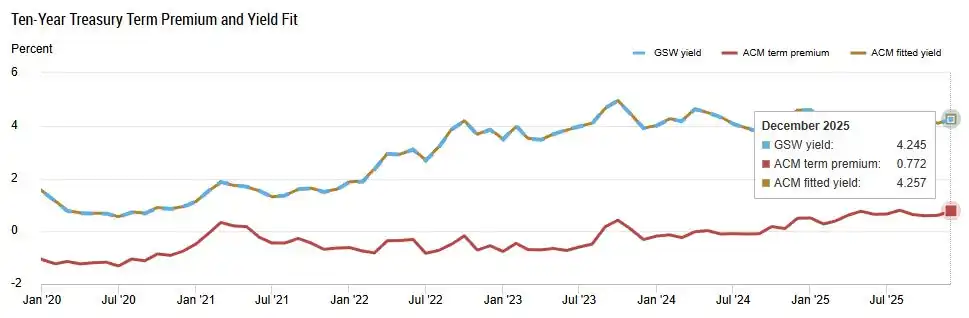
Caption: The 10-year US Treasury term premium rose to 0.772% in December 2025, the highest level since 2020, with yields reaching 4.245%.

The Term Premium Channel is the Discount Rate Channel

Bitcoin is in the same "discount rate universe" as stocks and other duration-sensitive assets.

When term premiums rise, long-end yields climb, financial conditions tighten, and liquidity premiums are compressed. ECB research documents how the dollar exchange rate appreciates with Fed tightening across multiple policy dimensions, making US interest rates the core pricing kernel for global pricing.

Bitcoin's historical upward momentum has often come from the expansion of liquidity premiums: when real yields are low, discount rates are loose, and risk appetite is high.

A term premium shock reverses this dynamic without the Fed changing the federal funds rate. This is why Lane's tone is significant for cryptocurrencies, even though he was speaking to European policymakers at the time.

On January 16, the US Dollar Index (DXY) was around 99.29, near the low end of its recent trading range. But the "reassessment of the dollar's role" mentioned by Lane opens up two截然不同的 (distinctly different) scenarios, not a single outcome.

In the traditional "yield differential" paradigm, higher US yields strengthen the dollar, tighten global liquidity, and put pressure on risk assets, including Bitcoin. Research shows that cryptocurrencies have had a stronger correlation with macro assets post-2020 and, in some samples, a negative correlation with the DXY.

But in the credibility risk paradigm, the outcome diverges: if investors demand a premium for US assets due to governance risks, term premiums could rise even as the dollar weakens or fluctuates. In this case, Bitcoin would trade more like a "pressure release valve" or alternative monetary asset, especially if inflation expectations rise alongside credibility concerns.

Furthermore, Bitcoin is now more connected to the stock market, AI narratives, and Fed signals than in previous cycles.

According to Farside Investors data, Bitcoin ETFs saw net inflows again in January, totaling over $1.6 billion. Coin Metrics points out that open interest in spot options is concentrated near the $100,000 strike price expiring at the end of January.

This positioning means that macro shocks could be amplified through leverage and Gamma dynamics, turning the abstract "term premium" concern mentioned by Lane into a concrete catalyst for market volatility.
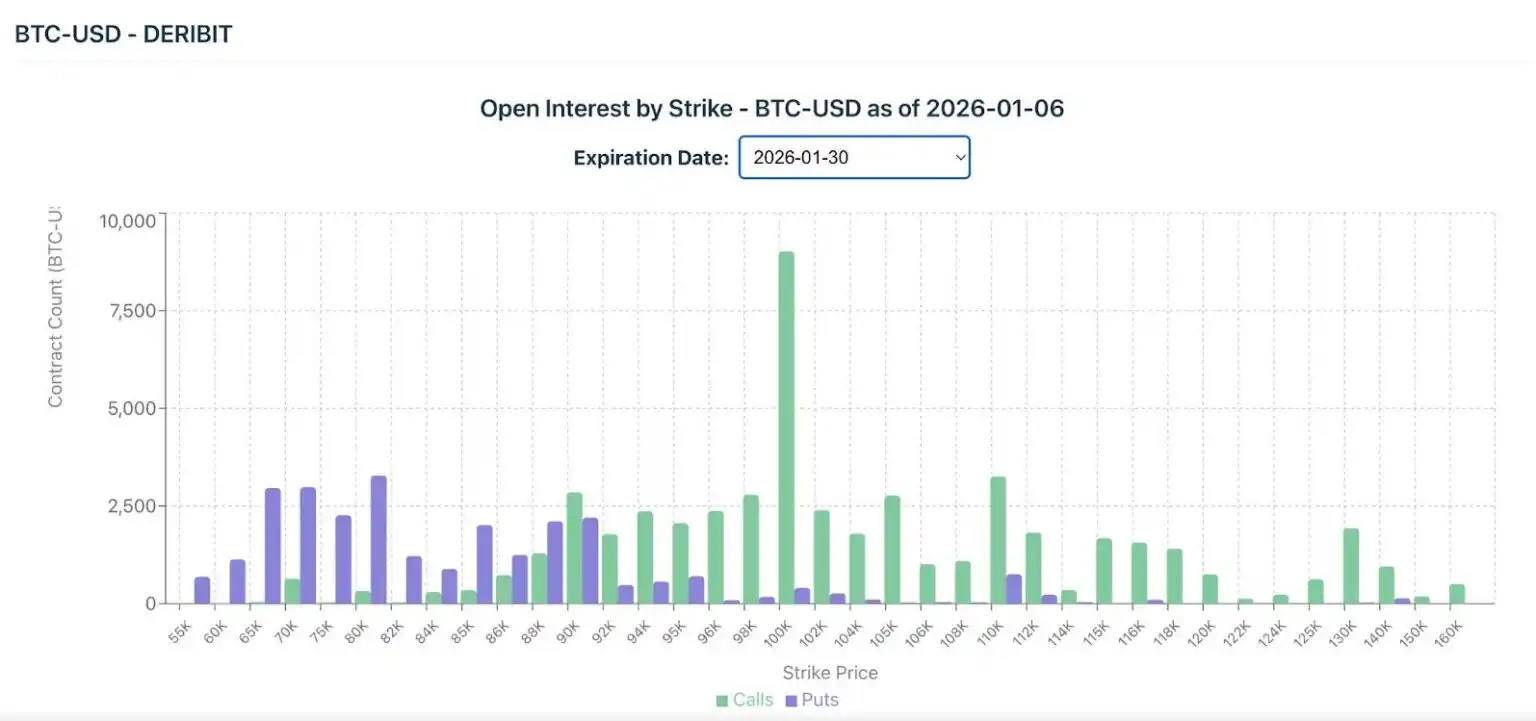
Caption: Open interest for Bitcoin options expiring on January 30, 2026, shows over 9,000 call contracts at the $100,000 strike price, the highest concentration.

Stablecoin Infrastructure Makes Dollar Risk "Crypto-Native"

A significant portion of the cryptocurrency trading layer operates on dollar-denominated stablecoins, which are backed by safe assets (typically US Treasuries).

Research from the Bank for International Settlements (BIS) links stablecoin pricing dynamics to that of safe assets. This means a term premium shock is not just some "macro vibe"; it directly permeates stablecoin yields, demand, and on-chain liquidity conditions.

When term premiums rise, the cost of holding duration increases, which could affect stablecoin reserve management and alter the liquidity available for risk trades. Bitcoin may not be a direct substitute for US Treasuries, but it exists in an ecosystem where Treasury pricing sets the benchmark for the definition of "risk-free."

Currently, the market sees about a 95% probability of the Fed holding rates steady at the January meeting, with major banks pushing their expected rate cut timing to 2026.

This consensus reflects confidence in near-term policy continuity, thereby anchoring term premiums. But Lane's warning is forward-looking: if this confidence breaks, term premiums could jump 25 to 75 basis points within weeks, without any change in the funds rate.

A mechanical example: if the term premium rises 50 basis points and expected short-term rates remain flat, the 10-year nominal yield could drift from around 4.15% to near 4.65%, with real yields repricing synchronously.

For Bitcoin, this means tighter financial conditions and brings downside risk through the same channels that squeeze high-duration stocks.

However, if triggered by a credibility shock causing dollar weakness, a completely different risk profile emerges.

If global investors begin reducing US asset holdings based on governance grounds, the dollar could weaken even as term premiums rise. In this scenario, Bitcoin's volatility would spike dramatically, and its price movement would depend on whether the yield differential paradigm or the credibility risk paradigm dominates at that time.

Although academia still debates Bitcoin's "inflation hedge" properties, in most risk regimes, the dominant channels remain real yields and liquidity, not simply breakeven inflation expectations.

Philip Lane's argument forces us to consider both possibilities simultaneously. This is why a "dollar repricing" is not a one-directional bet, but a fork in the regime road.

Watchlist

The checklist for tracking this development is clear:

At the Macro Level:

  • Term Premiums
  • 10-year TIPS Real Yields
  • 5-year Breakeven Inflation Expectations
  • US Dollar Index (DXY) Level and its Volatility

At the Crypto Level:

  • Bitcoin Spot ETF Flows
  • Options Positioning Near Key Strikes like $100,000
  • Changes in Skew Around Major Macro Events

These indicators link Lane's warning to Bitcoin's price action without speculating on the Fed's future policy decisions.

Lane's signal was initially sent to European markets, but the "pipes" he describes are the very same logic that determines Bitcoin's macro environment. The oil premium has faded, but the "governance risk" he pointed out remains.

If the market begins to price in the Fed's political tussle, this shock will by no means be confined to the US. It will be transmitted globally through the Dollar and the Yield Curve, and Bitcoin's reaction to such shocks tends to be sharper and earlier than most traditional assets.


Preguntas relacionadas

QWhat warning did ECB Chief Economist Philip Lane issue regarding the Federal Reserve?

APhilip Lane warned that the 'tussle' over the Federal Reserve's independence could lead to global market turmoil by pushing up US term premiums and triggering a reassessment of the dollar's role.

QHow might a rise in term premiums affect Bitcoin according to the article?

AA rise in term premiums could tighten financial conditions, compress liquidity premiums, and create downward pressure on Bitcoin, as it operates in the same discount rate universe as other duration-sensitive assets.

QWhat are the two distinct scenarios for Bitcoin if investors demand a premium for US assets due to governance risks?

AIn the credibility risk paradigm, Bitcoin could act as a 'release valve' or alternative monetary asset, especially if inflation expectations rise alongside governance concerns, potentially leading to volatility and a different risk profile compared to the traditional yield differential paradigm.

QWhich indicators should be monitored to assess the impact of Lane's warning on Bitcoin?

AKey indicators include term premiums, 10-year TIPS real yields, 5-year breakeven inflation expectations, the DXY level and volatility, Bitcoin ETF flows, options open interest near key strike prices like $100,000, and skew changes around macro events.

QHow do stablecoins relate to the term premium shock discussed in the article?

AStablecoins, which are dollar-denominated and backed by safe assets like US Treasuries, are directly affected by term premium shocks. This can impact stablecoin yields, demand, and on-chain liquidity conditions, as their pricing dynamics are tied to safe asset valuations.

Lecturas Relacionadas

Diálogo con Ray Dalio: Nos encontramos en una burbuja de IA actualmente, el 1% de mi cartera de inversiones está en Bitcoin

**Fuente: The Diary Of A CEO** **Resumen: Felix, PANews** Ray Dalio, fundador de Bridgewater Associates, advierte sobre una burbuja en la inteligencia artificial actual, comparable a burbujas históricas como la de Internet en 2000. Según Dalio, los signos clásicos están presentes: precios inflados, endeudamiento basado en ganancias especulativas y una posible corrección brusca si suben las tasas de interés o cambian las condiciones económicas. Dalio explica que esta burbuja se enmarca en un "gran ciclo" más amplio —de unos 80 años— caracterizado por tres dinámicas: creciente desigualdad interna, déficits fiscales gubernamentales y cambios en el orden geopolítico mundial. Estados Unidos y otros países occidentales se encuentran en una fase de declive relativo dentro de este ciclo. Para proteger la riqueza personal, Dalio recomienda diversificar las inversiones más allá del efectivo, incluyendo activos como oro, acciones y bonos. Aunque revela que alrededor del 1% de su cartera está en Bitcoin —considerándolo un activo escaso—, prefiere el oro físico por su seguridad histórica y su rol como reserva de los bancos centrales. Sobre el impacto laboral de la IA, Dalio prevé que aumentará la desigualdad, beneficiando sobre todo a los dueños de capital. Sin embargo, destaca que las habilidades humanas —como la intuición y la emoción— seguirán siendo valiosas y complementarias a la IA. En el ámbito geopolítico, Dalio anticipa un mundo más regionalizado, con EE.UU. y China como potencias líderes en sus respectivas esferas, y advierte que conflictos como el de Irán han expuesto debilidades estratégicas de Estados Unidos, acelerando un cambio en el equilibrio global de poder.

marsbitHace 47 min(s)

Diálogo con Ray Dalio: Nos encontramos en una burbuja de IA actualmente, el 1% de mi cartera de inversiones está en Bitcoin

marsbitHace 47 min(s)

¡Récord de compras netas extranjeras de 7,2 billones de wones en un solo día! Wall Street: Los vientos en contra de los flujos de capital en el mercado coreano se han disipado

La situación de los flujos de capital en el mercado de valores surcoreano está mostrando un cambio sustancial. El 31 de julio, la inversión extranjera realizó una compra neta récord de aproximadamente 7.2 billones de wones en acciones del KOSPI, marcando una reversión fundamental tras meses de importantes salidas de capital. Según análisis de Citi Research, las ventas netas mensuales de inversores extranjeros se redujeron drásticamente a 9.8 billones de wones en julio, comparado con 48.4 y 44.5 billones en junio y mayo, respectivamente. Paralelamente, los fondos de pensiones y fondos de inversión nacionales se convirtieron en compradores netos en julio (1.0 billón de wones), luego de ser vendedores netos en los dos meses anteriores. Además, la Comisión de Servicios Financieros de Corea implementó nuevas regulaciones que restringen el acceso de inversores minoristas a los ETF apalancados, lo que ha reducido significativamente su volumen de negociación y se espera que mitigue la volatilidad del mercado. Citi Research mantiene su objetivo para el KOSPI en 10,000 puntos, destacando fundamentos sólidos en el sector de chips de memoria, valoraciones históricamente bajas, una fuerte economía local y un entorno político favorable como factores de apoyo. La firma considera que los vientos en contra relacionados con los flujos de capital se están disipando, mientras que los impulsores fundamentales y políticos están ganando fuerza, creando condiciones para una mejora en el mercado.

marsbitHace 48 min(s)

¡Récord de compras netas extranjeras de 7,2 billones de wones en un solo día! Wall Street: Los vientos en contra de los flujos de capital en el mercado coreano se han disipado

marsbitHace 48 min(s)

Cómo Convertirse en Algo que la Inteligencia Artificial Jamás Podrá Reemplazar

**Resumen: Cómo ser irremplazable por la IA** Ante el temor de que la IA elimine trabajos, la solución no es resistirse, sino volverse "inempleable": un individuo autónomo que construya su propio proyecto vital y económico. El artículo critica la "esclavitud salarial"—depender de un empleo sin sentido—y propone escapar de ella desarrollando estas cinco capacidades clave: 1. **Agencia**: Capacidad de actuar sin pedir permiso. 2. **Gusto**: Criterio para discernir qué vale la pena crear. 3. **Persuasión**: Habilidad para conectar y lograr que otros valoren tu trabajo. 4. **Persistencia**: Resiliencia para ver los errores como aprendizaje. 5. **Iteración**: Proceso constante de ajuste basado en la retroalimentación. Estas habilidades se cultivan únicamente **haciendo**: creando algo propio. Se recomienda enfocarse en **crear contenido (medios)** más que solo en código, ya que el valor del contenido es subjetivo y requiere un criterio humano que la IA no puede replicar fácilmente, abriendo espacio para talentos auténticos. **Cómo empezar:** El cambio real requiere una transformación de identidad. Para ello: 1. Cambia radicalmente tu entorno (físico y digital). 2. Elige un "vehículo" (como crear contenido) que te dé retroalimentación real del mundo. 3. Dedica 15 minutos a responder preguntas introspectivas para encontrar tu "material en bruto" único y tu perspectiva contraria a la convencional. 4. **Publica tu primera idea mañana mismo.** La acción, el feedback y la iteración constante son el único camino. La conclusión es clara: en lugar de temer a la IA, conviértete en un creador que utilice todas las herramientas (incluida la IA) para construir una vida y un trabajo con significado, autonomía e impacto personal.

marsbitHace 2 hora(s)

Cómo Convertirse en Algo que la Inteligencia Artificial Jamás Podrá Reemplazar

marsbitHace 2 hora(s)

Los lanzamientos de dados mantienen las claves de Bitcoin en un modo aislado, pero no todo el mundo se molestará

El título sugiere que las claves de Bitcoin pueden almacenarse fuera de línea mediante lanzamientos de dados, aunque no todos los usuarios adoptarán este método. El artículo comienza explicando la entropía en la teoría de la información, utilizando ejemplos como monedas y dados. Tras un escándalo reciente con Coldcard, se popularizó la generación de semillas de billetera mediante dados. El texto explica que, aunque físicamente determinista, el lanzamiento es impredecible en la práctica, lo que lo hace útil para la seguridad. Se detalla cómo convertir los resultados en datos binarios, con métodos que van desde el simple "par/impar" hasta el uso de funciones hash para preservar más entropía. Para una frase de recuperación de 12 palabras (128 bits de entropía), se necesitan unos 50 lanzamientos; Coldcard recomienda 99 para mayor seguridad. La vulnerabilidad en Coldcard, relacionada con su generador de números aleatorios, puso en riesgo fondos. Las semillas generadas manualmente con dados no se vieron afectadas, pero el investigador Kevin Loaec señaló que otras funciones del dispositivo (como creación de billeteras de papel o claves de coproreseguridad) sí podían estar comprometidas, incluso si la semilla principal era segura. El artículo argumenta que, aunque técnicamente robusto, el proceso de lanzar dados es lento, propenso a errores y poco práctico para la mayoría, especialmente para nuevos usuarios. Concluye que, aunque debe ser una opción para expertos, el objetivo a largo plazo es que el hardware y software generen aleatoriedad fuerte de forma fiable y accesible. Se aconseja a los usuarios de Coldcard verificar su firmware y las funciones utilizadas, y se destaca la utilidad de las billeteras multisig con dispositivos de diferentes fabricantes para mitigar riesgos.

cryptonews.ruHace 6 hora(s)

Los lanzamientos de dados mantienen las claves de Bitcoin en un modo aislado, pero no todo el mundo se molestará

cryptonews.ruHace 6 hora(s)

Trading

Spot
活动图片




