Hyperliquid Infringement Dispute: Technological Rights Protection or Opportunistic Marketing?

marsbitPublicado a 2026-02-04Actualizado a 2026-02-04

Resumen

Hyperliquid, a high-performance decentralized exchange (DEX), faces patent infringement allegations from Cypherium, a competing RWA blockchain project. The dispute centers on US Patent 11,411,721 B2, held by Cypherium, which covers systems for dynamically selecting and reconfiguring validator committees using mechanisms like aggregated signatures and two-phase reconfiguration in a Proof-of-Stake (PoS) environment. Cypherium’s founder, Sky Guo, claims Hyperliquid’s core consensus engine, HyperCore—a custom variant of the HotStuff algorithm—illegally uses this patented technology to achieve its high throughput and sub-second finality. The controversy arises as Hyperliquid’s native token, HYPE, surged over 40% amid a broader market downturn and the launch of its new prediction market proposal, HIP-4. Critics question the timing of the allegations, noting coinciding promotions for Cypherium’s upcoming project, "G-Exchange," suggesting potential "clickbait marketing." Hyperliquid has not yet publicly responded to the legal claims. With Hyperliquid’s code remaining closed-source, external verification of the infringement is challenging. The situation highlights tensions between protecting proprietary tech and maintaining decentralization trust. Additionally, HYPE is set to unlock 9.92 million tokens (2.79% of supply) on February 6, worth approximately $357 million at current prices.

Original Author: Sanqing, Foresight News

On February 2, Hyperliquid announced that the HIP-4 proposal had gone live on the testnet on February 2. This proposal aims to build a prediction market infrastructure by introducing "Outcome Trading." Additionally, from late January to early February 2026, the cryptocurrency market showed weakness, with Bitcoin's price falling below the $75,000 mark, leading to a broad market correction. However, Hyperliquid's native token HYPE bucked the trend, rising over 40% in the past week.
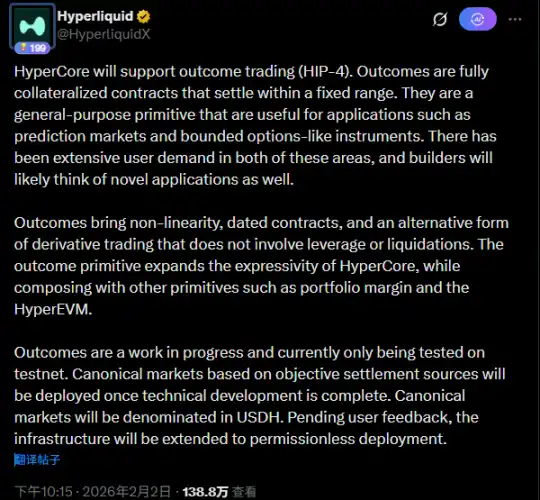
Image Source: Hyperliquid Tweet

However, as Hyperliquid expands its business, it has encountered allegations of technological infringement from a peer. On February 2, Sky Guo, founder of the RWA public chain project Cypherium, publicly accused Hyperliquid of infringing on its patented technology on social media. Sky Guo claimed that Hyperliquid's underlying consensus engine, HyperCore, uses a patented optimized version of the PoS-based HotStuff algorithm and demanded that Hyperliquid cease the infringement.
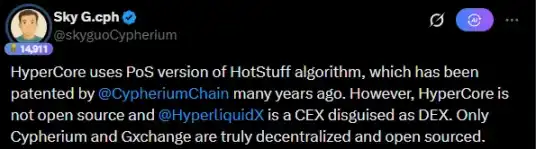
Image Source: Sky Guo Tweet


Core Dispute: The Technical Boundaries of Patent US 11,411,721 B2

The core of this dispute revolves around a formal patent issued by the United States Patent and Trademark Office (USPTO) on August 9, 2022, with the number US 11,411,721 B2. The assignee of this patent is Cypherium Blockchain Inc., and its title is "Systems and methods for selecting and utilizing a committee of validator nodes in a distributed system."

The patent details a mechanism for dynamically selecting and reconfiguring a validator committee, supporting node election through PoW, PoS, or PoA, and emphasizes the use of Aggregate Signatures to enhance consensus efficiency and fault tolerance. The patent also proposes specific implementation paths such as Two-phase Reconfiguration and Tree-structured Hierarchy.

Cypherium believes that these technologies are key to implementing HotStuff in large-scale, high-performance networks (such as Hyperliquid's 200,000 TPS), and this constitutes the core barrier of the patent rights.
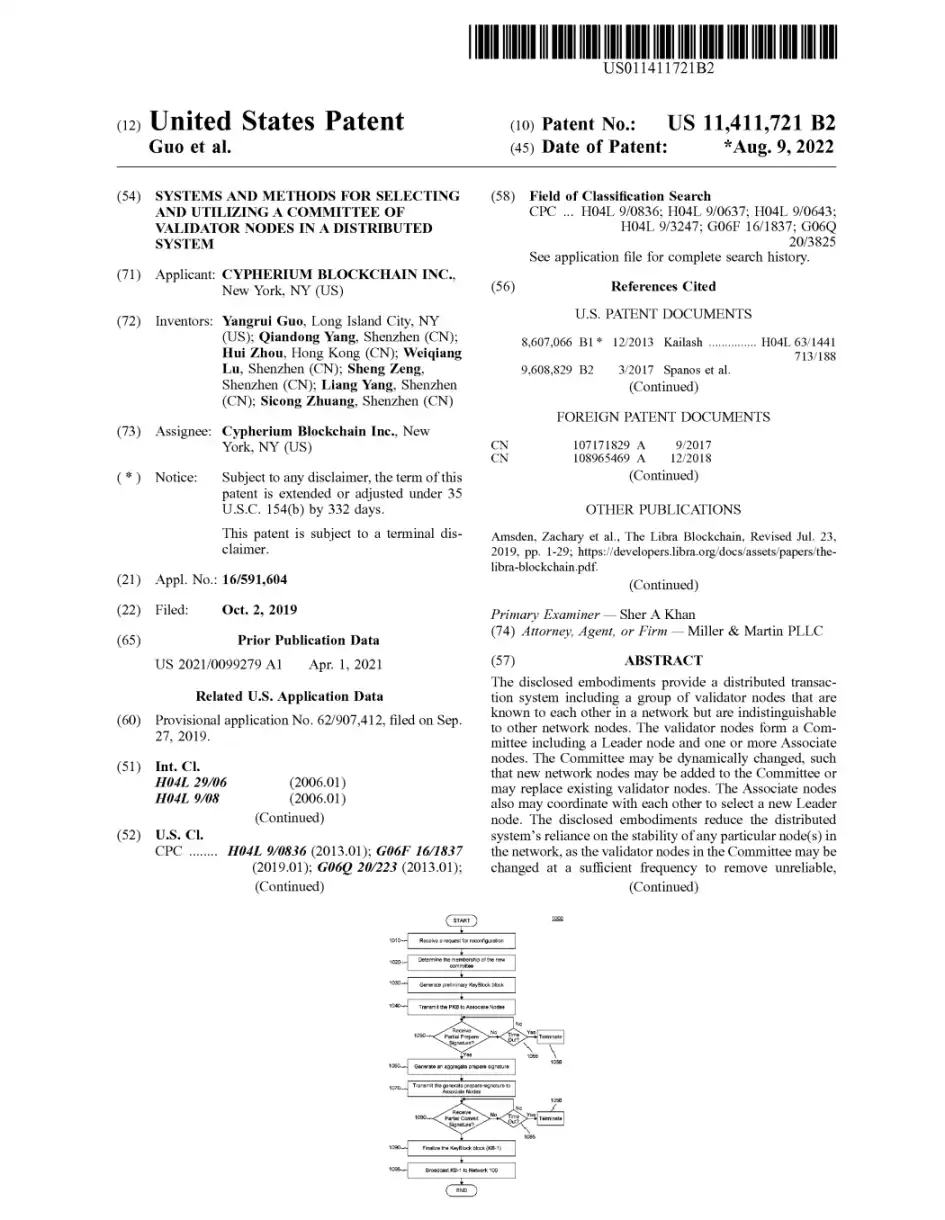
First Page of Cypherium Patent US 11,411,721 B2 | Image Source: Google Patents

The technical dispute centers on both parties' improvements and applications of the consensus algorithm HotStuff, but HotStuff itself is an open-source consensus protocol published in academia between 2018 and 2019.

Cypherium's CypherBFT combines HotStuff with PoW to achieve permissionless operation, while Hyperliquid's HyperBFT is a custom variant optimized for low-latency transactions.

However, Cypherium claims that its patent covers specific enhancement logic for HotStuff in a PoS environment. Hyperliquid has not yet responded regarding whether HyperBFT uses the unique claims covered by the patent.

Escalation of Accusations: From Questioning Transparency to Alleging Infringement

Prior to this infringement allegation, Sky Guo's criticism of Hyperliquid primarily focused on code transparency.

Image Source: Sky Guo Tweet

This lack of transparency, on one hand, protects Hyperliquid's commercial advantage in high-concurrency processing; on the other hand, it makes it difficult for the project to prove its innocence through public audits when facing external technical质疑 (questioning/doubt).

Sky Guo believes that it is precisely because HyperCore borrowed the dynamic committee selection logic described in his patent that it achieved its sub-second finality.

Sky Guo claims to have sent a legal letter to the Hyperliquid team and relevant responsible persons, accusing them of using the patented technology without permission. He stated that the Hyperliquid side is currently avoiding the issue and has not responded to the legal correspondence.

Solid Evidence or Ambush Marketing?

From a superficial legal and technical logic perspective, the US patent US 11,411,721 B2 held by Cypherium is indeed a formally issued legal document. Its scope of protection确实涵盖 (does indeed cover) key aspects of consensus mechanisms such as dynamic committee selection, signature aggregation, and two-phase reconfiguration.

According to Hyperliquid's publicly available technical documentation, the underlying HyperCore engine确实运行 (does indeed run) on a custom variant of the HotStuff algorithm called HyperBFT. HotStuff is precisely the technology改良对象 (improvement target) heavily involved in the claims of this patent.
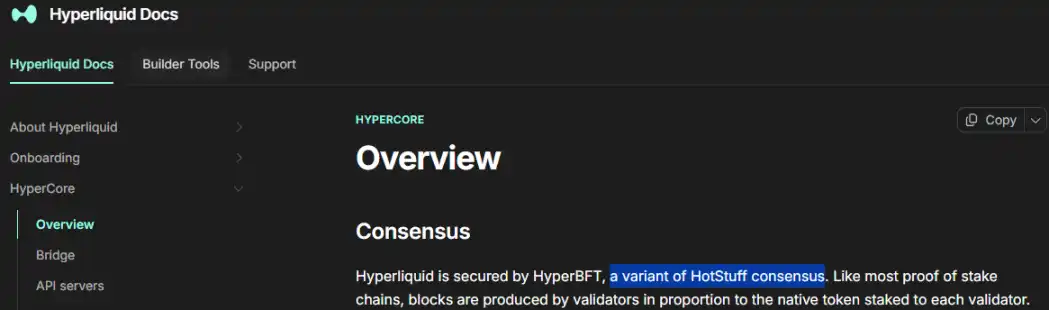
Image Source:Hyperliquid Docs

Furthermore, since Hyperliquid's core codebase is currently closed-source, this black-box属性 (attribute) makes it difficult for the outside world to determine whether its specific implementation path avoids the relevant patent through public code audits.

However, in reality, HotStuff and its variants are hardly new in the high-performance Layer 1 race. From Meta's (formerly Facebook) aborted Libra/Diem, to the currently prominent Aptos (AptosBFT), Monad (MonadBFT), and even early research iterations of Sui's core consensus, all have been significantly influenced by HotStuff's linear communication complexity and responsive design.

Additionally, the timing and context of the accusation are thought-provoking. Sky Guo published the infringement allegation at 12:00 on February 3, coinciding with strong market performance of the HYPE token and the热度 (heat/buzz) surrounding the HIP-4 proposal for the prediction market.

On social platforms, some KOLs expressed support for this rights protection action, but the comment sections of related posts featured疑似推广内容 (suspected promotional content) about "G-Exchange." "G-Exchange" is an upcoming new project within the Cypherium ecosystem. The coincidence in the timeline between this technical accusation and the预热 (pre-launch warm-up) of a new project makes this series of维权动作 (rights protection actions)疑似 (suspected of being) ambush marketing to generate buzz for the new business.
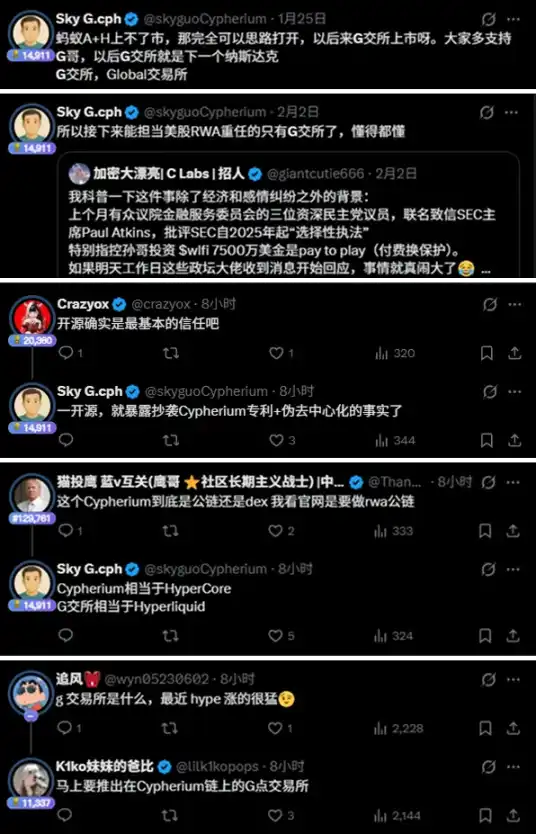
Image Source: Sky Guo and other X account tweets

Whether the accusation is a "real hammer" (solid evidence) or "ambush marketing," Hyperliquid seems to have reached a crossroads. As its business expands, community calls for increased transparency are growing. Faced with infringement质疑 (doubts/questions), will Hyperliquid insist on its black-box advantage, or will it prove its innocence through partial open-sourcing or third-party audits? This concerns the trust foundation of its decentralization narrative.

Note: 9.92 million HYPE tokens are scheduled to be unlocked on February 6, accounting for 2.79% of the circulating supply, with a value of approximately $357 million (based on a price of $36).


Preguntas relacionadas

QWhat is the core patent technology that Cypherium accuses Hyperliquid of infringing upon?

ACypherium accuses Hyperliquid of infringing upon US Patent No. 11,411,721 B2, which covers systems and methods for dynamically selecting and reconfiguring a committee of validator nodes in a distributed system, utilizing mechanisms like aggregate signatures and two-phase reconfiguration to enhance consensus efficiency and fault tolerance.

QHow did Hyperliquid's native token HYPE perform in the market amidst the broader cryptocurrency downturn mentioned?

ADespite a broader market correction where Bitcoin fell below $75,000, Hyperliquid's native token HYPE experienced significant growth, rising over 40% in the past week.

QWhat specific technical feature does Sky Guo claim Hyperliquid's HyperCore engine borrowed from Cypherium's patent?

ASky Guo claims that Hyperliquid's HyperCore engine borrowed the dynamic committee selection logic from Cypherium's patent, which is key to achieving its sub-second finality.

QWhy is it difficult to verify the patent infringement claims against Hyperliquid through public code audit?

AIt is difficult to verify the infringement claims because Hyperliquid's core codebase is currently closed-source and non-transparent, making it impossible for external parties to conduct a public code audit to determine if the implementation avoids the patented technology.

QWhat coincidental timing suggests that Cypherium's infringement accusation might be a form of 'clickbait marketing'?

AThe accusation was made just as HYPE token was performing strongly and the HIP-4 proposal was generating prediction market hype. Additionally, promotional content for Cypherium's new project 'G-Exchange' appeared in related social media discussions, suggesting the timing may be strategic for marketing purposes.

Lecturas Relacionadas

Análisis del Crecimiento de Notion: De una Herramienta de Notas a 100 Millones de Usuarios, Cómo Notion Construyó su Triple Volante de Crecimiento Basado en Producto, Plantillas y Comunidad

Notion ha evolucionado de una simple herramienta de notas a una plataforma global con más de 100 millones de usuarios mediante un sistema de crecimiento integrado en tres etapas. Primero, el crecimiento impulsado por el producto (PLG) permitió que los usuarios experimentaran valor rápidamente. La estrategia gratuita atrajo a estudiantes, creadores y equipos emergentes, mientras que la capacidad de compartir páginas y colaborar generó una expansión orgánica. Segundo, la economía de las plantillas resolvió la complejidad inicial del producto. Ofreciendo soluciones específicas para diversos escenarios, redujo la barrera de entrada y creó un ecosistema rico generado por los usuarios, que también impulsó el crecimiento orgánico a través de búsquedas. Tercero, una comunidad activa de usuarios y creadores asumió roles de educación, creación de contenido y organización local. Esto no solo amplió los casos de uso, sino que también facilitó la expansión global de manera autosostenible. La empresa complementó esto con un marketing de contenidos educativo que enfatiza metodologías de trabajo, no solo funciones. Su entrada en el mercado empresarial se logró de abajo hacia arriba, con equipos que adoptaron la herramienta de manera orgánica antes de que las empresas la adoptaran formalmente. La integración de la IA presenta una nueva curva de crecimiento, incrustando capacidades inteligentes directamente en los flujos de trabajo existentes de los usuarios y potenciando las plantillas. La ventaja duradera de Notion radica en su difícilmente replicable ecosistema: una red compleja de activos de conocimiento del usuario, un ecosistema de plantillas, una comunidad dedicada y una identidad de marca que trasciende la mera funcionalidad del software.

marsbitHace 41 min(s)

Análisis del Crecimiento de Notion: De una Herramienta de Notas a 100 Millones de Usuarios, Cómo Notion Construyó su Triple Volante de Crecimiento Basado en Producto, Plantillas y Comunidad

marsbitHace 41 min(s)

Guía práctica de la tarjeta AI de WeChat: ¿Ha llegado la era de las compras con IA?

**Resumen: ¿Ha llegado la era de las compras con IA? Guía práctica de la Tarjeta AI de WeChat** El 17 de junio, WeChat Pay presentó oficialmente la "Tarjeta AI", una función que permite a los usuarios realizar pagos a través de su asistente de IA WorkBuddy. Sin embargo, las pruebas revelan que aún no permite el "consumo totalmente automático". **¿Qué es realmente?** No es una tarjeta que la IA use libremente. Es más bien una "subcartera" aislada de la principal de WeChat Pay. Los usuarios deben vincularla y transferir fondos específicamente a esta tarjeta. Cada pago iniciado por la IA requiere la confirmación manual del usuario en el móvil, y los gastos se gestionan por separado. **¿Cómo activarla?** El acceso está dentro de WorkBuddy. Preguntando "¿Cómo uso la tarjeta de pago AI de WeChat?", el agente proporciona un enlace para vincular la tarjeta escaneando un código QR con WeChat (válido por 5 minutos). Tras aceptar los términos, se puede recargar desde la cartera principal. **Escenarios objetivo actuales:** Según WeChat, es para comprar contenido pago (informes, datos), usar API/tools de pago, y suscribirse o renovar servicios. Sin embargo, en pruebas no se pudo activar fácilmente para estos casos específicos. **Prueba práctica: Pedir un té de burbujas (fallida):** Al pedir a WorkBuddy que compre un "Heytea", no puede hacerlo directamente. Requiere una "Skill" (habilidad) externa, como el "Asistente de Meituan". Solo generar el código QR para autorizar la cuenta de Meituan consumió 185.37 puntos (más que los 150 puntos diarios gratuitos). Tras la autorización, la IA generó un enlace de pago con la Tarjeta AI, pero el resultado fue la compra de un cupón de Meituan no deseado, no el té específico solicitado. **Conclusión: El problema no es el pago, sino la ejecución del agente.** La Tarjeta AI solo resuelve la capacidad de pago, no la compleja cadena de ejecución: comprender la necesidad precisa, elegir la plataforma correcta, autorizar la cuenta, seleccionar el producto exacto y gestionar el cumplimiento. Los agentes de IA actuales aún no ejecutan tareas del mundo real de manera fiable. **Mecanismo de seguridad actual:** El usuario mantiene el control final. La IA solo puede usar el saldo de la Tarjeta AI, cada pago necesita confirmación en el móvil, y la cuenta principal de WeChat Pay no se toca. **Recomendaciones:** Si quieres probarla, hazlo con cantidades pequeñas y en servicios digitales de bajo riesgo. Antes de pagar, verifica siempre el nombre del producto, el precio y los términos. No asumas que el Agente de IA ha entendido tu necesidad real, especialmente para pedidos físicos, entregas o cupones.

marsbitHace 43 min(s)

Guía práctica de la tarjeta AI de WeChat: ¿Ha llegado la era de las compras con IA?

marsbitHace 43 min(s)

La cruda realidad del FDV de 535 millones de dólares de CARDS: ingresos netos de solo 43 millones y márgenes de beneficio reducidos a la mitad

**Resumen del Artículo: La dura realidad de CARDS con un FDV de 535 millones de dólares** El análisis desglosa los datos de Collector Crypt (CC), una plataforma de cromos coleccionables tokenizados. A pesar de un volumen bruto histórico de 635 millones de dólares, el 90.6% se devuelve instantáneamente a los usuarios a través de recompras automáticas, dejando unos ingresos netos de solo 43 millones (tasa de retención del 6.7%). La actividad es altamente concentrada: unas pocas docenas de carteras generan la mayor parte del volumen, con solo unos 420 jugadores activos diarios. El mercado secundario para cromos es casi inexistente, representando menos del 1% del volumen total. La participación en eBay ha caído 12 veces en seis trimestres consecutivos. La rentabilidad neta de la plataforma se ha reducido a la mitad (del 11.2% al 5.8%) a medida que el volumen se concentra en paquetes de mayor precio con márgenes más bajos. La captura de valor para el token CARDS (a través de quema y recompras) es mínima: solo 1.4 millones de dólares (3.4% de los ingresos netos). Mientras tanto, se han retirado 45.7 millones de USDC de las carteras operativas identificadas. Con un FDV de ~535M, la valoración equivale a 7.3 veces los ingresos netos anualizados, para un negocio con márgenes en compresión, una base de usuarios estrecha y un 72% de la oferta de tokens bloqueada hasta noviembre de 2027.

marsbitHace 1 hora(s)

La cruda realidad del FDV de 535 millones de dólares de CARDS: ingresos netos de solo 43 millones y márgenes de beneficio reducidos a la mitad

marsbitHace 1 hora(s)

Trading

Spot
Futuros
活动图片




