Original Author: Long Yue
Original Source: Wall Street News
A financial product launched just one and a half months ago has plunged South Korea's highest economic policymakers into an emergency state.
South Korea's "F4" high-level coordination mechanism will hold a meeting this Thursday to study response plans regarding the impact of single-stock leveraged ETFs on the stock market. This marks the first time this issue has formally entered the highest-level economic coordination platform jointly participated in by the Ministry of Economy and Finance, the Financial Services Commission, the Bank of Korea, and the Financial Supervisory Service.
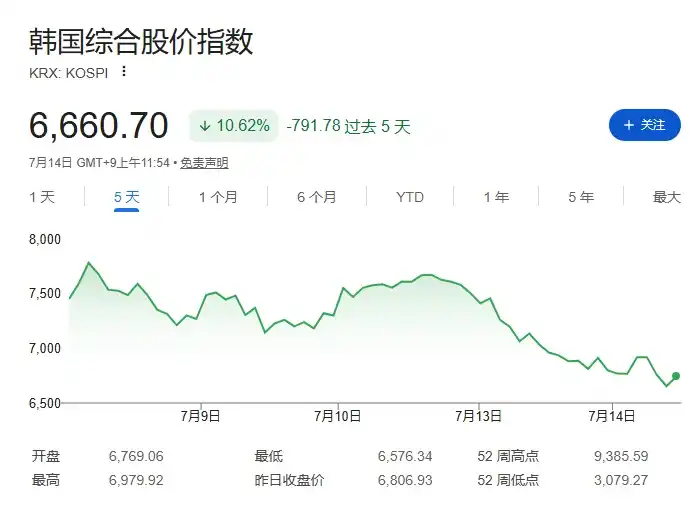
The catalyst is clear: The KOSPI plummeted more than 8% on Monday, triggering the seventh trading halt of the year, with market blame directed squarely at single-stock leveraged ETFs. These products amplify intraday gains and losses of individual stocks, accelerating price deviations during volatile market swings, creating a "buying-the-rip, selling-the-dip" magnifying effect. Single-stock leveraged products officially launched on May 27, allowing investors to make 2x leveraged bets on the price movements of Samsung Electronics and SK Hynix. Their returns are linked to a multiple of the underlying asset's daily price change. To achieve return matching, daily buying or selling of the underlying asset is required, further intensifying market volatility.
Prior to Thursday's government meeting, South Korean securities firms and asset management companies planned to hold an industry meeting on Tuesday to discuss the leveraged ETF issue and overall market conditions, gathering preliminary insights for the government session.
Regulators Escalate Rhetoric, Rarely Uttering "Regret"
Regulatory statements have escalated from "monitoring" to "self-criticism," even frankly admitting to facing structural dilemmas.
On July 13, FSS Governor Lee Bok-hyun chaired a closed-door meeting at the Korea Financial Investment Association in Yeouido attended by representatives from 20 asset management firms. He candidly stated: "There are structural issues, so it's unlikely we can provide a clear answer." He added, "In the current situation, this problem cannot be resolved at once; it requires continuous monitoring, revision, and improvement." This reflects the deep-seated difficulties financial authorities face in proposing specific solutions.
Governor Lee did not elaborate on the so-called "structural issues." It is widely interpreted externally as follows: First, individual investors have already made a net purchase of nearly 10 trillion won in these products, making forced liquidation nearly impossible; second, these products were launched only after a joint revision of enforcement decrees by the Blue House, the Financial Services Commission, and the Korea Exchange. Forcing their delisting would damage the legal credibility of the related regulations.
He also stated, "This doesn't seem to be an area where one person can make the final call. The authorities (the Financial Services Commission) may also need broad deliberation. We (the FSS) will do our best, but we are currently in a position to bear criticism. Asset management companies should frankly share their actual demands and institutional-level suggestions, which will become important references for policy decisions."
FSS Governor Lee Bok-hyun said frankly at a regular press conference on June 22: "Regarding the launch of single-stock leveraged ETFs, I regret not trying my utmost to stop them." This wording is extremely rare in the context of South Korean financial regulation. However, just one day after this statement, the KOSPI plunged 10%. From June 22 to July 13, the KOSPI has cumulatively fallen over 25%.
Earlier this month, he further stated that regulators are "seriously examining the unintended consequences that have arisen since these products were launched."
Deputy Prime Minister and Minister of Economy and Finance Koo Yun-cheol also stated at a National Assembly meeting last week, "Given the various issues raised by all sides, we are currently consulting on measures to remedy and minimize related problems."
Blue House Policy Chief Kim Yong-beom explicitly stated at a press conference that the F4 meeting is conducting an in-depth study of the issue of single-stock leveraged ETFs exacerbating market volatility, adding, "If remedial measures are necessary, a decision will be made at the F4 market condition review meeting."
Three Paths Underway Simultaneously: Raising Margins, Price Limits, Adjusting Leverage Cap
Before Thursday's meeting, regulators have been simultaneously advancing countermeasure studies through multiple paths.
According to sources from South Korea's financial investment industry, financial authorities have formally requested asset management companies to submit specific improvement suggestions regarding the market volatility potentially triggered by single-stock leveraged ETFs. The authorities will consolidate industry opinions before launching formal policy formulation.
Possible measures currently under market discussion include three categories: raising margin requirements, limiting daily price fluctuation ranges, and adjusting the leverage ratio cap.
The Financial Services Commission will convene experts from major securities firms and asset management companies on the 14th to discuss supplementary measures for single-stock leveraged products. Specific proposals include raising the minimum margin requirement (i.e., the capital threshold investors must pre-deposit in accounts) and strengthening pre-investment education.
However, regulatory officials also admitted that the above measures "might only be temporary fixes, not solving the structural root of market volatility." This means even if Thursday's meeting reaches a decision, follow-up policies may still face further adjustments.
Data Confirms Impact: Trading Halts Hit Historic Record
Data-wise, the comparison of market volatility before and after the launch of single-stock leveraged ETFs is startling. According to NH Investment & Securities statistics, in the 96 trading days before the product launch, the KOSPI experienced single-day gains/losses exceeding 3% on 27% of the days (26 days). In the 33 trading days after the launch until July 13, this proportion surged to 52% (17 days). In comparison, the U.S. S&P 500 index has not had a single-day movement reaching 3% so far this year.
Data from the Korea Exchange shows that as of July 13, the securities market has triggered 35 "sidecar" mechanisms (temporary trading suspensions, including 17 buyer-side and 18 seller-side triggers) this year, far exceeding last year's total of just 3 times. Even with July not yet over, this number has already surpassed the historical record of 26 times set during the 2008 global financial crisis. Market-wide trading halts (circuit breakers) have been triggered 7 times this year, exceeding half of the total 13 triggers since the mechanism's introduction in 2000.
The Wall Street Journal also noted: "South Korea's stock market volatility has been further amplified by leveraged products linked to Samsung Electronics and SK Hynix."
One and a Half Months Since Launch, Already Triggering Top Decision-Maker Intervention
It has been about one and a half months since single-stock leveraged ETFs were listed in South Korea, yet regulatory pressure has rapidly escalated from the Financial Supervisory Service level to the highest economic decision-making body.
Kim Yong-beom pointed out at the press conference, "These products have been operating for about one and a half months. The F4 will carefully assess their actual impact on the market."
Currently, market expectations for stricter restrictions on such products are rising—leverage ratio tightening, higher investor eligibility thresholds, or other structural constraints are all within the scope of discussion. As market volatility continues unabated, criticism is also growing louder over the hasty launch of these products in less than five months.
The future policy direction will depend on the assessment conclusions of Thursday's South Korean F4 meeting.