How to Make Web3 Products Inherently Viral? Four Years of User Growth Lessons from an Entrepreneur

比推Publicado a 2025-12-30Actualizado a 2025-12-30

Resumen

The author, a Web3 founder with four years of experience, shares seven key lessons learned from building consumer-facing crypto products after previously working on failed infrastructure projects. Key insights include: 1. Target younger users (ages 13-21) who are more open to adopting new technologies. 2. Design products with built-in virality to reduce marketing costs, as crypto users expect incentives and trust is low. 3. Implement user-requested features quickly (within 2-3 days) to build trust and prevent churn to competitors. 4. Choose simple, memorable product names for easier word-of-mouth sharing. 5. Engage with users directly through cold DMs despite low response rates, focusing on acquiring 10-20 dedicated early users. 6. Iterate rapidly based on user behavior rather than just feedback, prioritizing what they actually pay for. 7. Simplify websites and onboarding to minimize cognitive load and clicks, ensuring the core value is immediately apparent. The author emphasizes that speed, user-centric design, and marketing are more critical than technical perfection in consumer crypto.

Author: Rishabh Gupta

Compiled by: Jiahuan, ChainCatcher

Original title:7 Painful Lessons from 4 Years of Web3 Entrepreneurship


As a budding founder, I spent years pouring my heart into three infrastructure-layer projects that ultimately failed. In 2025, I started building a consumer product that people actually want to use. Here, I share my hard-earned insights on user acquisition and fundraising.

I've been in this industry for about 4 years.

In 2023, when "account abstraction" was the hottest topic in the circle, I started developing in the EVM ecosystem. At that time, everyone was building SDKs (Software Development Kits) for account abstract wallets. Rollup scaling solutions were also hot—Optimism, Arbitrum, and various RaaS (Rollup as a Service) dominated.

As a math enthusiast, I was deeply attracted to ZK (Zero-Knowledge proofs), believing it would change the world (I firmly believe it will, eventually).

I mistakenly believed that: Complexity == Credibility.

When VCs asked about application scenarios, I would confidently list zkML (Zero-Knowledge Machine Learning), zk identity, zk voting—but even today, no one is really using these areas. I mistook amazing technology for a useful product.

Over time, I began to believe that the more complex an idea was, the greater its chance of success.

VCs also told me that in the crypto space, building infrastructure was the only path to success.

It took me nearly 2 years and over 500 rejections to realize this wasn't for me.

Entering the Solana Ecosystem

This was a completely new ecosystem for me—here, people care about application scenarios. Even meme coins are okay, because revenue matters.

Speed matters. Distribution matters.

Having built consumer applications on Solana for 7 months, here are my insights:

1. Build for Young Users Willing to Try New Things

Try to develop for young people who are naturally receptive to new products.

In the consumer crypto space, this usually means people trading in the "trenches" or young users aged 13-21.

A 2024 study by the Consumer Technology Association showed that 86% of Gen Z (11-26 years old) consider technology core to life—a higher percentage than any older generation. They own more devices and are more willing to spend on tech products.

They are more willing to try new apps, experiment with new features, and change habits.

Users over 25 are generally less willing to adopt new workflows unless there is a very strong incentive.

(Note: If you're in the institutional business, this may not apply.)

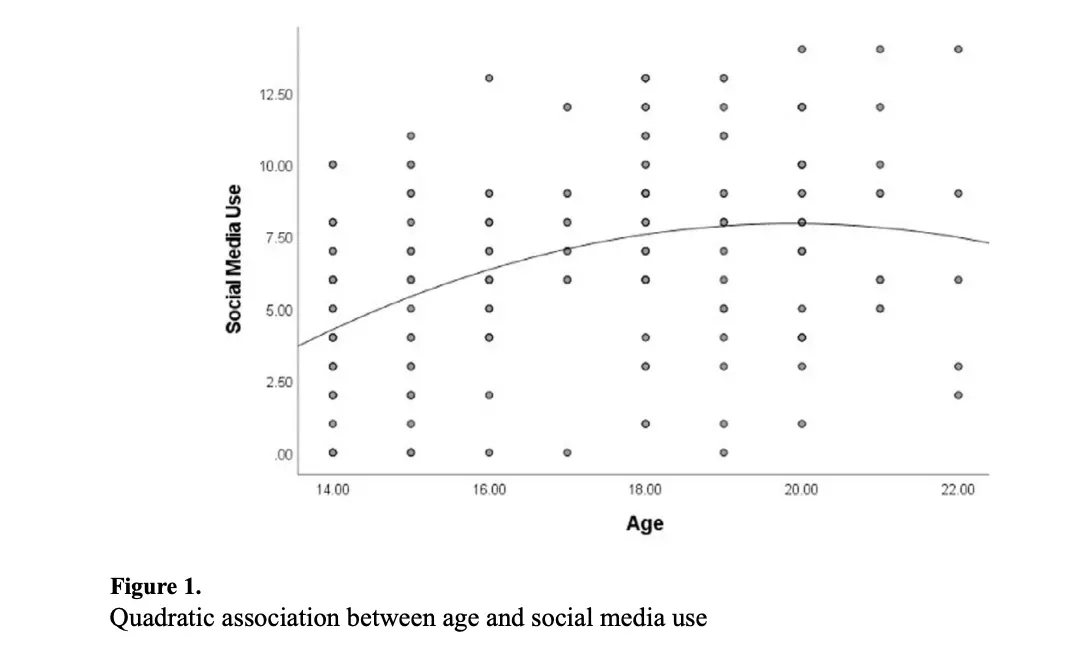
Research shows that social activity peaks around age 20-21. This means products built for young people are inherently more shareable.
2. Make the Product Inherently "Viral" to Reduce Marketing Costs

If you don't have a huge marketing or advertising budget, the product itself must be the traffic channel.

In crypto, shareability is especially important because:

  • KOL marketing is very expensive.

  • Trust is extremely low.

  • Everyone expects rewards or incentives.
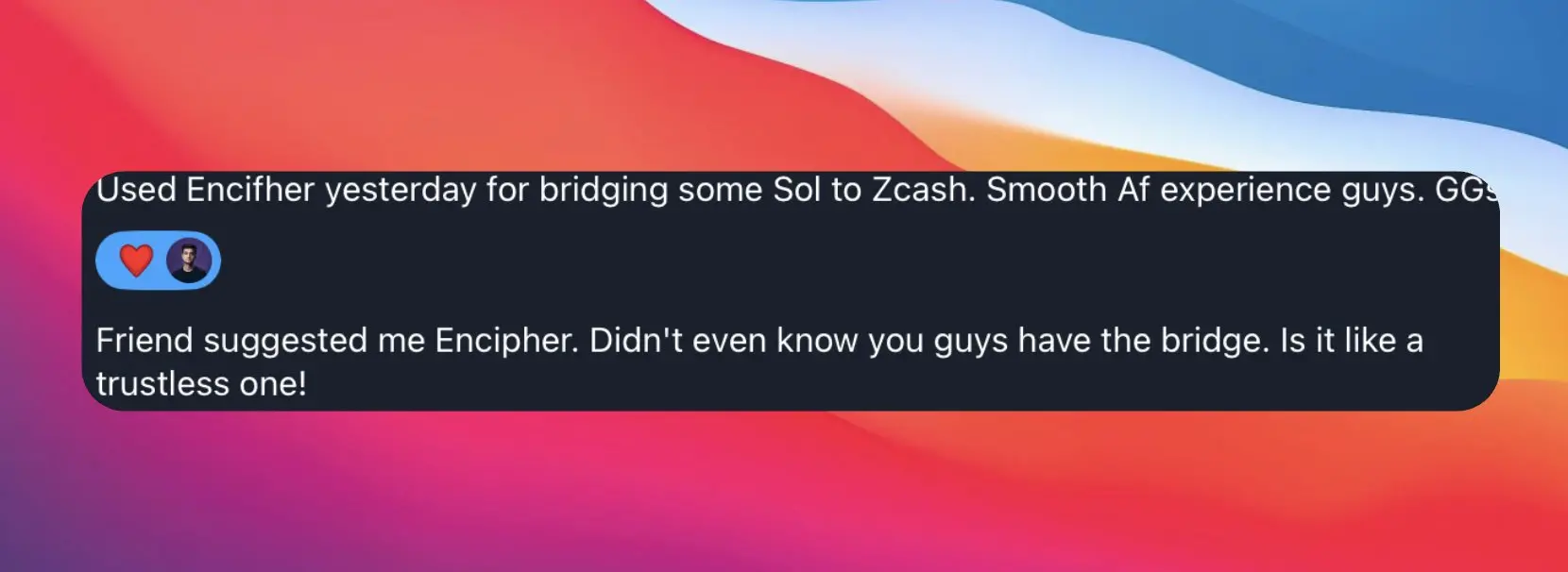
If your product gives users a reason to spontaneously share it with friends and communities, you've earned publicity without burning money. This is hard, but it's worth optimizing for from day one.

3. Launch Features Users Request as Soon as Possible

When users report a poor experience or a bug, fix it immediately, especially if it's a pain point that hinders use.

I used to wait until the end of the day to apply patches. The result was users DMing me: "Since your app doesn't have this feature, I'm going to use Product Y for now."

Once users go to a competitor and form a habit, it's hard to pull them back.

So, try to fix things immediately (ideally within 2-5 hours).

If multiple users request a feature and it's feasible:

  • Build it within 2-3 days.

  • Tell them it was launched based on their feedback.

  • Maybe even give them a reward.

This builds deep trust. Users will start to feel the product "belongs to them," and this sense of emotional ownership is incredibly powerful in early-stage products.
4. The App Name is Very Important

This seems simple, but many people (including me) have messed it up.

The app name should be highly recognizable and easy to share verbally.

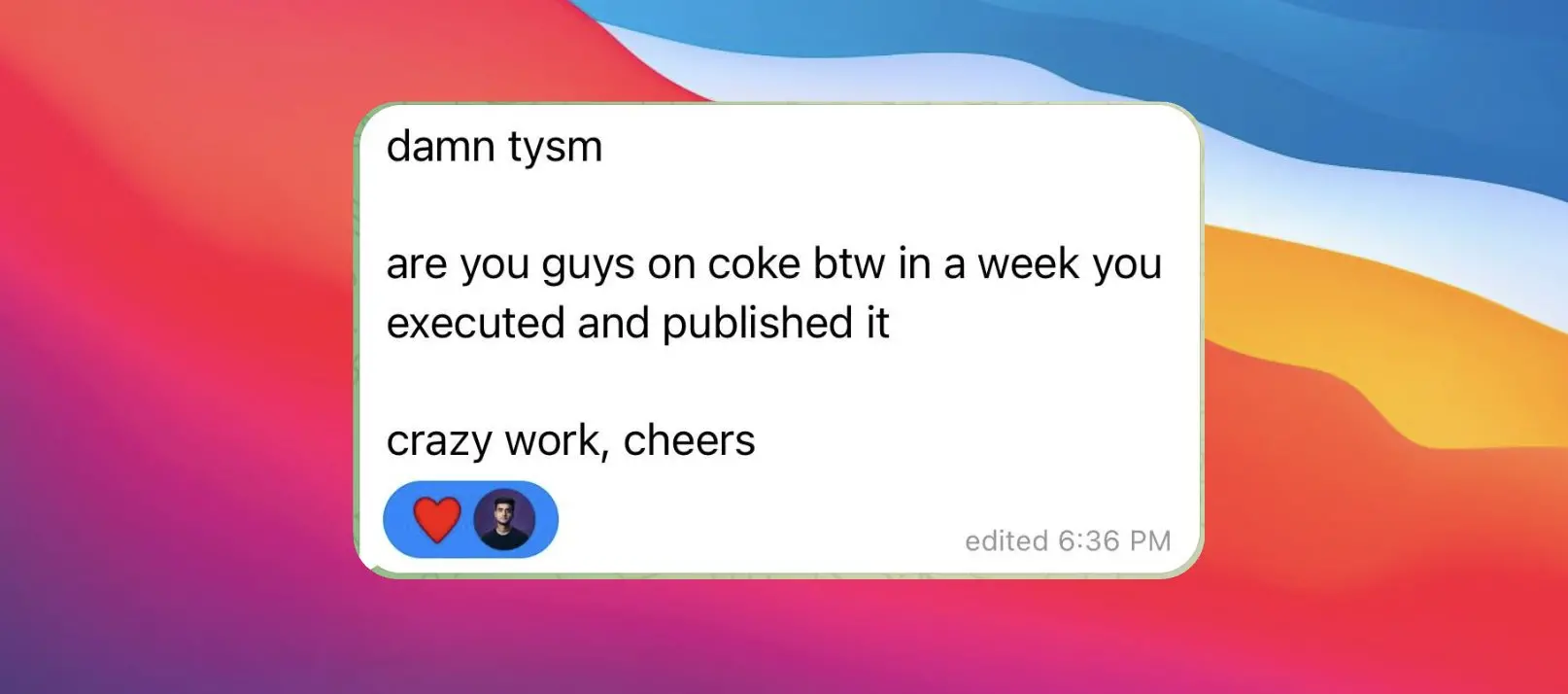
My previous product was called "Encifher," a name extremely hard to remember. Even investors and partners would misspell it when creating group chats.

So we later changed it to encrypt.trade. Simple, memorable, sexy.

5. Talking to Users is Hard, But Essential

Finding and talking to users is extremely difficult, especially when what you're building isn't part of the current "hot narrative."

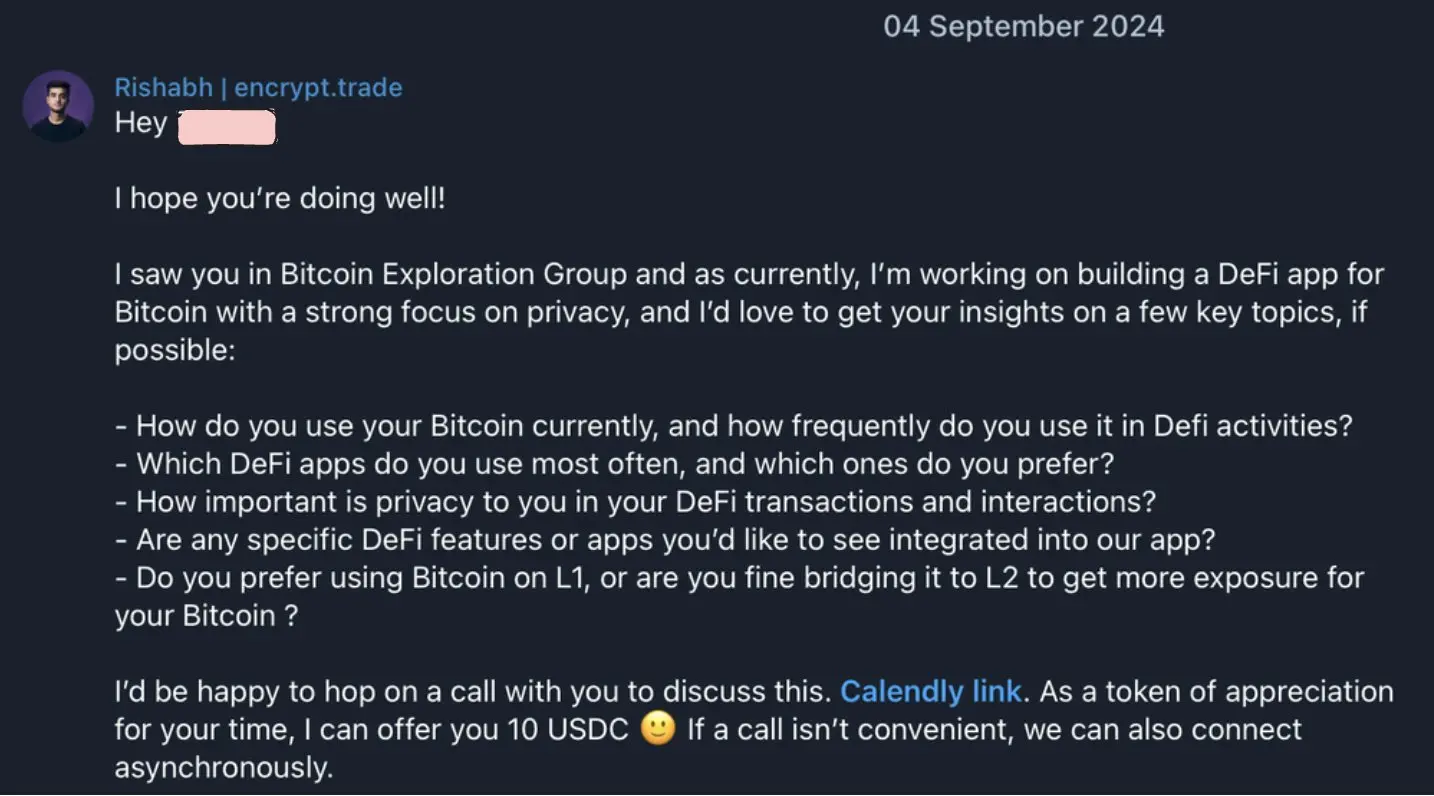
When I started working on privacy, it wasn't popular. I contacted nearly 1000 people via Cold-DM: maybe 10 out of 100 would reply. Only 3-4 of those could provide substantial help.
I talked to anyone who showed the slightest interest

I iterated on the product with them

Framing a Cold-DM is also an iterative process. Here are some key points to note:

  • Start with a warm greeting.

  • Put the highlights (funding status, trading volume, etc.) at the beginning.

  • Mention where you found them.

  • Give a friendly call to action.

  • Always remember to follow up.

There's no perfect Cold-DM; you must A/B test to find what works for your target audience.

Here's a decent Cold-DM template to use: But be aware, this process is slow and exhausting.
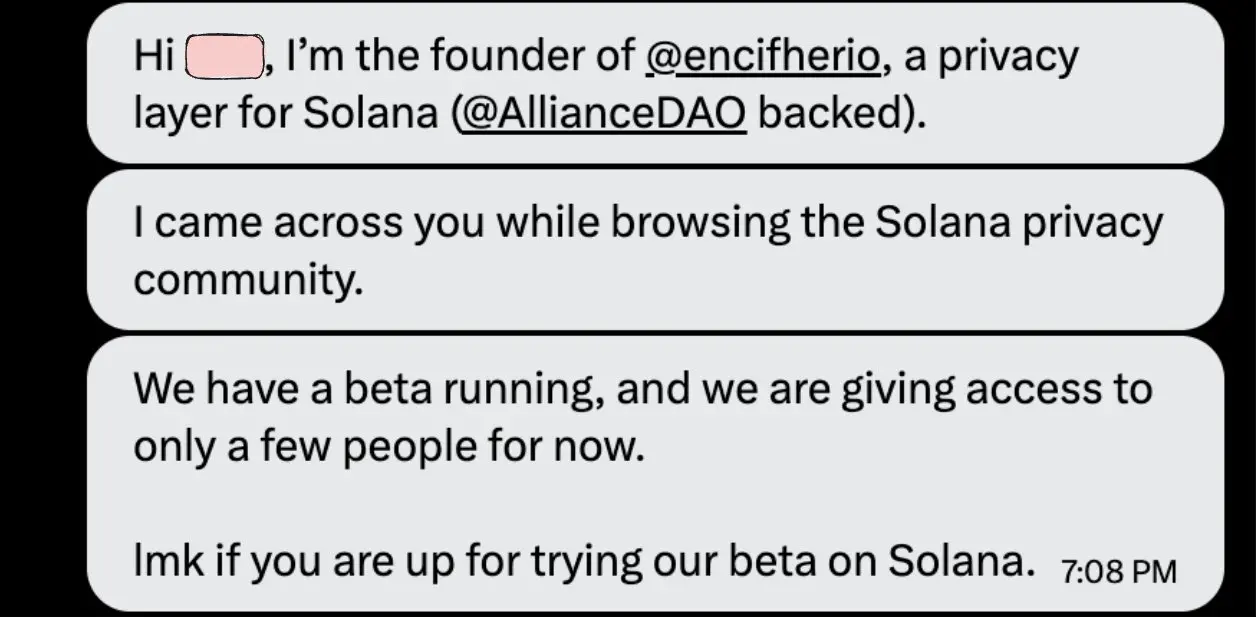

In the crypto circle, few people reply to DMs because scams are everywhere.

Low reply rates are the norm (I know, it's a bit frustrating).

Nevertheless, you must do it.

Your goal at this stage is not to get 1000 users.

Your goal is 10-20 early users who care about the problem, are willing to try the product, and will provide honest feedback.

These early users will become your support system.

Early products often go wrong; these users will help you through that phase.

6. Iterate Quickly

The crypto industry changes rapidly, and attention spans are extremely short.

You must study user behavior, not just listen to their words:

  • What are they doing repeatedly?

  • What kind of workarounds are they using?

  • What are they already willing to pay for? (Many ideas sound good, but if users aren't willing to pay, it can't survive.)

7. Make Your Website Simple to the Point of Being "Foolproof"

Never make any assumptions about the user's knowledge.

As a developer, you've stared at the product for hundreds of hours and find it obvious, but for someone entering for the first time, it's completely foreign.

  • Don't introduce new terminology or complex processes.

  • Minimize the number of clicks.

  • The core value should be presented within 5 seconds of entering the app.

Conclusion

Building consumer crypto products is both fun and challenging. Speed of iteration, user-centric thinking, and marketing ability are more important than perfect technology. This is completely different from B2B.


Twitter:https://twitter.com/BitpushNewsCN

Bitpush TG Discussion Group:https://t.me/BitPushCommunity

Bitpush TG Subscription: https://t.me/bitpush

Original link:https://www.bitpush.news/articles/7599210

Preguntas relacionadas

QWhat is one of the key lessons the founder learned about building Web3 products for user growth?

AOne key lesson is to build for young, early-adopter users (like those aged 13-21) who are naturally more receptive to new products and have higher social activity, making the product more inherently shareable.

QWhy is it important for a Web3 product to have built-in shareability?

ABuilt-in shareability is crucial because KOL marketing is expensive, trust is low in crypto, and users expect rewards. If the product gives users a reason to share it with friends and communities organically, it reduces marketing costs and drives growth without burning cash.

QHow should founders handle user feedback and feature requests according to the article?

AFounders should address user feedback and bugs immediately, ideally within 2-5 hours for critical issues. If multiple users request a feasible feature, build it within 2-3 days, inform them it was based on their feedback, and even offer rewards to build deep trust and a sense of ownership.

QWhat did the founder realize about product names after his experience with 'Encifher'?

AHe realized that product names should be highly recognizable and easy to share verbally. 'Encifher' was hard to remember and often misspelled, so he changed it to 'encrypt.trade' for simplicity, memorability, and appeal.

QWhat is the recommended approach for cold outreach (Cold-DM) to potential users?

AThe approach includes starting with a warm greeting, highlighting key points (like funding or traction) upfront, mentioning where you found them, giving a friendly call-to-action, and always following up. The goal isn't to get thousands of users but to find 10-20 early users who care and provide honest feedback.

Lecturas Relacionadas

Telegram toma el control personalmente de TON, el tráfico social reescribe la narrativa de la cadena pública

Pavel Durov, fundador de Telegram, anunció que la plataforma se convertirá en el principal impulsor y validador de la red TON, reemplazando a la Fundación TON. Esto marca un cambio significativo: de una relación estrecha pero no directiva, Telegram asume ahora un papel central en el desarrollo técnico, la gobernanza y la seguridad de la red. El enfoque se centra en reducir drásticamente las tarifas (casi a cero) y mejorar la velocidad (finalidad en 0.6 segundos). El objetivo es permitir transacciones pequeñas y frecuentes dentro del ecosistema de Telegram, transformando sus funciones (Mini Apps, pagos, recompensas) en actividades reales en la cadena. TON no busca solo el tráfico de Telegram, sino integrarse como una capa subyacente e imperceptible en la experiencia del usuario. Este movimiento conlleva un equilibrio. Si bien la participación directa de Telegram puede acelerar el desarrollo y la adopción, también plantea preguntas sobre la descentralización de la red. Además, Durov destacó que TON ofrece una de las recompensas de staking más altas (18.8%), una estrategia para retener capital dentro del ecosistema. En resumen, TON avanza para convertir el acceso masivo de Telegram en un uso sostenible. Su éxito ya no depende de la proximidad a la plataforma, sino de la profundidad de su integración en las interacciones diarias de los usuarios. La oportunidad y el desafío radican en ser la infraestructura invisible que potencia la economía interna de Telegram.

Odaily星球日报Hace 36 min(s)

Telegram toma el control personalmente de TON, el tráfico social reescribe la narrativa de la cadena pública

Odaily星球日报Hace 36 min(s)

Weng Jiayi, ingeniero de Post-Entrenamiento de OpenAI, plantea una nueva hipótesis de paradigma para la IA Agéntica

El ingeniero de post-entrenamiento de OpenAI, Weng Jiayi, propone un nuevo paradigma para la IA Agéntica: el "Heuristic Learning" (HL). En lugar de depender únicamente de grandes modelos entrenados con datos masivos, este enfoque permite a un agente de codificación (como Codex) iterar de forma autónoma: escribir, probar, ejecutar y modificar código basado en reglas para resolver tareas. En experimentos clave, este sistema logró la puntuación máxima teórica (864) en Atari Breakout y resultados competitivos en entornos de control robótico como MuJoCo Ant. La idea central es que el aprendizaje no tiene por qué residir solo en los pesos de una red neuronal; la experiencia puede codificarse en un sistema de software explícito, interpretable y mantenible. Esto ofrece ventajas en eficiencia muestral inicial, explicabilidad y capacidad de auditoría, especialmente relevante para robótica y escenarios de seguridad crítica. Sin embargo, el enfoque encuentra límites en tareas que requieren planificación a largo plazo o percepción compleja (ej. Montezuma's Revenge). Weng sugiere un futuro híbrido donde redes neuronales (Sistema 1), sistemas heurísticos (también Sistema 1) y agentes LLM (Sistema 2) colaboren, trasladando parte de la "deuda técnica" de los pesos de la red al dominio de la ingeniería de software tradicional.

marsbitHace 1 hora(s)

Weng Jiayi, ingeniero de Post-Entrenamiento de OpenAI, plantea una nueva hipótesis de paradigma para la IA Agéntica

marsbitHace 1 hora(s)

El mercado de CoreWeave, que Duan Yongping compró en la caída, se ha convertido en un sangriento campo de batalla entre alcistas y bajistas

El proveedor de capacidad de computación en la nube para IA, CoreWeave (CRWV), experimentó una caída del 11,4% en sus acciones tras presentar sus resultados del primer trimestre. Aunque los ingresos se duplicaron interanuales hasta los 2.080 millones de dólares, las pérdidas netas también se ampliaron, superando los 740 millones. La guía del Q2, inferior a las expectativas del mercado, avivó las ventas. La compañía, una de las apuestas más controvertidas del sector, presenta una narrativa alcista basada en una cartera de pedidos de casi 1.000 billones de dólares, una relación privilegiada con Nvidia y una creciente diversificación de clientes, incluyendo a Meta y Anthropic. Sin embargo, los bajos márgenes operativos (solo un 1% ajustado), el rápido aumento del gasto en capital y la deuda (unos 25.000 millones) alimentan la tesis bajista. En este contexto, destaca la operación del inversor chino Duan Yongping, quien tomó una pequeña posición (0,12% de su cartera) en el cuarto trimestre de 2025, coincidiendo con mínimos anuales de la acción. Su movimiento contrasta con las continuas ventas de directivos e inversores internos de CoreWeave. La cuestión clave es si la compañía, que el CEO Michael Intrator promete alcanzará una facturación anualizada de más de 30.000 millones en 2027, encontrará el punto de inflexión hacia la rentabilidad, o si la expansión agresiva seguirá erosionando los márgenes. El próximo informe del segundo trimestre servirá como una prueba decisiva para la credibilidad de la narrativa de crecimiento a largo plazo frente a los datos financieros actuales.

marsbitHace 1 hora(s)

El mercado de CoreWeave, que Duan Yongping compró en la caída, se ha convertido en un sangriento campo de batalla entre alcistas y bajistas

marsbitHace 1 hora(s)

El "Burning Man" tecnológico chino hace su debut en Shanghái, muShanghai crea una "ciudad pop-up" global para geeks

Del 10 de mayo al 6 de junio de 2026, se celebró en Shanghai el experimento de "ciudad efímera" (Pop-up City) organizado por muShanghai, iniciado por la comunidad internacional de código abierto The Mu y coorganizado por el Centro Alibaba de Hongqiao. Esta "fiesta tecnológica al estilo Burning Man" china reunió durante 28 días a desarrolladores, investigadores y emprendedores de más de 50 países para construir colectivamente una "ciudad paralela" para la comunidad tecnológica global. El evento atrajo más de 2000 solicitudes, con 800 participantes seleccionados de países como Estados Unidos, Argentina, Canadá, Japón, Francia, Sudáfrica, Reino Unido y China. La asistencia incluyó talentos destacados como ex ingenieros de OpenAI, fundadores de startups y contribuidores clave de proyectos como OpenClaw. La agenda se estructuró en cuatro semanas temáticas con cerca de 100 eventos: * **Semana de IA (11-15 mayo):** Conferencias sobre grandes modelos, seguridad de IA y aplicaciones de consumo. * **Semana de Biotecnología (18-22 mayo):** Enfocada en longevidad, automatización de laboratorios y ciencia de materiales. * **Semana de Robótica (25-29 mayo):** Con competiciones, desfiles de moda cibernética y exposiciones de hardware. * **Semana Cultural (1-6 junio):** Explorando futuras formas sociales, cultura ciberpunk y creación de videojuegos. Se destacaron los "mercados de innovadores" semanales y el principio de "Build in Public" para fomentar la iteración abierta de proyectos. El Centro Alibaba de Hongqiao sirvió como hub de apoyo integral para talento internacional. Tras éxitos en Argentina, San Francisco y la Expo Osaka 2025, The Mu eligió Shanghai para este desafío, superando obstáculos logísticos y regulatorios. El evento contó con la presencia de autoridades locales en su inauguración. En resumen, muShanghai fue tanto un festival tecnológico de vanguardia como una ventana crucial para la conexión del ecosistema de innovación chino con el mundo.

marsbitHace 1 hora(s)

El "Burning Man" tecnológico chino hace su debut en Shanghái, muShanghai crea una "ciudad pop-up" global para geeks

marsbitHace 1 hora(s)

Trading

Spot
Futuros
活动图片





