Double Whammy: Circle's Growth Logic Is Being 'Dismantled' Simultaneously by Legislation and Competitors

marsbitPublicado a 2026-03-25Actualizado a 2026-03-25

Resumen

U.S. stablecoin issuer Circle (CRCL) experienced its largest single-day drop, falling over 20% on March 24, following the leak of a draft version of the Clarity Act. The bill aims to prohibit digital asset service providers from paying yields—directly or indirectly—on stablecoin holdings, including any structure “economically or functionally equivalent to interest.” This directly impacts Circle’s key partner Coinbase, which currently shares most of the reserve interest earnings from USDC holdings with users through its “USDC Rewards” program. The proposed rule could significantly slow USDC’s growth, which has been partly driven by its use as a high-yield savings alternative. Without yield incentives, demand for USDC may decline, undermining Circle’s revenue model built on scale expansion. On the same day, rival Tether announced it had hired a Big Four accounting firm to conduct a full financial audit—including its USDT reserves. This move enhances Tether’s credibility and could diminish Circle’s competitive edge in transparency and compliance, which had previously driven its growth. The draft legislation reinforces a regulatory stance that stablecoins should function primarily as payment instruments rather than interest-bearing assets, challenging Circle’s core growth strategy.

Original Author: Sanqing, Foresight News

On March 24 (Eastern Time), the share price of stablecoin issuer Circle (CRCL) closed at $101.17 on the New York Stock Exchange, marking a single-day drop of over 20%, its largest single-day decline since going public. Its largest distribution partner, Coinbase (COIN), also fell nearly 10% in sync, closing at $181.04 on the Nasdaq.

The trigger for the sell-off was the leaked details of the latest draft text of the Clarity Act. The draft intends to prohibit digital asset service providers from "directly or indirectly" paying yields on stablecoin balances, and also bans any structural arrangements that are "economically or functionally equivalent to interest."

Image Source: Tweet by Eleanor Terrett, host of Crypto in America and former Fox Business reporter

On the same day, its competitor Tether announced that it had hired one of the Big Four accounting firms to conduct its first full financial audit (including the USDT reserves).

"Directly or Indirectly": Who Do These Five Words Block?

The draft text was submitted to crypto industry representatives for review in a closed-door meeting on March 24, with banking representatives to follow for review the next day. Reporter Eleanor Terrett disclosed the draft details on X, citing a related email.

USDC itself has never paid interest, and Circle, as the issuer, has never paid any yield to holders. So, what does the draft's prohibition on issuers paying interest have to do with Circle?

The draft's "scope" extends beyond the issuer. The entity actually paying yields to users is Coinbase.

According to the revenue-sharing structure disclosed in Circle's prospectus, 100% of the reserve interest for USDC held by users on the Coinbase platform belongs to Coinbase; for USDC circulating outside the platform, 50% of the reserve interest belongs to Coinbase.

Coinbase passes on the vast majority of the reserve proceeds obtained on-platform to users in the form of "USDC Rewards." According to an analysis by Columbia Law School, Coinbase's profit margin on USDC Rewards is extremely thin, retaining only about 20 to 25 basis points.

The "directly or indirectly" and "economically or functionally equivalent to interest" clauses in the Clarity Act draft are precisely designed to block this loophole.

This ban may have a limited financial impact on Coinbase, or could even be positive. Coinbase is both a shareholder of Circle and holds a pure profit share of 50% of the reserve income from off-platform USDC. Its commercial incentive to promote USDC will not disappear because of this.

However, USDC's competitors are not only USDT but also the US dollar itself.

USDC Rewards allowed USDC to play the de facto role of a "digital high-yield savings account." This has also been one of the drivers behind USDC's growth rate outpacing USDT's for two consecutive years. Once this channel is closed, users holding USDC would see yields drop to zero, reducing their willingness to hold it.

The path of demand contraction points to Circle. Weakened holding motivation on the retail end leads to a slowdown in the growth of the total circulating supply of USDC. The speed at which the reserve pool thickens subsequently decreases, and Circle's revenue growth story, built on the expectation of scale expansion, begins to loosen.

The draft also preserves an exemption for "activity-based rewards." Rewards linked to payments, transfers, or platform usage are still permitted. But this is a completely different product from the current "hold-to-earn" model.

Furthermore, the standard phrasing "economically or functionally equivalent to interest" is overly vague, leaving significant room for interpretation by future regulators. The boundaries of activity-based rewards also face the risk of being tightened.

Another Pressure on the Same Day

If the Clarity Act draft is dismantling Circle's growth flywheel, then the audit announcement made by Tether on the same day targets another competitive advantage of Circle.

USDC's long-term differentiation narrative has largely been built on compliance.

Circle regularly undergoes reserve attestations from top-tier accounting firms. During the years when regulatory uncertainty weighed on Tether, "We are the transparent and compliant one" was an extremely effective card for institutional clients and compliance-sensitive exchanges.

Tether, on the other hand, relied on quarterly attestations rather than full audits to respond to the outside world. S&P Global had previously assigned USDT a "weak" credit rating in 2025, warning of under-collateralization risks if Bitcoin prices fell further.

Additionally, the GENIUS Act requires large stablecoin issuers to undergo annual independent audits. Tether's hiring of a Big Four firm seems more like a response to this legal obligation. Regardless of the motive, the timing of this signal was enough to add to the market's negative sentiment.

USDC's growth rate has outpaced USDT's for two consecutive years. The narrative of compliance and transparency has been one of the most important drivers of this growth. Tether's hiring of a Big Four auditor has not yet begun, and the results are far from known. But if the audit is completed successfully, it is obvious that the compliance premium that Circle relies on to maintain its growth advantage will be compressed.
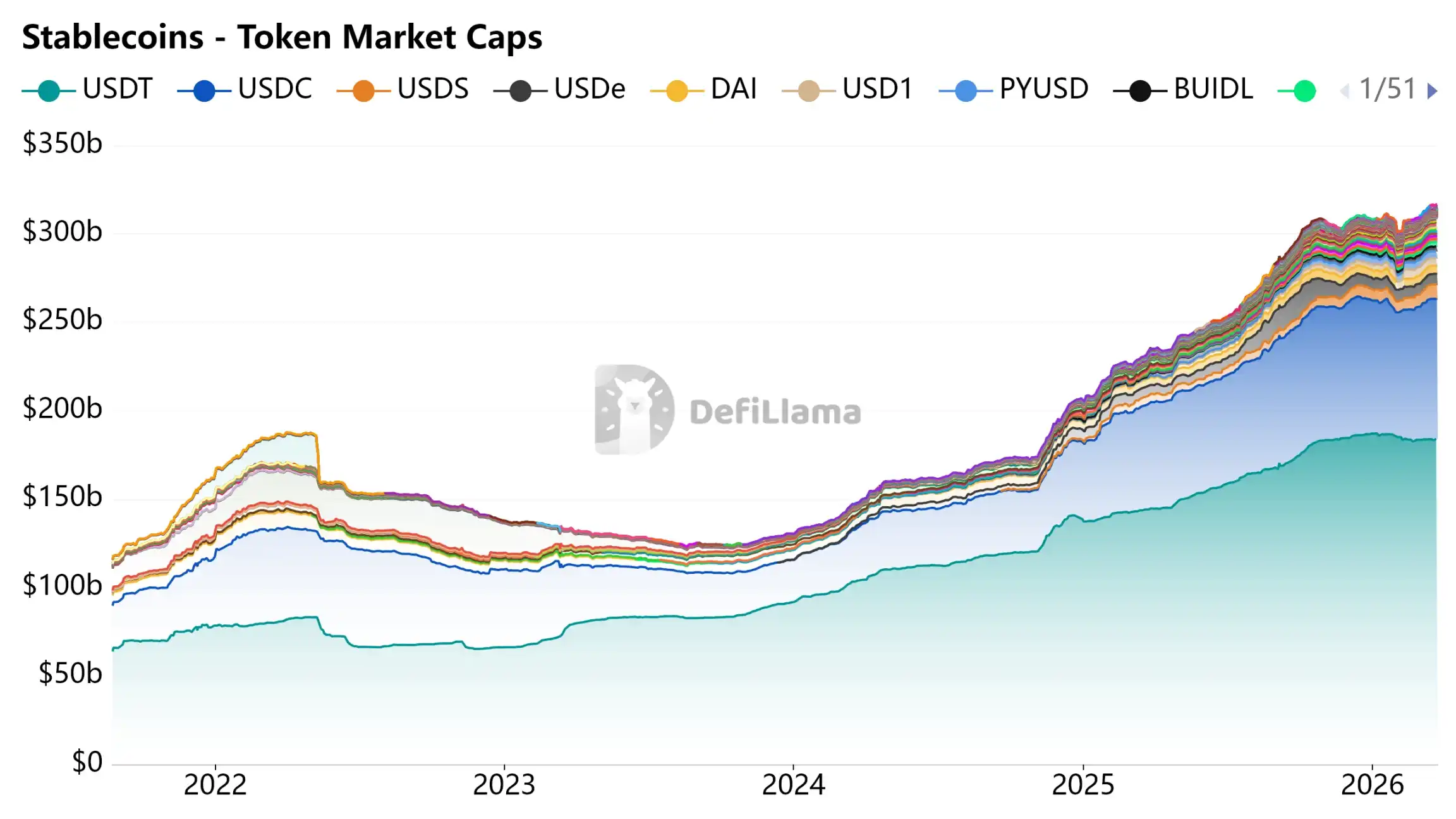
Image Source: DeFiLlama - Stablecoins

Payment Tool, Not Savings Account

Circle's value benefits from its growth model: yield incentives drive users to hold USDC, scale expansion leads to a thickening reserve pool, and reserve interest supports revenue growth. For this model to work, the premise is that stablecoins are allowed to play the role of an interest-bearing asset or savings deposit.

The Clarity Act draft is negating this premise at the legislative level.

Without yield incentives, the growth of USDC's scale must instead rely on natural penetration through real payment scenarios. This path is not impassable, but it is much slower and far more uncertain than yield-driven growth.

Compliance preserves Circle's license, but it does not preserve its growth model. The bankers' answer is clear: stablecoins can exist, but they cannot bear interest.


Preguntas relacionadas

QWhat caused Circle's stock price to drop by over 20% on March 24th?

AThe sharp decline in Circle's stock price was triggered by the leaked details of the Clarity Act draft, which proposes to prohibit digital asset service providers from paying yields, directly or indirectly, on stablecoin balances, including any structure economically or functionally equivalent to interest.

QHow does the Clarity Act draft impact Coinbase's USDC Rewards program?

AThe Clarity Act draft, with its 'direct or indirect' and 'economically or functionally equivalent to interest' clauses, is designed to close the loophole that allowed Coinbase to pay 'USDC Rewards' to users. This program, funded by the interest earned on USDC reserves, would likely be prohibited, removing a key incentive for users to hold USDC on the platform.

QWhat is the significance of Tether announcing a full financial audit on the same day?

ATether's announcement of hiring a Big Four accounting firm for its first full financial audit (including USDT reserves) challenges Circle's key competitive advantage of transparency and compliance. If completed successfully, this audit could compress the 'compliance premium' that has been a major driver of USDC's growth advantage over USDT in recent years.

QWhat was the core growth model for Circle and USDC that is being challenged?

ACircle's growth model was driven by yield incentives encouraging users to hold USDC, leading to an expansion of its circulating supply. This growth thickened the reserve pool, and the interest earned on those reserves supported revenue growth. The Clarity Act draft legislatively challenges this model by aiming to prevent stablecoins from functioning as interest-bearing savings accounts.

QWhat alternative path for USDC's growth does the article suggest if the yield incentive is removed?

AIf the yield incentive is removed, USDC's growth would have to rely solely on organic penetration into real payment use cases. The article states that this path is viable but will be much slower and more uncertain compared to the previous model driven by收益激励 (yield incentives).

Lecturas Relacionadas

La CPU regresa a la mesa: comienza un 'ascenso' de 170.000 millones de dólares

El 1 de junio, NVIDIA presentó su primera CPU independiente, Vera, en el GTC Taipei 2026, marcando su entrada directa en este mercado. Simultáneamente, AMD ha duplicado su previsión del tamaño del mercado de CPUs para servidores a más de 1,2 billones de dólares, reflejando el crecimiento explosivo impulsado por la IA. Según UBS, se espera que el mercado de CPUs para servidores alcance unos 170.000 millones de dólares en 2030. El motivo principal de este resurgimiento es la transición de la IA hacia la fase de inferencia y los Agentes Inteligentes (Agentic AI). En este contexto, las CPUs asumen un papel crucial, gestionando hasta el 90% de la latencia en tareas complejas que involucran razonamiento múltiple, llamadas a herramientas externas y gestión de datos. A diferencia del entrenamiento, dominado por las GPUs, los Agentes generan grandes volúmenes de datos intermedios (KV Cache) que superan la capacidad de memoria de las GPUs, trasladándose a la memoria masiva de las CPUs. Esto ha alterado la proporción típica entre GPU y CPU, acercándose a 1:1 en escenarios de Agentes, frente a la proporción anterior de 1:8. Esta mayor demanda ha provocado un aumento de precios del 10%-15% en CPUs de servidor, la primera subida significativa en más de una década, y ha generado escasez de suministro. Se prevé que el mercado se divida en CPUs de alto rendimiento para clústeres de IA (~700.000 millones dólares) y CPUs desplegadas de forma independiente para Agentes (~700.000 millones dólares), un segmento nuevo desde 2026. NVIDIA, con su CPU Vera basada en ARM, apunta a un ratio 1:1 con sus GPUs Rubin. AMD superó a Intel en ingresos por centro de datos en el primer trimestre de 2026. En China, fabricantes como Hygon (arquitectura x86) y Huawei (ARM) se benefician de esta tendencia global y de las políticas de sustitución de importaciones, enfrentándose a una ventana de oportunidad crítica antes de 2027. En resumen, la era de los Agentes de IA ha reposicionado a la CPU como un cuello de botella crítico y un motor de crecimiento clave, donde la capacidad de colaboración entre CPU y GPU será más decisiva que el rendimiento individual de cada chip.

marsbitHace 10 hora(s)

La CPU regresa a la mesa: comienza un 'ascenso' de 170.000 millones de dólares

marsbitHace 10 hora(s)

TechFlow Inteligencia: Director de IA de AMD critica públicamente a Claude Code por "volverse más tonto y perezoso"; Trump anuncia alto al fuego en el estrecho de Ormuz, pero quedan 80 minas sin despejar

Resumen de TechFlow Intelligence: **IA y Tecnología:** - El Director de IA de AMD critica que Claude Code se ha vuelto "más torpe y perezoso". - SK Telecom, socio de Anthropic, bajo escrutinio de control de exportaciones de EE.UU. por posible transferencia de tecnología del modelo Mythos. - Z.AI lanza GLM-5.2, modelo chino que rivaliza con Claude Opus sin usar chips de Nvidia. - 0G Labs supera el hito de 1000 mil millones de tokens en inferencia de IA descentralizada. - DeepSeek genera gran debate en Zhihu por sus nuevas capacidades visuales. - Investigadores del MIT crean su propio sistema operativo para estudiar chips. **Cripto/Web3:** - Bithumb lista el par comercial de ReProtocol (RE) en won coreano. - Upbit elimina el par de KernelDAO (KERNEL). **Semiconductores/Hardware:** - Disputa entre EE.UU. y ASML sobre si máquinas litográficas EUV de última generación han llegado a China. - Amazon negocia la venta externa de sus chips de IA Trainium/Inferentia. - El A21 Pro de Apple usará exclusivamente el proceso N2P de TSMC. **Empresas Tecnológicas:** - Se descubren 10,000 repositorios en GitHub distribuyendo malware. - Apple parcha una vulnerabilidad crítica de escucha en Beats Studio Buds. - Ingenieros de Amazon investigados por criticar la expansión de centros de datos de IA. - Microsoft y Amazon Web Services, posibles objetivos de una estricta regulación antimonopolio de la UE. **Mercados/Macroeconomía:** - Trump afirma que se logró un "alto al fuego total" en el estrecho de Ormuz, pero la asociación de petroleros Intertanko advierte que aún hay unas 80 minas sin despejar en la ruta principal. - Cerca de 80 superpetroleros, cargados con 80 millones de barriles de petróleo, esperan una "señal de seguridad" para navegar. - Irán pospone viaje diplomático a Suiza, ensombreciendo las perspectivas de las conversaciones de paz. - Trump califica el acuerdo con Irán como "rendición incondicional" y afirma tener "poder ilimitado" como presidente. - Sector semiconductores en auge en bolsa: Intel sube un 10.6%, SpaceX cae un 3.5%. **Línea Subyacente:** Mientras la "paz" geopolítica en Ormuz es temporal y frágil (minas, viajes cancelados, petroleros a la espera), la guerra por los chips y la redefinición de las cadenas de suministro tecnológico (como los modelos chinos sin Nvidia o Amazon vendiendo sus chips) avanza de forma más permanente.

marsbitHace 10 hora(s)

TechFlow Inteligencia: Director de IA de AMD critica públicamente a Claude Code por "volverse más tonto y perezoso"; Trump anuncia alto al fuego en el estrecho de Ormuz, pero quedan 80 minas sin despejar

marsbitHace 10 hora(s)

Trading

Spot
Futuros
活动图片