Anthropic Just Released an "AI Job Disruption Report": The Higher the Education, the More "Disrupted"

marsbitPublicado a 2026-01-16Actualizado a 2026-01-16

Resumen

Anthropic's latest "Economic Index Report" reveals a counterintuitive finding: AI accelerates work most dramatically in complex, high-skill tasks. While AI boosts speed by 9x for high-school-level tasks, this jumps to 12x for college-level work, indicating that knowledge-intensive roles are most impacted. The report highlights a critical shift towards "deskilling," where AI handles the analytical core of jobs, potentially leaving humans with diminished, routine tasks. However, effective human-AI collaboration extends AI's effective task horizon from 2 hours to 19 hours, showcasing a 10x improvement in handling complex projects. Globally, a divide exists: wealthier nations use AI for productivity enhancement, while poorer regions primarily use it for education. Anthropic forecasts AI could drive 1.0-1.2% annual US productivity growth, echoing 1990s tech boom levels. The key takeaway is that the future belongs not to those replaced by AI, but to those who master defining problems and collaborating with it.

Original Author: Xinzhiyuan

The "gold content" of your job is being hollowed out by AI. Anthropic's latest report reveals a counterintuitive truth: the more complex a task is as measured by years of education required, the more dramatically AI accelerates it. More frightening than direct replacement is "deskilling"—AI takes away the joy of thinking, leaving you with only mundane chores. But the data also points to the only way out: mastering human-AI collaboration can increase your odds of success tenfold. In this era of computational surplus, this is a survival guide you must understand.

Anthropic just released its "Economic Index Report" on its official website yesterday.

The report not only focuses on what people are using AI for but also on the extent to which AI is truly replacing human thinking.
This time, they introduced a new dimension called "Economic Primitives" to quantify task complexity, required education level, and the degree of AI autonomy.

The future of the workplace reflected in the data is far more complex than simple "unemployment" or "utopian" theories.

The Harder the Task, the Faster AI Does It

In our traditional understanding, machines are usually good at repetitive, simple labor but appear clumsy in areas involving profound knowledge.

But Anthropic's data presents a completely opposite conclusion: the more complex the task, the more惊人 (stunning) the "acceleration" brought by AI.

The report shows that for tasks understandable with just a high school education, Claude can increase work speed by 9 times;

once the task difficulty rises to a level requiring a college degree, this acceleration multiplier soars to 12 times.

This means that the white-collar elite work that originally required humans to ponder for hours is currently the area where AI "harvests" most efficiently.

Even when considering the failure rate of AI occasionally producing hallucinations, the conclusion remains unchanged: the efficiency surge AI brings to complex tasks is enough to offset the cost of fixing its errors.

This explains why programmers and financial analysts are now more reliant on Claude than data entry clerks—because in these high-intelligence-density fields, the leverage effect demonstrated by AI is the strongest.

19 Hours: The "New Moore's Law" of Human-AI Collaboration

The most shocking data in this report comes from the test of AI's "endurance" (task horizons, measured by 50% success rate).

Standard benchmark tests like METR (Model Evaluation & Threat Research) suggest that current top models (like Claude Sonnet 4.5) see their success rate drop below 50% when handling tasks that would take a human 2 hours.
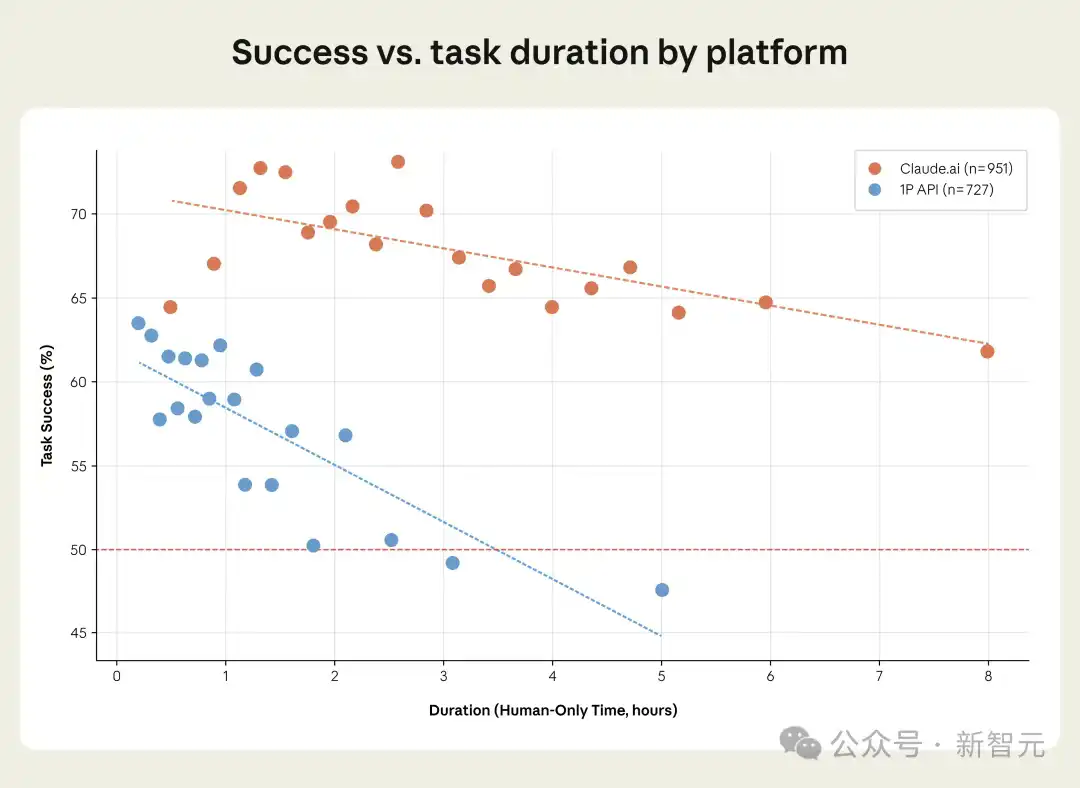
But in Anthropic's actual user data, this time limit is significantly extended.

In commercial scenarios using API calls, Claude can maintain a success rate of over 50% for tasks involving 3.5 hours of work.

And in the Claude.ai chat interface, this number is astonishingly pushed to 19 hours.

Why such a huge gap? The secret lies in human intervention.

Benchmark tests are AI facing the test alone, while real-world users break down a massive complex project into countless small steps, constantly correcting AI's course through feedback loops.

This human-AI collaborative workflow pushes the (50% success rate measured) task duration上限 (upper limit) from 2 hours to about 19 hours, nearly a 10-fold increase.

This might be the true shape of future work: not AI doing everything independently, but humans learning how to steer it through a marathon.

The Folded World Map: The Poor Learn Knowledge, the Rich Engage in Production

If we zoom out to a global perspective, we see a clear and slightly ironic "adoption curve".

In high per capita GDP developed countries, AI is already deeply embedded in productivity and personal life.

People use it to write code, create reports, and even plan travel itineraries.

But in countries with lower per capita GDP, Claude's primary role is "teacher," with大量 (a large number of) uses concentrated on coursework and educational tutoring.
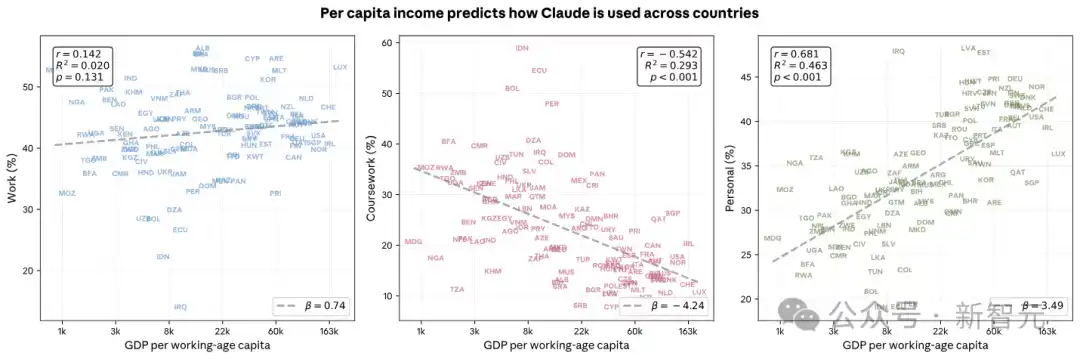
Beyond wealth disparity, this is also a manifestation of a technological gap.

Anthropic mentioned they are collaborating with the Rwandan government, trying to help people there leapfrog the mere "learning" phase and enter broader application layers.

Because without intervention, AI is likely to become a new barrier: people in wealthy regions use it to exponentially amplify output, while people in less developed regions are still using it to补习 (remedially learn) basic knowledge.

Workplace Concerns: The Specter of "Deskilling"

The most controversial and警惕 (warranting caution) part of the report is the discussion on "Deskilling".

Data indicates that the tasks currently covered by Claude require, on average, 14.4 years of educational background (equivalent to an associate degree), significantly higher than the 13.2 years required on average for overall economic activity.
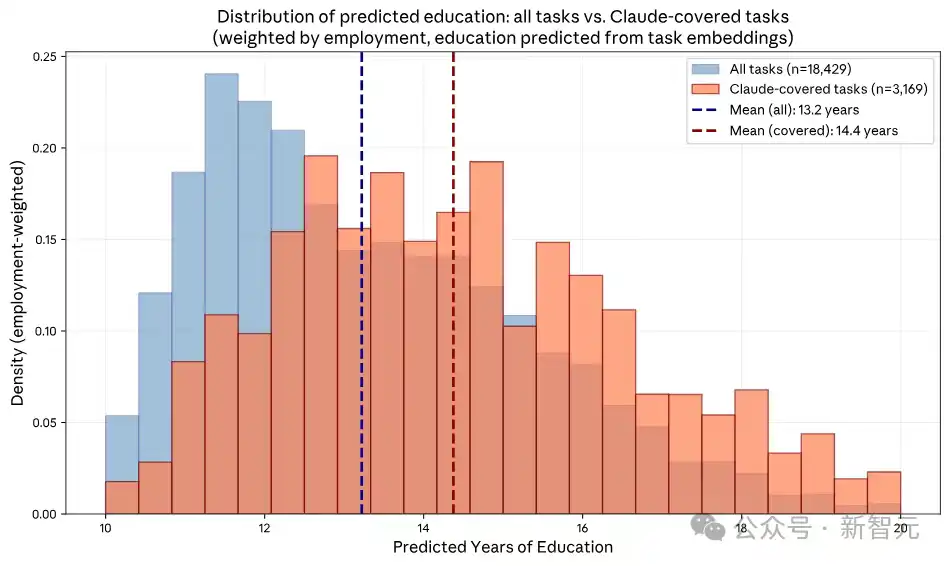
AI is systematically剔除 (removing) the "high-intelligence" parts of work.

For technical writers or travel agency agents, this could be disastrous.

AI takes over分析行业动态 (analyzing industry trends),规划复杂行程 (planning complex itineraries) — the tasks that require "brains" — leaving humans with only琐碎工作 (trivial tasks) like sketching or collecting invoices.

Your job remains, but the "gold content" of the job is hollowed out.

Of course, there are beneficiaries.

For example, real estate managers, when AI handles枯燥的行政工作 (tedious administrative work) like bookkeeping and contract comparison, can focus their energy on client negotiation and stakeholder management requiring high emotional intelligence—this is反而 (instead) a form of "Upskilling".

Anthropic cautiously states this is only an extrapolation based on the current situation, not an inevitable prophecy.

But the alarm it sounds is real.

If your core competitiveness is merely processing complex information, then you are at the eye of the storm.

A Return to the "Golden Age" of Productivity?

Finally, let's return to the macro perspective.

Anthropic revised its forecast for US labor productivity.

After剔除 (removing) possible AI errors and failures, they predict AI will drive productivity growth by 1.0% to 1.2% annually over the next decade.

This seems like a reduction of one-third compared to the previous optimistic estimate of 1.8%, but don't underestimate this 1 percentage point.

It is enough to bring US productivity growth back to the levels of the late 1990s internet boom.

Moreover, this is based solely on the model capabilities as of November 2025. With the entry of Claude Opus 4.5, and the gradual dominance of "augmented mode" (where people no longer try to dump all work on AI but collaborate with it more intelligently) in user behavior, this number has significant upside potential.

Conclusion

Reading through the entire report, what is most感慨 (striking) is not just how strong AI has become, but more how quickly humans are adapting.

We are undergoing a migration from "passive automation" to "active enhancement".

In this transformation, AI acts like a mirror; it takes over those tasks that require high education but can be completed through logical deduction, thereby forcing us to seek out value that cannot be quantified by algorithms.

In this era of computational surplus, humanity's scarcest ability is no longer finding answers, but defining problems.

References:

https://www.anthropic.com/research/economic-index-primitives

https://www.anthropic.com/research/anthropic-economic-index-january-2026-report

Preguntas relacionadas

QAccording to Anthropic's report, which type of tasks does AI accelerate the most?

AAI accelerates complex tasks that require a higher level of education the most. Tasks requiring a college degree see a 12x speedup, compared to a 9x speedup for tasks requiring only a high school education.

QWhat is the key finding regarding human-AI collaboration in terms of task duration?

AThe key finding is that human-AI collaboration dramatically extends the viable task duration. While benchmarks suggest AI's 50% success rate drops at 2-hour tasks, real-world collaborative workflows push this limit to approximately 19 hours.

QHow does the primary use of AI differ between high-GDP and low-GDP countries, as per the report?

AIn high-GDP countries, AI is primarily used for productivity and personal life enhancement (e.g., coding, reports). In low-GDP countries, its main role is as an educational tool for coursework and tutoring.

QWhat is 'deskilling' and which professionals are most at risk from it?

A'Deskilling' is the process where AI systematically removes the high-intellect, analytical parts of a job, leaving humans with more mundane tasks. Professionals like technical writers and travel agents, whose core value is processing complex information, are most at risk.

QWhat is Anthropic's revised forecast for AI's annual impact on US productivity growth over the next decade?

AAnthropic's revised forecast estimates that AI will boost US labor productivity growth by 1.0% to 1.2% annually over the next decade, a figure comparable to the growth rates seen during the late 1990s internet boom.

Lecturas Relacionadas

El nodo taiwanés en la cadena industrial de la IA: las 9 acciones taiwanesas que recomienda el 'nuevo dios de las acciones' Serenity

El "nuevo gurú bursátil" Serenity ha compartido su visión sistemática sobre la cadena de suministro de IA en Taiwán, destacando 9 acciones que cubren tres áreas clave: CPO (óptica en co-paquete), ASIC (circuitos integrados específicos) y semiconductores compuestos. Considera el CPO como "el mayor tema industrial de la próxima fase", citando proyecciones de Goldman Sachs de un crecimiento explosivo del mercado óptico global. Serenity afirma que no existe una burbuja en la cadena de suministro de IA taiwanesa y que el riesgo real no es geopolítico, sino que depende de los gastos de capital de los grandes proveedores de servicios en la nube. La columna vertebral de su tesis del CPO es la plataforma COUPE de TSMC, programada para producción en masa en 2026. Serenity identifica cinco acciones taiwanesas posicionadas en los cuellos de botella de esta cadena: **FOCI** (socio clave en FAU), **Shunsin Technology** (ensamblaje y prueba), **Xintec** (pruebas a nivel de oblea), **MSSCorps** (inspección y monopolio funcional en pruebas CPO) y **Nextronics** (conectores y disipación térmica). En la línea ASIC, destaca tres empresas vinculadas a chips personalizados de grandes hyperscalers: **Alchip** (diseño para los chips de AWS), **Unimicron** (sustratos ABF para NVIDIA, Google y AWS) y **MediaTek** (posible colaboración en diseño para los TPU de Google). Su inversión más firme es **Win Semiconductor**, un duopolio global en fundición de semiconductores compuestos (InP/GaAs), subestimado por el mercado a pesar de su papel crucial en futuras aplicaciones como comunicaciones ópticas de IA. Finalmente, señala que el riesgo principal para esta cadena de suministro no son las tensiones geopolíticas, sino una posible reducción en los gastos de capital de los grandes proveedores de nube como Microsoft, Amazon y Google. Una señal de alerta temprana fue la reciente caída de los semiconductores tras las guías de Broadcom. La dirección futura de los gastos de capital de estos hyperscalers será la variable clave a monitorizar.

marsbitHace 1 hora(s)

El nodo taiwanés en la cadena industrial de la IA: las 9 acciones taiwanesas que recomienda el 'nuevo dios de las acciones' Serenity

marsbitHace 1 hora(s)

La próxima evolución de las finanzas en cadena en la visión de Vitalik: ¿Cómo reestructurar DeFi con el 'pensamiento de opciones'?

Si has pasado más de un ciclo en la industria, reconocerás este patrón recurrente: durante movimientos extremos del mercado, los oráculos fallan, los bots de liquidación atacan y las posiciones se cierran en cadena en minutos, amplificando la presión vendedora y provocando crisis de liquidez en todo el ecosistema. Desde el "312" de 2020, eventos como el "519" o el "1011" han demostrado que la liquidación forzosa es un punto débil clave. Vitalik Buterin propone una idea disruptiva: ¿puede DeFi reemplazar el modelo tradicional de Posiciones de Deuda Colateralizada (CDP) y liquidaciones forzadas con un mecanismo basado en opciones? En su diseño, la exposición del usuario a un índice se desviaría de forma gradual (similar a una curva cuadrática) en lugar de sufrir una liquidación instantánea. Esto reduciría drásticamente la dependencia de oráculos en tiempo real y el riesgo de manipulación. El modelo CDP, pilar de protocolos como MakerDAO o Aave, permite usar criptoactivos como colateral para préstamos. Aunque fue fundamental para la composabilidad de DeFi, tiene desventajas claras: depende de oráculos precisos, amplifica las crisis en mercados volátiles y crea una ilusión de liquidez al asumir que siempre habrá compradores durante liquidaciones. La propuesta de Vitalik cambia el enfoque: en lugar de construir sobre deuda, se construiría sobre opciones. Un activo subyacente (por ejemplo, 1 ETH) se dividiría en dos instrumentos con perfiles de riesgo complementarios. Esto eliminaría las "liquidaciones duras", ya que el usuario no sería forzosamente cerrado en un umbral específico, sino que tendría un período para rebalancear su posición. Además, reduciría la exposición a ataques de MEV y la dependencia de oráculos de alta frecuencia. En un contexto donde surgen ecosistemas que priorizan la velocidad y experiencia de usuario, Ethereum debe responder por qué los usuarios deberían seguir usando su DeFi. La ventaja no está en replicar productos tradicionales con mayor apalancamiento, sino en ofrecer diseños con límites de riesgo más transparentes, mayor autonomía para el usuario y estructuras más robustas ante escenarios extremos. La evolución de DeFi no consiste solo en trasladar las finanzas tradicionales a la cadena, sino en usar la programabilidad para crear nuevas estructuras de riesgo.

marsbitHace 1 hora(s)

La próxima evolución de las finanzas en cadena en la visión de Vitalik: ¿Cómo reestructurar DeFi con el 'pensamiento de opciones'?

marsbitHace 1 hora(s)

Trading

Spot
Futuros
活动图片





