AI2 Releases Fully Open-Source Web Agent MolmoWeb: Controlling Web Pages Using Only "Vision"

marsbitPublicado a 2026-03-26Actualizado a 2026-03-26

Resumen

AI2 has released MolmoWeb, a groundbreaking, fully open-source web agent that operates solely by analyzing screenshots, marking a significant leap in vision-driven web navigation. Unlike traditional agents that rely on DOM, MolmoWeb captures and interprets visual data to make decisions—such as clicking, scrolling, or typing—making its process transparent and robust. Despite its compact size (4B and 8B parameters), MolmoWeb performs impressively: it scores 78.2% on the WebVoyager benchmark, nearing OpenAI’s proprietary o3 model (79.3%), and achieves up to 94.7% success with multiple attempts. It even surpasses Anthropic’s Claude3.7 in UI element localization. AI2 also released MolmoWebMix, a massive open dataset with 36K human-browsing tasks, over 2.2M screenshot-QA pairs, and GPT-4o-verified synthetic data. The model and data are fully available on Hugging Face and GitHub under Apache 2.0, promoting transparency and collaboration in AI development. Challenges remain in complex instructions, logins, and legal compliance.

The Allen Institute for Artificial Intelligence (AI2) recently released the groundbreaking fully open-source web agent MolmoWeb . Unlike traditional agents that rely on a webpage's underlying code (DOM), MolmoWeb makes decisions solely by reading screenshots, marking a significant leap forward in "vision-driven" web navigation technology.

Core Technology: "Seeing" Web Pages Like a Human

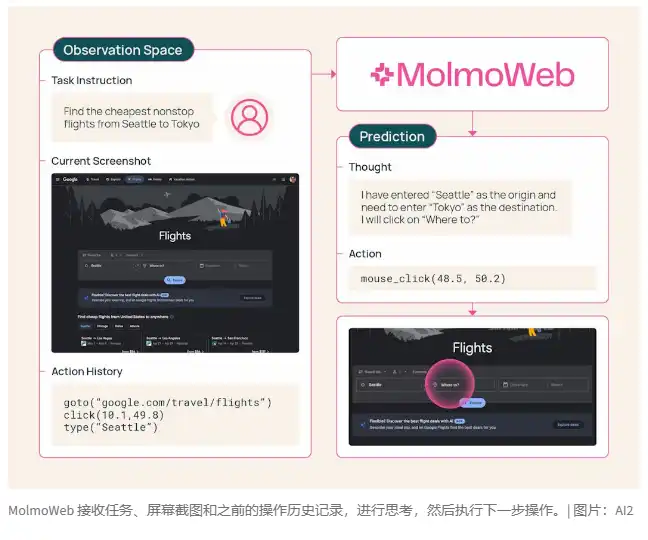
MolmoWeb's operating logic is very intuitive: it captures a screenshot of the current browser window, decides the next action (such as clicking, scrolling, or paging) through visual analysis, then executes it and repeats. This "what you see is what you get" model makes it more robust than traditional agents because the visual layout of a webpage is generally more stable than its underlying code, and its decision-making process is completely transparent and explainable to human users.
Performance Leap: Small Model Outperforms Giants

Despite having parameter sizes of only 4B and 8B, MolmoWeb demonstrates a "small but mighty" performance:

  • Topping the Charts: In the WebVoyager test, the 8B version scored an impressive 78.2%, not only ranking among the top open-source models but also approaching the performance of OpenAI's proprietary model o3 (79.3%).

  • Huge Potential: Research found that by running tasks multiple times and selecting the optimal result, its success rate could further jump to 94.7%.

  • Precise Localization: In UI element localization benchmark tests, it even surpassed Anthropic's Claude3.7.

Data Support: The Largest Open Dataset to Date

AI2 has not only open-sourced the model weights but also contributed a massive dataset named MolmoWebMix. This dataset contains:

  • 36,000 real browsing tasks completed by human volunteers.

  • Over 2.2 million screenshot-question-answer pairs.

  • Automated synthetic data verified by GPT-4o. Experiments show that synthetic data is even better than human trajectories at guiding the agent to find the "optimal path".

Open-Source Spirit and Future Challenges

Currently, MolmoWeb is fully available under the Apache 2.0 license on Hugging Face and GitHub. Although it still faces challenges in handling complex instructions, login authentication, and legal compliance (such as terms of service), AI2 firmly believes that only through complete transparency and community collaboration can we truly counter the data monopoly of large tech companies.


Preguntas relacionadas

QWhat is the name of the fully open-source web agent released by the Allen Institute for AI (AI2) that navigates using only screenshots?

AThe web agent is called MolmoWeb.

QHow does MolmoWeb's approach to web navigation differ from traditional web agents?

AUnlike traditional agents that rely on a webpage's underlying code (DOM), MolmoWeb makes decisions by reading and analyzing screenshots, making it a 'vision-driven' technology.

QWhat was the performance score of the 8B parameter version of MolmoWeb on the WebVoyager test, and how does it compare to OpenAI's model?

AThe 8B version scored 78.2% on the WebVoyager test, which is very close to the performance of OpenAI's proprietary model o3, which scored 79.3%.

QWhat is the name of the large, open dataset released alongside MolmoWeb, and what does it contain?

AThe dataset is called MolmoWebMix. It contains 36,000 real browsing tasks completed by human volunteers, over 2.2 million screenshot-QA pairs, and automated synthetic data verified by GPT-4o.

QOn which platforms has MolmoWeb been made available, and under what license?

AMolmoWeb has been fully released on Hugging Face and GitHub under the Apache 2.0 license.

Lecturas Relacionadas

Por qué el Bitcoin se mantiene en $64,000 tras la dura pausa de la Fed

Bitcóin cierra julio cerca de los 64.000 dólares tras una volátil reacción a la decisión de la Fed de mantener las tasas sin cambios, aunque sin indicar un pronto aflojamiento monetario. Esto ha provocado una rotación de capital hacia los ETF de Bitcoin, que registraron una entrada neta de 32,1 millones de dólares, mientras que los fondos de Ethereum experimentaron salidas. El mercado de criptomonedas, con una capitalización de unos 2,29 billones de dólares, se mantiene en un rango lateral, con Bitcoin encontrando soporte en 63.000-63.500 dólares y resistencia en 66.000 dólares. La Fed mantuvo su tasa clave, pero tres miembros votaron a favor de un aumento, señalando una postura más dura de lo esperada. En este entorno macroeconómico incierto, los inversores institucionales parecen favorecer a Bitcoin como activo principal, aunque persiste el interés selectivo en activos como Solana. Mientras, la aprobación de la ley CLARITY en EE.UU. se retrasa hasta después del receso de agosto. Para el último día de julio, el enfoque estará en los datos macro de EE.UU. El escenario base para Bitcoin es la consolidación entre 63.000 y 66.000 dólares, con su ruptura superior dependiendo de nuevos flujos institucionales. La estabilidad por encima de 63.000 dólares para BTC, el mantenimiento de Ethereum sobre 1.860 dólares y las entradas continuas en ETF son claves para una posible base de recuperación en la segunda mitad del año.

cryptonews.ruHace 2 hora(s)

Por qué el Bitcoin se mantiene en $64,000 tras la dura pausa de la Fed

cryptonews.ruHace 2 hora(s)

Parker Lewis responde por qué bitcoin sigue siendo el mejor dinero

El influyente analista de Bitcoin, Parker Lewis, critica las estrategias de marketing de corporaciones que actúan como tesorerías cripto. Advierte que la venta de "crédito digital" mediante acciones preferentes perpetuas distorsiona la esencia de la criptomoneda. Lewis enfatiza que Bitcoin no genera rendimiento fiduciario por diseño y que las promesas de dividendos son riesgosas, dependiendo de nuevos inversores. Destaca el riesgo de estos derivados, señalando que el mercado de acciones preferentes perpetuas es minúsculo comparado con el crédito global, lo que demuestra que los grandes actores evitan estos riesgos, trasladándolos a minoristas. Rechaza la idea de que Bitcoin es "demasiado volátil", argumentando que la volatilidad es una consecuencia natural de la adopción masiva de un activo con oferta fija e inelástica. En lugar de comprar derivados corporativos como acciones de MicroStrategy, recomienda adquirir Bitcoin directamente, considerándolo más seguro. Lewis alerta que este enfoque distrae de la verdadera amenaza: la rápida devaluación del dinero fiduciario. Ilustra la inflación real con su "Índice Ribeye", mostrando un aumento del 90% en el precio de un filete desde 2020, muy superior a las cifras oficiales. Concluye que la estrategia más prudente es la posesión directa de Bitcoin y el control total de las claves privadas, protegiendo así los ahorros de la inflación y los riesgos sistémicos de los derivados corporativos.

cryptonews.ruHace 2 hora(s)

Parker Lewis responde por qué bitcoin sigue siendo el mejor dinero

cryptonews.ruHace 2 hora(s)

Trading

Spot
活动图片




