AI2 Releases Fully Open-Source Web Agent MolmoWeb: Controlling Web Pages Using Only "Vision"

marsbitPublicado a 2026-03-26Actualizado a 2026-03-26

Resumen

AI2 has released MolmoWeb, a groundbreaking, fully open-source web agent that operates solely by analyzing screenshots, marking a significant leap in vision-driven web navigation. Unlike traditional agents that rely on DOM, MolmoWeb captures and interprets visual data to make decisions—such as clicking, scrolling, or typing—making its process transparent and robust. Despite its compact size (4B and 8B parameters), MolmoWeb performs impressively: it scores 78.2% on the WebVoyager benchmark, nearing OpenAI’s proprietary o3 model (79.3%), and achieves up to 94.7% success with multiple attempts. It even surpasses Anthropic’s Claude3.7 in UI element localization. AI2 also released MolmoWebMix, a massive open dataset with 36K human-browsing tasks, over 2.2M screenshot-QA pairs, and GPT-4o-verified synthetic data. The model and data are fully available on Hugging Face and GitHub under Apache 2.0, promoting transparency and collaboration in AI development. Challenges remain in complex instructions, logins, and legal compliance.

The Allen Institute for Artificial Intelligence (AI2) recently released the groundbreaking fully open-source web agent MolmoWeb . Unlike traditional agents that rely on a webpage's underlying code (DOM), MolmoWeb makes decisions solely by reading screenshots, marking a significant leap forward in "vision-driven" web navigation technology.

Core Technology: "Seeing" Web Pages Like a Human

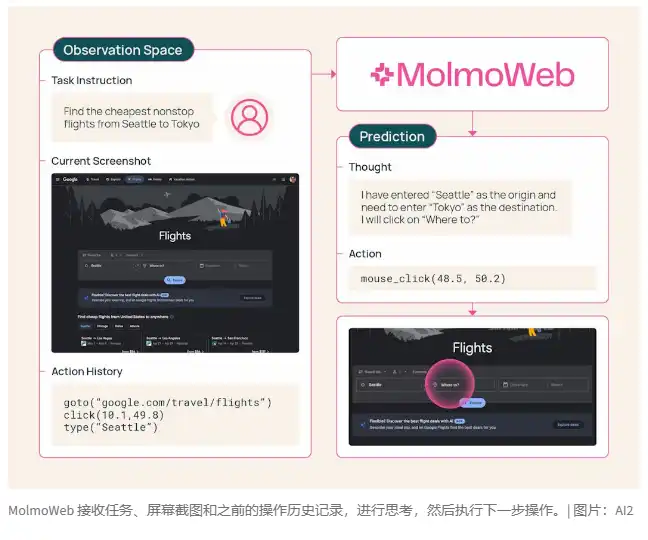
MolmoWeb's operating logic is very intuitive: it captures a screenshot of the current browser window, decides the next action (such as clicking, scrolling, or paging) through visual analysis, then executes it and repeats. This "what you see is what you get" model makes it more robust than traditional agents because the visual layout of a webpage is generally more stable than its underlying code, and its decision-making process is completely transparent and explainable to human users.
Performance Leap: Small Model Outperforms Giants

Despite having parameter sizes of only 4B and 8B, MolmoWeb demonstrates a "small but mighty" performance:

  • Topping the Charts: In the WebVoyager test, the 8B version scored an impressive 78.2%, not only ranking among the top open-source models but also approaching the performance of OpenAI's proprietary model o3 (79.3%).

  • Huge Potential: Research found that by running tasks multiple times and selecting the optimal result, its success rate could further jump to 94.7%.

  • Precise Localization: In UI element localization benchmark tests, it even surpassed Anthropic's Claude3.7.

Data Support: The Largest Open Dataset to Date

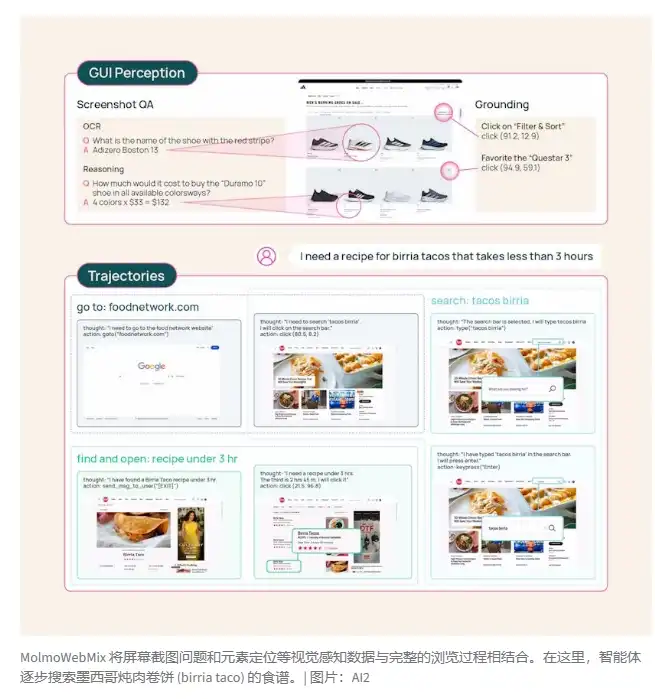
AI2 has not only open-sourced the model weights but also contributed a massive dataset named MolmoWebMix. This dataset contains:

  • 36,000 real browsing tasks completed by human volunteers.

  • Over 2.2 million screenshot-question-answer pairs.

  • Automated synthetic data verified by GPT-4o. Experiments show that synthetic data is even better than human trajectories at guiding the agent to find the "optimal path".
Open-Source Spirit and Future Challenges

Currently, MolmoWeb is fully available under the Apache 2.0 license on Hugging Face and GitHub. Although it still faces challenges in handling complex instructions, login authentication, and legal compliance (such as terms of service), AI2 firmly believes that only through complete transparency and community collaboration can we truly counter the data monopoly of large tech companies.


Preguntas relacionadas

QWhat is the name of the fully open-source web agent released by the Allen Institute for AI (AI2) that navigates using only screenshots?

AThe web agent is called MolmoWeb.

QHow does MolmoWeb's approach to web navigation differ from traditional web agents?

AUnlike traditional agents that rely on a webpage's underlying code (DOM), MolmoWeb makes decisions by reading and analyzing screenshots, making it a 'vision-driven' technology.

QWhat was the performance score of the 8B parameter version of MolmoWeb on the WebVoyager test, and how does it compare to OpenAI's model?

AThe 8B version scored 78.2% on the WebVoyager test, which is very close to the performance of OpenAI's proprietary model o3, which scored 79.3%.

QWhat is the name of the large, open dataset released alongside MolmoWeb, and what does it contain?

AThe dataset is called MolmoWebMix. It contains 36,000 real browsing tasks completed by human volunteers, over 2.2 million screenshot-QA pairs, and automated synthetic data verified by GPT-4o.

QOn which platforms has MolmoWeb been made available, and under what license?

AMolmoWeb has been fully released on Hugging Face and GitHub under the Apache 2.0 license.

Lecturas Relacionadas

No es que Jensen Huang quiera cambiar el PC, sino que el PC quiere revolucionarse a sí mismo

La industria del PC, con 40 años de historia, está experimentando una transformación radical. En junio de 2026, NVIDIA anunció el chip RTX Spark, su entrada al mercado de procesadores centrales para PCs con Windows, redefiniendo el concepto de AI PC con el respaldo de Microsoft y los principales fabricantes de hardware. Esta movida marca un punto de inflexión: el PC está evolucionando de un dispositivo operado por personas a una plataforma donde los usuarios colaboran con Agentes de IA locales, capaces de ejecutar tareas de forma autónoma. Microsoft ha reposicionado Windows como la plataforma nativa para estos agentes. El núcleo de la estrategia de NVIDIA es su ecosistema, con 6 millones de desarrolladores en CUDA. El RTX Spark, un SoC que integra CPU ARM, núcleos CUDA y memoria unificada, busca llevar este ecosistema del centro de datos al dispositivo personal, cambiando la estructura de poder histórica del dúo Wintel. La industria se mueve de una arquitectura centrada en la CPU a una centrada en SoCs de IA, siguiendo la senda marcada por Apple. Intel, con sus procesadores Panther Lake, y otros actores también avanzan en esta dirección. El cambio no lo impulsa un solo jugador, sino la tendencia tecnológica inevitable de la IA integrada localmente. La próxima década verá cómo se reinventa la computación personal, y la rapidez para adaptarse definirá a los ganadores.

marsbitHace 4 hora(s)

No es que Jensen Huang quiera cambiar el PC, sino que el PC quiere revolucionarse a sí mismo

marsbitHace 4 hora(s)

La SEC de EE.UU. quiere derogar una norma de 2005, ¿qué ven las acciones tokenizadas?

El 11 de junio, la SEC de EE. UU. propuso rescindir las Reglas 611 y 610(e) del Reglamento NMS, normas de 2005 que protegen las mejores cotizaciones en el mercado bursátil. La Regla 611 (norma de ejecución a través del precio) evita que las órdenes se ejecuten ignorando ofertas mejores en otros centros de negociación. La Regla 610(e) restringe las cotizaciones bloqueadas y cruzadas. La SEC argumenta que el mercado, ahora altamente automatizado y fragmentado, ha evolucionado, y que estas reglas añaden complejidad y costos de cumplimiento innecesarios, limitando la innovación. Su eliminación podría dar a los centros de negociación y brókeres más flexibilidad en el enrutamiento de órdenes y los mecanismos de ejecución. Esta propuesta es relevante para Web3 y las acciones tokenizadas, ya que la SEC menciona explícitamente que tecnologías como DLT y los contratos inteligentes permiten nuevas formas de negociación de valores. Las normas actuales, centradas en un marco de protección de cotizaciones, pueden no ser compatibles con mercados potencialmente las 24 horas y mecanismos como AMM en cadena. Una relajación de estas reglas podría abrir espacio para probar estructuras de negociación más innovadoras y eficientes para activos tokenizados, aunque persisten otros desafíos regulatorios clave. La propuesta está en período de comentarios públicos. La SEC estima que la eliminación podría ahorrar entre 54,2 y 77 millones de dólares anuales en costos de cumplimiento.

Foresight NewsHace 5 hora(s)

La SEC de EE.UU. quiere derogar una norma de 2005, ¿qué ven las acciones tokenizadas?

Foresight NewsHace 5 hora(s)

Trading

Spot
Futuros
活动图片