AC Exits Sonic Board, 'DeFi Godfather' Pulls Off Another Strategic Retreat

marsbitPublicado a 2026-06-22Actualizado a 2026-06-22

Resumen

Andre Cronje, known as the "DeFi Godfather," and two other founding directors have stepped down from the Sonic Labs board. The S token, once valued at $1.03, has plummeted 97% to $0.028, and the chain's TVL has evaporated 98% from its peak. In his exit statement, Cronje clarified he was a technical architect, not a founder, and distanced himself from token economics and migration decisions behind the token's crash. Cronje revealed his focus for the past 18 months has been his new project, Flying Tulip. This project raised $200 million privately last year at a $10 billion valuation. Its token design includes a perpetual put option (ftPUT NFT) for early investors, allowing them to redeem their initial investment at any time—a protection not extended to public market buyers. This pattern mirrors Cronje's past exits from projects like Yearn Finance and Fantom, where he departed near peak hype, leaving later holders to bear significant losses. Sonic itself has seen a complete management overhaul in recent months. The article frames this as a microcosm of the broader crypto bear market, where Layer-1 chains are bleeding value. It highlights a harsh reality: a project's valuation is often tied to a founder's reputation rather than fundamentals. Ironically, Flying Tulip is set to launch first on the Sonic chain Cronje just left, underscoring a disconnect between the person and the platform.

Author: Kuli, Deep Chao TechFlow

My feeling about crypto this year is probably this: watching the U.S. stock market hitting new highs every day, then opening my own portfolio, staying silent for three seconds, and closing it.

BTC has fallen by nearly 20% year-to-date, ETH has performed even worse, and altcoins—let's not even mention them. In such a market, it wouldn't be news if any public chain's token dropped 90%. But even colder than the prices is the feeling of abandonment.

On June 19, DeFi Godfather AC, along with two other founding directors, exited the Sonic Labs board. The S token was trading at $0.028 at the time, just a fraction of its peak of $1.03 at the beginning of the year. On-chain TVL had plummeted from a high of $1.14 billion last May to $20 million. According to DefiLlama data, that's a 98% evaporation.

The industry's reaction to AC's departure was muted. After all, he quit the space once in 2022, only to return later. This exit statement was also standard, saying he "remains bullish on Sonic" but will no longer be involved in business decisions.

But the next part was the real sting.

He said his primary focus for the past 18 months has been on Flying Tulip. This project raised a $200 million private placement last August at a $1 billion valuation, and opened a public sale on CoinList this February. The investors include names like Brevan Howard, DWF Labs, and Susquehanna.

In other words, during the exact period S was dropping from $1.03 to $0.028, AC was busy setting the stage for a brand-new billion-dollar project.

The real kicker is Flying Tulip's token design.

Primary subscription investors receive an NFT called ftPUT, which is essentially a perpetual put option. If they incur losses, they can burn the token at any time and redeem their principal at the original price. The CoinList public sale page clearly states, in bold, that the FT tokens (the tradable tokens, i.e., the normal coins) bought on the open market do not carry this right—only primary participants have it.

In contrast, S holders who bought on the secondary market are stuck with $0.028 being $0.028. No floor, no redemption, no safety net written by anyone...

Not My Fault

AC posted his exit statement on X. It was short, but every sentence seemed carefully measured.

He said he joined Fantom as a technical advisor in 2018 and only formally became a director in December 2022. He was not Fantom's founder, never was, just the earliest technical architect. He was responsible for the underlying technology, including Sonic's core system and cross-chain gateway.

Then came the key paragraph, which roughly translates to:

"I am responsible for the technical decisions I led, but decisions regarding the migration, airdrop, tokenomics, and disposition of the old network—I was not the initiator, nor the final decision-maker."

With one sentence, he absolved himself from the S token's 97% drop. I built the tech, the tech is fine. As for why the coin you bought fell from a dollar to three cents, those were someone else's decisions.
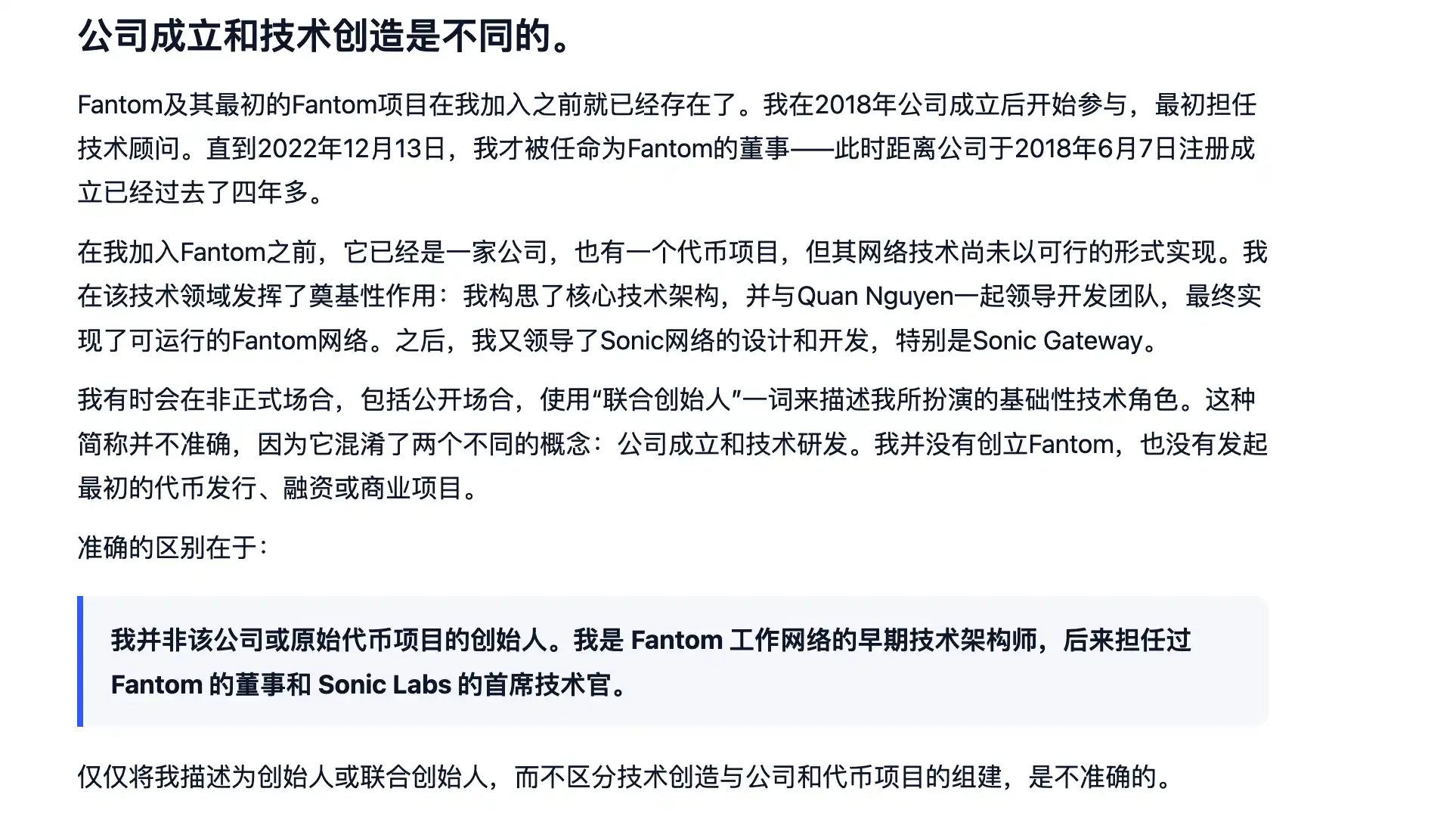
The author won't comment on whether this claim holds water, but one must admit this separation is impressively clean.

When most project founders abandon ship, they either go silent or issue vague statements full of "we" and "the team," diluting responsibility into a murky soup. AC is different. He draws his responsibility boundaries with extreme precision, so precise it's hard to argue, because he indeed didn't manage tokenomics.

And this wasn't a spur-of-the-moment idea.

In March 2022, AC announced his exit from the crypto industry, citing regulatory pressure and burnout. At the time, Fantom's TVL evaporated nearly a third within a week, drawing a torrent of community criticism. He quietly returned a few months later, returning to work on Sonic's technical overhaul.

He left saying he was tired, returned without fanfare, and now leaves again saying, "I've actually been busy with other things for the past 18 months."

As for Sonic? In the half-year before his departure, its executive team was completely overhauled. CEO Mitchell Demeter, hired just last September, resigned in February, along with the head of business. After the CEO left, the board stepped in to manage for a few months. Now the board has also stepped down, replaced by a new CEO, Matt Visser, who has never managed a public chain operation at the front lines.

In five months, the entire management team from top to bottom has been replaced. Sonic's official statement didn't sugarcoat it either, directly stating, "The token price dropped, community sentiment dropped, we're not going to pretend it didn't happen."

This kind of "hands-up honesty" is rare in the crypto industry. But the problem is, the ones telling the truth are the new team, while the one leaving is the one whose name carries value.

The Script for a Strategic Retreat

Looking back at AC's trajectory over the past few years reveals a pattern.

2020: Wrote Yearn Finance, the iconic product of DeFi Summer, with TVL once soaring to tens of billions of dollars. He essentially let it go not long after, and Yearn ran on its own. It ran okay, but it had little to do with him anymore.

Next, he worked on Fantom's technical architecture. Fantom rallied for a while. In March 2022, he announced his exit. Fantom subsequently entered a long, slow decline, later rebranding as Sonic and relaunching. He returned with a CTO title. Sonic's TVL initially broke through a billion but then collapsed all the way down to its current state.

Every time, he disengaged at the peak of hype or just as it started cooling, moving on to the next thing. Every time, holders of the old project bore most of the decline after his departure.

Flying Tulip is his fourth project to date. The author thinks this time, he might have truly absorbed the lessons from previous experiences and baked them into the token design.
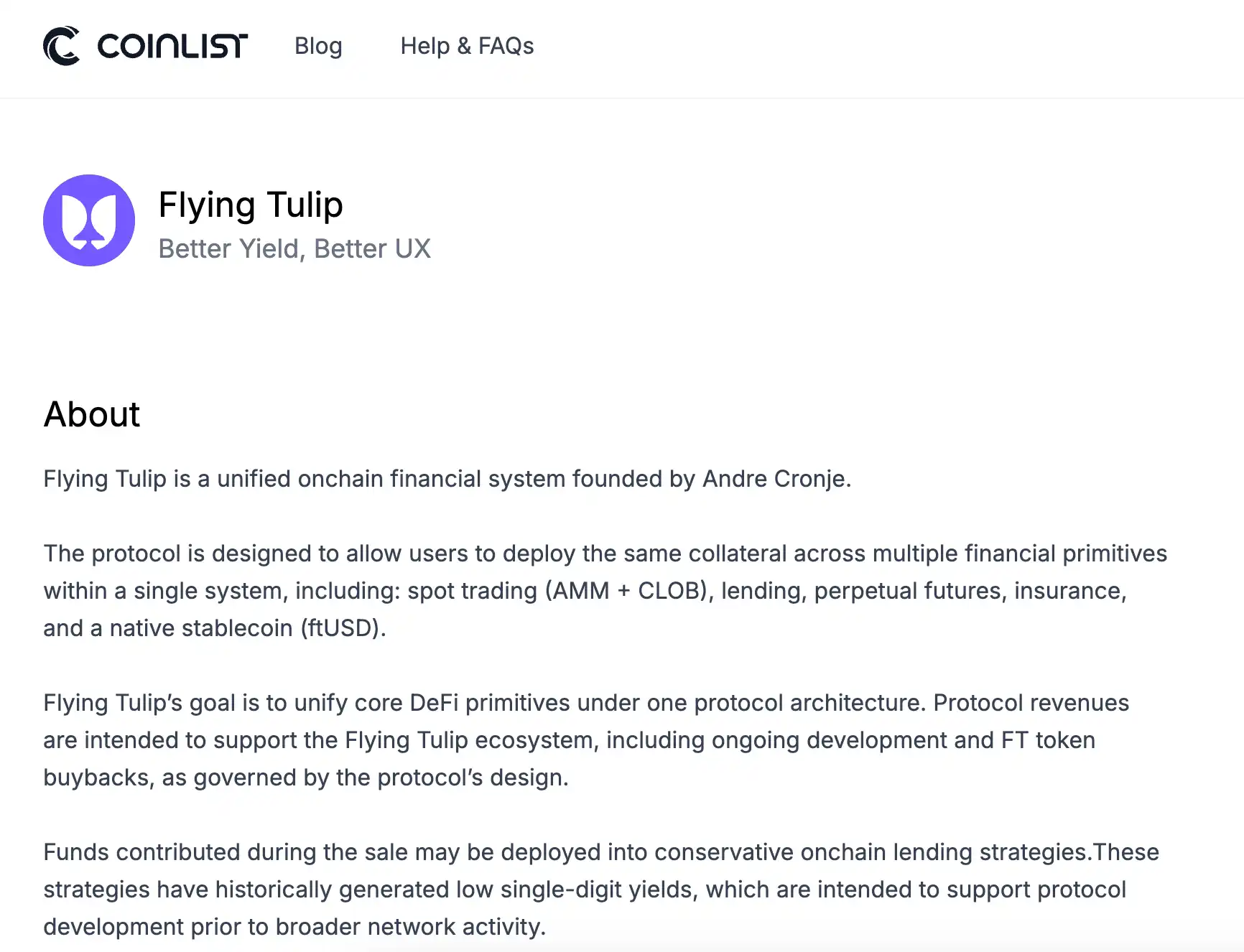
When you participate in Flying Tulip's public sale on CoinList, spending $0.10 to buy an FT, you don't receive the token directly. Instead, you get an NFT called ftPUT, with the token locked inside. This NFT is that perpetual put option. You have three choices.

First, do nothing. The token remains in the NFT, non-tradable, but the redemption right persists. Whenever you want to leave, burn the token and get your USDC or ETH back at the original price. Regardless of how low the FT price falls on the secondary market, your principal has a floor.

Second, extract the tokens from the NFT to trade freely. But the moment you extract them, the redemption right is permanently forfeited. The principal corresponding to the extracted tokens is released to the protocol for buyback and burn.

Third, extract some, keep some. The portion kept in the NFT continues to have protection; the extracted portion goes naked.

AC himself said something very interesting in an interview with The Block, the gist being that because of the perpetual PUT's existence, the funds raised essentially cannot be spent at all.

The net funds raised are zero. So where does operating capital come from?

All raised capital is placed into lending protocols like Aave and Ethena for conservative strategies, targeting around 4% annual yield. Based on a full raise of $1 billion, this would generate approximately $40 million in interest annually. This money funds the team, development, and buybacks. The team has no initial token allocation; all FT tokens must be bought back by the protocol from the open market using protocol revenue.

The author must admit, this design is quite ingenious within DeFi. It addresses the foulest problem in the crypto industry in recent years: project founders taking the money and running, or spending it recklessly, leaving investors with nothing. AC's solution essentially ties his own hands: the money can't be touched, the team gets no pre-allocated tokens, and investors can exit at any time.

But ingenious as it is, this protection exists only in the primary market. Once FT is listed on exchanges, tokens bought on the secondary market do not come with ftPUT. This sentence is written in bold on CoinList's page.

Buyers on the open market see the same token but receive completely different treatment.

A Microcosm of the Industry

Money is flowing out of the crypto market this year—that's no secret.

BTC has fallen nearly 20% year-to-date, and the median drop for altcoins far exceeds that. People in the circle look at the Nasdaq hitting new highs, then switch back to their own holdings—the feeling needs no description.

Many people's real strategy this year has been slowly shifting their positions into U.S. stocks and stablecoin yield products. On-chain activity is visibly shrinking.

In this environment, AC's exit from Sonic is just the tip of the iceberg. The entire L1 sector is experiencing the same story: TVL contraction, user attrition, founding team changes, or direct disappearances. Sonic just gets highlighted as a case study because of its fame and extreme decline.

But AC's case has a layer other projects lack.

Flying Tulip's current valuation is about $1 billion. Sonic's current market cap is about $100 million. The same person, the same period, one at $1 billion, the other at $100 million—a tenfold difference. What's the distinction? The distinction lies in which project AC's name is attached to.

This is a fact few in the DeFi industry are willing to voice openly.

The valuation of many projects isn't built on revenue, users, or technological moats—it's built on a person's name. The name stays, the money stays. The name leaves, the money follows.

The bear market ripped off this fig leaf. In a bull market, all L1s rise, making it hard to distinguish whether fundamentals or a name is propping it up. When the tide recedes, what remains becomes clear.

There's one more detail the author finds most interesting.

Flying Tulip's primary deployment chain is Sonic. AC exited Sonic's board, no longer involved in any business decisions, but his new project's first stop is on Sonic. He's gone, but his business remains.

The captain has disembarked, but opened a new shop on the dock, selling things more expensive than what was on the ship.


Preguntas relacionadas

QWho is AC and what is his recent major action mentioned in the article?

AAC, known as the 'DeFi Godfather,' is a prominent figure in the decentralized finance space. According to the article, his recent major action is stepping down from the Sonic Labs (formerly Fantom) board of directors on June 19, along with two other founding directors.

QWhat is the main difference in token design between AC's previous project Sonic (S) and his new project Flying Tulip (FT)?

AThe key difference lies in the investor protection mechanism. Flying Tulip's private investors receive an ftPUT NFT, which is a perpetual put option allowing them to redeem their principal at the original price. Secondary market buyers of FT tokens on platforms like CoinList do not have this right. In contrast, Sonic's S token had no such protection mechanism for secondary market holders.

QHow does AC explain his role and responsibilities regarding Sonic's decline in his exit statement?

AIn his exit statement, AC clearly delineates his responsibilities. He states he was responsible for the core technical architecture and decisions but explicitly distances himself from decisions related to the token migration, airdrop, tokenomics, and handling of the old network. He implies he is not responsible for the S token's 97% price drop, attributing it to others' decisions.

QWhat pattern does the article suggest exists in AC's involvement with past projects like Yearn Finance and Fantom/Sonic?

AThe article suggests a recurring pattern where AC is heavily involved during a project's initial hype or peak phase, then steps away or reduces involvement just before or during a significant decline. This was observed with Yearn Finance, Fantom, and now Sonic, leaving token holders to bear the brunt of the subsequent price drops.

QAccording to the article, what broader industry trend does AC's exit from Sonic represent in the current crypto market?

AAC's exit from Sonic is presented as a symptom of a broader trend in the Layer-1 (L1) blockchain sector during the bear market. The article highlights that many L1 projects are experiencing collapsing Total Value Locked (TVL), user exodus, and founder/team departures. It underscores the reality that many project valuations are heavily reliant on founder reputation ('the name') rather than fundamentals, a weakness exposed when market conditions deteriorate.

Lecturas Relacionadas

Resumen Semanal de Financiación | Crypto.com obtiene 400 millones de dólares de inversión, los sectores CeFi y de stablecoins siguen atrayendo capital

**Resumen Financiero Semanal: Cripto y IA Acaparan Grandes Inversiones** La semana pasada, los mercados de capitales de cripto y IA experimentaron una actividad significativa. En el sector cripto, se registraron 17 rondas de financiación, sumando más de 812 millones de dólares, mostrando una concentración de capital en transacciones grandes. El titular principal fue la ronda de 400 millones de dólares para el exchange **Crypto.com**, respaldada por Citadel Securities, valorando la empresa en 200.000 millones. Otras operaciones destacadas en finanzas centralizadas (CeFi) e infraestructura incluyeron 135 millones para el bróker API **Alpaca** y 70 millones para la plataforma bancaria transfronteriza **Flex**. El sector de **infraestructura y herramientas** recaudó fuertes sumas, con proyectos enfocados en pagos con stablecoins y liquidación, como **Cyclops** (20 millones) y **Pact Labs** (7 millones liderados por Tether). **Glacis Labs**, una plataforma de liquidación, levantó 6,8 millones. La **IA y la robótica** dominaron las megainversiones fuera del ámbito cripto. **Fireworks**, servicio en la nube para IA, recaudó 1.500 millones con respaldo de NVIDIA. En robótica, **Walden Robotics** (separada de Toyota) y la china **逐际动力 (Climber Robotics)** completaron rondas de 300 y casi 200 millones, respectivamente, para el desarrollo de robots humanoides. Otras áreas con actividad fueron DeFi, mercados de predicción y AI+Web3, con rondas menores. Además, se reportaron varias adquisiciones estratégicas, como la de MoonPay sobre la startup de depósitos Glide. En general, el capital continúa fluyendo hacia segmentos maduros como CeFi, stablecoins e infraestructura de trading en cripto, mientras que la IA y la robótica atraen apuestas masivas de capital riesgo para su comercialización.

marsbitHace 55 min(s)

Resumen Semanal de Financiación | Crypto.com obtiene 400 millones de dólares de inversión, los sectores CeFi y de stablecoins siguen atrayendo capital

marsbitHace 55 min(s)

¿El mercado bajista más moderado? Los bajistas del BTC cierran posiciones, ARK y Bitwise colectivamente son optimistas

**Resumen:** El 20 de julio, BTC se mantenía cerca de 75.000 USD, mientras que ETH retrocedía a 1.900 USD tras acercarse a los 2.000 USD. El mercado altcoin se mostraba mayormente débil. En las últimas 24 horas, se liquidaron 116 millones de USD en contratos, principalmente posiciones cortas (62.7 millones). El índice de miedo se sitúa en 35, indicando un sentimiento de pánico. Las perspectivas de diversas instituciones y analistas sugieren un posible punto de inflexión. **Polymarket** indica una probabilidad del 33% de que BTC caiga por debajo de 50.000 USD este año. **ARK Invest** señala señales de agotamiento de los vendedores, como el aumento de la ofente en manos de "hodlers" a largo plazo y del suministro en pérdidas (~54%). **Bitwise** describe esta caída como el "mercado bajista estructuralmente más suave" registrado, con una corrección del ~50% desde máximos, menor que en ciclos anteriores. Destaca que los inversionistas institucionales están comprando en la baja y que la base de cada ciclo es más alta. El análisis técnico de **Bit** sugiere que el mínimo de la onda C podría haberse formado, con un rango de soporte clave entre 59.000 y 70.000 USD. Sin embargo, **Glassnode** advierte que si BTC no logra superar con fuerza los 66.000 USD, el riesgo de un techo local aumenta. El analista **Darkfost** resalta la intensa zona de soporte entre 59.000 y 70.000 USD, donde se ha intercambiado el 50% del suministro circulante. Finalmente, el trader **Doctor Profit** anunció haber cerrado todas sus posiciones cortas (reportando grandes ganancias) y haber comenzado a comprar BTC spot desde los 64.000 USD, su primera compra para largo plazo desde septiembre de 2025. Argumenta que el consenso del mercado que espera mínimos más bajos en septiembre/octubre podría estar equivocado, y que el fondo del ciclo podría llegar antes de lo esperado, citando también avances regulatorios e institucionales como motivos estructurales para su cambio de postura.

Foresight NewsHace 1 hora(s)

¿El mercado bajista más moderado? Los bajistas del BTC cierran posiciones, ARK y Bitwise colectivamente son optimistas

Foresight NewsHace 1 hora(s)

Evolución del orden en la era de la IA y Web3: Las dimensiones competitivas y los caminos de exploración de m&W

La humanidad está evolucionando de la mejora de la productividad a la reconfiguración de las relaciones de producción. La rápida evolución de los Agentes de IA está liberando una capacidad productiva sin precedentes. En este contexto, la colaboración a largo plazo entre humanos y agentes de IA requiere la construcción de relaciones de confianza, la evaluación de contribuciones complejas y mecanismos de distribución de valor justos y sostenibles. Mientras que Web3 ha sentado bases técnicas para la desconfianza en activos e identidades, la era de los Agentes de IA exige un nuevo sistema de orden que aborde crédito, colaboración e incentivos económicos. El artículo analiza el enfoque de m&WDAO, que propone EcoFi (Finanzas/Orden del Ecosistema), un modelo que busca conectar activos cognitivos humanos, capacidades de ejecución de agentes de IA y mecanismos económicos on-chain. Se exploran y contrastan varias direcciones existentes: * **Colony**: Enfocado en gobernanza y colaboración organizacional humana basada en contribución (reputación). * **SingularityNET (ASI)**: Centrado en la creación de un mercado abierto para el intercambio y composición de servicios de IA. * **Gitcoin Passport / Verax**: Especializados en infraestructura de verificación de identidad y resistencia a sybil. * **Farcaster / Lens Protocol**: Orientados a redes sociales y de información descentralizadas con identidad propia. Frente a estos enfoques, m&W busca una integración más profunda, proponiendo una evolución en tres etapas: 1. **m&W 1.0 - Anclaje de Crédito**: Selección de nodos de alta calidad ("Builders") y sedimentación de sus contribuciones en activos de crédito no transferibles (SBT). 2. **m&W 2.0 - Economía Colaborativa**: Implementación del protocolo EcoFi, donde el crédito se conecta con tareas reales, utilizando una verificación híbrida (IA + juicio humano + arbitraje) para tareas no estructuradas y creando un ciclo de retroalimentación valor-crédito. 3. **m&W 3.0 - Orden Inteligente**: Evolución hacia una economía de agentes, donde el historial de crédito humano sirve como base de confianza para que sus "gemelos digitales" (Agentes de IA) participen autónomamente en la red económica. El camino presenta desafíos significativos como el arranque frío por el filtrado estricto, el equilibrio entre verificación por IA y gobernanza humana, y la estabilidad del modelo económico del token ($CMW). La misión final de m&W no es ser otra plataforma de IA, sino explorar los cimientos de un nuevo orden productivo para la economía colaborativa humano-IA, utilizando blockchain para establecer credibilidad, reglas y un marco económico sostenible.

链捕手Hace 1 hora(s)

Evolución del orden en la era de la IA y Web3: Las dimensiones competitivas y los caminos de exploración de m&W

链捕手Hace 1 hora(s)

China arrasa con puntajes perfectos en la IMO 2026, el Shanghai High School barre con el oro, GPT-5.6 revive el momento AlphaGo

¡China arrasa en la IMO 2026 con puntuación perfecta y la inteligencia artificial alcanza un hito! El equipo chino se ha proclamado campeón absoluto en la 67ª Olimpiada Internacional de Matemáticas (IMO) celebrada en Shanghái, logrando una hazaña histórica. Consiguieron el primer puesto por equipos con 232 puntos, superando por 25 puntos al segundo clasificado. Todos sus miembros obtuvieron medalla de oro. Tres estudiantes, Deng Leyan y Zhang Bolun de la Escuela Secundaria Shanghái, y Liu Che de la Escuela Secundaria Afiliada a la Universidad Normal del Este de China, lograron la puntuación perfecta de 42 puntos. Estados Unidos y Rusia completaron el podio. Este es el 26º título por equipos para China desde 1989. Destaca que, por primera vez, la IMO se celebró en una escuela secundaria (la Escuela Secundaria Shanghái), institución que acumula ya 20 oros olímpicos. La noticia va más allá del éxito humano. Se reporta que la inteligencia artificial, específicamente el modelo GPT-5.6 Pro, resolvió por sí solo los seis problemas de la IMO 2026 en su primer intento, sin intervención humana. Si se confirma, este logro marcaría un punto de inflexión: la IA pasaría de encontrar soluciones mediante búsqueda computacional a generar demostraciones perfectas a la primera, un dominio que hasta ahora parecía exclusivo de las mentes matemáticas más brillantes. OpenAI ofreció una suscripción anual de ChatGPT Pro a todos los ganadores de la medalla de oro. Fuentes: Sitio oficial de la IMO 2026 y publicaciones en redes sociales.

marsbitHace 1 hora(s)

China arrasa con puntajes perfectos en la IMO 2026, el Shanghai High School barre con el oro, GPT-5.6 revive el momento AlphaGo

marsbitHace 1 hora(s)

Trading

Spot
活动图片