Farewell to the Copper Era: Understanding the Logic of the AI Silicon Photonics Industry Chain and Key US Stock Players

marsbitPublicado a 2026-05-19Actualizado a 2026-05-19

Resumen

**Summary: The Era of Silicon Photonics and Key AI Infrastructure Stocks** The article delves into the transition from copper-based interconnects to silicon photonics (SiPh) as a critical enabler for next-generation AI data centers. It explains that copper faces fundamental physical limits—the bandwidth wall, density wall, and power wall—at high data rates (1.6T+), making a material shift essential. Silicon photonics, which integrates components like lasers, modulators, and detectors onto a silicon chip, offers a solution by leveraging mature CMOS manufacturing for cost-effective, high-volume production. A key challenge is that silicon itself is not an efficient light source, making Indium Phosphide (InP) lasers a critical and supply-constrained component. A major industry catalyst was NVIDIA's 2025 GTC announcement, declaring optical interconnects a "standard" from its Rubin platform onward, followed by strategic investments to secure the supply chain. The industry is structured in four key layers: 1. **Foundries:** TSMC leads with its COUPE platform, while Tower Semiconductor (specialized SiPh foundry) and GlobalFoundries are major players. 2. **Core Component Suppliers:** Lumentum is highlighted as the sole volume manufacturer of the crucial 200G/lane EML laser, with orders locked by NVIDIA through 2027. 3. **Module & System Manufacturers:** Coherent holds significant market share, with Chinese manufacturers like InnoLight also noted for scale. 4. **System Integrato...

Author: Godot

The two hottest sectors in AI are storage and photonics. Previously, I wrote a framework on storage (Understanding the Profit Pools and Industry Landscape of AI Storage Tiers). This article focuses on photonics.

Silicon photonics (Silicon Photonics) is used for communication between computing chips, replacing traditional copper wires, as clearly shown in the diagram below.

Terms you might come across but find confusing, such as LPO (Linear-drive Pluggable Optics), CPO (Co-packaged Optics), OCS (Optical Circuit Switching), and Optical I/O (Optical Input/Output), represent different technical approaches to implementing silicon photonics.
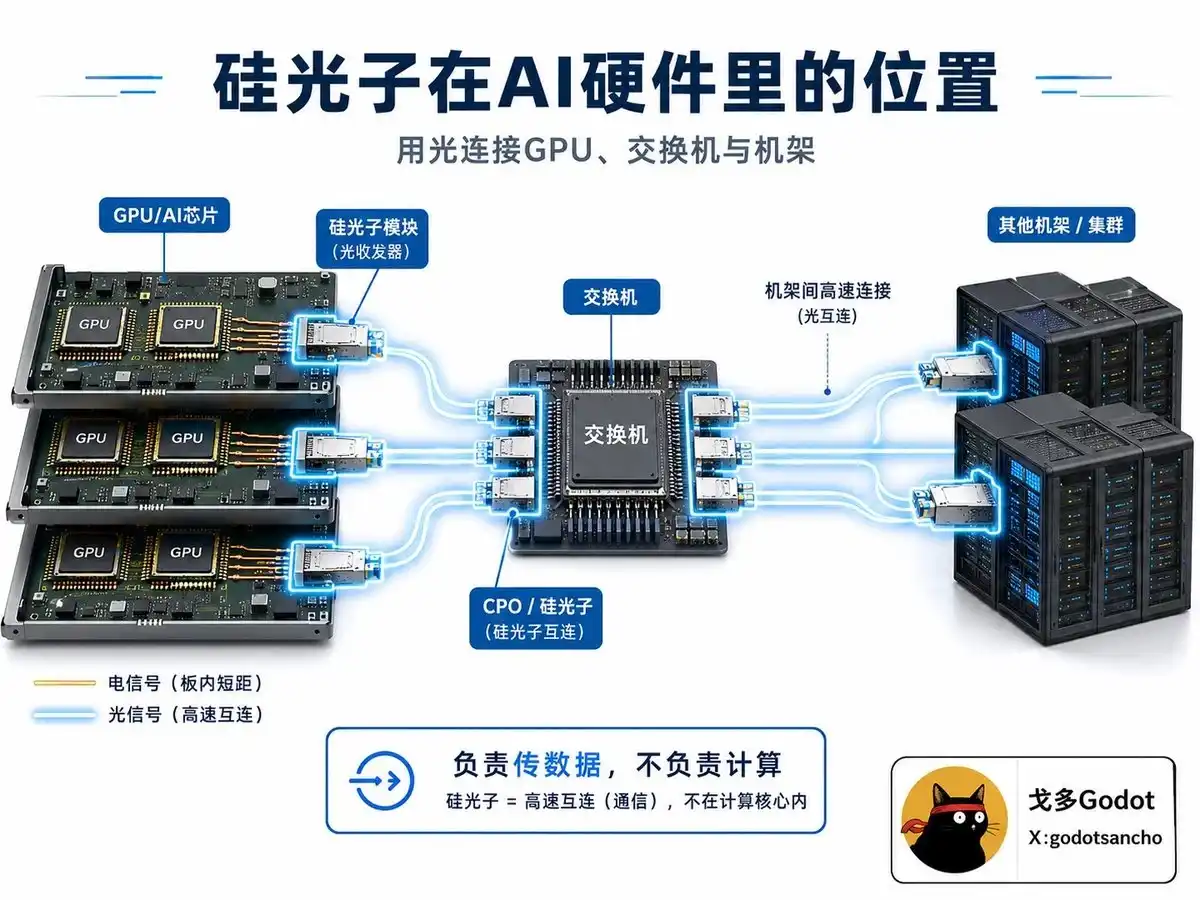
Typically, chips communicate using copper wires. Silicon photonic chips integrate components like lasers (which generate light), modulators (which "modulate" light), and *detectors* (which "receive" light) directly onto silicon wafers, enabling communication via photons.

So, why replace copper? And why use silicon photonics instead of other alternatives?

First, copper wires nearly reach their physical limits when transmitting signals above 1.6T, leading to signal degradation. Switching materials becomes imperative. This is the most critical issue and a necessary change. The technical term is the "bandwidth wall."

Second, copper is a tangible physical entity. As GPU clusters expand, there simply isn't enough space for all the copper wiring. This is another compelling reason to replace copper. Photonics are different; optical interfaces can be soldered directly next to switch chips, eliminating the need for extensive cabling. The term for this is the "scale wall."

Third, copper consumes too much power. In facilities consuming hundreds of megawatts, silicon photonics can save tens of thousands of kilowatt-hours daily—energy otherwise wasted on copper wire communication. After switching to photonics, this power can be redirected to GPUs for actual computation. This is termed the "power wall."

More interestingly, silicon photonics can leverage the mature CMOS manufacturing processes of the existing semiconductor industry, eliminating the need to build entirely new factories from scratch, thus enabling low-cost, high-volume production.

Of course, silicon photonics also has a drawback: silicon itself cannot emit light efficiently and must rely on Indium Phosphide (InP) materials. This has become the most critical bottleneck in the entire supply chain.

The Evolution of Silicon Photonics Technology

The most significant watershed moment was in March 2025 when NVIDIA, at its GTC conference, launched the Quantum-X and Spectrum-X photonic switches. Jensen Huang announced that starting from the next-generation Rubin architecture, "optical interconnect is not an option, it's a requirement."

A week later, NVIDIA announced a combined $4 billion investment in Coherent and Lumentum to secure key supply chains.

The paper on the silicon-based photoelectric effect was published in the 1980s. From 2004 to 2014, Intel and IBM manufactured silicon-based optical modulators.

In the previous decade, hyperscale cloud service providers like AWS, Google, and Meta adopted silicon photonics, though at the time it was only a part of fiber optic communication.

Current Industry Landscape

1) The Foundation: Foundries

They manufacture photonic chips. TSMC $TSM leads with its COUPE process. Tower Semiconductor $TSEM specializes in silicon photonics foundry services, with its silicon photonics revenue growing 70% year-over-year in 2025. GlobalFoundries $GFS, through its acquisition of Singapore's AMF, has become the world's largest dedicated silicon photonics foundry.

2) The Second Tier: Core Component Suppliers

They provide components like lasers and modulators, primarily Indium Phosphide (InP) lasers. Globally, fewer than five companies can manufacture high-speed EML lasers.

Lumentum $LITE is the only manufacturer capable of mass-producing 200G/lane EML lasers, a core component for 1.6T optical modules. To lock in its capacity, NVIDIA has secured orders extending beyond 2027.

3) The Third Tier: Module and System Manufacturers

They assemble components into finished products. Coherent holds about 25% of the global optical transceiver market share. Chinese companies like InnoLight, Eoptolink, and Accelink are significant contenders in terms of manufacturing scale and cost competitiveness.

4) The Top Tier: System Integrators

This layer includes NVIDIA, Cisco, Broadcom $AVGO, and Marvell $MRVL.

In summary,

NVIDIA $NVDA

Holds a dominant position, deciding the interconnect standards for AI data centers and securing supply chains through strategic investments.

Broadcom $AVGO

The absolute leader in networking switch chips, commanding nearly 80% market share in Ethernet switches. The Tomahawk 6-Davisson is the world's first 102.4 Tbps CPO switch.

Marvell $MRVL

Broadcom's strongest challenger, dominating the PAM4 optical DSP market with a 60-70% share. Recently acquired Celestial AI to enter the chip-to-chip optical interconnect space.

Lumentum $LITE

The most critical supplier of EML lasers. The world's only manufacturer capable of mass-producing 200G/lane EML lasers. NVIDIA has locked in orders until after 2027.

Coherent $COHR

An integrated player across the entire supply chain, with a presence from materials and lasers to modules. FY2025 revenue was $5.8 billion, making it the market leader in optical transceiver share.

TSMC $TSM

The process standard-setter. Its 65nm silicon photonics process is in mass production. The COUPE platform is currently the most advanced 3D heterogeneous integration solution, and NVIDIA's CPO roadmap is deeply tied to it.

Tower Semiconductor $TSEM

The purest beneficiary of the silicon photonics foundry trend. Its silicon photonics revenue grew 70% year-over-year in 2025. It is investing $650 million to triple its capacity. It has the highest potential for valuation elasticity among all the mentioned players.

Lightmatter / Ayar Labs (Unlisted · IPO Candidates)

Lightmatter, valued at $4.4 billion, focuses on 3D photonic interconnects. Ayar Labs has received investments from AMD, Intel, and NVIDIA, working on optical I/O chiplets. Both are potential major IPO candidates.

Valuation Logic Shift Driven by the Silicon Photonics Boom

Take an example. Previously, Wall Street valued Tower Semiconductor as a regular analog foundry, with a Price-to-Sales (P/S) ratio of around 2-3x.

But when its silicon photonics business grew from 5% to 30%-40% of total revenue, the market began to revalue it as a scarce asset within AI infrastructure, potentially lifting its P/S ratio to 6-10x.

Lumentum and Coherent, once viewed as telecom component suppliers, are now being redefined as indispensable providers of AI interconnect components. BofA analyst Vivek Arya raised Marvell's target price to $200, underpinned by valuing Marvell as an AI infrastructure platform rather than a communications chipmaker.

Evercore ISI's assessment of Cisco is similar. As silicon photonics products penetrate hyperscale data centers, Cisco's core AI-related revenue could potentially explode from $3 billion to $12-$15 billion over the next 3-4 years.

The Moat of the Silicon Photonics Industry

The silicon photonics industry exhibits clear winner-take-most characteristics, as every single process has been refined over a long period *before* the AI boom.

InP lasers: Globally, fewer than five companies can mass-produce high-end EML lasers, with a capacity expansion cycle of 3-5 years. This is the most critical bottleneck in the entire supply chain.

TSMC's COUPE process: The technological barrier of 3D heterogeneous integration puts competitors at least two generations behind, requiring years of yield experience accumulation.

Foundry PDK ecosystem: Once a customer designs with a specific foundry's Process Design Kit (PDK), the switching cost is extremely high—redesigning and recertification can take 12-18 months.

Thermal management and packaging: CPO requires managing the coupling of electrical, thermal, and optical domains within a few millimeters of space, which cannot be achieved without years of system integration experience.

The supplier certification process for giants like AWS and Google typically takes 12-24 months. Once certified, customer stickiness is extremely strong.

Risks and Cold-headed Considerations

The growth of the entire industry chain is highly dependent on the capital expenditures of the five hyperscale cloud giants: Microsoft, Google, Meta, Amazon, and Oracle.

There is substitutability among technical paths like LPO, CPO, OCS, and Optical I/O. If one route is disrupted by another, previously invested capital may face depreciation or write-downs.

Research firms like LightCounting judge that truly large-scale CPO deployment will not arrive until after 2028. Before that, transitional solutions like LPO will dominate volumes.

Therefore, betting on the success of the *industry* is safer than betting on the success of a *single company*.

Preguntas relacionadas

QAccording to the article, what are the three major limitations (or 'walls') of using copper interconnects in high-performance AI systems that silicon photonics aims to overcome?

AThe article outlines three major limitations of copper: 1) The Bandwidth Wall: Copper wires hit a physical limit for transmitting signals above 1.6T, leading to signal degradation. 2) The Scale Wall: As GPU clusters grow, physical copper wiring takes up too much space, whereas optical interfaces can be placed directly next to switch chips. 3) The Power Wall: Copper interconnects consume significant power, with silicon photonics potentially saving tens of thousands of kilowatt-hours per day in large facilities, freeing up power for GPUs to compute.

QWhy is Indium Phosphide (InP) a critical 'chokepoint' in the silicon photonics supply chain?

AInP is a critical chokepoint because silicon itself is not an efficient light emitter. High-performance lasers, particularly the essential Electro-absorption Modulated Lasers (EML) needed for high-speed data transmission, are made from Indium Phosphide. The article states there are fewer than five companies globally capable of manufacturing high-end EML lasers, and capacity expansion takes 3-5 years.

QName two companies positioned in the 'Core Components Supplier' layer of the silicon photonics industry chain as described in the article and explain their key advantage.

ATwo companies in the core components layer are Lumentum (LITE) and Coherent (COHR). Lumentum's key advantage is being the world's only company capable of mass-producing the 200G/lane EML laser, a core component for 1.6T optical modules, with NVIDIA having locked in its capacity through 2027. Coherent, as a full-industry-chain integrator, holds about 25% of the global optical transceiver market share, with a strong position from materials to modules.

QHow is the valuation logic changing for companies like Tower Semiconductor due to the rise of AI silicon photonics?

APreviously, Tower Semiconductor (TSEM) was valued as an ordinary analog foundry with a price-to-sales ratio of 2-3x. As its silicon photonics business is forecasted to grow from 5% to potentially 30-40% of revenue, the market is beginning to revalue it as a scarce AI infrastructure asset. This could push its price-to-sales ratio to a range of 6-10x.

QWhat is one major risk factor highlighted for the silicon photonics industry's growth, aside from dependence on hyperscaler capital expenditure?

AA major risk factor is technological substitution. Different technical paths like LPO, CPO, OCS, and Optical I/O are competing. If one technology path is ultimately displaced by another, the capital invested in the former could face depreciation and impairment risks.

Lecturas Relacionadas

El Mundial se acerca, el deporte está entrando en la era de las 'finanzas fragmentadas'

Con la Copa Mundial a punto de comenzar, la industria del coleccionismo deportivo está experimentando una transformación hacia la "financiarización fragmentada". La FIFA ha introducido un nuevo "parche de debut" para los jugadores que disputen su primer partido en el Mundial. Este elemento físico será luego cortado, certificado e incorporado a tarjetas coleccionables (cromos), creando activos exclusivos que pueden alcanzar valores extraordinarios en el mercado secundario. Este fenómeno no es nuevo, pero el fútbol históricamente ha estado rezagado frente a mercados maduros como el de la NBA, que lleva décadas convirtiendo las tarjetas en activos alternativos con ciclos alcistas y bajistas. La NBA, con su narrativa unificada y centrada en el individuo, es ideal para la creación de activos. El fútbol, más fragmentado entre clubes, ligas y selecciones, busca ahora emular este modelo mediante elementos como el nuevo parche. El mercado de cromos de la NBA ha evolucionado durante 70 años, superando una burbuja en los 90 para reinventarse con ediciones limitadas, autógrafos, fragmentos de uniforme y un sistema de calificación. Empresas como PSA actúan casi como una "capa de emisión de activos", determinando el valor. Este ecosistema incluye plataformas de subastas, creadores de contenido y comunidades de trading, muy similar a los mercados de criptoactivos. Lo que impulsa este mercado no es solo la escasez, sino la "narrativa". Una tarjeta vale más si encapsula un momento histórico o la promesa de un futuro "GOAT". Los deportes, a diferencia de muchos proyectos NFT, son una máquina perpetua de creación de historias y emociones colectivas reales. En resumen, el consumo deportivo está cambiando: los fans siguen los dramas y narrativas, no solo los partidos completos. Las tarjetas coleccionables se convierten así en la salida financiera directa de estas emociones. En una era de financiarización, los deportes se están consolidando como una plataforma de emisión de activos, aprovechando su capacidad única para generar historias y consenso emocional continuos.

Odaily星球日报Hace 36 min(s)

El Mundial se acerca, el deporte está entrando en la era de las 'finanzas fragmentadas'

Odaily星球日报Hace 36 min(s)

Renovación total de la Fundación Ethereum tras perder varios veteranos en cuatro meses, enfrentando la prueba de la reestructuración

En los últimos meses, la Fundación Ethereum (EF) ha experimentado una importante pérdida de miembros clave, lo que ha generado preocupación en la comunidad. Desde febrero, siete miembros centrales o colaboradores veteranos han dejado la organización, incluidos el ex co-ejecutivo Tomasz Stańczak, el influyente Josh Stark y Trent Van Epps. Estas salidas se producen mientras la EF atraviesa una reestructuración interna, habiendo publicado recientemente un manifiesto que redefine su rol de "guardián principal" a "uno de los muchos guardianes". Aunque la mayoría no ha dado razones públicas, se especula con posibles desacuerdos internos, incluida la exigencia de firmar un documento sobre principios de anti-censura. La partida masiva plantea dudas sobre la retención de talento, especialmente ante la competencia salarial de otras cadenas. Paralelamente, el equipo central de Protocolo ha sido reorganizado, con nuevos co-líderes: Will Corcoran, Kev Wedderburn y Fredrik Svantes. Sus prioridades inmediatas son implementar la actualización Glamsterdam (retrasada posiblemente hasta el Q3 de 2026) y preparar la siguiente, Hegotá. Algunos ven esta agitación como un desafío que podría ralentizar las actualizaciones. Otros argumentan que es un reajuste natural en la transición de la EF hacia un papel menos central, alineado con la visión de Vitalik Buterin de un protocolo que funcione de forma estable incluso sin sus desarrolladores originales.

marsbitHace 1 hora(s)

Renovación total de la Fundación Ethereum tras perder varios veteranos en cuatro meses, enfrentando la prueba de la reestructuración

marsbitHace 1 hora(s)

Trading

Spot
Futuros

Artículos destacados

Cómo comprar ERA

¡Bienvenido a HTX.com! Hemos hecho que comprar Caldera (ERA) sea simple y conveniente. Sigue nuestra guía paso a paso para iniciar tu viaje de criptos.Paso 1: crea tu cuenta HTXUtiliza tu correo electrónico o número de teléfono para registrarte y obtener una cuenta gratuita en HTX. Experimenta un proceso de registro sin complicaciones y desbloquea todas las funciones.Obtener mi cuentaPaso 2: ve a Comprar cripto y elige tu método de pagoTarjeta de crédito/débito: usa tu Visa o Mastercard para comprar Caldera (ERA) al instante.Saldo: utiliza fondos del saldo de tu cuenta HTX para tradear sin problemas.Terceros: hemos agregado métodos de pago populares como Google Pay y Apple Pay para mejorar la comodidad.P2P: tradear directamente con otros usuarios en HTX.Over-the-Counter (OTC): ofrecemos servicios personalizados y tipos de cambio competitivos para los traders.Paso 3: guarda tu Caldera (ERA)Después de comprar tu Caldera (ERA), guárdalo en tu cuenta HTX. Alternativamente, puedes enviarlo a otro lugar mediante transferencia blockchain o utilizarlo para tradear otras criptomonedas.Paso 4: tradear Caldera (ERA)Tradear fácilmente con Caldera (ERA) en HTX's mercado spot. Simplemente accede a tu cuenta, selecciona tu par de trading, ejecuta tus trades y monitorea en tiempo real. Ofrecemos una experiencia fácil de usar tanto para principiantes como para traders experimentados.

529 Vistas totalesPublicado en 2025.07.17Actualizado en 2025.07.17

Cómo comprar ERA

Discusiones

Bienvenido a la comunidad de HTX. Aquí puedes mantenerte informado sobre los últimos desarrollos de la plataforma y acceder a análisis profesionales del mercado. A continuación se presentan las opiniones de los usuarios sobre el precio de ERA (ERA).

活动图片