Author: Michael Nadeau, The Defi Report
Compilation: Glendon, Techub News
In this market cycle, the standout performers are not the traditional tokens, but crypto stocks. Among them, Robinhood has shown the strongest performance. Its stock has surged 17-fold in less than two years, turning one of our most contrarian investments (HOOD's stock price fell 80% below its IPO price in 2022) into a major victory for the portfolio.
We first bought the company's stock during the last bear market (average cost $21.49) and closed our position in October, ultimately locking in a gain of over 550%.
Now, with continued positive product development and a more diversified revenue structure compared to two years ago, Robinhood is officially back on the 'watch list' (our investment alternative list prepared during the bear market).
This report, released today, is a comprehensive update on the company's fundamentals, valuation, and its ambitious deep expansion plans in the cryptocurrency and prediction markets, based on detailed data.
Revenue and Revenue Growth
Data source: Yahoo Finance, Robinhood
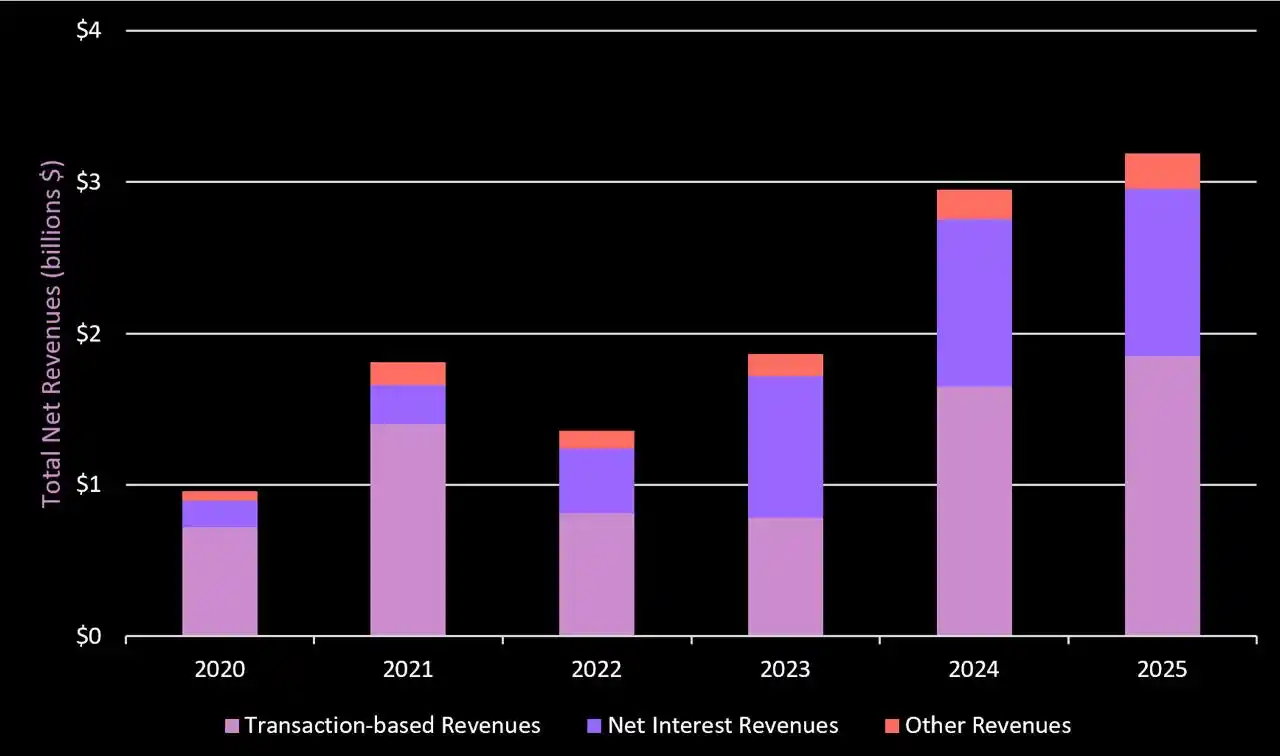
Robinhood is projected to achieve revenue of $2.95 billion in 2024, a 58% increase from 2023. As of the third quarter of this year, its revenue has already reached $3.19 billion, surpassing the total for the entire last year.
Over the past 12 months, the company's revenue reached $4.2 billion (a 31% increase year-over-year).
Below, we will break down the revenue sources and growth of each business line.
Revenue Breakdown
Data source: Robinhood 10 Q
Key Summary
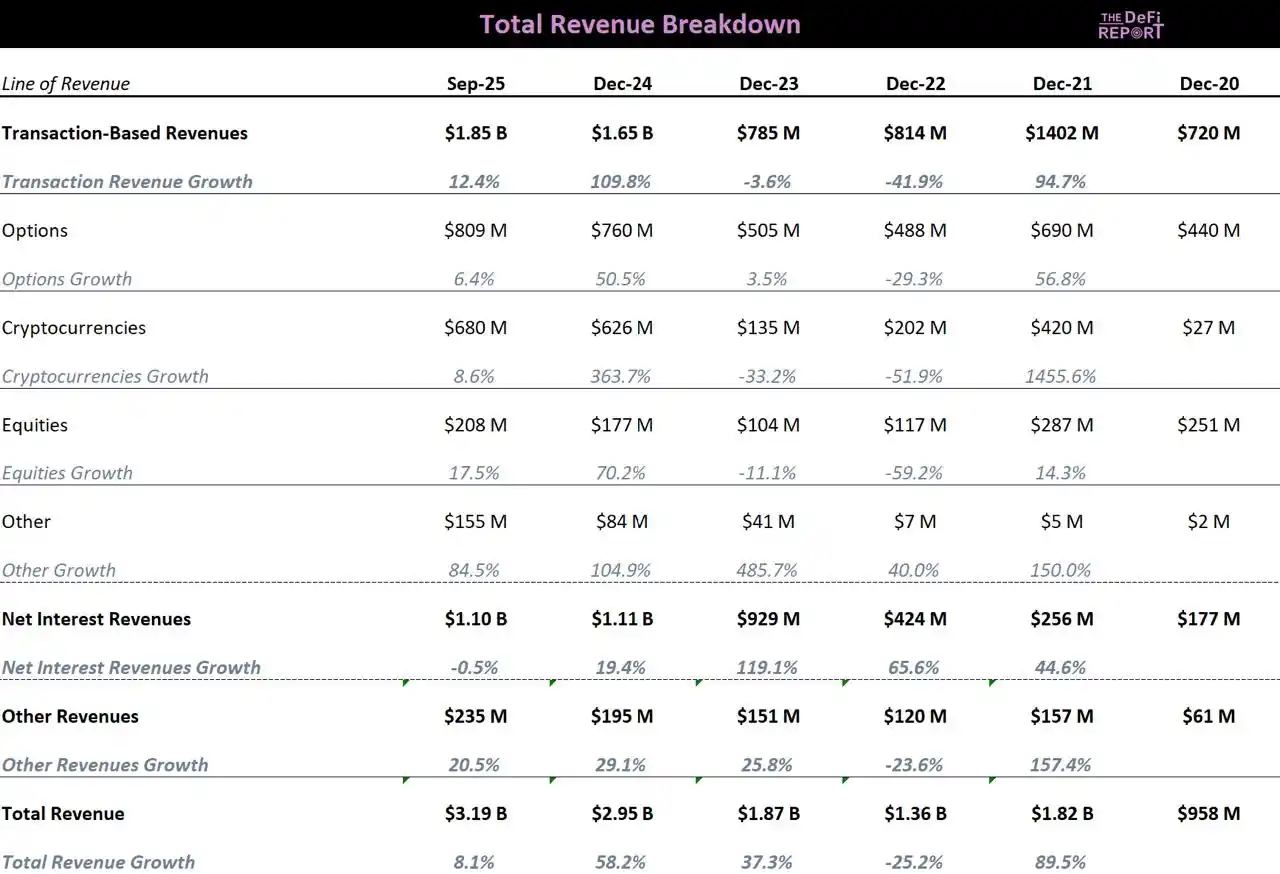
Robinhood's revenue compound annual growth rate (CAGR) over the past five years is 34%. The company set a record with a net profit of $565 million in the third quarter (a 271% increase year-over-year).
Cryptocurrency business accounts for 21% of Robinhood's year-to-date (YTD) total revenue (unchanged from last year).
Year-to-date, transaction-based revenue is $1.85 billion (up from $1.65 billion in the same period of 2024). Overall, transaction-based revenue accounts for 58% of total revenue (down from 77% in 2021).
This indicates: 1) Transaction-based revenue is growing (covering stocks, options, and cryptocurrencies); 2) Robinhood has been adding new revenue lines.
What are these new revenue lines? Prediction markets (via Kalshi) have achieved an annualized revenue of $100 million, making it the company's fastest-growing business line ever.
Robinhood Gold now has 3.9 million paying users (paying $5 per month), generating annual subscription revenue of $234 million.
Instant withdrawal fees, futures market fees, and swap revenue (Robinhood credit card business) are included in 'Other revenue'.
In addition to transaction-based revenue and new revenue lines, Robinhood had achieved over $1.1 billion in net interest income as of the third quarter (35% of total revenue).
Transaction-Based Revenue
Key Summary
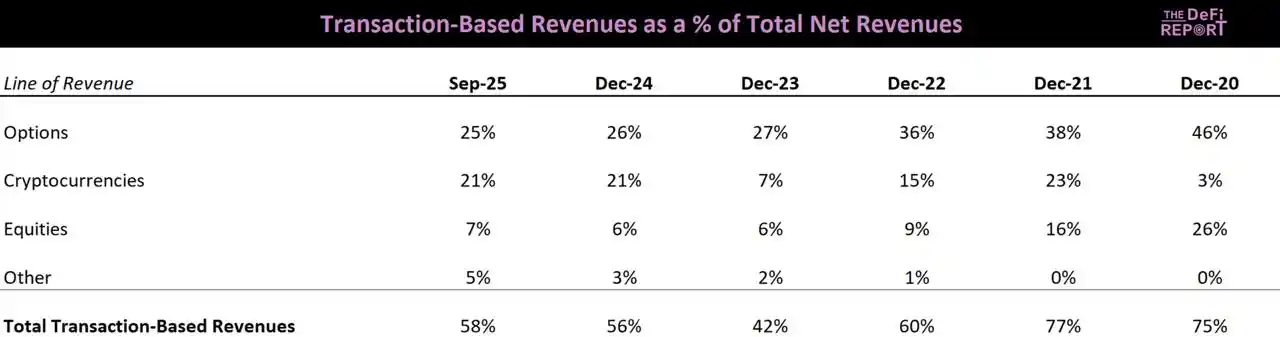
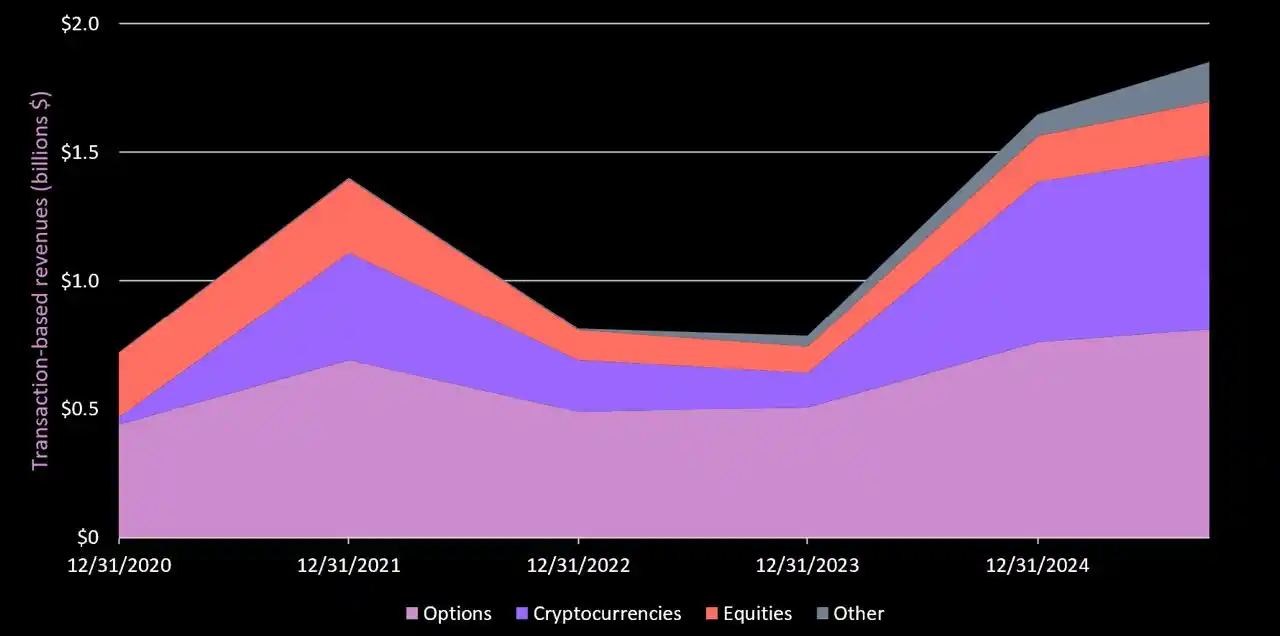
Options are Robinhood's 'cash cow'.
Cryptocurrency ranks second, even though it only accounts for 12% of stock trading volume.
This highlights the superior business model Robinhood employs in the cryptocurrency trading space.
Stock trading volume accounts for 88% of total trading volume, but trading revenue only accounts for 7%.
Fundamentals
Users
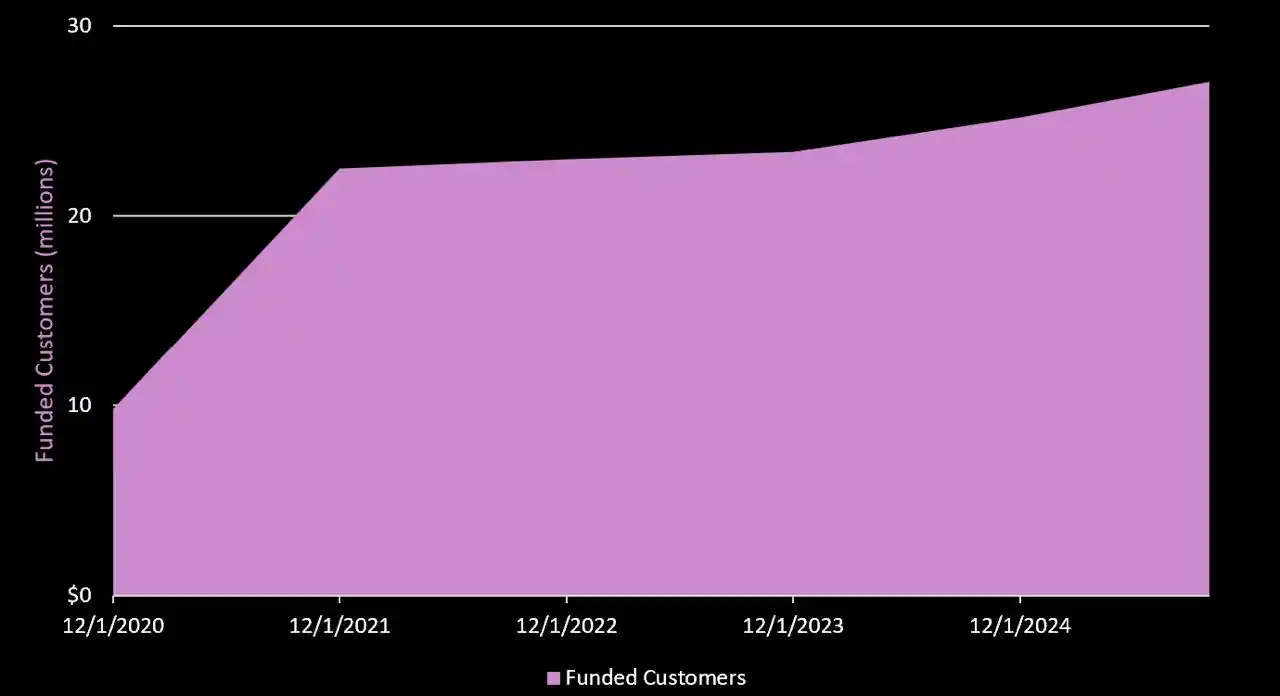
As of September 30, 2025, Robinhood has 27.1 million funded users. The user growth rate over the past five years is 22.6%, with the majority of growth occurring in 2020.
Valuation Comparison
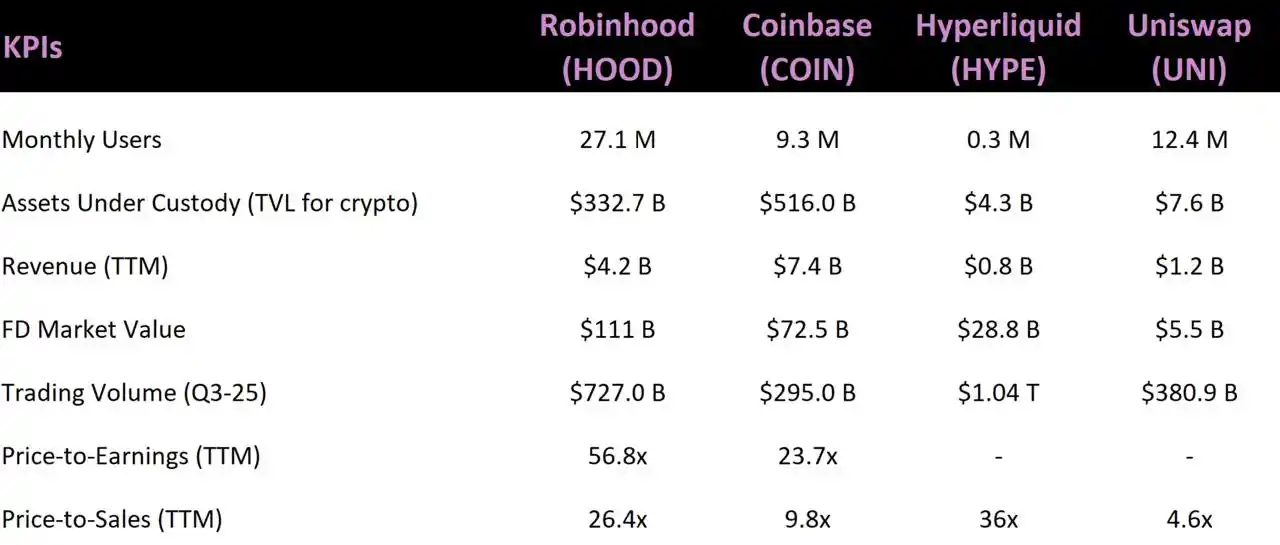
Some thoughts:
Ultra-liquidity (malicious trading + spot trading) dwarfs all platforms in trading volume but generates the least revenue.
Uniswap faces the biggest challenge in user monetization because historically 100% of transaction fees were paid to liquidity providers (this has changed with recent governance proposals).
Coinbase vs Robinhood
Coinbase's user base is only one-third of Robinhood's, but its revenue is almost twice that of Robinhood. Meanwhile, by market capitalization, Coinbase trades at a 53% discount to Robinhood.
Why?
We believe the market favors Robinhood for the following reasons:
Diversified business, including stocks, options, prediction markets, and cryptocurrencies.
The market positions Robinhood as a 'super app' entering the consumer/retail finance track; while Coinbase is still seen as a 'cryptocurrency exchange' (even though its business is much more than that).
Regulatory licenses: Robinhood is registered as a broker-dealer and regulated by FINRA and the SEC. Coinbase does not have such qualifications, meaning Coinbase cannot offer stocks, options, margin loans, etc.
Robinhood has a larger and more active user base. But since 2021, Coinbase's user growth has been struggling.
Furthermore, in terms of traditional financial platforms, Robinhood's revenue over the past twelve months accounts for 18% of Charles Schwab's. Charles Schwab has 38 million active accounts (Robinhood has 27.1 million).
Product Roadmap (Cryptocurrency Direction)
Brief history of Robinhood's cryptocurrency business development.
2018
Robinhood officially launched cryptocurrency trading in some states, initially supporting Bitcoin and Ethereum trading.
2019
Robinhood obtained the BitLicense from New York State, allowing it to provide cryptocurrency trading services in New York.
2020
Robinhood's cryptocurrency trading volume grew significantly. This coincided with a substantial increase in Robinhood's user base—during the COVID-19 period, renewed interest in stock and cryptocurrency trading among retail investors drove the company's user expansion.
2021
Robinhood reported that cryptocurrency business accounted for 41% of revenue in the first quarter, largely driven by Dogecoin trading (25% of total revenue). Later that year, Robinhood filed for an IPO, noting that cryptocurrency trading was an important part of its business.
2022
Robinhood announced plans to launch a cryptocurrency wallet feature, allowing users to deposit and withdraw crypto assets.
2023
Robinhood announced the addition of multiple new crypto assets for trading on its platform and plans to expand into the EU market.
2024
Robinhood announced a partnership with Arbitrum (Ethereum Layer 2), enabling users to perform cryptocurrency swaps through Arbitrum decentralized exchanges (DEX). Subsequently, the Robinhood team announced integration with MetaMask, allowing users to purchase cryptocurrencies on Robinhood and fund their wallets via debit card, bank transfer, or funds from their Robinhood account.
The team then launched staking service for European customers, as well as a cryptocurrency trading API, providing access to market data and programmatic orders.
Acquired Bitstamp, a global cryptocurrency exchange with 4.4 million users and $200 million in annual revenue.
Launched support for Base (Coinbase's L2 project).
Became a primary cryptocurrency gateway for retail traders (covering more assets, wallet access, integration services, and low fees).
2025
Complete full integration of Bitstamp exchange;
Launch of Robinhood Crypto Wallet v2 (cross-chain swaps, DeFi connectivity, Arbitrum features, potential Base and Solana swaps, web3 wallet experience);
Awaiting approval for US cryptocurrency staking business;
Provide institutional cryptocurrency services through Bitstamp;
Announce plans to build an L2 chain on Arbitrum;
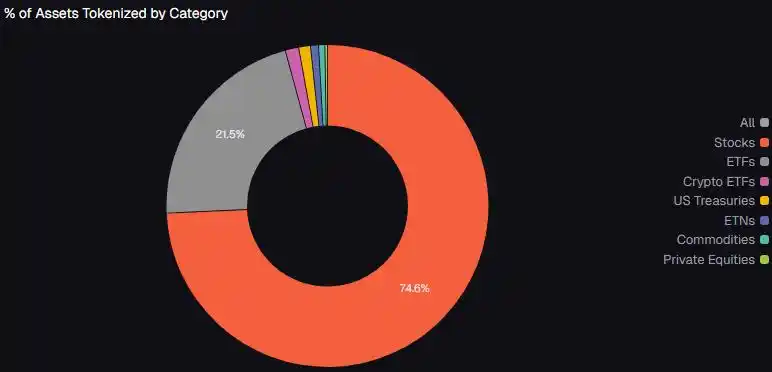
Announce plans to tokenize public and private equity (24/7 trading, instant settlement, integration with DeFi, global access for users outside the US, cost structure lower than traditional broker channels).
This last point marks the beginning of Robinhood's full-scale entry into the cryptocurrency space, leveraging its infrastructure (Bitstamp, Robinhood Crypto, Arbitrum) and user base to position itself in the following areas:
- Regulated global exchange
- Custody solutions with integrated staking
- Tokenization and DeFi integration
- Wallet and payment services
- On-ramp/off-ramp channels
- What's the focus?
Robinhood is building a full-stack platform encompassing tokenization, cryptocurrency trading, and financial services.
Future Roadmap
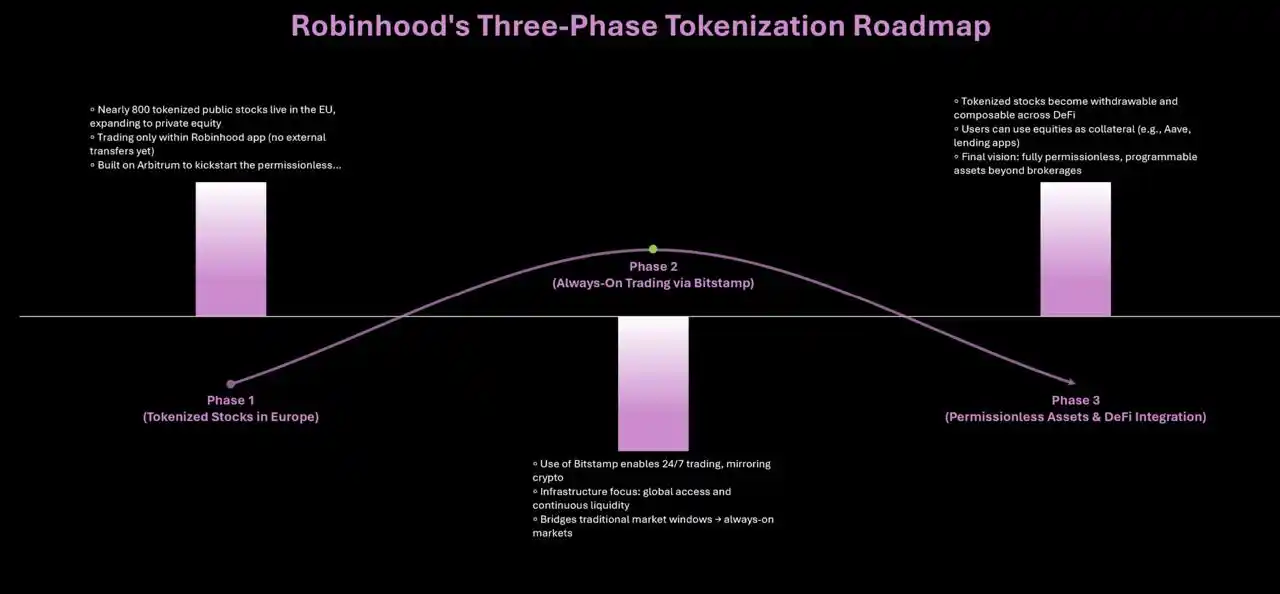
Phase 1 (Ongoing)
There are currently nearly 800 tokenized listed stocks in the EU, expanding into private equity.
Trading only through the Robinhood app (no external transfers)
Built on Arbitrum
Phase 2 (Early 2026)
Achieve 24/7 trading using Bitstamp, replicating the cryptocurrency trading model;
Achieve global access and continuous liquidity.
Phase 3 (End of 2026?)
Tokenized stocks can be withdrawn and composited across DeFi platforms;
Users can use tokenized equity as collateral in DeFi (e.g., Aave);
Ultimate vision: Fully permissionless, programmable assets beyond brokers.
Why Cryptocurrency?
Unlike the stock business (where Robinhood heavily relies on payment for order flow), cryptocurrency trading employs a completely different profit model and is more profitable. Because the cryptocurrency market lacks NBBO (National Best Bid and Offer), Robinhood does not need to sell order flow to market makers. Instead, it profits from spreads and routing gains, meaning it earns the difference between the price it quotes to users and the price at which it obtains liquidity (through internal market makers or Bitstamp).
This means Robinhood has greater control over the economics of trading and can retain a higher proportion of revenue from each cryptocurrency transaction. The end result is significantly improved profit margins, higher average revenue per user (ARPU), and better operating leverage.
Globally accessible market: Cryptocurrency trading operates 24/7, across different jurisdictions and time zones.
Staking, tokenized stocks, swaps, wallet fees, L2 fees, and programmatic cryptocurrency order flow can all expand margins and revenue.
User base: Robinhood primarily serves Millennials and Gen Z, who will inherit the wealth of the Baby Boomers in the coming years and are increasingly inclined to use crypto-native services and Robinhood's top-tier mobile experience.
Cryptocurrency infrastructure can reduce costs, create new revenue streams, and improve operational leverage. As the infrastructure matures, Robinhood is poised to become the 'gateway' to DeFi, staking, trading, payments, and more.
Robinhood, being an early mover in the cryptocurrency space, is building a moat with its large user base, comprehensive service portfolio, and cryptocurrency infrastructure. We believe traditional platforms like Charles Schwab will find it difficult to compete as the customer demographic shifts.
Risks
Competition
Currently, all major brokerages and trading platforms offer cryptocurrency trading services. These include Charles Schwab, Fidelity, Interactive Brokers, Webull, and E*Trade.
They all want a piece of the high fees from cryptocurrency trading. This competition is likely to compress Robinhood's profit margins.
Meanwhile, Coinbase leads in crypto-native infrastructure and product suites.
Execution Risk
The team faces the daunting task of perfectly integrating Robinhood's user experience and mobile application with the cryptocurrency platform. This is no easy feat.
Tokenization Strategy Risk
The real value of tokenization lies in the actual shares being tokenized.
Why?
This means the shareholder's crypto wallet (with completed KYC) becomes the official record of ownership, meaning dividends would be paid directly to that wallet.
Now, Robinhood does not have the authority to decide which stocks can be tokenized and which cannot. The issuer (the company) has the decision-making power.
Do they have an incentive to tokenize now?
We believe this remains to be seen. If possible, they would want to tokenize to:
Reduce issuance costs
Expand distribution
Improve liquidity
Reduce settlement friction
Open up new investor groups globally
Currently, these advantages are not sufficient to incentivize large existing enterprises to tokenize, especially before new regulations are introduced.
Furthermore, shareholders are not currently demanding tokenization, and we believe existing traditional service providers (such as transfer agents, prime brokers, custodians, settlement networks, market makers, fund administration/middle office) are opposed to tokenization.
What's the point?
Robinhood has a strong incentive to promote tokenization. However, they have limited control over the decision of issuers to adopt tokenization. We believe this will take longer than the market currently expects.
Conclusion
Robinhood's revenue compound annual growth rate over the past five years has reached 34%. In recent years, the platform has made significant progress across all trading business lines. New revenue additions like Robinhood Gold, prediction markets, and a series of crypto services (wallets, staking, transfers, European expansion, crypto co-branded card, Arbitrum Layer 2) point to a bright future.
We recognize its leadership team: they have delivered an excellent user experience in the past and have a vision for a 'full transition to cryptocurrency.' From personal experience, the asset migration process is convenient and efficient. It is worth mentioning that Robinhood's 'cash reward for transferring assets (2-4% cash reward on the transferred value)' is essentially a 'vampire attack' on companies like Charles Schwab, Fidelity, and Coinbase. (Note: A 'vampire attack' is a competitive strategy where a new protocol attracts liquidity, users, and trading volume from an existing dominant protocol by offering significantly more attractive incentives, such as higher yields or token rewards.)
Simultaneously, Robinhood is challenging Coinbase in the crypto-native service space and is leading in tokenization strategy. Therefore, we believe Robinhood has the potential to become a leading financial institution in the future.
However, Robinhood's current price-to-earnings (P/E) ratio is as high as 56x. Our analysis suggests that its cryptocurrency revenue (currently accounting for 21% of total revenue, a significant component) may face some pressure in the short term, and the risk appetite of retail investors is also showing signs of cooling.
Given the precedent of a 25% revenue decline in 2022 and an 80% stock price drawdown, in the current risk-averse market environment, we expect the company's stock price could experience a similar significant correction. But looking at it another way, this could also provide an excellent buying opportunity for long-term investors.