AC Exits Sonic Board, 'DeFi Godfather' Pulls Off Another Strategic Retreat

marsbitPublicado a 2026-06-22Actualizado a 2026-06-22

Resumen

Andre Cronje, known as the "DeFi Godfather," and two other founding directors have stepped down from the Sonic Labs board. The S token, once valued at $1.03, has plummeted 97% to $0.028, and the chain's TVL has evaporated 98% from its peak. In his exit statement, Cronje clarified he was a technical architect, not a founder, and distanced himself from token economics and migration decisions behind the token's crash. Cronje revealed his focus for the past 18 months has been his new project, Flying Tulip. This project raised $200 million privately last year at a $10 billion valuation. Its token design includes a perpetual put option (ftPUT NFT) for early investors, allowing them to redeem their initial investment at any time—a protection not extended to public market buyers. This pattern mirrors Cronje's past exits from projects like Yearn Finance and Fantom, where he departed near peak hype, leaving later holders to bear significant losses. Sonic itself has seen a complete management overhaul in recent months. The article frames this as a microcosm of the broader crypto bear market, where Layer-1 chains are bleeding value. It highlights a harsh reality: a project's valuation is often tied to a founder's reputation rather than fundamentals. Ironically, Flying Tulip is set to launch first on the Sonic chain Cronje just left, underscoring a disconnect between the person and the platform.

Author: Kuli, Deep Chao TechFlow

My feeling about crypto this year is probably this: watching the U.S. stock market hitting new highs every day, then opening my own portfolio, staying silent for three seconds, and closing it.

BTC has fallen by nearly 20% year-to-date, ETH has performed even worse, and altcoins—let's not even mention them. In such a market, it wouldn't be news if any public chain's token dropped 90%. But even colder than the prices is the feeling of abandonment.

On June 19, DeFi Godfather AC, along with two other founding directors, exited the Sonic Labs board. The S token was trading at $0.028 at the time, just a fraction of its peak of $1.03 at the beginning of the year. On-chain TVL had plummeted from a high of $1.14 billion last May to $20 million. According to DefiLlama data, that's a 98% evaporation.

The industry's reaction to AC's departure was muted. After all, he quit the space once in 2022, only to return later. This exit statement was also standard, saying he "remains bullish on Sonic" but will no longer be involved in business decisions.

But the next part was the real sting.

He said his primary focus for the past 18 months has been on Flying Tulip. This project raised a $200 million private placement last August at a $1 billion valuation, and opened a public sale on CoinList this February. The investors include names like Brevan Howard, DWF Labs, and Susquehanna.

In other words, during the exact period S was dropping from $1.03 to $0.028, AC was busy setting the stage for a brand-new billion-dollar project.

The real kicker is Flying Tulip's token design.

Primary subscription investors receive an NFT called ftPUT, which is essentially a perpetual put option. If they incur losses, they can burn the token at any time and redeem their principal at the original price. The CoinList public sale page clearly states, in bold, that the FT tokens (the tradable tokens, i.e., the normal coins) bought on the open market do not carry this right—only primary participants have it.

In contrast, S holders who bought on the secondary market are stuck with $0.028 being $0.028. No floor, no redemption, no safety net written by anyone...

Not My Fault

AC posted his exit statement on X. It was short, but every sentence seemed carefully measured.

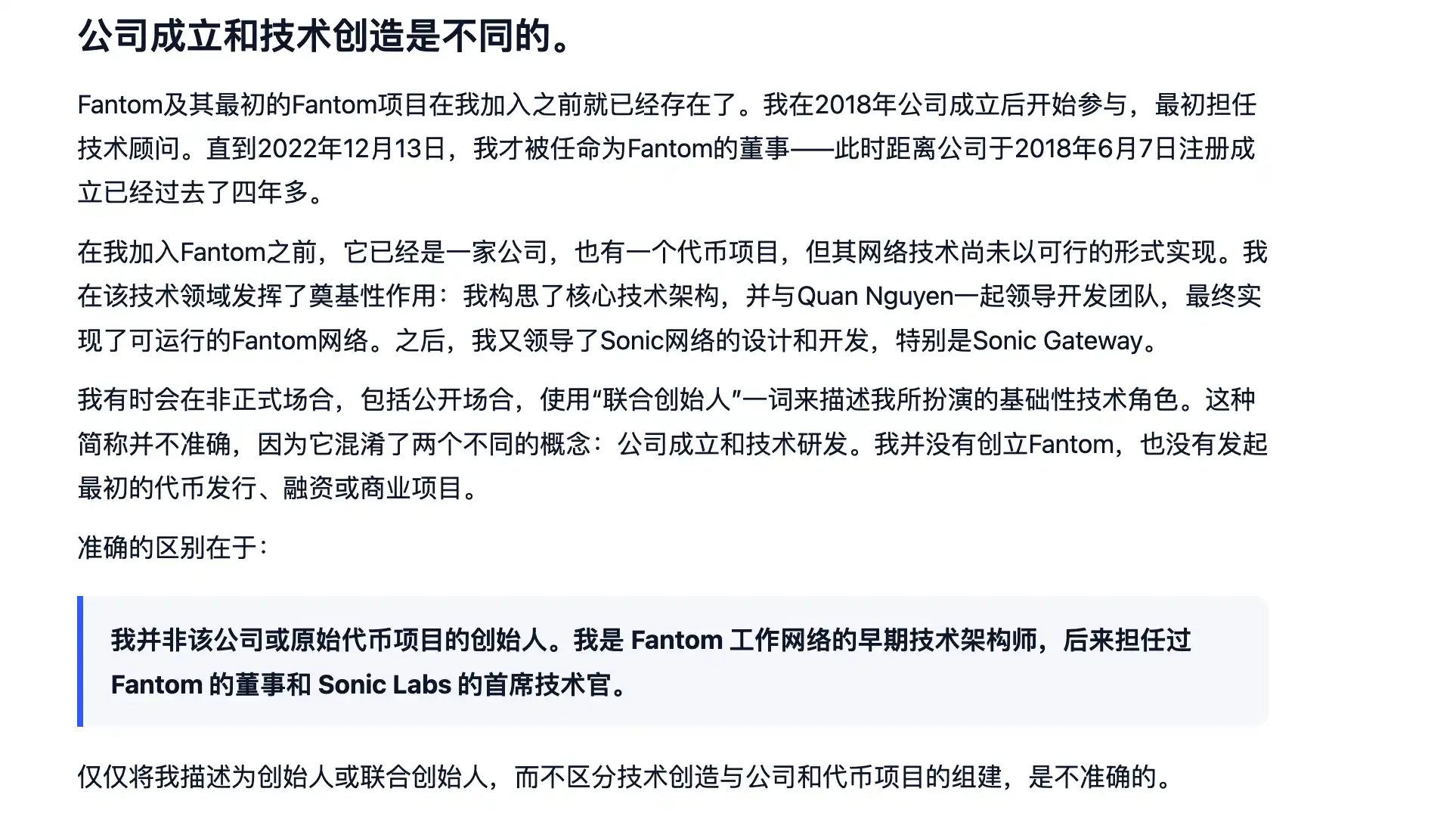
He said he joined Fantom as a technical advisor in 2018 and only formally became a director in December 2022. He was not Fantom's founder, never was, just the earliest technical architect. He was responsible for the underlying technology, including Sonic's core system and cross-chain gateway.

Then came the key paragraph, which roughly translates to:

"I am responsible for the technical decisions I led, but decisions regarding the migration, airdrop, tokenomics, and disposition of the old network—I was not the initiator, nor the final decision-maker."

With one sentence, he absolved himself from the S token's 97% drop. I built the tech, the tech is fine. As for why the coin you bought fell from a dollar to three cents, those were someone else's decisions.
The author won't comment on whether this claim holds water, but one must admit this separation is impressively clean.

When most project founders abandon ship, they either go silent or issue vague statements full of "we" and "the team," diluting responsibility into a murky soup. AC is different. He draws his responsibility boundaries with extreme precision, so precise it's hard to argue, because he indeed didn't manage tokenomics.

And this wasn't a spur-of-the-moment idea.

In March 2022, AC announced his exit from the crypto industry, citing regulatory pressure and burnout. At the time, Fantom's TVL evaporated nearly a third within a week, drawing a torrent of community criticism. He quietly returned a few months later, returning to work on Sonic's technical overhaul.

He left saying he was tired, returned without fanfare, and now leaves again saying, "I've actually been busy with other things for the past 18 months."

As for Sonic? In the half-year before his departure, its executive team was completely overhauled. CEO Mitchell Demeter, hired just last September, resigned in February, along with the head of business. After the CEO left, the board stepped in to manage for a few months. Now the board has also stepped down, replaced by a new CEO, Matt Visser, who has never managed a public chain operation at the front lines.

In five months, the entire management team from top to bottom has been replaced. Sonic's official statement didn't sugarcoat it either, directly stating, "The token price dropped, community sentiment dropped, we're not going to pretend it didn't happen."

This kind of "hands-up honesty" is rare in the crypto industry. But the problem is, the ones telling the truth are the new team, while the one leaving is the one whose name carries value.

The Script for a Strategic Retreat

Looking back at AC's trajectory over the past few years reveals a pattern.

2020: Wrote Yearn Finance, the iconic product of DeFi Summer, with TVL once soaring to tens of billions of dollars. He essentially let it go not long after, and Yearn ran on its own. It ran okay, but it had little to do with him anymore.

Next, he worked on Fantom's technical architecture. Fantom rallied for a while. In March 2022, he announced his exit. Fantom subsequently entered a long, slow decline, later rebranding as Sonic and relaunching. He returned with a CTO title. Sonic's TVL initially broke through a billion but then collapsed all the way down to its current state.

Every time, he disengaged at the peak of hype or just as it started cooling, moving on to the next thing. Every time, holders of the old project bore most of the decline after his departure.

Flying Tulip is his fourth project to date. The author thinks this time, he might have truly absorbed the lessons from previous experiences and baked them into the token design.
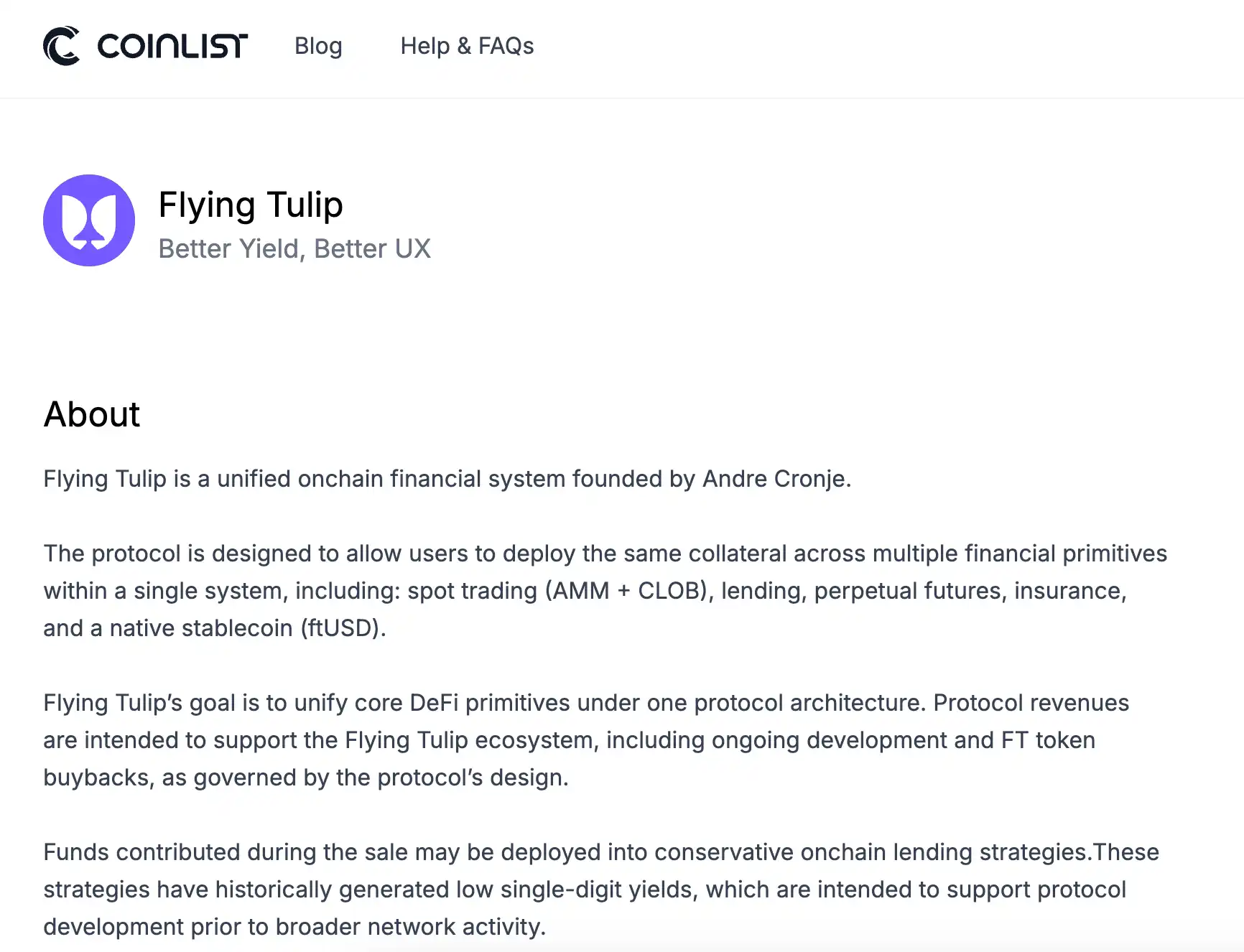
When you participate in Flying Tulip's public sale on CoinList, spending $0.10 to buy an FT, you don't receive the token directly. Instead, you get an NFT called ftPUT, with the token locked inside. This NFT is that perpetual put option. You have three choices.

First, do nothing. The token remains in the NFT, non-tradable, but the redemption right persists. Whenever you want to leave, burn the token and get your USDC or ETH back at the original price. Regardless of how low the FT price falls on the secondary market, your principal has a floor.

Second, extract the tokens from the NFT to trade freely. But the moment you extract them, the redemption right is permanently forfeited. The principal corresponding to the extracted tokens is released to the protocol for buyback and burn.

Third, extract some, keep some. The portion kept in the NFT continues to have protection; the extracted portion goes naked.

AC himself said something very interesting in an interview with The Block, the gist being that because of the perpetual PUT's existence, the funds raised essentially cannot be spent at all.

The net funds raised are zero. So where does operating capital come from?

All raised capital is placed into lending protocols like Aave and Ethena for conservative strategies, targeting around 4% annual yield. Based on a full raise of $1 billion, this would generate approximately $40 million in interest annually. This money funds the team, development, and buybacks. The team has no initial token allocation; all FT tokens must be bought back by the protocol from the open market using protocol revenue.

The author must admit, this design is quite ingenious within DeFi. It addresses the foulest problem in the crypto industry in recent years: project founders taking the money and running, or spending it recklessly, leaving investors with nothing. AC's solution essentially ties his own hands: the money can't be touched, the team gets no pre-allocated tokens, and investors can exit at any time.

But ingenious as it is, this protection exists only in the primary market. Once FT is listed on exchanges, tokens bought on the secondary market do not come with ftPUT. This sentence is written in bold on CoinList's page.

Buyers on the open market see the same token but receive completely different treatment.

A Microcosm of the Industry

Money is flowing out of the crypto market this year—that's no secret.

BTC has fallen nearly 20% year-to-date, and the median drop for altcoins far exceeds that. People in the circle look at the Nasdaq hitting new highs, then switch back to their own holdings—the feeling needs no description.

Many people's real strategy this year has been slowly shifting their positions into U.S. stocks and stablecoin yield products. On-chain activity is visibly shrinking.

In this environment, AC's exit from Sonic is just the tip of the iceberg. The entire L1 sector is experiencing the same story: TVL contraction, user attrition, founding team changes, or direct disappearances. Sonic just gets highlighted as a case study because of its fame and extreme decline.

But AC's case has a layer other projects lack.

Flying Tulip's current valuation is about $1 billion. Sonic's current market cap is about $100 million. The same person, the same period, one at $1 billion, the other at $100 million—a tenfold difference. What's the distinction? The distinction lies in which project AC's name is attached to.

This is a fact few in the DeFi industry are willing to voice openly.

The valuation of many projects isn't built on revenue, users, or technological moats—it's built on a person's name. The name stays, the money stays. The name leaves, the money follows.

The bear market ripped off this fig leaf. In a bull market, all L1s rise, making it hard to distinguish whether fundamentals or a name is propping it up. When the tide recedes, what remains becomes clear.

There's one more detail the author finds most interesting.

Flying Tulip's primary deployment chain is Sonic. AC exited Sonic's board, no longer involved in any business decisions, but his new project's first stop is on Sonic. He's gone, but his business remains.

The captain has disembarked, but opened a new shop on the dock, selling things more expensive than what was on the ship.


Preguntas relacionadas

QWho is AC and what is his recent major action mentioned in the article?

AAC, known as the 'DeFi Godfather,' is a prominent figure in the decentralized finance space. According to the article, his recent major action is stepping down from the Sonic Labs (formerly Fantom) board of directors on June 19, along with two other founding directors.

QWhat is the main difference in token design between AC's previous project Sonic (S) and his new project Flying Tulip (FT)?

AThe key difference lies in the investor protection mechanism. Flying Tulip's private investors receive an ftPUT NFT, which is a perpetual put option allowing them to redeem their principal at the original price. Secondary market buyers of FT tokens on platforms like CoinList do not have this right. In contrast, Sonic's S token had no such protection mechanism for secondary market holders.

QHow does AC explain his role and responsibilities regarding Sonic's decline in his exit statement?

AIn his exit statement, AC clearly delineates his responsibilities. He states he was responsible for the core technical architecture and decisions but explicitly distances himself from decisions related to the token migration, airdrop, tokenomics, and handling of the old network. He implies he is not responsible for the S token's 97% price drop, attributing it to others' decisions.

QWhat pattern does the article suggest exists in AC's involvement with past projects like Yearn Finance and Fantom/Sonic?

AThe article suggests a recurring pattern where AC is heavily involved during a project's initial hype or peak phase, then steps away or reduces involvement just before or during a significant decline. This was observed with Yearn Finance, Fantom, and now Sonic, leaving token holders to bear the brunt of the subsequent price drops.

QAccording to the article, what broader industry trend does AC's exit from Sonic represent in the current crypto market?

AAC's exit from Sonic is presented as a symptom of a broader trend in the Layer-1 (L1) blockchain sector during the bear market. The article highlights that many L1 projects are experiencing collapsing Total Value Locked (TVL), user exodus, and founder/team departures. It underscores the reality that many project valuations are heavily reliant on founder reputation ('the name') rather than fundamentals, a weakness exposed when market conditions deteriorate.

Lecturas Relacionadas

¿Sube más del 130% en un mes, se mantiene como un gran consumidor de Blobs de Ethereum? ¿Cuál es el verdadero crecimiento de World Chain?

Autor: Nancy, PANews Mentre la competició entre Layer 2 s'intensifica, World Chain mostra un creixement diferent. El seu token, WLD, ha pujat més d'un 130% en 30 dies, impulsat per l'entusiasme per la IA, l'adquisició institucional, la major activitat comercial i l'esperança d'una reducció en la seva emissió diària a partir de juliol de 2026. Paral·lelament, la xarxa World Chain experimenta una gran activitat. El seu valor bloquejat (TVL) va créixer un 122,6% en un mes, arribant als 6.100 milions de dòlars, principalment per entrades de fons mitjançant ponts. Les adreces actives diàries es van disparar un 649%. Tot i això, el seu ecosistema DeFi roman incipient, amb gran part de la liquiditat concentrada en un sol protocol. Un punt destacat és el seu alt consum de "Blobs" d'Ethereum per a disponibilitat de dades. World Chain és el segon major consumidor d'aquests recursos, just darrere de Base, amb una alta freqüència d'enviaments i eficiència de costos. Això es deu a l'activitat dels milions d'usuaris reals de Worldcoin que realitzen transaccions freqüents a la cadena per a verificació d'identitat i recompenses. En resum, World Chain combina la tendència de la IA i una base d'usuaris actius per a un creixement notable en preu i activitat de xarxa, tot i que el desenvolupament del seu ecosistema extern encara és un repte per al seu futur.

marsbitHace 19 min(s)

¿Sube más del 130% en un mes, se mantiene como un gran consumidor de Blobs de Ethereum? ¿Cuál es el verdadero crecimiento de World Chain?

marsbitHace 19 min(s)

¿Por qué el «padrino de la AGI», Ben Goertzel, cree que el futuro de la inteligencia artificial depende de la blockchain?

Ben Goertzel, conocido como el "padre de la AGI" e impulsor del concepto de Inteligencia General Artificial (AGI), defiende que el futuro de la IA debe basarse en la tecnología blockchain para evitar el control corporativo y garantizar su desarrollo abierto y descentralizado. Critica a compañías como OpenAI y Anthropic por haber abandonado sus principios iniciales de código abierto en favor de modelos cerrados y financiados por capital de riesgo. Según Goertzel, la apertura del código no es suficiente; se necesita una red de computación distribuida y accesible para que la AGI sea verdaderamente útil y no dependa de infraestructuras centralizadas costosas. Su proyecto, SingularityNET, y la Alianza de Superinteligencia Artificial, buscan crear una economía de agentes de IA que operen en una red blockchain, permitiendo que los usuarios controlen y monetizen sus propios agentes inteligentes. Aunque reconoce los riesgos de que actores malintencionados puedan usar la tecnología, confía en que una mayoría benévola prevalecerá. Goertzel prevé el lanzamiento de una capa de pago para empresas y usuarios avanzados, con agentes capaces de realizar transacciones autónomas. Mantiene su predicción de que la AGI a nivel humano podría llegar entre 2027 y 2030, y subraya la importancia de reducir la brecha de conocimiento para evitar una mayor desigualdad. Su primer gran test público será el lanzamiento del agente Omega Claw en las próximas semanas.

Foresight NewsHace 29 min(s)

¿Por qué el «padrino de la AGI», Ben Goertzel, cree que el futuro de la inteligencia artificial depende de la blockchain?

Foresight NewsHace 29 min(s)

Una empresa que casi quiebra acaba de superar la capitalización de mercado de Bitcoin

El 22 de junio, SK Hynix alcanzó una capitalización de mercado de 1,35 billones de dólares, superando la capitalización total de Bitcoin de 1,29 billones, convirtiéndose brevemente en la empresa más valiosa de Corea del Sur. Este crecimiento está impulsado por su dominio en la producción de memoria HBM, esencial para la IA, donde posee más del 60% del mercado y es proveedor clave de Nvidia. La empresa reportó un margen de beneficio operativo del 72% en el primer trimestre, con pronósticos al alza para el segundo. Su apuesta por la tecnología HBM comenzó en 2009, una inversión de alto riesgo que finalmente dio frutos con el auge de la IA. La trayectoria de SK Hynix incluyó una crisis cercana a la quiebra en 2001, seguida de una adquisición salvadora por parte de SK Group en 2012, que permitió financiar el desarrollo del HBM. El mercado valora su posición en la cadena de suministro de IA por sus barreras técnicas, pedidos reales y ciclos de producción prolongados, cambiando su valoración de cíclica a de crecimiento. En contraste, el artículo señala que el ecosistema Crypto AI, que promete infraestructura descentralizada, aún se encuentra en etapas tempranas con avances limitados. Proyectos como Bittensor siguen desarrollando sus mecanismos fundamentales, mientras que las empresas mineras de Bitcoin enfrentan dificultades y una transición costosa hacia la computación de IA. Expertos como Arthur Hayes argumentan que la IA está absorbiendo la mayor parte de la liquidez del mercado, y que una posible corrección podría afectar también a las criptomonedas. La clave para Crypto AI será definir un valor tangible y una ventaja clara en la cadena de suministro de IA, donde actualmente priman la capacidad de producción física y los márgenes cuantificables.

marsbitHace 35 min(s)

Una empresa que casi quiebra acaba de superar la capitalización de mercado de Bitcoin

marsbitHace 35 min(s)

El nuevo campeón de la IA en Japón: ¿Cómo se compara un pequeño modelo de 7B con Fable y Mythos?

En junio de 2026, Sakana AI de Japón sacudió la comunidad con Fugu, un pequeño modelo de solo 7B de parámetros que actúa como "capataz" orquestando modelos globales líderes como GPT-5 y Claude Opus. En los exigentes benchmarks SWE-Bench Pro (73.7) y TerminalBench 2.1 (82.1), Fugu Ultra superó a modelos como GPT-5.5 y Claude Opus 4.8. Sakana afirma que rivaliza incluso con los restringidos Fable 5 y Mythos Preview, aunque esta comparación se basa en informes públicos y no en pruebas directas. Su arquitectura se centra en un núcleo de 7B, el RL Conductor, que no genera respuestas directas, sino que descompone tareas, las asigna a modelos especialistas y sintetiza los resultados. Esto mejora la estabilidad en sesiones largas, la revisión profunda de código y reduce el consumo de tokens. Las pruebas beta destacaron su eficacia en flujos de trabajo complejos. Sin embargo, esta estrategia presenta vulnerabilidades: depende de APIs de modelos estadounidenses (riesgo de costes e inestabilidad), puede tener mayor latencia y las comparaciones con modelos no accesibles son polémicas. Para Japón, con limitaciones en cómputo y datos, Fugu representa una vía de "salida asimétrica", priorizando la orquestación inteligente sobre el tamaño bruto del modelo. Demuestra que la competencia en IA se desplaza hacia la integración de sistemas, aunque la dependencia de tecnologías subyacentes sigue siendo un límite.

marsbitHace 1 hora(s)

El nuevo campeón de la IA en Japón: ¿Cómo se compara un pequeño modelo de 7B con Fable y Mythos?

marsbitHace 1 hora(s)

Bittensor avanza hacia la descentralización definitiva: ¿Han llegado los 18 meses clave para el ecosistema TAO?

Bittensor, el protocolo de inteligencia artificial descentralizado, ha presentado su hoja de ruta para lograr una descentralización total en los próximos 18 meses. En un comunicado, el cofundador Const reconoció que el proyecto opera actualmente en un estado "semi-descentralizado". Mientras que la propiedad y el acceso a la red son abiertos y se basan en méritos (con 128 subredes y más de 20 equipos validadores), las actualizaciones clave del protocolo aún son dirigidas centralmente por el equipo central. Const defendió este enfoque como una elección estratégica para la etapa temprana y de rápido desarrollo de la IA, priorizando la velocidad de innovación. Sin embargo, señaló que, una vez que la red alcanza un nivel de madurez con una economía robusta, la gobernanza centralizada se convierte en un riesgo. La futura descentralización completa tiene como objetivo mitigar riesgos sistémicos y aumentar la resiliencia de la red. El plan para los próximos 18 meses incluye optimizar la competencia entre validadores, abrir grupos de liquidez, introducir derechos de gobernanza para los poseedores de Alpha, ajustar los modelos de emisión de TaoFlow y DTAO, y eliminar participantes que no contribuyan a la red. Este proceso culminaría con el equipo central retirándose gradualmente de la gobernanza. Este movimiento podría redefinir la lógica de valor de TAO, añadiendo una prima de gobernanza a su valoración actual basada en la narrativa de IA. Además, podría cambiar la competencia en el sector de Crypto-AI, pasando de narrativas a batallas de infraestructura de protocolos. Bittensor aspira a convertirse en una "federación de inteligencia milenaria" descentralizada, planteando una pregunta fundamental: ¿debería el futuro de la IA pertenecer a unas pocas grandes tecnológicas o a una red abierta?

marsbitHace 1 hora(s)

Bittensor avanza hacia la descentralización definitiva: ¿Han llegado los 18 meses clave para el ecosistema TAO?

marsbitHace 1 hora(s)

Trading

Spot
Futuros
活动图片