AC Exits Sonic Board, 'DeFi Godfather' Pulls Off Another Strategic Retreat

marsbitPublicado a 2026-06-22Actualizado a 2026-06-22

Resumen

Andre Cronje, known as the "DeFi Godfather," and two other founding directors have stepped down from the Sonic Labs board. The S token, once valued at $1.03, has plummeted 97% to $0.028, and the chain's TVL has evaporated 98% from its peak. In his exit statement, Cronje clarified he was a technical architect, not a founder, and distanced himself from token economics and migration decisions behind the token's crash. Cronje revealed his focus for the past 18 months has been his new project, Flying Tulip. This project raised $200 million privately last year at a $10 billion valuation. Its token design includes a perpetual put option (ftPUT NFT) for early investors, allowing them to redeem their initial investment at any time—a protection not extended to public market buyers. This pattern mirrors Cronje's past exits from projects like Yearn Finance and Fantom, where he departed near peak hype, leaving later holders to bear significant losses. Sonic itself has seen a complete management overhaul in recent months. The article frames this as a microcosm of the broader crypto bear market, where Layer-1 chains are bleeding value. It highlights a harsh reality: a project's valuation is often tied to a founder's reputation rather than fundamentals. Ironically, Flying Tulip is set to launch first on the Sonic chain Cronje just left, underscoring a disconnect between the person and the platform.

Author: Kuli, Deep Chao TechFlow

My feeling about crypto this year is probably this: watching the U.S. stock market hitting new highs every day, then opening my own portfolio, staying silent for three seconds, and closing it.

BTC has fallen by nearly 20% year-to-date, ETH has performed even worse, and altcoins—let's not even mention them. In such a market, it wouldn't be news if any public chain's token dropped 90%. But even colder than the prices is the feeling of abandonment.

On June 19, DeFi Godfather AC, along with two other founding directors, exited the Sonic Labs board. The S token was trading at $0.028 at the time, just a fraction of its peak of $1.03 at the beginning of the year. On-chain TVL had plummeted from a high of $1.14 billion last May to $20 million. According to DefiLlama data, that's a 98% evaporation.

The industry's reaction to AC's departure was muted. After all, he quit the space once in 2022, only to return later. This exit statement was also standard, saying he "remains bullish on Sonic" but will no longer be involved in business decisions.

But the next part was the real sting.

He said his primary focus for the past 18 months has been on Flying Tulip. This project raised a $200 million private placement last August at a $1 billion valuation, and opened a public sale on CoinList this February. The investors include names like Brevan Howard, DWF Labs, and Susquehanna.

In other words, during the exact period S was dropping from $1.03 to $0.028, AC was busy setting the stage for a brand-new billion-dollar project.

The real kicker is Flying Tulip's token design.

Primary subscription investors receive an NFT called ftPUT, which is essentially a perpetual put option. If they incur losses, they can burn the token at any time and redeem their principal at the original price. The CoinList public sale page clearly states, in bold, that the FT tokens (the tradable tokens, i.e., the normal coins) bought on the open market do not carry this right—only primary participants have it.

In contrast, S holders who bought on the secondary market are stuck with $0.028 being $0.028. No floor, no redemption, no safety net written by anyone...

Not My Fault

AC posted his exit statement on X. It was short, but every sentence seemed carefully measured.

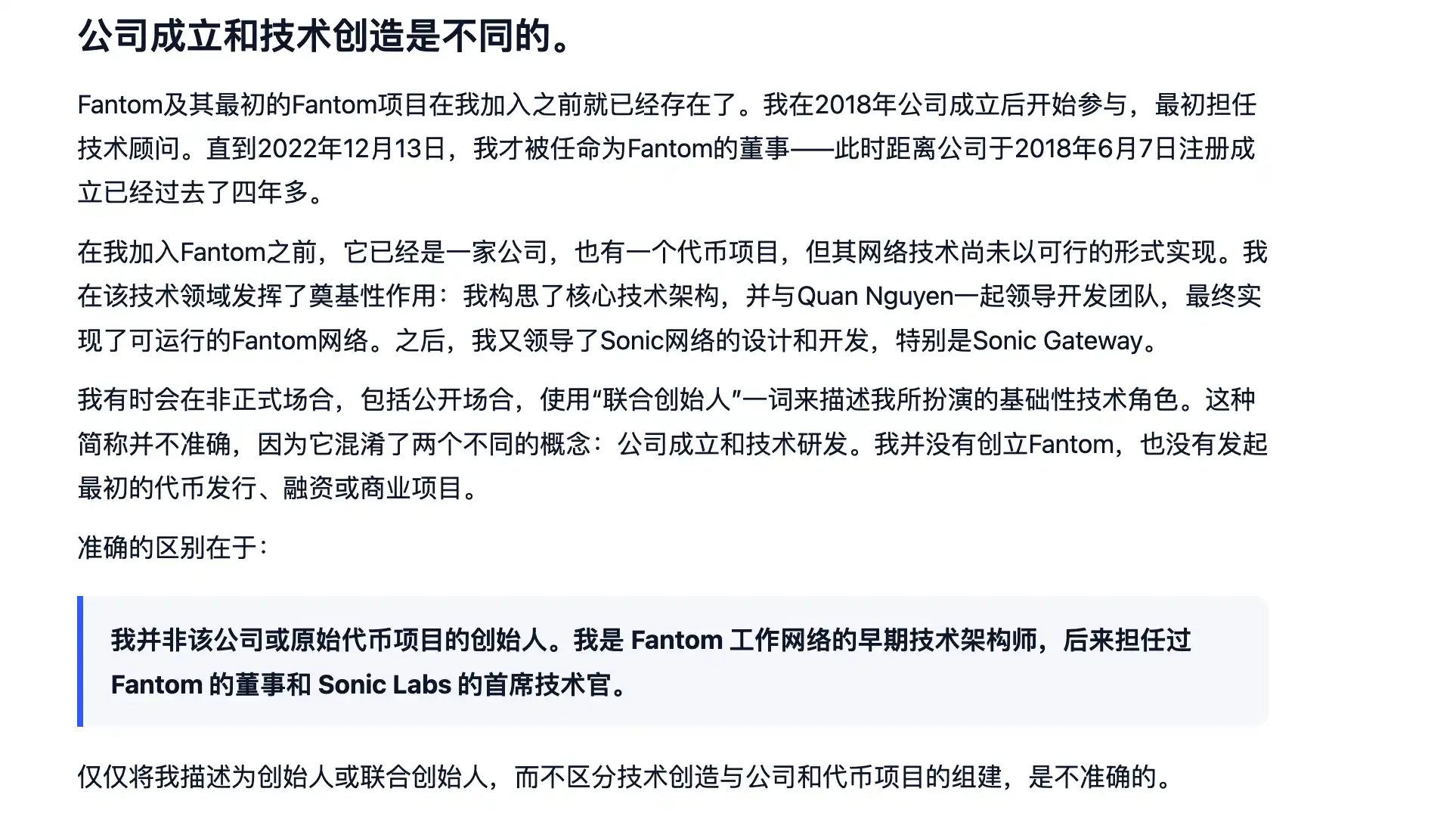
He said he joined Fantom as a technical advisor in 2018 and only formally became a director in December 2022. He was not Fantom's founder, never was, just the earliest technical architect. He was responsible for the underlying technology, including Sonic's core system and cross-chain gateway.

Then came the key paragraph, which roughly translates to:

"I am responsible for the technical decisions I led, but decisions regarding the migration, airdrop, tokenomics, and disposition of the old network—I was not the initiator, nor the final decision-maker."

With one sentence, he absolved himself from the S token's 97% drop. I built the tech, the tech is fine. As for why the coin you bought fell from a dollar to three cents, those were someone else's decisions.
The author won't comment on whether this claim holds water, but one must admit this separation is impressively clean.

When most project founders abandon ship, they either go silent or issue vague statements full of "we" and "the team," diluting responsibility into a murky soup. AC is different. He draws his responsibility boundaries with extreme precision, so precise it's hard to argue, because he indeed didn't manage tokenomics.

And this wasn't a spur-of-the-moment idea.

In March 2022, AC announced his exit from the crypto industry, citing regulatory pressure and burnout. At the time, Fantom's TVL evaporated nearly a third within a week, drawing a torrent of community criticism. He quietly returned a few months later, returning to work on Sonic's technical overhaul.

He left saying he was tired, returned without fanfare, and now leaves again saying, "I've actually been busy with other things for the past 18 months."

As for Sonic? In the half-year before his departure, its executive team was completely overhauled. CEO Mitchell Demeter, hired just last September, resigned in February, along with the head of business. After the CEO left, the board stepped in to manage for a few months. Now the board has also stepped down, replaced by a new CEO, Matt Visser, who has never managed a public chain operation at the front lines.

In five months, the entire management team from top to bottom has been replaced. Sonic's official statement didn't sugarcoat it either, directly stating, "The token price dropped, community sentiment dropped, we're not going to pretend it didn't happen."

This kind of "hands-up honesty" is rare in the crypto industry. But the problem is, the ones telling the truth are the new team, while the one leaving is the one whose name carries value.

The Script for a Strategic Retreat

Looking back at AC's trajectory over the past few years reveals a pattern.

2020: Wrote Yearn Finance, the iconic product of DeFi Summer, with TVL once soaring to tens of billions of dollars. He essentially let it go not long after, and Yearn ran on its own. It ran okay, but it had little to do with him anymore.

Next, he worked on Fantom's technical architecture. Fantom rallied for a while. In March 2022, he announced his exit. Fantom subsequently entered a long, slow decline, later rebranding as Sonic and relaunching. He returned with a CTO title. Sonic's TVL initially broke through a billion but then collapsed all the way down to its current state.

Every time, he disengaged at the peak of hype or just as it started cooling, moving on to the next thing. Every time, holders of the old project bore most of the decline after his departure.

Flying Tulip is his fourth project to date. The author thinks this time, he might have truly absorbed the lessons from previous experiences and baked them into the token design.
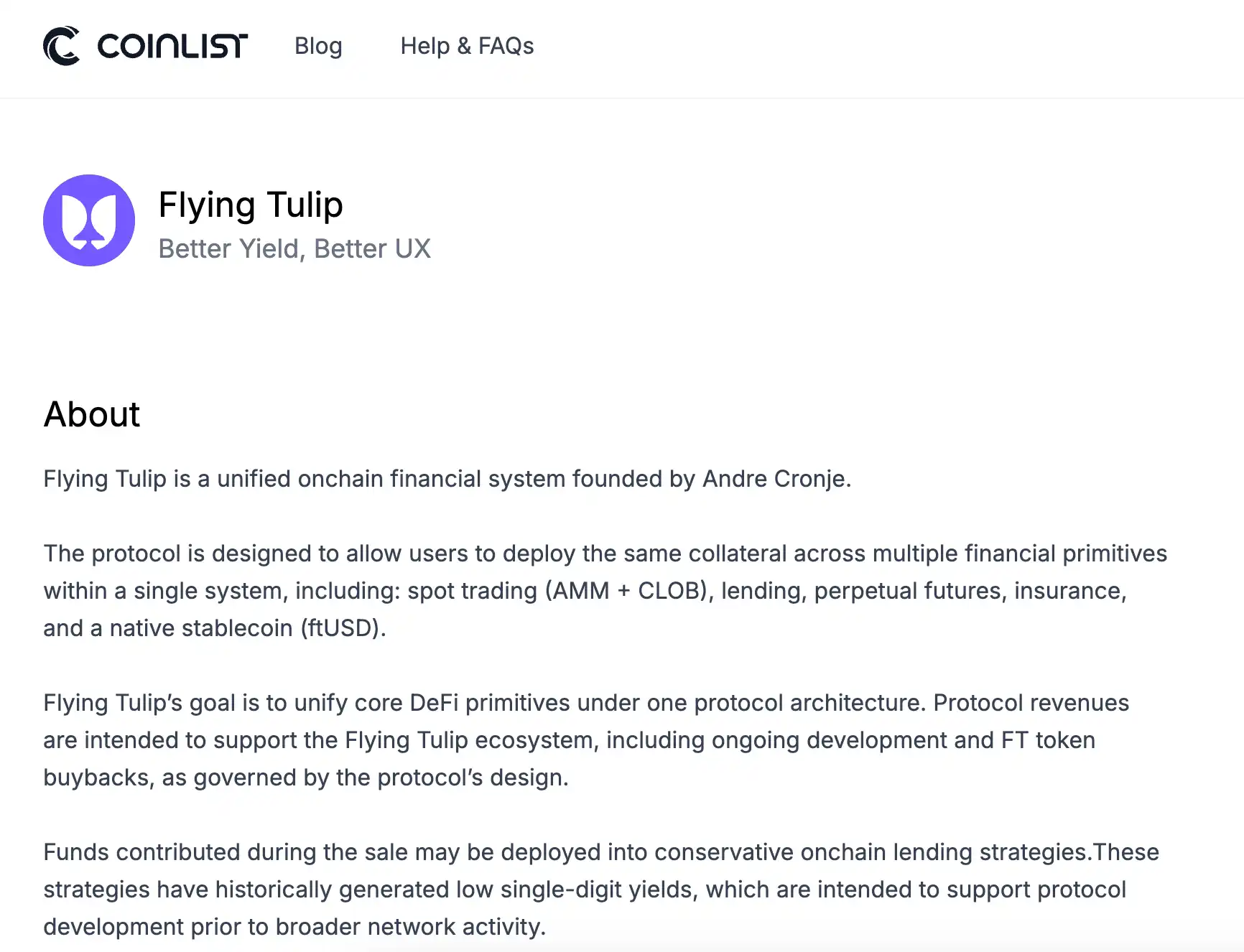
When you participate in Flying Tulip's public sale on CoinList, spending $0.10 to buy an FT, you don't receive the token directly. Instead, you get an NFT called ftPUT, with the token locked inside. This NFT is that perpetual put option. You have three choices.

First, do nothing. The token remains in the NFT, non-tradable, but the redemption right persists. Whenever you want to leave, burn the token and get your USDC or ETH back at the original price. Regardless of how low the FT price falls on the secondary market, your principal has a floor.

Second, extract the tokens from the NFT to trade freely. But the moment you extract them, the redemption right is permanently forfeited. The principal corresponding to the extracted tokens is released to the protocol for buyback and burn.

Third, extract some, keep some. The portion kept in the NFT continues to have protection; the extracted portion goes naked.

AC himself said something very interesting in an interview with The Block, the gist being that because of the perpetual PUT's existence, the funds raised essentially cannot be spent at all.

The net funds raised are zero. So where does operating capital come from?

All raised capital is placed into lending protocols like Aave and Ethena for conservative strategies, targeting around 4% annual yield. Based on a full raise of $1 billion, this would generate approximately $40 million in interest annually. This money funds the team, development, and buybacks. The team has no initial token allocation; all FT tokens must be bought back by the protocol from the open market using protocol revenue.

The author must admit, this design is quite ingenious within DeFi. It addresses the foulest problem in the crypto industry in recent years: project founders taking the money and running, or spending it recklessly, leaving investors with nothing. AC's solution essentially ties his own hands: the money can't be touched, the team gets no pre-allocated tokens, and investors can exit at any time.

But ingenious as it is, this protection exists only in the primary market. Once FT is listed on exchanges, tokens bought on the secondary market do not come with ftPUT. This sentence is written in bold on CoinList's page.

Buyers on the open market see the same token but receive completely different treatment.

A Microcosm of the Industry

Money is flowing out of the crypto market this year—that's no secret.

BTC has fallen nearly 20% year-to-date, and the median drop for altcoins far exceeds that. People in the circle look at the Nasdaq hitting new highs, then switch back to their own holdings—the feeling needs no description.

Many people's real strategy this year has been slowly shifting their positions into U.S. stocks and stablecoin yield products. On-chain activity is visibly shrinking.

In this environment, AC's exit from Sonic is just the tip of the iceberg. The entire L1 sector is experiencing the same story: TVL contraction, user attrition, founding team changes, or direct disappearances. Sonic just gets highlighted as a case study because of its fame and extreme decline.

But AC's case has a layer other projects lack.

Flying Tulip's current valuation is about $1 billion. Sonic's current market cap is about $100 million. The same person, the same period, one at $1 billion, the other at $100 million—a tenfold difference. What's the distinction? The distinction lies in which project AC's name is attached to.

This is a fact few in the DeFi industry are willing to voice openly.

The valuation of many projects isn't built on revenue, users, or technological moats—it's built on a person's name. The name stays, the money stays. The name leaves, the money follows.

The bear market ripped off this fig leaf. In a bull market, all L1s rise, making it hard to distinguish whether fundamentals or a name is propping it up. When the tide recedes, what remains becomes clear.

There's one more detail the author finds most interesting.

Flying Tulip's primary deployment chain is Sonic. AC exited Sonic's board, no longer involved in any business decisions, but his new project's first stop is on Sonic. He's gone, but his business remains.

The captain has disembarked, but opened a new shop on the dock, selling things more expensive than what was on the ship.


Preguntas relacionadas

QWho is AC and what is his recent major action mentioned in the article?

AAC, known as the 'DeFi Godfather,' is a prominent figure in the decentralized finance space. According to the article, his recent major action is stepping down from the Sonic Labs (formerly Fantom) board of directors on June 19, along with two other founding directors.

QWhat is the main difference in token design between AC's previous project Sonic (S) and his new project Flying Tulip (FT)?

AThe key difference lies in the investor protection mechanism. Flying Tulip's private investors receive an ftPUT NFT, which is a perpetual put option allowing them to redeem their principal at the original price. Secondary market buyers of FT tokens on platforms like CoinList do not have this right. In contrast, Sonic's S token had no such protection mechanism for secondary market holders.

QHow does AC explain his role and responsibilities regarding Sonic's decline in his exit statement?

AIn his exit statement, AC clearly delineates his responsibilities. He states he was responsible for the core technical architecture and decisions but explicitly distances himself from decisions related to the token migration, airdrop, tokenomics, and handling of the old network. He implies he is not responsible for the S token's 97% price drop, attributing it to others' decisions.

QWhat pattern does the article suggest exists in AC's involvement with past projects like Yearn Finance and Fantom/Sonic?

AThe article suggests a recurring pattern where AC is heavily involved during a project's initial hype or peak phase, then steps away or reduces involvement just before or during a significant decline. This was observed with Yearn Finance, Fantom, and now Sonic, leaving token holders to bear the brunt of the subsequent price drops.

QAccording to the article, what broader industry trend does AC's exit from Sonic represent in the current crypto market?

AAC's exit from Sonic is presented as a symptom of a broader trend in the Layer-1 (L1) blockchain sector during the bear market. The article highlights that many L1 projects are experiencing collapsing Total Value Locked (TVL), user exodus, and founder/team departures. It underscores the reality that many project valuations are heavily reliant on founder reputation ('the name') rather than fundamentals, a weakness exposed when market conditions deteriorate.

Lecturas Relacionadas

Interpretación del Informe: JPMorgan Detalla el Sentimiento de los Compradores antes de los Resultados Trimestrales de Micron y la Situación Actual del Sector de Hardware

**Resumen del informe de J.P. Morgan: Sentimiento de compradores antes de resultados de Micron y panorama del sector de hardware** Un informe de J.P. Morgan analiza el sentimiento antes de los resultados de Micron, las tendencias en la cadena de suministro de hardware y las perspectivas de gasto de capital en IA. **Conclusiones clave:** 1. **Micron:** El sentimiento de los compradores sigue siendo muy positivo, siendo la memoria una de las apuestas más consensuadas en IA. Se espera que anuncien más contratos a largo plazo (SCA). Los focos de atención son la sostenibilidad de sus márgenes brutos, superiores al 80%, y el potencial para nuevos aumentos de precios impulsados por la IA. 2. **Cadena de suministro de hardware:** La demanda relacionada con IA en servidores, redes y almacenamiento sigue fuerte, pero con divergencia entre empresas. Destacan: * **Celestica (CLS):** Perspectivas de márgenes mejoradas, mayor confianza en proyectos de redes para IA y mejor capacidad para trasladar costes. * **Western Digital y Seagate:** Se benefician de la mejora continua de precios en un entorno de oferta limitada. * **Fabrinet (FN):** Mayor visibilidad en módulos ópticos para IA; los productos para Amazon comenzarán a generar ingresos. * **Teradyne (TER):** Se espera una caída de ingresos en el 2º semestre, pero Google podría convertirse en un nuevo cliente clave a finales de año. 3. **Gasto en capital de IA revisado al alza:** J.P. Morgan eleva su previsión de crecimiento del mercado de equipos para obleas (WFE) a un 28% en 2026 y un 29% en 2027. El financiamiento mediante deuda para proyectos de IA está aumentando, lo que reduce las restricciones para esta expansión del gasto. **Señales a seguir:** * Detalles de los SCAs y perspectivas de margen de Micron en sus resultados. * Posible mejora de la guía anual de Arista Networks. * Evolución de los ingresos de Fabrinet por módulos ópticos para Amazon. **Fuente:** Informe de J.P. Morgan (Joshua Meyers et al., 21 de junio de 2026).

marsbitHace 3 hora(s)

Interpretación del Informe: JPMorgan Detalla el Sentimiento de los Compradores antes de los Resultados Trimestrales de Micron y la Situación Actual del Sector de Hardware

marsbitHace 3 hora(s)

Interpretación del informe: El debut del nuevo presidente de la Fed, ¿cambio de timonel, pero no de guion?

**Resumen del informe: El debut del nuevo presidente de la Fed - ¿Cambio de liderazgo, pero el mismo guion?** El economista jefe global de Morgan Stanley, Seth B. Carpenter, analiza la primera reunión de la FOMC bajo el nuevo presidente de la Fed, Kevin Warsh. El informe destaca tres conclusiones clave: 1. **Warsh no ofrece una hoja de ruta para las tasas.** Su filosofía de reducir la "orientación prospectiva" es clara. La declaración de la FOMC fue más concisa y no proporciona un camino claro para la política. El gráfico de puntos sugiere solo una subida de tipos este año, pero Carpenter señala que si la inflación cae por debajo de lo esperado (posible ahora que los efectos de inflación de los aranceles se han disipado), la lógica para esa única subida podría desvanecerse, especialmente dado que las proyecciones apuntan a recortes para el próximo año. 2. **La reducción del balance (quantitative tightening, QT) podría ser más agresiva de lo esperado, con un impacto limitado.** La postura de Warsh sobre la reducción del balance es firme. Carpenter argumenta que medidas como reducir a la mitad la cuenta del Tesoro en la Fed podrían reducir el balance en ~$500 mil millones con poco efecto en el mercado. Los ajustes a los requisitos de liquidez y a las tasas de interés de las reservas podrían permitir una reducción mayor de la esperada. El principal riesgo de mercado sería si la Fed vende activos de hipotecas (MBS) de manera activa. 3. **Revisión del marco, pero el objetivo de inflación del 2% se mantiene.** Warsh inició una revisión del marco de política, pero se ha reafirmado el objetivo del 2%. Carpenter subraya que el cambio en el estilo de comunicación (declaraciones más breves, menos orientación prospectiva) es un regreso a la tradición más que un cambio fundamental, ya que la orientación prospectiva solo es crucial cuando las tasas están cerca de cero. **En resumen:** Carpenter sugiere que el pánico del mercado por las subidas de tipos podría ser excesivo, ya que la trayectoria inflacionaria podría no justificarlas. En cambio, la reducción del balance podría ser el aspecto más significativo y con potencial de sorprender en magnitud, aunque su impacto en el mercado podría ser moderado si se gestiona como se prevé. Las claves para seguir serán los datos de inflación (PCE básico), los detalles del camino de reducción del balance y las recomendaciones de la revisión del marco político.

marsbitHace 3 hora(s)

Interpretación del informe: El debut del nuevo presidente de la Fed, ¿cambio de timonel, pero no de guion?

marsbitHace 3 hora(s)

Semana Clave del Juego: Reconfirmación de BTC y Lucha por el Soporte de HYPE | Análisis Invitado

**Resumen del Análisis Semanal: Semana Clave de Confrontación - Confirmación de Retroceso de BTC y Lucha por el Soporte de HYPE** **Panorama General del Mercado:** Esta semana, el mercado entra en una fase crucial de confrontación entre compradores y vendedores. A nivel macro, los cambios marginales en las expectativas de la política de la Reserva Federal continúan dominando el ritmo de valoración de los activos de riesgo. En el mercado de criptomonedas, tras una fase previa de consolidación, las discrepancias entre alcistas y bajistas se están manifestando claramente en niveles de precio clave. **Análisis y Perspectiva para Bitcoin (BTC):** * **Estructura:** En el gráfico de 4 horas, el precio se encuentra en una fase de "retroceso y confirmación" tras romper la línea inferior de un canal alcista a corto plazo. El punto 41 es crucial. * **Pronóstico Semanal:** El escenario depende del resultado de esta confirmación. * **Escenario Alcista:** Si el precio se consolida con éxito por encima del soporte del canal (alrededor de $64,500-$65,000), podría intentar atacar la zona de resistencia clave de $69,500-$70,500. * **Escenario Bajista:** Si el retroceso falla y el precio cae, es probable una nueva prueba del soporte principal entre $59,000 y $60,000. * **Estrategia Operativa:** El modelo de seguimiento de posiciones indica una estructura de mercado dominada por los vendedores. Se mantiene una posición corta inicial del 20% establecida la semana pasada. La estrategia de corto plazo (30% del capital) contempla tres planes (A, B, C) para operar en diferencial, basados en reacciones del precio en los niveles de resistencia ($64.5K-$65K y $69.5K-$70.5K) o en una ruptura del soporte de $59K-$60K. **Análisis y Perspectiva para HYPE:** * **Estructura:** En 4 horas, HYPE muestra una fuerte tendencia alcista (récord en $76.94), seguida de un ajuste correctivo en tres ondas. El precio se acerca ahora a una zona de soporte crítica entre $64 y $66. * **Pronóstico Semanal:** La lucha en la zona de $64-$66 es clave. * **Escenario Alcista:** Un rebote sostenido desde este soporte podría reanudar la tendencia alcista hacia nuevos máximos. * **Escenario Bajista:** Una ruptura de $64-$66 podría extender la corrección hacia la siguiente zona de soporte fuerte en $52-$54. * **Estrategia Operativa:** La estrategia de corto plazo es "comprar en soportes, evitar comprar en máximos". Se considera una posición larga de prueba (con capital <30%) solo si el precio muestra señales claras de estabilización y rebote en las zonas de soporte de $64-$66 o $52-$54, confirmado por señales de los modelos cuantitativos. **Disciplina de Gestión de Riesgos (Aplicable a todas las operaciones):** 1. Establecer un stop-loss inicial inmediatamente al abrir una posición. 2. Mover el stop-loss al precio de entrada (punto de equilibrio) cuando la ganancia alcance el 1%. 3. Mover el stop-loss al nivel del 1% de ganancia cuando esta alcance el 2%. 4. Ajustar el stop-loss para bloquear ganancias de forma dinámica, moviéndolo un 1% adicional por cada 1% adicional de ganancia. **Descargo de responsabilidad:** Este análisis es un registro personal para la toma de decisiones y revisión de operaciones, no constituye asesoramiento de inversión. Los mercados son complejos y la gestión de riesgo y el respeto a los stop-loss son siempre la máxima prioridad.

marsbitHace 3 hora(s)

Semana Clave del Juego: Reconfirmación de BTC y Lucha por el Soporte de HYPE | Análisis Invitado

marsbitHace 3 hora(s)

Interpretación de Informe de Investigación: Citi Asiste a la Cumbre de AWS, Es Optimista sobre la Aceleración del Negocio en la Nube, pero la Gobernanza de Datos Sigue Siendo una Variable Clave

Análisis de Citi sobre la Cumbre de AWS: El Negocio en la Nube se Acelera, pero la Gobernanza de Datos Sigue siendo Clave El equipo de análisis de Citi, tras asistir a la cumbre de AWS en Nueva York, mantiene una calificación "compra" para Amazon, proyectando una aceleración en los ingresos de AWS hasta el 37% en el año fiscal 2027. **Conclusiones Principales:** 1. **Cambio de Enfoque:** AWS ha pasado de las pruebas de concepto a ofrecer soluciones para un **despliegue escalable** de la IA empresarial, con lanzamientos como AWS Context (para gestión de datos y conocimiento), Amazon Quick (asistente transversal) y herramientas de seguridad y desarrollo. 2. **Beneficiarios Directos:** Los proveedores de **infraestructura de datos** (como Snowflake, Elastic, Oracle) se ven favorecidos por la demanda de gestionar las cargas de trabajo de IA. 3. **Reto Crítico:** La **gobernanza de datos** es la variable clave para escalar la IA. AWS Context aborda este desafío al crear una capa unificada de conocimiento y permisos, permitiendo que los agentes de IA accedan de forma segura y precisa a los datos corporativos dispersos. **Perspectiva de Inversión:** Citi sugiere observar la aceleración de los ingresos de AWS, el crecimiento en el uso de sus herramientas de agentes de IA (como Bedrock) y el impacto en los proveedores de datos. Señala que, aunque la optimización de costes de IA es una prioridad, no frena la demanda. La capacidad de resolver la gobernanza determinará si la IA pasa de proyectos piloto a integrarse en los procesos centrales del negocio. *Nota: Este resumen interpreta un informe de Citi. Las proyecciones y valoraciones son del analista, no constituyen recomendación de inversión.*

marsbitHace 3 hora(s)

Interpretación de Informe de Investigación: Citi Asiste a la Cumbre de AWS, Es Optimista sobre la Aceleración del Negocio en la Nube, pero la Gobernanza de Datos Sigue Siendo una Variable Clave

marsbitHace 3 hora(s)

Trading

Spot
Futuros
活动图片