Plummeting Around 12%, Duan Yongping's Bottom-Fishing CoreWeave Turns into a Fierce Battlefield Between Bulls and Bears

marsbitPublicado a 2026-05-09Actualizado a 2026-05-09

Resumen

On May 8th, AI cloud computing provider CoreWeave (CRWV) plunged 11.4% following its Q1 2026 earnings report, intensifying the polarized market view on the stock. While revenue doubled year-over-year to $2.08B and its Remaining Performance Obligations (RPO) surged to nearly $100B, its net loss also widened to $740M. The key trigger was a weaker-than-expected Q2 revenue forecast, coupled with rising costs that compressed adjusted operating margin to just 1%. The bull thesis centers on CoreWeave's massive order backlog, deep strategic ties with NVIDIA as a key customer and investor, and client diversification with major names like Anthropic and Meta. Supporters point to its 'hyperscale' status and over $20B in recent financing. Bears highlight the "growth at all costs" model: despite soaring revenue, losses are expanding, capital expenditures are massive (~$6.8B in Q1), and total debt has ballooned to around $25B. Significant insider selling by executives adds to skepticism. This contrast is embodied by investor Duan Yongping (known as "China's Buffett"), who initiated a small, exploratory position (~0.12% of his portfolio) in Q4 2025 near the stock's lows, viewing it as a speculative bet on the AI infrastructure chain. The upcoming Q2 report is seen as a critical test for management's promise of a profit margin rebound. CoreWeave remains a battleground stock where long-term narrative clashes with near-term financial reality.

Author: Deep Tide TechFlow

On May 8, AI cloud computing provider CoreWeave (CRWV) plummeted 11.4% in a single day, closing at $114.15. This marks another instance of "earnings day decline" for the company since its IPO in March of last year. However, unlike previous times, this sell-off is compounded by a more dramatic contrast: Duan Yongping, widely known in Chinese circles as a disciple of Warren Buffett, just established a new position in CoreWeave in Q4 2025, amounting to approximately $20 million. Based on the position size and the Q4 average price, his entry point was close to CoreWeave's lowest range for the year in December 2025.

CoreWeave is currently one of the most divisive AI assets in the US stock market. On one side is the narrative of being a "pick-and-shovel seller" deeply tied to Nvidia, backed by nearly $100 billion in order backlog; on the other side is the financial reality of expanding losses with scale, alongside continuous insider selling. The Q1 earnings report acted like a prism, refracting this divide with stark clarity.

Q1 Earnings: Revenue Doubles but Losses Widen, Q2 Guidance Punctures Valuation

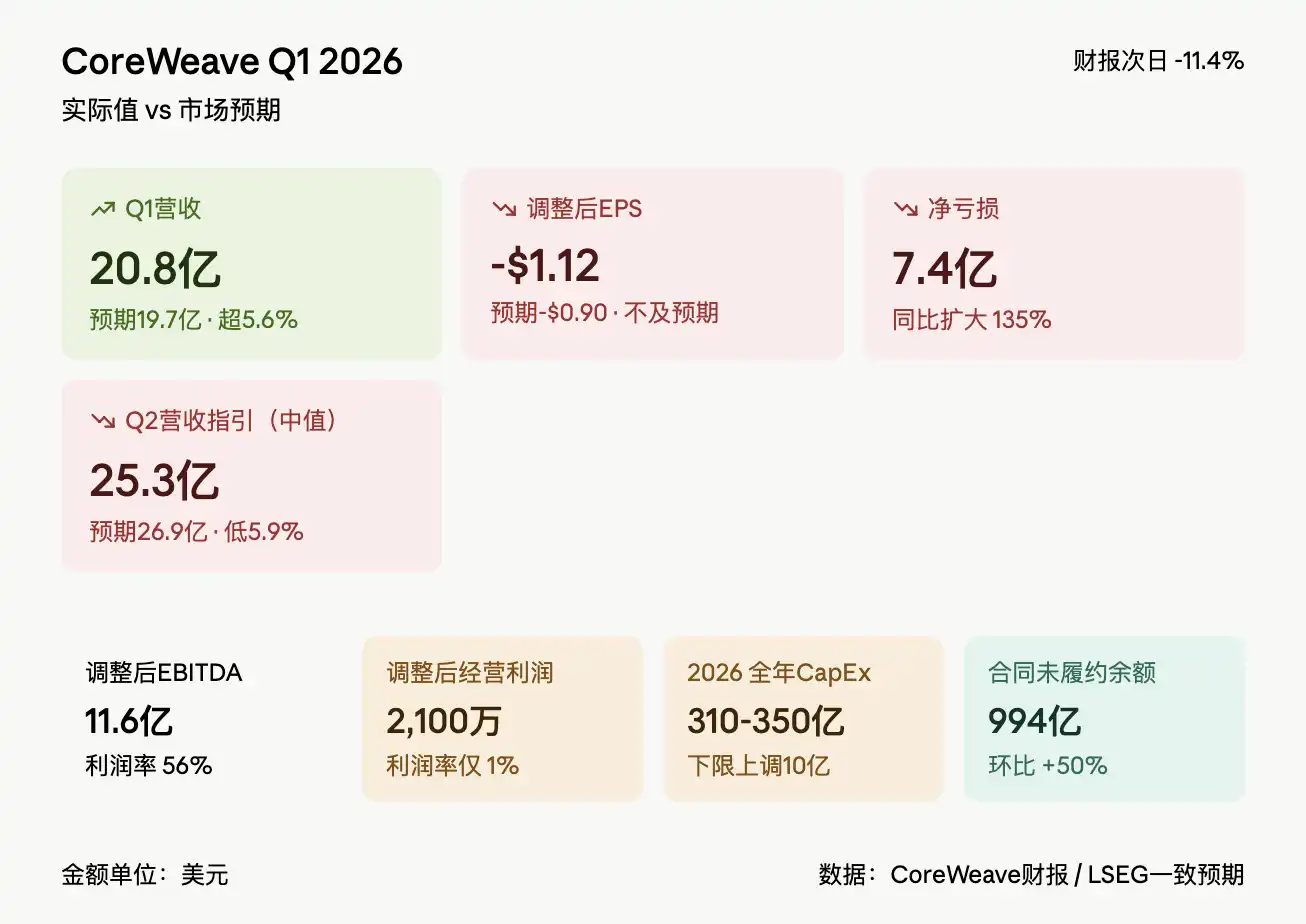
CoreWeave's Q1 revenue reached $2.08 billion, a 112% year-over-year increase and a 32% sequential increase, surpassing the LSEG market consensus of $1.97 billion. However, adjusted earnings per share loss was $1.12, worse than the expected loss of $0.90; the net loss widened to $740 million, more than doubling from $315 million a year ago.

The forward guidance is what truly ignited the sell-off. The company provided a Q2 revenue range of $2.45 billion to $2.6 billion, with a midpoint of $2.53 billion, significantly lower than the market expectation of $2.69 billion. Concurrently, the lower limit for the full-year 2026 capital expenditure was raised from $30 billion to $31 billion, with CFO Nitin Agrawal attributing the increase to rising component costs.

The fragility of the profit structure was laid bare. While Q1 adjusted EBITDA reached $1.16 billion (a 56% margin), which appeared impressive; adjusted operating profit was merely $21 million, compressing the operating margin to just 1%. The reason lies in the 127% year-over-year surge in technology and infrastructure costs to $1.27 billion, and sales and marketing expenses skyrocketing over sixfold to $69 million. Revenue is growing, but costs are growing faster.

CEO Michael Intrator emphasized on the earnings call: "We have reached hyperscale." He disclosed that the company now has 10 clients committed to spending over $1 billion each, a significant improvement in concentration risk compared to 2024 when 62% of revenue relied on a single customer, Microsoft. Intrator also projected that CoreWeave's annualized revenue should exceed $30 billion by the end of 2027.
The Bull Narrative: $100 Billion Order Backlog, Deep Ties with Nvidia

The core supporting the bull case is the order backlog. As of the end of Q1, CoreWeave's remaining performance obligations (RPO) stood at $99.4 billion, a net increase of approximately $33 billion sequentially and nearly quadrupling year-over-year. Intrator stated that new contracts signed in Q1 alone exceeded $40 billion.

The client roster is also reshaping market perception. In Q1, CoreWeave added Anthropic as a client, providing computing power for its Claude series models; signed a $2.1 billion AI cloud agreement with Meta; trading firm Jane Street committed to roughly $6 billion in orders and separately completed a $1 billion equity investment. Nvidia purchased an additional $2 billion worth of CoreWeave Class A common stock this quarter. This global largest GPU supplier is simultaneously an investor and a significant customer of CoreWeave, a tripartite relationship dubbed Nvidia's "favored son."

Regarding financing structure, CoreWeave completed an $8.5 billion investment-grade HPC (High-Performance Computing) secured delayed draw term loan (DDTL) in Q1, priced below 6%, hailed by management as "groundbreaking." Year-to-date, the company has raised over $20 billion in debt and equity financing, with the weighted average cost of debt decreasing by approximately 80 basis points. S&P Global Ratings concurrently upgraded CoreWeave's credit rating outlook from "stable" to "positive."

The Bear Logic: Bigger Scale, Less Profit, Debt Snowball Grows Larger

However, another set of numbers in the earnings report is causing anxiety. Q1 capital expenditure reached $6.8 billion, and the company expects Q2 capital expenditure to further climb to between $7 billion and $9 billion. The Q2 interest expense guidance range is $650 million to $730 million, reflecting the rapid expansion of the debt pile.

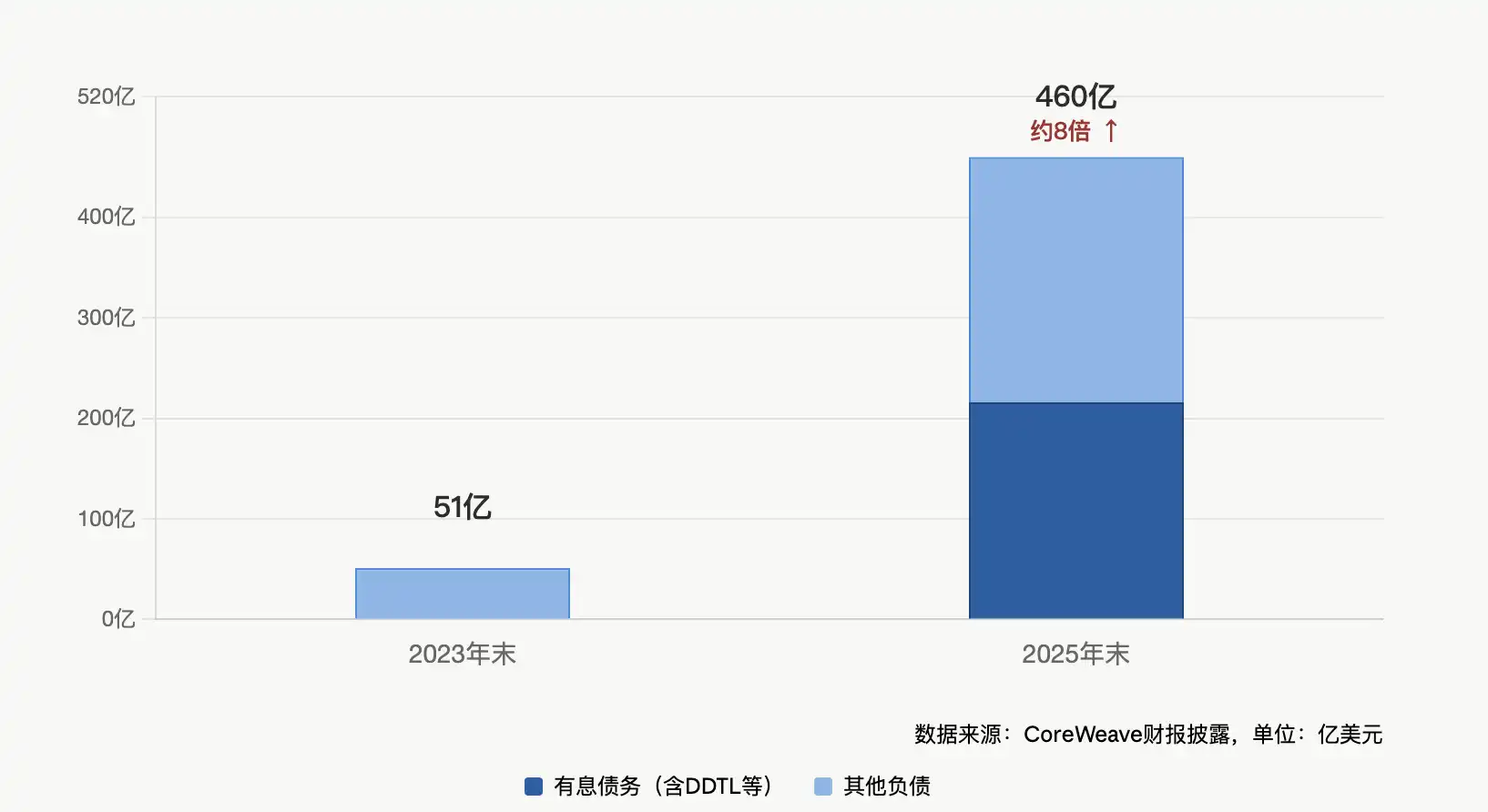
The total debt burden is already staggering. As of the end of Q1, CoreWeave's total debt was approximately $25 billion. Relative to the company's current annualized revenue scale, this leverage level is significantly higher than that of traditional cloud service providers. Morgan Stanley data shows that CoreWeave's debt financing for the full year 2025 reached about $11.8 billion, far exceeding the approximately $1.5 billion in equity financing during the same period. The company's core expansion tool is the DDTL, a "book-then-fund" model where it secures bank financing to purchase GPUs, using order contracts as collateral.

The sharpest criticism stems from profit quality. Although management repeatedly highlights the 56% EBITDA margin, the adjusted operating margin is only 1%, and the "real" gross margin after deducting technology and infrastructure costs is about 4%, showing compression both sequentially and against market expectations. On the call, Intrator attributed this to the phased effects of scaling, where the dilution effect on margins from adding new capacity is immense when expanding rapidly from a 1-gigawatt operational scale. He promised this was the "low point for margins," which would gradually rebound in future quarters.

However, the market is currently unwilling to pay for that promise. While analysts from Morgan Stanley and Jefferies issued positive evaluations, CoreWeave has experienced short-term pullbacks after every previous earnings report, with this decline being one of the steeper ones.
Ongoing Insider Selling, Mirroring Duan Yongping's Bottom Fishing

Around the earnings release, CoreWeave insiders continued their selling. CEO Mike Intrator sold 307,693 shares in late April; co-founders Brian Venturo and Chen Goldberg also recorded sales; institutional shareholder Magnetar Financial had previously offloaded over $300 million worth. The latest disclosures show another major shareholder recently sold approximately 1.2 million shares.

This forms a stark contrast with Duan Yongping's Q4 position building. According to a 13F filing by H&H International Investment in February 2026, Duan Yongping initiated a position in CoreWeave of 299,900 shares in Q4 2025, when the company's stock price had retreated over 65% from its highs, and market concern over its debt structure peaked.

It is noteworthy that CoreWeave constitutes only 0.12% of Duan Yongping's total H&H portfolio, a "light test" position. During the same period, Duan aggressively increased his Nvidia stake by over 1110% and initiated new positions in Credo Technology (high-speed connectivity) and Tempus AI (AI healthcare), with these three new AI positions combined accounting for less than 0.3%. This suggests Duan's real heavy bet is on Nvidia itself, with CoreWeave resembling a small, extended bet on the downstream AI computing supply chain.

The Key Question Now: Inflection Point or Trap?

During the Q&A session of the earnings call, Intrator posed an emotionally charged rhetorical question: "I've always felt like everyone is staring at the stock price tree and missing the whole forest."

This statement aptly summarizes the current bull-bear standoff. The bulls see the forest: the nearly $100 billion contract backlog, diversified customer base, tripartite Nvidia ties, and the credit rating upgrade. The bears see the tree: the 1% operating margin, widening net loss, aggressive capital expenditure, and continuously selling insiders.

CoreWeave's stock price is still up nearly 80% year-to-date and over 200% since its IPO. However, when a stock's bull case relies on long-term narratives while the bear case rests on current numbers, every earnings report becomes a battleground for these two narratives. In a previous interview with Fang Sanwen, Duan Yongping stated: "AI is a massive revolution brought about by qualitative changes in computing power, potentially exceeding the impact of the internet and industrial revolutions. There is a clear AI bubble currently; 90% of companies may be eliminated, but the survivors will become the next generation of giants." His 0.12% light position itself acknowledges the uncertainty of this gamble.

The next test point is already clear: the Q2 earnings report. If the operating margin fails to rebound as promised by management by then, the credibility of the "forest" narrative will face a real stress test.

Preguntas relacionadas

QWhy did CoreWeave's stock price drop sharply on May 8th?

ACoreWeave's stock price dropped 11.4% on May 8th primarily due to disappointing Q2 revenue guidance. The company forecast Q2 revenue between $2.45 and $2.6 billion, with a midpoint of $2.53 billion, which was significantly below market expectations of $2.69 billion. Additionally, the company's Q1 net loss widened to $740 million, more than double the loss from a year ago, and its adjusted operating margin was compressed to just 1%, fueling investor concerns about profitability despite rapid revenue growth.

QWhat are the main arguments of CoreWeave's bullish investors?

ABullish investors focus on CoreWeave's massive backlog of nearly $100 billion in Remaining Performance Obligations (RPO), which grew significantly in Q1. They highlight its deep ties with Nvidia, which is an investor, customer, and key GPU supplier. The company has diversified its client base, securing major agreements with companies like Meta and Anthropic, and improving its reliance on a single customer (previously Microsoft). Strong financing, including low-cost debt, and an 'investment-grade' credit rating upgrade from S&P also support the positive long-term narrative.

QWhat are the main concerns of CoreWeave's bearish investors?

ABearish investors point to CoreWeave's deteriorating profitability as scale increases. Key concerns include a net loss that more than doubled year-over-year, a razor-thin 1% adjusted operating margin, and capital expenditures that are soaring ($6.8B in Q1). The company's massive and growing debt load (approximately $25B) and high interest expense are seen as significant risks. Furthermore, the ongoing insider selling by executives and major shareholders contrasts with the bullish public narrative, raising questions about internal confidence.

QWhat was Duan Yongping's investment action regarding CoreWeave, and what does it signify?

ADuan Yongping, through his investment firm H&H International, initiated a position in CoreWeave in Q4 2025, purchasing approximately 299,900 shares worth around $20 million when the stock was near its yearly low. However, this position represents a very small 0.12% of his total portfolio. His much larger bet is on Nvidia itself. The CoreWeave investment is viewed as a minor, exploratory allocation to the downstream AI infrastructure sector, acknowledging both the sector's potential and its high uncertainty, rather than a strong conviction bet on the company.

QWhat is the key upcoming test for CoreWeave's investment thesis according to the article?

AThe next crucial test for CoreWeave will be its Q2 2026 earnings report. CEO Michael Intrator has promised that Q1 represented a 'low point' for margins and that profitability would improve in subsequent quarters. If the Q2 report fails to show a meaningful rebound in the operating margin from the current 1% level, the credibility of the company's long-term growth and profitability narrative ('the forest') will face severe pressure, potentially leading to further investor skepticism and stock price volatility.

Lecturas Relacionadas

El Mercado de Deuda Japonesa se Dirige a la Cadena de Bloques

El mercado de deuda pública japonés (JGB), valorado en más de 9 billones de dólares, se prepara para una transformación crucial mediante la tokenización en blockchain. Instituciones clave como JSCC, Mizuho, Nomura y Digital Asset han iniciado una prueba de concepto en la red Canton para mover garantías JGB a la cadena. Este cambio responde a la urgencia de modernizar un sistema anticuado, donde las transferencias de colateral pueden tardar días y están limitadas al horario de Tokio, lo que pone en riesgo la competitividad del JGB frente a los Bonos del Tesoro de EE.UU., que ya avanzan hacia una liquidación tokenizada 24/7. La red Canton, elegida por su arquitectura que cumple con estrictos requisitos legales y de privacidad, permite liquidaciones atómicas e instantáneas entre instituciones, sincronizando solo los datos autorizados para cada parte. Este sistema "siempre activo" podría liberar billones en colateral inmovilizado, reducir costes operativos y mitigar riesgos sistémicos, como los ciclos de ventas forzosas durante crisis de mercado, al permitir el uso directo de bonos como garantía. Este movimiento representa una revolución en la eficiencia de la infraestructura financiera global, aunque consolida el papel de los actores tradicionales en una nueva capa tecnológica. La convergencia de los principales bonos soberanos en Canton apunta a que esta red podría convertirse en un estándar fundamental para el movimiento de colateral a nivel mundial.

marsbitHace 26 min(s)

El Mercado de Deuda Japonesa se Dirige a la Cadena de Bloques

marsbitHace 26 min(s)

Resumen de Financiación Semanal | 14 Eventos de Financiación Pública, Kalshi Cierra una Nueva Ronda de $10 Mil Millones con una Valoración de $220 Mil Millones, Liderada por Coatue Management

**Resumen semanal de financiación: 14 rondas recaudan más de 10.490 millones de dólares** Esta semana (4-10 de mayo) se registraron 14 eventos de financiación en el sector blockchain, con un volumen total superior a los 10.490 millones de dólares, según datos recopilados por PANews. **Desglose por sectores:** * **DeFi (4):** Destaca OnRe, una reaseguradora regulada en cadena, que completó una ronda Serie A de 5 millones de dólares. * **Infraestructura y herramientas (4):** OpenTrade lideró con una ronda estratégica de 17 millones para expandir su infraestructura de rendimiento para stablecoins. * **Mercados de predicción (3):** La plataforma Kalshi recaudó 1.000 millones de dólares en una nueva ronda liderada por Coatue Management, alcanzando una valoración de 22.000 millones. * **Finanzas centralizadas (1):** La plataforma de trading impulsada por IA Stockcoin.ai completó una ronda semilla. * **Otras aplicaciones Web3 (2):** SC Ventures, de Standard Chartered, realizó una inversión estratégica en el creador de mercado de cripto GSR. **Inversiones institucionales relevantes:** * Coinbase realizó una inversión estratégica "de siete cifras" en Centrifuge, designándola como socio clave para la tokenización de activos reales (RWA) en su ecosistema Base. * Haun Ventures, fundada por Katie Haun, completó la captación de un nuevo fondo de 1.000 millones de dólares para invertir en cripto, IA y activos alternativos. * La firma suiza Multi Investment recaudó ~616 millones de dólares para aumentar sus inversiones en blockchain, Web3 y fintech.

marsbitHace 30 min(s)

Resumen de Financiación Semanal | 14 Eventos de Financiación Pública, Kalshi Cierra una Nueva Ronda de $10 Mil Millones con una Valoración de $220 Mil Millones, Liderada por Coatue Management

marsbitHace 30 min(s)

El prototipo de 'El gran golpe' duplica su apuesta contra la burbuja de la IA: mantiene posiciones cortas en NVIDIA y Palantir y compra acciones de software tradicional

El inversor Michael Burry, famoso por apostar contra la burbuja inmobiliaria en 2008, está incrementando sus posiciones en contra del entusiasmo actual por la IA. Según su blog 'Cassandra Unchained', mantiene y amplía sus apuestas bajistas contra Nvidia y Palantir, añadiendo posiciones cortas en ETFs de semiconductores (SOXX) y del Nasdaq 100 (QQQ). Simultáneamente, está comprando acciones de empresas de software tradicional como Adobe, Autodesk y Salesforce, cuyos precios han caído, argumentando que se han visto perjudicadas injustamente por la narrativa de la IA. Burry comenzó a apostar contra Palantir y Nvidia en el tercer trimestre de 2025. Aunque su posición contra Palantir ya es rentable, espera que la acción caiga más del 60% desde sus niveles actuales. Su apuesta contra Nvidia, sin embargo, está en pérdidas, ya que la acción sigue cerca de máximos históricos. Su tesis central es que la actual euforia por la infraestructura de IA es una burbuja comparable a la de internet en los años 90. Al combinar ventas en corto de los "ganadores de la IA" con compras de los "perdedores" castigados, Burry construye una cartera que busca beneficiarse de una corrección en los precios excesivos. Aunque sus opiniones contrastan fuertemente con el mercado alcista, insiste en su análisis de que la valoración del sector de la IA está desconectada de los fundamentos reales.

marsbitHace 34 min(s)

El prototipo de 'El gran golpe' duplica su apuesta contra la burbuja de la IA: mantiene posiciones cortas en NVIDIA y Palantir y compra acciones de software tradicional

marsbitHace 34 min(s)

“El Gran Corto” Burry y el legendario magnate Jones advierten: la fiebre por la IA se parece mucho a la víspera del desplome del 2000

El famoso inversor Michael Burry, conocido por predecir el colapso del mercado inmobiliario estadounidense, ha advertido que la actual obsesión del mercado bursátil con la inteligencia artificial comienza a parecerse a las últimas etapas previas al estallido de la burbuja puntocom en 2000. En un artículo publicado en Substack, Burry señaló que, durante un largo viaje en coche, escuchó programas financieros en los que solo se hablaba de la IA todo el día. Criticó que el mercado ya no reacciona de manera lógica a datos económicos como los informes de empleo o la confianza del consumidor, atribuyendo el alza de las acciones simplemente a un "impulso alcista" alimentado por una narrativa de dos letras (IA). Comparó el reciente rendimiento del índice de semiconductores de Filadelfia (SOX) con el aumento previo al desplome tecnológico de marzo de 2000. Por su parte, el legendario trader macro Paul Tudor Jones, de Tudor Investment Corporation, también comparó el actual auge impulsado por la IA con el período anterior al estallido de la burbuja de internet. Sin embargo, Jones cree que este mercado alcista podría tener aún espacio para seguir subiendo durante uno o dos años. No obstante, advirtió que si las valoraciones continúan inflándose, el eventual ajuste podría ser extremadamente severo, imaginando un escenario donde la capitalización del mercado en relación con el PIB alcance niveles insostenibles.

marsbitHace 54 min(s)

“El Gran Corto” Burry y el legendario magnate Jones advierten: la fiebre por la IA se parece mucho a la víspera del desplome del 2000

marsbitHace 54 min(s)

Perspectiva de las Noticias de esta Semana | Estados Unidos publica los datos de IPC de abril; Comité Bancario del Senado de EE. UU. examina el proyecto de ley "Ley de Clarificación de Mercados de Activos Digitales de 2025"

**Resumen de las noticias clave de esta semana** **12 de mayo (Martes):** Estados Unidos publicará los datos del IPC de abril a las 20:30 (hora de Pekín). La cadena de juegos Ronin migrará a Ethereum Layer 2, causando unas 10 horas de interrupción. **13 de mayo (Miércoles):** Base planea activar en la red principal su primera actualización independiente de red, "Base Azul", destinada a mejorar la seguridad, el rendimiento y la experiencia del desarrollador. **14 de mayo (Jueves):** El Comité Bancario del Senado de EE. UU. debatirá y votará la "Ley de Claridad del Mercado de Activos Digitales de 2025". El protocolo DeFi Carrot en Solana cerrará, estableciendo el 14 de mayo como fecha límite para retiros. La Bolsa de Moscú lanzará futuros sobre índices de Solana, Ripple y Tron para inversores cualificados. **15 de mayo (Viernes):** Dmail Network comenzará a cerrar todos sus servicios debido a altos costos operativos y falta de un modelo comercial sostenible. Los usuarios deben exportar sus datos antes de esa fecha. La cadena de préstamos UX Chain en Cosmos también cerrará completamente. **16 de mayo (Sábado):** Lattice, infraestructura para juegos blockchain, cesará sus operaciones. Su red Layer 2, Redstone, dejará de funcionar. Los usuarios deben retirar sus fondos antes de esa fecha.

链捕手Hace 1 hora(s)

Perspectiva de las Noticias de esta Semana | Estados Unidos publica los datos de IPC de abril; Comité Bancario del Senado de EE. UU. examina el proyecto de ley "Ley de Clarificación de Mercados de Activos Digitales de 2025"

链捕手Hace 1 hora(s)

Trading

Spot
Futuros
活动图片