This Generation of East Asian Ordinary People Getting Rich Thanks to TSMC and AI-Related Korean Stocks

marsbitPublicado a 2026-06-22Actualizado a 2026-06-22

Resumen

The article describes how the global AI boom, driven by demand for semiconductors, is creating newfound wealth for ordinary young investors and professionals in East Asia, particularly in South Korea and Taiwan. Fueled by massive capital expenditure from tech giants, the surge in AI-related exports has propelled stock markets in South Korea, Taiwan, and Japan to significant gains. This has led to a widespread retail investing frenzy. In South Korea, individuals like 24-year-old programmer Na Se-bin and 35-year-old teacher Choi Sung-ho are investing heavily and seeing substantial returns, altering their spending habits. In Taiwan, the chipmaker TSMC, a dominant force in advanced manufacturing, is central to the economic euphoria, offering high salaries and social prestige. The company's stock surge has significantly boosted the local market. The phenomenon extends to Japan, where even companies in seemingly unrelated sectors are benefiting from the AI supply chain. The narrative highlights a region capitalizing on its role as the essential hardware provider for the AI "gold rush," with its tech giants acting as the "sellers of shovels." This has translated into rapid wealth accumulation, a booming luxury market, and a pervasive culture of stock trading among everyday people, including younger generations.

Originally fromThe Wall Street Journal

Compiled by / Odaily Planet Daily Golem(@web 3_golem)
Na Se-bin has completely lost her sense of consumption.

Since January this year, attracted by the global AI boom, she has poured almost her entire life savings (about $47,000) into the stock market, a frenzy that is filling the coffers of tech giants in South Korea, Taiwan, and Japan.

The 24-year-old South Korean programmer says that during sharp market swings, she has made or lost the equivalent of a month's salary in a single second. Despite the huge risks, she can't resist, especially after seeing the stock she holds double in price. South Korea's stock market has been one of the world's best performers over the past 18 months, and Na jokes with her colleagues that they should sell their underwear to buy more stocks.

"Even friends who never touched stocks before are now starting to jump in," Na says. "Everyone is speculating on something."

Na Se-bin, a 24-year-old software developer in Seoul, started investing in January this year and quickly became addicted. (Image credit: Tim Franco for The Wall Street Journal)

Trillions of dollars are pouring into the global construction of AI, which relies on the semiconductors and chip-making technology supplied by a handful of Asian exporters. The surge in global chip demand seems endless, fueling export growth, corporate profits, and wealth for many investors.

Even after recent pullbacks, Taiwan's stock market has still doubled in value over the past year, South Korea's has tripled, and Japan's Nikkei index has risen over 80% in the same period, three times the gain of the S&P 500.

The accelerating demand for AI-related products is stimulating investor enthusiasm and pushing up wages. In Taipei, taxi drivers even trade stocks while driving, and in the job market, the high salaries in the tech industry are enviable. Nowadays, one of the most effective "pick-up lines" in Taiwan is to tell someone you work for Taiwan Semiconductor Manufacturing Co. (TSMC), the world's largest chip foundry and also one of the most generous local employers. Employees in the memory-chip division of South Korea's Samsung Electronics are expecting an average bonus of about $400,000 this year. The company is forecast to generate more profit by 2026 than any global company except Nvidia.

Whether AI services from OpenAI's ChatGPT, Anthropic, and SpaceX can deliver on the promise of commercialization, this part of the tech sector seems destined to benefit. These Asian tech giants, which provide indispensable hardware for the AI industry, are the "shovel sellers" of the AI gold rush.

The four Silicon Valley hyperscale data centers — Microsoft, Meta Platforms, Amazon, and Alphabet's Google — plan to spend up to $670 billion this year on AI-related capital expenditures. This spending far exceeds the inflation-adjusted expenditure of the U.S. railroad expansion in the 1850s and the decades-long construction cost of the U.S. interstate highway system launched a century later.

According to an Allianz Trade report, global exports of AI-related products reached nearly $4 trillion last year, with Asia accounting for two-thirds. These products include semiconductors, data storage servers, and cooling systems.

Market research firm Gartner predicts that direct spending in the AI field (covering services, infrastructure, and software) is expected to reach $2.6 trillion this year, a 47% increase from 2025. Next year, that number is forecast to reach about $3.5 trillion.

Nvidia CEO Jensen Huang recently concluded an 18-day high-profile visit, participating in a series of events, speeches, and business meetings in Taiwan and South Korea.

In Taipei, convenience stores sell lottery tickets with a top prize of 500 shares of Nvidia stock. Huang announced plans to invest $150 billion annually in Taiwan, which he called the center of the AI revolution. In South Korea, Huang signed cooperation agreements with local companies in robotics, memory chips, and AI.

During Huang's visit to Seoul, the KOSPI index halted trading on June 8 after plunging more than 8%, following a sell-off in U.S. chip stocks (including Nvidia). Huang, wearing his signature leather jacket even in Seoul's summer heat, was unfazed by the stock drop.

"People should be very happy with the current stock prices," he said. "Because now you can buy stocks more cheaply."
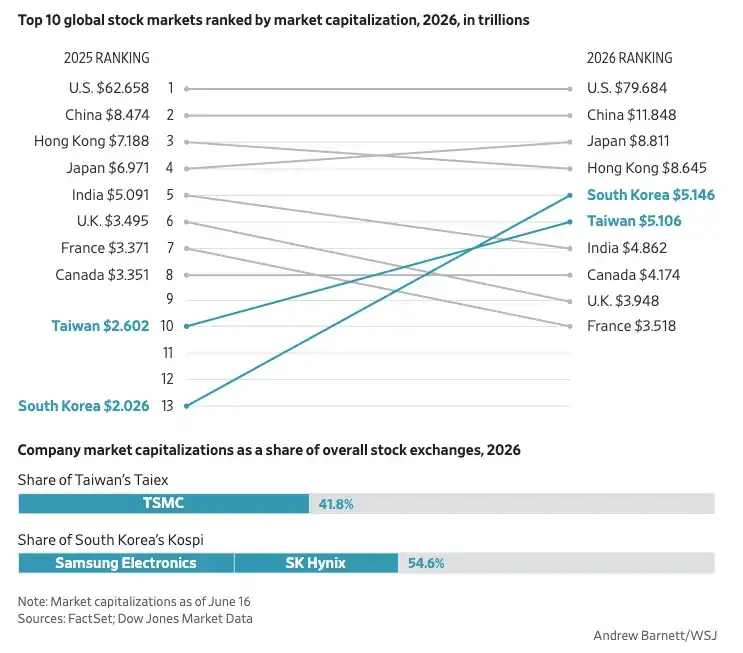
Global Top 10 Stock Market Capitalizations in 2026 and the Share of TSMC and SK Hynix in Their Respective Market's Total Capitalization

Na only started trading stocks this year. She estimates that over 80% of her social circle actively invests, as do her colleagues. One colleague, she says, made enough money from stock investments to spend tens of thousands of dollars on an engagement ring.

Now, Na is "extravagant" when it comes to concert tickets, branded clothing, and treating her parents to meals. She planned to buy a gold ring for her mother to celebrate her parents' 30th wedding anniversary, but her mother declined.

"She told me to just give her cash," Na said, "so she could buy stocks."

TSMC, Put on a Pedestal

Ye Lunhao, a 37-year-old insurance agent, invests more than half of his roughly $2,100 monthly salary in local AI and chip-related companies. His investment returns have quadrupled, and he recently bought a $440,000 four-bedroom apartment in Taichung, Taiwan.

For years, his friends steered clear of stock market investing. Now, they all ask him for investment advice.
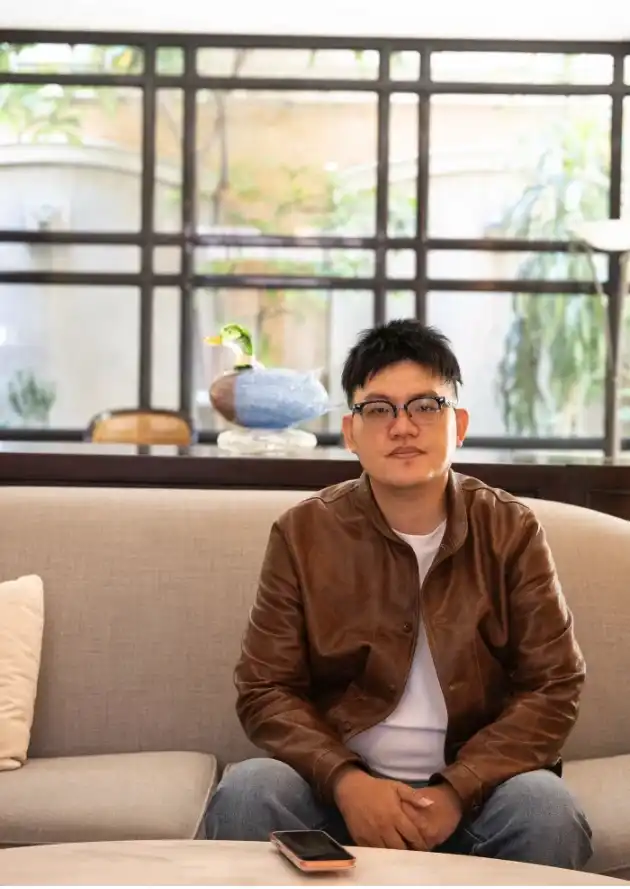
37-year-old insurance agent Ye Lunhao sits in the lobby of his apartment building in Taichung, Taiwan. Photo by Lin Yifei for The Wall Street Journal

"Without semiconductors, none of this would have happened," Mr. Ye said. "Investing has freed me from mere drudgery and given me a chance to enjoy the beauty of this world."

TSMC is the main driver of Taiwan's stock market surge. According to tech market research firm Counterpoint Research, the company captured over 90% of revenue share in the most advanced chip manufacturing last year. TSMC is the world's seventh-highest valued company, with a market cap exceeding $2.2 trillion, surpassing Tesla and Meta.

The company's stock price has more than doubled in the past year, pushing Taiwan's benchmark index past markets like France, the U.K., and India.

The chipmaker accounts for over 41% of Taiwan's benchmark index. In comparison, the seven tech giants Apple, Microsoft, Alphabet, Amazon, Nvidia, Meta, and Tesla combined account for about one-third of the S&P 500.

TSMC engineers' salaries can be three times the low end of what other companies pay for similar roles. Choc Chiang, co-founder of Taipei recruitment platform WeFer, said some managers poached by TSMC from smaller companies saw salary increases of up to 30%.

Wang Canlong, owner of an upscale liquor store in Zhubei, Taiwan, has supplied TSMC numerous times. He said he once sold a bottle of Napa Valley whiskey to TSMC founder Morris Chang. Now, his store is too small to meet TSMC's demands. "We look up to them," he said. "With awe and respect in our hearts."

Wang Canlong, owner of a liquor store in Zhubei, Taiwan, has sold large quantities of alcohol to TSMC. (Lin Yifei/The Wall Street Journal)

Wang Weiwen earned an engineering degree in Taiwan. Part of his coursework was visiting a TSMC factory where the base salary was about $62,000 a year. He said such a salary level was simply unheard of. "Every household talks about TSMC."

He is now a graduate student at the University of Michigan, and TSMC recruiters have also called him. Wang Weiwen has concerns about the company's heavy workload, but he sees benefits beyond the hefty paycheck. The social status that comes with being a TSMC engineer is highly attractive to Taiwanese parents who are very picky about their daughters' suitors.

Mr. Wang said, "Your opening line can simply be 'You work at TSMC.'"

Products bearing the TSMC logo also command high prices in the secondary market. A rice cooker with the company logo and circuit board motif sells for about $312 on e-commerce platforms, more than four times the price TSMC employees pay. Buyers scramble for TSMC-branded luggage, thermoses, and shoes. Even the envelope for holiday red packets received by TSMC employees can be sold online for nearly $15 each.

A Carnival for Ordinary People

The South Korean market is dominated by two chip giants, Samsung and SK Hynix, which dominate the production of the two main types of memory chips used in AI computing and data storage.
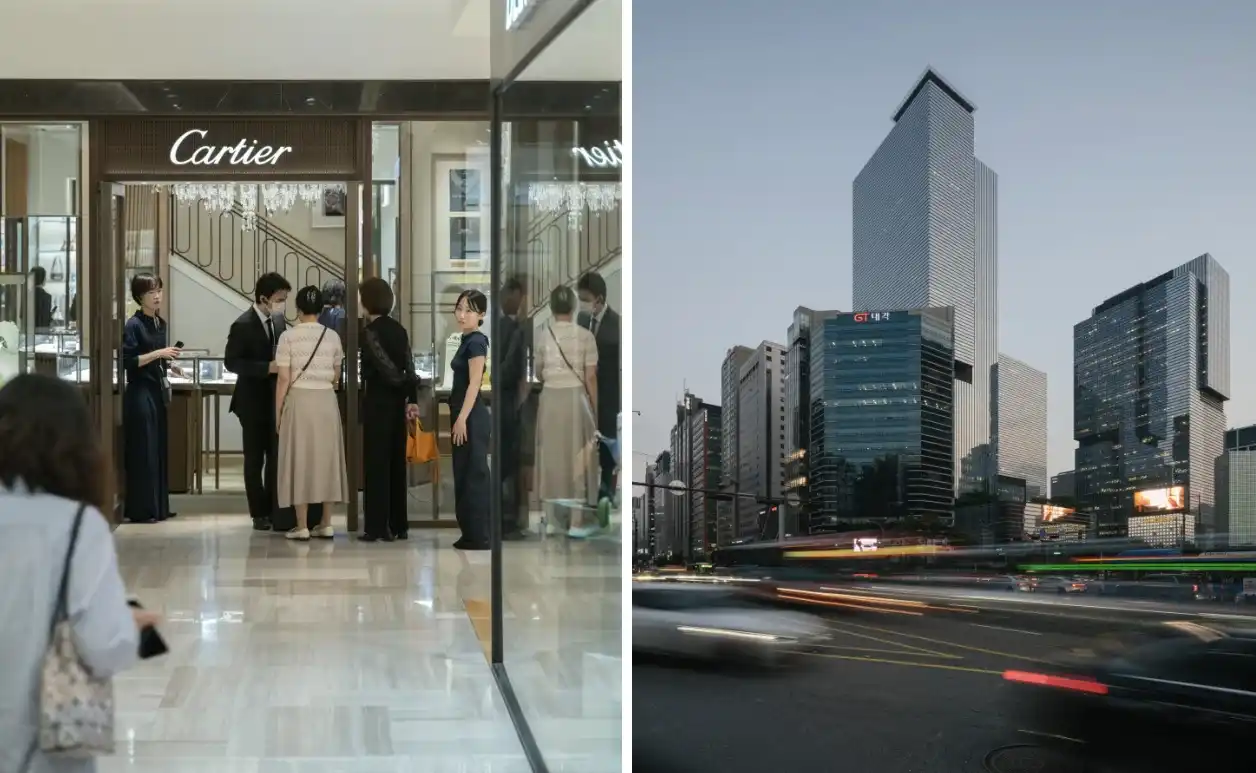
Customers line up outside a Cartier boutique inside the Shinsegae Department Store in Seoul; Samsung Electronics campus. Tim Franco for The Wall Street Journal

Both companies recently surpassed the trillion-dollar market cap mark, accounting for over half of the total market capitalization of South Korea's KOSPI index. KOSPI was the world's best-performing index last year and continues to lead global rankings this year.

Choi Sung-ho, 35, an ordinary elementary school teacher, is another beneficiary of the Korean stock market. Over the past year, his Korean stock portfolio grew nearly fivefold, exceeding $300,000, including investments in ETFs tracking semiconductor stocks. He says he has upgraded his mobile devices and plans to spend six figures on his next car, perhaps a Mercedes S-Class or Tesla Model X.

"Even the kids at my school are saying their parents are happy with stock gains," Choi said.

In the first quarter of this year, South Korean brokerage Toss Securities opened over 180,000 trading accounts for children aged 18 and under. These accounts require parental approval to open and allow children to trade independently. Recently, the company launched a promotion offering $14 in "experience money" to newly opened accounts for high school students.

On YouTube, the "ETF-explaining Bro" channel is one of the emerging "finfluencer" media that offer market advice. Channel owner Park Soo-in says the channel has attracted over 127,000 followers since launching in July last year. "Many people seem to think this rally will continue," she said.

The stock market surge has further boosted an already strong luxury market. The Cartier boutique inside a major Seoul department store is so crowded that part of its "D'Amour" jewelry collection is now only available online.

Lim Chae-hoon, sales manager at a BMW dealership in Seoul, said his customers often mention their profits from the stock market rise. "There are definitely more people with money to spare now," he said.
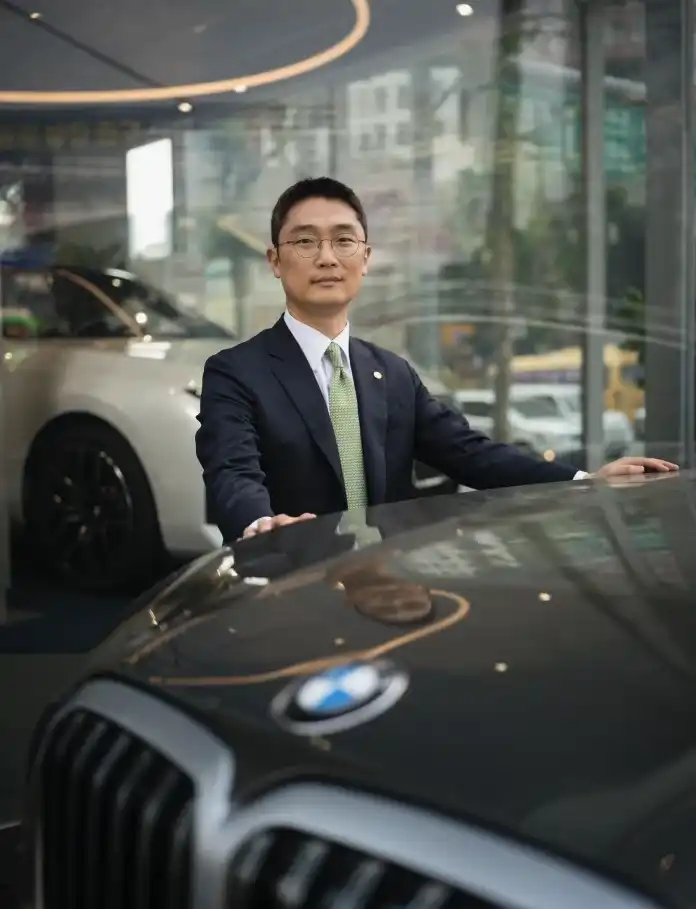
Lim Chae-hoon, sales manager at a BMW dealership in Seoul, says customers now feel flush with cash. Tim Franco for The Wall Street Journal

In Japan, Toyota Motor held the title of highest-valued company for 22 consecutive years but was surpassed this month by SoftBank Group, which has made huge bets on OpenAI and data centers.

SoftBank's reign didn't last long. Last Friday, a little-known memory chip maker, Kioxia, jumped to the top spot. A year ago, Kioxia's stock was around $14; now it's about $600. Kioxia's success has sparked investor hunting for the next potential stock market blockbuster.

Even Japan's luxury bathroom fixture maker TOTO is profiting from the AI boom. Its high-tech ceramics are used to hold silicon wafers still while circuits are etched. The company's stock has more than doubled.

Another company, Ajinomoto, uses a byproduct from its world-famous umami seasoning to make insulating films for AI chips. Its stock is up 50%.

Ryoki Nao, a 21-year-old top student in semiconductor engineering at a university in Kumamoto, Japan, says his classmates are investing, but he isn't. While he follows market trends, he plans to graduate, find a job, and then consider investing.

"I want to wait until I can earn a decent income before investing," he said, but the stock market frenzy might not wait for him.

Criptos en tendencia

Preguntas relacionadas

QWhat are the main AI-related companies driving the wealth boom for ordinary people in East Asia, as described in the article?

AThe main companies are TSMC (Taiwan Semiconductor Manufacturing Company) in Taiwan, and Samsung Electronics and SK Hynix in South Korea. These companies are key suppliers of semiconductors and chip manufacturing technology essential for the global AI infrastructure boom.

QWhat evidence does the article provide to show how deeply the stock market and AI investment craze has penetrated everyday life in South Korea and Taiwan?

AThe article provides multiple examples: In Taiwan, telling someone you work at TSMC is a highly effective pickup line, and taxi drivers trade stocks while driving. In South Korea, people are joking about selling their underwear to buy more stocks, a teacher reports his school children talking about their parents' stock gains, and securities firms are opening thousands of trading accounts for minors.

QAccording to the article, what role do TSMC, Samsung, and SK Hynix play in the global AI 'gold rush'?

AThey play the role of the 'shovel sellers' in the AI gold rush. They provide the indispensable hardware—semiconductors and memory chips—that powers AI development and data centers, profiting from the massive capital expenditure by tech giants regardless of which AI service companies ultimately succeed.

QWhat significant statement did NVIDIA's CEO Jensen Huang make about Taiwan during his visit, as mentioned in the article?

AJensen Huang announced plans to invest $150 billion annually in Taiwan, calling it the center of the AI revolution. His high-profile visit underscored Taiwan's critical role in the global AI supply chain.

QHow has the AI boom indirectly benefited seemingly unrelated Japanese companies like TOTO and Ajinomoto?

AThe AI boom has created demand for their specialized materials. TOTO's high-tech ceramics are used to hold silicon wafers steady during chip manufacturing, and Ajinomoto uses a byproduct from its flavor enhancer production to make insulating films for AI chips, leading to significant stock price increases for both companies.

Lecturas Relacionadas

27 años de reinado llegan a su fin: SK Hynix supera por primera vez en capitalización a Samsung, una reconfiguración del poder en los chips coreanos impulsada por la IA

En junio de 2026, SK Hynix hizo historia al superar por primera vez en capitalización bursátil a Samsung Electronics, poniendo fin a 27 años de dominio del gigante surcoreano. Este cambio de poder, impulsado por la revolución de la IA, marca una dramática transformación en el sector mundial de los semiconductores. La clave del éxito de SK Hynix fue su apuesta temprana y decisiva por la memoria de alto ancho de banda (HBM), componente esencial para el entrenamiento de modelos de IA avanzados. Con una cuota de mercado del 59% en HBM en 2025 y márgenes de beneficio que superan incluso a los de Nvidia, la empresa genera beneficios extraordinarios, reportando ganancias netas diarias superiores a los 20 mil millones de yuanes. Su enfoque especializado contrasta con el modelo diversificado de Samsung, cuyos negocios en móviles y fundición de chips enfrentan dificultades, mientras se queda rezagado en la carrera por el HBM. Esta transición, de una empresa que una vez estuvo al borde de la bancarrota con una deuda de 140 mil millones de dólares a líder del mercado, simboliza un cambio más profundo: el paso de la economía surcoreana desde la electrónica de consumo hacia la infraestructura de IA, y la transformación de los chips de memoria en productos de alto valor estratégico. Sin embargo, la nueva rivalidad continúa. Con una expansión masiva de capacidad prevista para 2028 y Samsung luchando por recuperar terreno, la batalla por el liderazgo en la era de la IA está lejos de terminar.

marsbitJusto ahora

27 años de reinado llegan a su fin: SK Hynix supera por primera vez en capitalización a Samsung, una reconfiguración del poder en los chips coreanos impulsada por la IA

marsbitJusto ahora

¿Sube más del 130% en un mes, se mantiene como un gran consumidor de Blobs de Ethereum? ¿Cuál es el verdadero crecimiento de World Chain?

Autor: Nancy, PANews Mentre la competició entre Layer 2 s'intensifica, World Chain mostra un creixement diferent. El seu token, WLD, ha pujat més d'un 130% en 30 dies, impulsat per l'entusiasme per la IA, l'adquisició institucional, la major activitat comercial i l'esperança d'una reducció en la seva emissió diària a partir de juliol de 2026. Paral·lelament, la xarxa World Chain experimenta una gran activitat. El seu valor bloquejat (TVL) va créixer un 122,6% en un mes, arribant als 6.100 milions de dòlars, principalment per entrades de fons mitjançant ponts. Les adreces actives diàries es van disparar un 649%. Tot i això, el seu ecosistema DeFi roman incipient, amb gran part de la liquiditat concentrada en un sol protocol. Un punt destacat és el seu alt consum de "Blobs" d'Ethereum per a disponibilitat de dades. World Chain és el segon major consumidor d'aquests recursos, just darrere de Base, amb una alta freqüència d'enviaments i eficiència de costos. Això es deu a l'activitat dels milions d'usuaris reals de Worldcoin que realitzen transaccions freqüents a la cadena per a verificació d'identitat i recompenses. En resum, World Chain combina la tendència de la IA i una base d'usuaris actius per a un creixement notable en preu i activitat de xarxa, tot i que el desenvolupament del seu ecosistema extern encara és un repte per al seu futur.

marsbitHace 20 min(s)

¿Sube más del 130% en un mes, se mantiene como un gran consumidor de Blobs de Ethereum? ¿Cuál es el verdadero crecimiento de World Chain?

marsbitHace 20 min(s)

¿Por qué el «padrino de la AGI», Ben Goertzel, cree que el futuro de la inteligencia artificial depende de la blockchain?

Ben Goertzel, conocido como el "padre de la AGI" e impulsor del concepto de Inteligencia General Artificial (AGI), defiende que el futuro de la IA debe basarse en la tecnología blockchain para evitar el control corporativo y garantizar su desarrollo abierto y descentralizado. Critica a compañías como OpenAI y Anthropic por haber abandonado sus principios iniciales de código abierto en favor de modelos cerrados y financiados por capital de riesgo. Según Goertzel, la apertura del código no es suficiente; se necesita una red de computación distribuida y accesible para que la AGI sea verdaderamente útil y no dependa de infraestructuras centralizadas costosas. Su proyecto, SingularityNET, y la Alianza de Superinteligencia Artificial, buscan crear una economía de agentes de IA que operen en una red blockchain, permitiendo que los usuarios controlen y monetizen sus propios agentes inteligentes. Aunque reconoce los riesgos de que actores malintencionados puedan usar la tecnología, confía en que una mayoría benévola prevalecerá. Goertzel prevé el lanzamiento de una capa de pago para empresas y usuarios avanzados, con agentes capaces de realizar transacciones autónomas. Mantiene su predicción de que la AGI a nivel humano podría llegar entre 2027 y 2030, y subraya la importancia de reducir la brecha de conocimiento para evitar una mayor desigualdad. Su primer gran test público será el lanzamiento del agente Omega Claw en las próximas semanas.

Foresight NewsHace 30 min(s)

¿Por qué el «padrino de la AGI», Ben Goertzel, cree que el futuro de la inteligencia artificial depende de la blockchain?

Foresight NewsHace 30 min(s)

Una empresa que casi quiebra acaba de superar la capitalización de mercado de Bitcoin

El 22 de junio, SK Hynix alcanzó una capitalización de mercado de 1,35 billones de dólares, superando la capitalización total de Bitcoin de 1,29 billones, convirtiéndose brevemente en la empresa más valiosa de Corea del Sur. Este crecimiento está impulsado por su dominio en la producción de memoria HBM, esencial para la IA, donde posee más del 60% del mercado y es proveedor clave de Nvidia. La empresa reportó un margen de beneficio operativo del 72% en el primer trimestre, con pronósticos al alza para el segundo. Su apuesta por la tecnología HBM comenzó en 2009, una inversión de alto riesgo que finalmente dio frutos con el auge de la IA. La trayectoria de SK Hynix incluyó una crisis cercana a la quiebra en 2001, seguida de una adquisición salvadora por parte de SK Group en 2012, que permitió financiar el desarrollo del HBM. El mercado valora su posición en la cadena de suministro de IA por sus barreras técnicas, pedidos reales y ciclos de producción prolongados, cambiando su valoración de cíclica a de crecimiento. En contraste, el artículo señala que el ecosistema Crypto AI, que promete infraestructura descentralizada, aún se encuentra en etapas tempranas con avances limitados. Proyectos como Bittensor siguen desarrollando sus mecanismos fundamentales, mientras que las empresas mineras de Bitcoin enfrentan dificultades y una transición costosa hacia la computación de IA. Expertos como Arthur Hayes argumentan que la IA está absorbiendo la mayor parte de la liquidez del mercado, y que una posible corrección podría afectar también a las criptomonedas. La clave para Crypto AI será definir un valor tangible y una ventaja clara en la cadena de suministro de IA, donde actualmente priman la capacidad de producción física y los márgenes cuantificables.

marsbitHace 36 min(s)

Una empresa que casi quiebra acaba de superar la capitalización de mercado de Bitcoin

marsbitHace 36 min(s)

El nuevo campeón de la IA en Japón: ¿Cómo se compara un pequeño modelo de 7B con Fable y Mythos?

En junio de 2026, Sakana AI de Japón sacudió la comunidad con Fugu, un pequeño modelo de solo 7B de parámetros que actúa como "capataz" orquestando modelos globales líderes como GPT-5 y Claude Opus. En los exigentes benchmarks SWE-Bench Pro (73.7) y TerminalBench 2.1 (82.1), Fugu Ultra superó a modelos como GPT-5.5 y Claude Opus 4.8. Sakana afirma que rivaliza incluso con los restringidos Fable 5 y Mythos Preview, aunque esta comparación se basa en informes públicos y no en pruebas directas. Su arquitectura se centra en un núcleo de 7B, el RL Conductor, que no genera respuestas directas, sino que descompone tareas, las asigna a modelos especialistas y sintetiza los resultados. Esto mejora la estabilidad en sesiones largas, la revisión profunda de código y reduce el consumo de tokens. Las pruebas beta destacaron su eficacia en flujos de trabajo complejos. Sin embargo, esta estrategia presenta vulnerabilidades: depende de APIs de modelos estadounidenses (riesgo de costes e inestabilidad), puede tener mayor latencia y las comparaciones con modelos no accesibles son polémicas. Para Japón, con limitaciones en cómputo y datos, Fugu representa una vía de "salida asimétrica", priorizando la orquestación inteligente sobre el tamaño bruto del modelo. Demuestra que la competencia en IA se desplaza hacia la integración de sistemas, aunque la dependencia de tecnologías subyacentes sigue siendo un límite.

marsbitHace 1 hora(s)

El nuevo campeón de la IA en Japón: ¿Cómo se compara un pequeño modelo de 7B con Fable y Mythos?

marsbitHace 1 hora(s)

Trading

Spot
Futuros

Artículos destacados

Cómo comprar PEOPLE

¡Bienvenido a HTX.com! Hemos hecho que comprar ConstitutionDAO (PEOPLE) sea simple y conveniente. Sigue nuestra guía paso a paso para iniciar tu viaje de criptos.Paso 1: crea tu cuenta HTXUtiliza tu correo electrónico o número de teléfono para registrarte y obtener una cuenta gratuita en HTX. Experimenta un proceso de registro sin complicaciones y desbloquea todas las funciones.Obtener mi cuentaPaso 2: ve a Comprar cripto y elige tu método de pagoTarjeta de crédito/débito: usa tu Visa o Mastercard para comprar ConstitutionDAO (PEOPLE) al instante.Saldo: utiliza fondos del saldo de tu cuenta HTX para tradear sin problemas.Terceros: hemos agregado métodos de pago populares como Google Pay y Apple Pay para mejorar la comodidad.P2P: tradear directamente con otros usuarios en HTX.Over-the-Counter (OTC): ofrecemos servicios personalizados y tipos de cambio competitivos para los traders.Paso 3: guarda tu ConstitutionDAO (PEOPLE)Después de comprar tu ConstitutionDAO (PEOPLE), guárdalo en tu cuenta HTX. Alternativamente, puedes enviarlo a otro lugar mediante transferencia blockchain o utilizarlo para tradear otras criptomonedas.Paso 4: tradear ConstitutionDAO (PEOPLE)Tradear fácilmente con ConstitutionDAO (PEOPLE) en HTX's mercado spot. Simplemente accede a tu cuenta, selecciona tu par de trading, ejecuta tus trades y monitorea en tiempo real. Ofrecemos una experiencia fácil de usar tanto para principiantes como para traders experimentados.

744 Vistas totalesPublicado en 2024.12.12Actualizado en 2026.06.02

Cómo comprar PEOPLE

Discusiones

Bienvenido a la comunidad de HTX. Aquí puedes mantenerte informado sobre los últimos desarrollos de la plataforma y acceder a análisis profesionales del mercado. A continuación se presentan las opiniones de los usuarios sobre el precio de PEOPLE (PEOPLE).

活动图片