This Generation of East Asian Ordinary People Getting Rich Thanks to TSMC and AI-Related Korean Stocks

marsbitPublicado a 2026-06-22Actualizado a 2026-06-22

Resumen

The article describes how the global AI boom, driven by demand for semiconductors, is creating newfound wealth for ordinary young investors and professionals in East Asia, particularly in South Korea and Taiwan. Fueled by massive capital expenditure from tech giants, the surge in AI-related exports has propelled stock markets in South Korea, Taiwan, and Japan to significant gains. This has led to a widespread retail investing frenzy. In South Korea, individuals like 24-year-old programmer Na Se-bin and 35-year-old teacher Choi Sung-ho are investing heavily and seeing substantial returns, altering their spending habits. In Taiwan, the chipmaker TSMC, a dominant force in advanced manufacturing, is central to the economic euphoria, offering high salaries and social prestige. The company's stock surge has significantly boosted the local market. The phenomenon extends to Japan, where even companies in seemingly unrelated sectors are benefiting from the AI supply chain. The narrative highlights a region capitalizing on its role as the essential hardware provider for the AI "gold rush," with its tech giants acting as the "sellers of shovels." This has translated into rapid wealth accumulation, a booming luxury market, and a pervasive culture of stock trading among everyday people, including younger generations.

Originally fromThe Wall Street Journal

Compiled by / Odaily Planet Daily Golem(@web 3_golem)

Na Se-bin has completely lost her sense of consumption.

Since January this year, attracted by the global AI boom, she has poured almost her entire life savings (about $47,000) into the stock market, a frenzy that is filling the coffers of tech giants in South Korea, Taiwan, and Japan.

The 24-year-old South Korean programmer says that during sharp market swings, she has made or lost the equivalent of a month's salary in a single second. Despite the huge risks, she can't resist, especially after seeing the stock she holds double in price. South Korea's stock market has been one of the world's best performers over the past 18 months, and Na jokes with her colleagues that they should sell their underwear to buy more stocks.

"Even friends who never touched stocks before are now starting to jump in," Na says. "Everyone is speculating on something."

Na Se-bin, a 24-year-old software developer in Seoul, started investing in January this year and quickly became addicted. (Image credit: Tim Franco for The Wall Street Journal)

Trillions of dollars are pouring into the global construction of AI, which relies on the semiconductors and chip-making technology supplied by a handful of Asian exporters. The surge in global chip demand seems endless, fueling export growth, corporate profits, and wealth for many investors.

Even after recent pullbacks, Taiwan's stock market has still doubled in value over the past year, South Korea's has tripled, and Japan's Nikkei index has risen over 80% in the same period, three times the gain of the S&P 500.

The accelerating demand for AI-related products is stimulating investor enthusiasm and pushing up wages. In Taipei, taxi drivers even trade stocks while driving, and in the job market, the high salaries in the tech industry are enviable. Nowadays, one of the most effective "pick-up lines" in Taiwan is to tell someone you work for Taiwan Semiconductor Manufacturing Co. (TSMC), the world's largest chip foundry and also one of the most generous local employers. Employees in the memory-chip division of South Korea's Samsung Electronics are expecting an average bonus of about $400,000 this year. The company is forecast to generate more profit by 2026 than any global company except Nvidia.

Whether AI services from OpenAI's ChatGPT, Anthropic, and SpaceX can deliver on the promise of commercialization, this part of the tech sector seems destined to benefit. These Asian tech giants, which provide indispensable hardware for the AI industry, are the "shovel sellers" of the AI gold rush.

The four Silicon Valley hyperscale data centers — Microsoft, Meta Platforms, Amazon, and Alphabet's Google — plan to spend up to $670 billion this year on AI-related capital expenditures. This spending far exceeds the inflation-adjusted expenditure of the U.S. railroad expansion in the 1850s and the decades-long construction cost of the U.S. interstate highway system launched a century later.

According to an Allianz Trade report, global exports of AI-related products reached nearly $4 trillion last year, with Asia accounting for two-thirds. These products include semiconductors, data storage servers, and cooling systems.

Market research firm Gartner predicts that direct spending in the AI field (covering services, infrastructure, and software) is expected to reach $2.6 trillion this year, a 47% increase from 2025. Next year, that number is forecast to reach about $3.5 trillion.

Nvidia CEO Jensen Huang recently concluded an 18-day high-profile visit, participating in a series of events, speeches, and business meetings in Taiwan and South Korea.

In Taipei, convenience stores sell lottery tickets with a top prize of 500 shares of Nvidia stock. Huang announced plans to invest $150 billion annually in Taiwan, which he called the center of the AI revolution. In South Korea, Huang signed cooperation agreements with local companies in robotics, memory chips, and AI.

During Huang's visit to Seoul, the KOSPI index halted trading on June 8 after plunging more than 8%, following a sell-off in U.S. chip stocks (including Nvidia). Huang, wearing his signature leather jacket even in Seoul's summer heat, was unfazed by the stock drop.

"People should be very happy with the current stock prices," he said. "Because now you can buy stocks more cheaply."
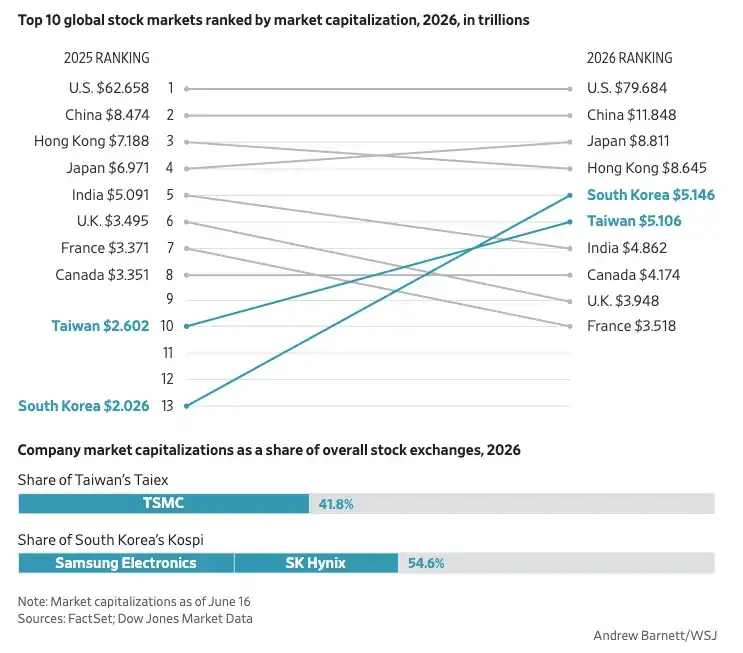
Global Top 10 Stock Market Capitalizations in 2026 and the Share of TSMC and SK Hynix in Their Respective Market's Total Capitalization

Na only started trading stocks this year. She estimates that over 80% of her social circle actively invests, as do her colleagues. One colleague, she says, made enough money from stock investments to spend tens of thousands of dollars on an engagement ring.

Now, Na is "extravagant" when it comes to concert tickets, branded clothing, and treating her parents to meals. She planned to buy a gold ring for her mother to celebrate her parents' 30th wedding anniversary, but her mother declined.

"She told me to just give her cash," Na said, "so she could buy stocks."

TSMC, Put on a Pedestal

Ye Lunhao, a 37-year-old insurance agent, invests more than half of his roughly $2,100 monthly salary in local AI and chip-related companies. His investment returns have quadrupled, and he recently bought a $440,000 four-bedroom apartment in Taichung, Taiwan.

For years, his friends steered clear of stock market investing. Now, they all ask him for investment advice.

37-year-old insurance agent Ye Lunhao sits in the lobby of his apartment building in Taichung, Taiwan. Photo by Lin Yifei for The Wall Street Journal

"Without semiconductors, none of this would have happened," Mr. Ye said. "Investing has freed me from mere drudgery and given me a chance to enjoy the beauty of this world."

TSMC is the main driver of Taiwan's stock market surge. According to tech market research firm Counterpoint Research, the company captured over 90% of revenue share in the most advanced chip manufacturing last year. TSMC is the world's seventh-highest valued company, with a market cap exceeding $2.2 trillion, surpassing Tesla and Meta.

The company's stock price has more than doubled in the past year, pushing Taiwan's benchmark index past markets like France, the U.K., and India.

The chipmaker accounts for over 41% of Taiwan's benchmark index. In comparison, the seven tech giants Apple, Microsoft, Alphabet, Amazon, Nvidia, Meta, and Tesla combined account for about one-third of the S&P 500.

TSMC engineers' salaries can be three times the low end of what other companies pay for similar roles. Choc Chiang, co-founder of Taipei recruitment platform WeFer, said some managers poached by TSMC from smaller companies saw salary increases of up to 30%.

Wang Canlong, owner of an upscale liquor store in Zhubei, Taiwan, has supplied TSMC numerous times. He said he once sold a bottle of Napa Valley whiskey to TSMC founder Morris Chang. Now, his store is too small to meet TSMC's demands. "We look up to them," he said. "With awe and respect in our hearts."

Wang Canlong, owner of a liquor store in Zhubei, Taiwan, has sold large quantities of alcohol to TSMC. (Lin Yifei/The Wall Street Journal)

Wang Weiwen earned an engineering degree in Taiwan. Part of his coursework was visiting a TSMC factory where the base salary was about $62,000 a year. He said such a salary level was simply unheard of. "Every household talks about TSMC."

He is now a graduate student at the University of Michigan, and TSMC recruiters have also called him. Wang Weiwen has concerns about the company's heavy workload, but he sees benefits beyond the hefty paycheck. The social status that comes with being a TSMC engineer is highly attractive to Taiwanese parents who are very picky about their daughters' suitors.

Mr. Wang said, "Your opening line can simply be 'You work at TSMC.'"

Products bearing the TSMC logo also command high prices in the secondary market. A rice cooker with the company logo and circuit board motif sells for about $312 on e-commerce platforms, more than four times the price TSMC employees pay. Buyers scramble for TSMC-branded luggage, thermoses, and shoes. Even the envelope for holiday red packets received by TSMC employees can be sold online for nearly $15 each.

A Carnival for Ordinary People

The South Korean market is dominated by two chip giants, Samsung and SK Hynix, which dominate the production of the two main types of memory chips used in AI computing and data storage.
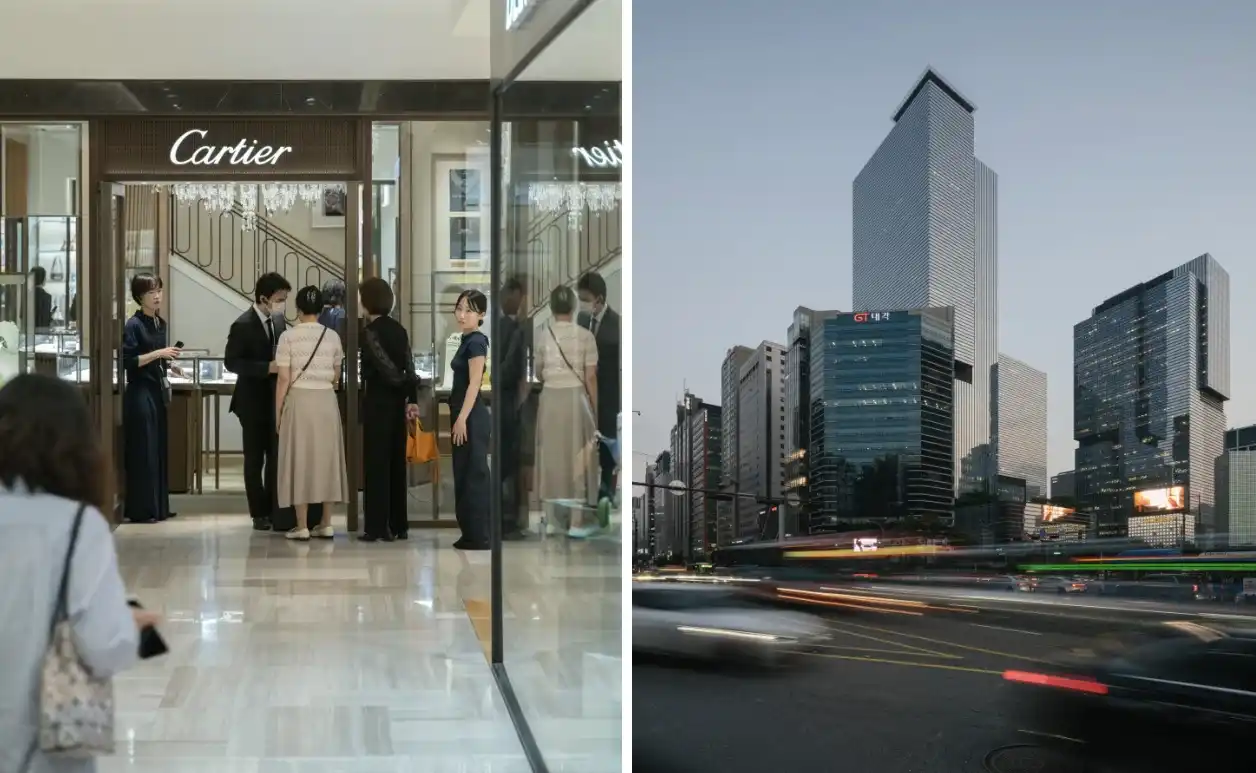
Customers line up outside a Cartier boutique inside the Shinsegae Department Store in Seoul; Samsung Electronics campus. Tim Franco for The Wall Street Journal

Both companies recently surpassed the trillion-dollar market cap mark, accounting for over half of the total market capitalization of South Korea's KOSPI index. KOSPI was the world's best-performing index last year and continues to lead global rankings this year.

Choi Sung-ho, 35, an ordinary elementary school teacher, is another beneficiary of the Korean stock market. Over the past year, his Korean stock portfolio grew nearly fivefold, exceeding $300,000, including investments in ETFs tracking semiconductor stocks. He says he has upgraded his mobile devices and plans to spend six figures on his next car, perhaps a Mercedes S-Class or Tesla Model X.

"Even the kids at my school are saying their parents are happy with stock gains," Choi said.

In the first quarter of this year, South Korean brokerage Toss Securities opened over 180,000 trading accounts for children aged 18 and under. These accounts require parental approval to open and allow children to trade independently. Recently, the company launched a promotion offering $14 in "experience money" to newly opened accounts for high school students.

On YouTube, the "ETF-explaining Bro" channel is one of the emerging "finfluencer" media that offer market advice. Channel owner Park Soo-in says the channel has attracted over 127,000 followers since launching in July last year. "Many people seem to think this rally will continue," she said.

The stock market surge has further boosted an already strong luxury market. The Cartier boutique inside a major Seoul department store is so crowded that part of its "D'Amour" jewelry collection is now only available online.

Lim Chae-hoon, sales manager at a BMW dealership in Seoul, said his customers often mention their profits from the stock market rise. "There are definitely more people with money to spare now," he said.

Lim Chae-hoon, sales manager at a BMW dealership in Seoul, says customers now feel flush with cash. Tim Franco for The Wall Street Journal

In Japan, Toyota Motor held the title of highest-valued company for 22 consecutive years but was surpassed this month by SoftBank Group, which has made huge bets on OpenAI and data centers.

SoftBank's reign didn't last long. Last Friday, a little-known memory chip maker, Kioxia, jumped to the top spot. A year ago, Kioxia's stock was around $14; now it's about $600. Kioxia's success has sparked investor hunting for the next potential stock market blockbuster.

Even Japan's luxury bathroom fixture maker TOTO is profiting from the AI boom. Its high-tech ceramics are used to hold silicon wafers still while circuits are etched. The company's stock has more than doubled.

Another company, Ajinomoto, uses a byproduct from its world-famous umami seasoning to make insulating films for AI chips. Its stock is up 50%.

Ryoki Nao, a 21-year-old top student in semiconductor engineering at a university in Kumamoto, Japan, says his classmates are investing, but he isn't. While he follows market trends, he plans to graduate, find a job, and then consider investing.

"I want to wait until I can earn a decent income before investing," he said, but the stock market frenzy might not wait for him.


Criptos en tendencia

Preguntas relacionadas

QWhat are the main AI-related companies driving the wealth boom for ordinary people in East Asia, as described in the article?

AThe main companies are TSMC (Taiwan Semiconductor Manufacturing Company) in Taiwan, and Samsung Electronics and SK Hynix in South Korea. These companies are key suppliers of semiconductors and chip manufacturing technology essential for the global AI infrastructure boom.

QWhat evidence does the article provide to show how deeply the stock market and AI investment craze has penetrated everyday life in South Korea and Taiwan?

AThe article provides multiple examples: In Taiwan, telling someone you work at TSMC is a highly effective pickup line, and taxi drivers trade stocks while driving. In South Korea, people are joking about selling their underwear to buy more stocks, a teacher reports his school children talking about their parents' stock gains, and securities firms are opening thousands of trading accounts for minors.

QAccording to the article, what role do TSMC, Samsung, and SK Hynix play in the global AI 'gold rush'?

AThey play the role of the 'shovel sellers' in the AI gold rush. They provide the indispensable hardware—semiconductors and memory chips—that powers AI development and data centers, profiting from the massive capital expenditure by tech giants regardless of which AI service companies ultimately succeed.

QWhat significant statement did NVIDIA's CEO Jensen Huang make about Taiwan during his visit, as mentioned in the article?

AJensen Huang announced plans to invest $150 billion annually in Taiwan, calling it the center of the AI revolution. His high-profile visit underscored Taiwan's critical role in the global AI supply chain.

QHow has the AI boom indirectly benefited seemingly unrelated Japanese companies like TOTO and Ajinomoto?

AThe AI boom has created demand for their specialized materials. TOTO's high-tech ceramics are used to hold silicon wafers steady during chip manufacturing, and Ajinomoto uses a byproduct from its flavor enhancer production to make insulating films for AI chips, leading to significant stock price increases for both companies.

Lecturas Relacionadas

Pulso del Mercado de BTC: Semana 26

Bitcóin se encuentra en una fase de consolidación tras una fuerte recuperación, con una participación y convicción direccional del mercado que comienzan a enfriarse. El flujo de órdenes ha cambiado a ventas netas a medida que disminuye la demanda agresiva. La actividad en el mercado spot se ha contraído y los volúmenes se sitúan en el extremo inferior de su rango reciente. Los mercados de derivados reflejan un tono igualmente cauteloso. El interés abierto de futuros se mantiene estable, lo que sugiere que el apalancamiento se conserva pero no se expande. La presión de compra en perpetuas disminuye y el sesgo de 25-delta está elevado, indicando que los operadores están pagando más por protección ante caídas. La demanda institucional se ha suavizado, con salidas netas continuas en los ETF spot estadounidenses. La actividad on-chain sigue débil, con volúmenes de transferencia y tarifas en tendencia a la baja, reflejando una desaceleración más amplia de la participación especulativa. Sin embargo, la dinámica de oferta sigue siendo favorable. El balance de suministro sigue migrando hacia holders a largo plazo, los niveles de rentabilidad se mantienen elevados y las ganancias realizadas aumentan. Un incremento en la participación de capital a corto plazo podría crear condiciones para una mayor volatilidad, pero no señala necesariamente un deterioro en la estructura del mercado. En general, Bitcóin permanece en un rango. La participación y el apetito por el riesgo se han moderado, pero el comportamiento resiliente de los holders, el posicionamiento estable en futuros y una rentabilidad saludable continúan proporcionando una base constructiva. El mercado está atrapado entre un impulso que se desvanece y una fortaleza subyacente, a la espera de su próximo catalizador direccional.

insights.glassnodeHace 2 hora(s)

Pulso del Mercado de BTC: Semana 26

insights.glassnodeHace 2 hora(s)

Interpretación del Informe: JPMorgan Detalla el Sentimiento de los Compradores antes de los Resultados Trimestrales de Micron y la Situación Actual del Sector de Hardware

**Resumen del informe de J.P. Morgan: Sentimiento de compradores antes de resultados de Micron y panorama del sector de hardware** Un informe de J.P. Morgan analiza el sentimiento antes de los resultados de Micron, las tendencias en la cadena de suministro de hardware y las perspectivas de gasto de capital en IA. **Conclusiones clave:** 1. **Micron:** El sentimiento de los compradores sigue siendo muy positivo, siendo la memoria una de las apuestas más consensuadas en IA. Se espera que anuncien más contratos a largo plazo (SCA). Los focos de atención son la sostenibilidad de sus márgenes brutos, superiores al 80%, y el potencial para nuevos aumentos de precios impulsados por la IA. 2. **Cadena de suministro de hardware:** La demanda relacionada con IA en servidores, redes y almacenamiento sigue fuerte, pero con divergencia entre empresas. Destacan: * **Celestica (CLS):** Perspectivas de márgenes mejoradas, mayor confianza en proyectos de redes para IA y mejor capacidad para trasladar costes. * **Western Digital y Seagate:** Se benefician de la mejora continua de precios en un entorno de oferta limitada. * **Fabrinet (FN):** Mayor visibilidad en módulos ópticos para IA; los productos para Amazon comenzarán a generar ingresos. * **Teradyne (TER):** Se espera una caída de ingresos en el 2º semestre, pero Google podría convertirse en un nuevo cliente clave a finales de año. 3. **Gasto en capital de IA revisado al alza:** J.P. Morgan eleva su previsión de crecimiento del mercado de equipos para obleas (WFE) a un 28% en 2026 y un 29% en 2027. El financiamiento mediante deuda para proyectos de IA está aumentando, lo que reduce las restricciones para esta expansión del gasto. **Señales a seguir:** * Detalles de los SCAs y perspectivas de margen de Micron en sus resultados. * Posible mejora de la guía anual de Arista Networks. * Evolución de los ingresos de Fabrinet por módulos ópticos para Amazon. **Fuente:** Informe de J.P. Morgan (Joshua Meyers et al., 21 de junio de 2026).

marsbitHace 5 hora(s)

Interpretación del Informe: JPMorgan Detalla el Sentimiento de los Compradores antes de los Resultados Trimestrales de Micron y la Situación Actual del Sector de Hardware

marsbitHace 5 hora(s)

Interpretación del informe: El debut del nuevo presidente de la Fed, ¿cambio de timonel, pero no de guion?

**Resumen del informe: El debut del nuevo presidente de la Fed - ¿Cambio de liderazgo, pero el mismo guion?** El economista jefe global de Morgan Stanley, Seth B. Carpenter, analiza la primera reunión de la FOMC bajo el nuevo presidente de la Fed, Kevin Warsh. El informe destaca tres conclusiones clave: 1. **Warsh no ofrece una hoja de ruta para las tasas.** Su filosofía de reducir la "orientación prospectiva" es clara. La declaración de la FOMC fue más concisa y no proporciona un camino claro para la política. El gráfico de puntos sugiere solo una subida de tipos este año, pero Carpenter señala que si la inflación cae por debajo de lo esperado (posible ahora que los efectos de inflación de los aranceles se han disipado), la lógica para esa única subida podría desvanecerse, especialmente dado que las proyecciones apuntan a recortes para el próximo año. 2. **La reducción del balance (quantitative tightening, QT) podría ser más agresiva de lo esperado, con un impacto limitado.** La postura de Warsh sobre la reducción del balance es firme. Carpenter argumenta que medidas como reducir a la mitad la cuenta del Tesoro en la Fed podrían reducir el balance en ~$500 mil millones con poco efecto en el mercado. Los ajustes a los requisitos de liquidez y a las tasas de interés de las reservas podrían permitir una reducción mayor de la esperada. El principal riesgo de mercado sería si la Fed vende activos de hipotecas (MBS) de manera activa. 3. **Revisión del marco, pero el objetivo de inflación del 2% se mantiene.** Warsh inició una revisión del marco de política, pero se ha reafirmado el objetivo del 2%. Carpenter subraya que el cambio en el estilo de comunicación (declaraciones más breves, menos orientación prospectiva) es un regreso a la tradición más que un cambio fundamental, ya que la orientación prospectiva solo es crucial cuando las tasas están cerca de cero. **En resumen:** Carpenter sugiere que el pánico del mercado por las subidas de tipos podría ser excesivo, ya que la trayectoria inflacionaria podría no justificarlas. En cambio, la reducción del balance podría ser el aspecto más significativo y con potencial de sorprender en magnitud, aunque su impacto en el mercado podría ser moderado si se gestiona como se prevé. Las claves para seguir serán los datos de inflación (PCE básico), los detalles del camino de reducción del balance y las recomendaciones de la revisión del marco político.

marsbitHace 5 hora(s)

Interpretación del informe: El debut del nuevo presidente de la Fed, ¿cambio de timonel, pero no de guion?

marsbitHace 5 hora(s)

Semana Clave del Juego: Reconfirmación de BTC y Lucha por el Soporte de HYPE | Análisis Invitado

**Resumen del Análisis Semanal: Semana Clave de Confrontación - Confirmación de Retroceso de BTC y Lucha por el Soporte de HYPE** **Panorama General del Mercado:** Esta semana, el mercado entra en una fase crucial de confrontación entre compradores y vendedores. A nivel macro, los cambios marginales en las expectativas de la política de la Reserva Federal continúan dominando el ritmo de valoración de los activos de riesgo. En el mercado de criptomonedas, tras una fase previa de consolidación, las discrepancias entre alcistas y bajistas se están manifestando claramente en niveles de precio clave. **Análisis y Perspectiva para Bitcoin (BTC):** * **Estructura:** En el gráfico de 4 horas, el precio se encuentra en una fase de "retroceso y confirmación" tras romper la línea inferior de un canal alcista a corto plazo. El punto 41 es crucial. * **Pronóstico Semanal:** El escenario depende del resultado de esta confirmación. * **Escenario Alcista:** Si el precio se consolida con éxito por encima del soporte del canal (alrededor de $64,500-$65,000), podría intentar atacar la zona de resistencia clave de $69,500-$70,500. * **Escenario Bajista:** Si el retroceso falla y el precio cae, es probable una nueva prueba del soporte principal entre $59,000 y $60,000. * **Estrategia Operativa:** El modelo de seguimiento de posiciones indica una estructura de mercado dominada por los vendedores. Se mantiene una posición corta inicial del 20% establecida la semana pasada. La estrategia de corto plazo (30% del capital) contempla tres planes (A, B, C) para operar en diferencial, basados en reacciones del precio en los niveles de resistencia ($64.5K-$65K y $69.5K-$70.5K) o en una ruptura del soporte de $59K-$60K. **Análisis y Perspectiva para HYPE:** * **Estructura:** En 4 horas, HYPE muestra una fuerte tendencia alcista (récord en $76.94), seguida de un ajuste correctivo en tres ondas. El precio se acerca ahora a una zona de soporte crítica entre $64 y $66. * **Pronóstico Semanal:** La lucha en la zona de $64-$66 es clave. * **Escenario Alcista:** Un rebote sostenido desde este soporte podría reanudar la tendencia alcista hacia nuevos máximos. * **Escenario Bajista:** Una ruptura de $64-$66 podría extender la corrección hacia la siguiente zona de soporte fuerte en $52-$54. * **Estrategia Operativa:** La estrategia de corto plazo es "comprar en soportes, evitar comprar en máximos". Se considera una posición larga de prueba (con capital <30%) solo si el precio muestra señales claras de estabilización y rebote en las zonas de soporte de $64-$66 o $52-$54, confirmado por señales de los modelos cuantitativos. **Disciplina de Gestión de Riesgos (Aplicable a todas las operaciones):** 1. Establecer un stop-loss inicial inmediatamente al abrir una posición. 2. Mover el stop-loss al precio de entrada (punto de equilibrio) cuando la ganancia alcance el 1%. 3. Mover el stop-loss al nivel del 1% de ganancia cuando esta alcance el 2%. 4. Ajustar el stop-loss para bloquear ganancias de forma dinámica, moviéndolo un 1% adicional por cada 1% adicional de ganancia. **Descargo de responsabilidad:** Este análisis es un registro personal para la toma de decisiones y revisión de operaciones, no constituye asesoramiento de inversión. Los mercados son complejos y la gestión de riesgo y el respeto a los stop-loss son siempre la máxima prioridad.

marsbitHace 5 hora(s)

Semana Clave del Juego: Reconfirmación de BTC y Lucha por el Soporte de HYPE | Análisis Invitado

marsbitHace 5 hora(s)

Trading

Spot
Futuros

Artículos destacados

Cómo comprar PEOPLE

¡Bienvenido a HTX.com! Hemos hecho que comprar ConstitutionDAO (PEOPLE) sea simple y conveniente. Sigue nuestra guía paso a paso para iniciar tu viaje de criptos.Paso 1: crea tu cuenta HTXUtiliza tu correo electrónico o número de teléfono para registrarte y obtener una cuenta gratuita en HTX. Experimenta un proceso de registro sin complicaciones y desbloquea todas las funciones.Obtener mi cuentaPaso 2: ve a Comprar cripto y elige tu método de pagoTarjeta de crédito/débito: usa tu Visa o Mastercard para comprar ConstitutionDAO (PEOPLE) al instante.Saldo: utiliza fondos del saldo de tu cuenta HTX para tradear sin problemas.Terceros: hemos agregado métodos de pago populares como Google Pay y Apple Pay para mejorar la comodidad.P2P: tradear directamente con otros usuarios en HTX.Over-the-Counter (OTC): ofrecemos servicios personalizados y tipos de cambio competitivos para los traders.Paso 3: guarda tu ConstitutionDAO (PEOPLE)Después de comprar tu ConstitutionDAO (PEOPLE), guárdalo en tu cuenta HTX. Alternativamente, puedes enviarlo a otro lugar mediante transferencia blockchain o utilizarlo para tradear otras criptomonedas.Paso 4: tradear ConstitutionDAO (PEOPLE)Tradear fácilmente con ConstitutionDAO (PEOPLE) en HTX's mercado spot. Simplemente accede a tu cuenta, selecciona tu par de trading, ejecuta tus trades y monitorea en tiempo real. Ofrecemos una experiencia fácil de usar tanto para principiantes como para traders experimentados.

744 Vistas totalesPublicado en 2024.12.12Actualizado en 2026.06.02

Cómo comprar PEOPLE

Discusiones

Bienvenido a la comunidad de HTX. Aquí puedes mantenerte informado sobre los últimos desarrollos de la plataforma y acceder a análisis profesionales del mercado. A continuación se presentan las opiniones de los usuarios sobre el precio de PEOPLE (PEOPLE).

活动图片