The FTX incident can be said as the "Lehman moment" of the crypto world that the spread of the event has gone far beyond expected within a rather short time. Both traditional centralized exchanges (CEX) and various investment funds have seen waves of damages from the FTX incident, and the crisis has begun to spread to the NFT market. This report depicts causes and effects of the plunge of BAYC in depth, follows up on consequences on well-known projects on the NFT markets and thoroughly analyzes the plummet of blue-chip NFTs. In such a drastic fluctuation, how should stakeholders of NFT react in a panic environment? How should investors respond?
1. The whole story of BAYC’s plummet: radical actions from the whale, Franklin
1.1 BAYC plummet and Franklin’s arbitrage
BAYC is the leading project of the NFT market that is as significant as BTC in the FT market. As the total supply is limited, and mostly diamond hands, the price is more volatile to actions made by whales. The user Franklinisbored is the 7th largest holder of BAYC with 58 bored apes on hand so far.
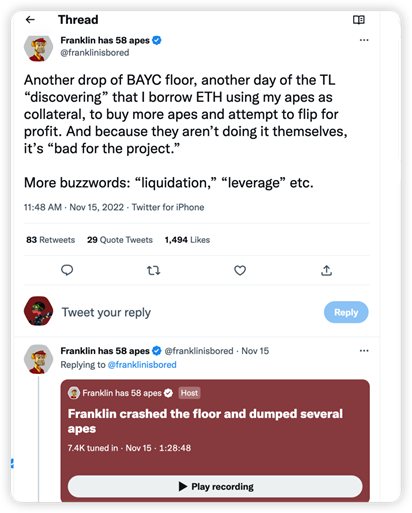
Figure 1. Franklin’s arbitrage trading on BAYC (source: Franklin on Twitter)
Franklin has tweeted long time ago that he has been making profits by staking BAYC, lending ETH, and simultaneously suppressing the floor price; after each arbitrage operation, he also organizes a Twitter Space to share the strategy to his friends and have a discussion on improvements of the strategy as well as potential opportunities. With the sequence of operations, he was able to keep making profits regardless of the market condition of BAYC. The arbitrage strategy is elaborated below.
Step 1, low prices of listings were used to induce more cheap listings from others, and an active acceptance of cheap offers were followed to knit the illusion of dumping. Compared to FT, NFT is less liquid that is highly exposed to price manipulation, not to mention the blue-chip NFTs, such as BAYC, that a single piece could sell for over $100K. Franklin has 58 BAYC, and the number is sufficient to provide him with room for arbitrage. He first listed at a price close to the floor price, other holders reacted to this listing by following the action, and then he selected 1-2 relatively low offerings from counterparty to accept the trade. The cheap listings and the successful matching are easily to be deemed by others as, which is an illusion: there are whales doing "clearance". The low-priced listings and the corresponding acceptance of trading further aggravated the panic of other holders, therefore, others followed by listing at lower prices; the outcome is positively correlated to the market panic.
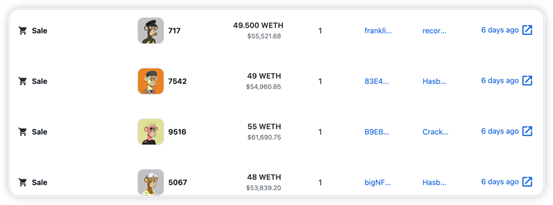
Figure 2. Franklin’s BAYC listings (source: Opensea)
Furthermore, BendDAO's oracle is fed by prices from various platforms (Opensea, X2Y2, etc.) to benchmark the floor price, thus, a chain reaction on price feeds of oracles was triggered and lighted the fuse of BendDAO’s liquidation.
Step 2, Franklin placed bids on underpriced BAYC with ETH from staking BAYC on hand. ETHs were borrowed from BendDAO by staking 14 other BAYCs on Franklin’s hand, and were injected with his remaining funds (mainly the ETH from accepting the low-ball offer in the first step) right away on ongoing biddings of BAYC on BendDAO, which are in the range of 43 ETH - 44.3 ETH. (Prices shown on the right side of the chart below)
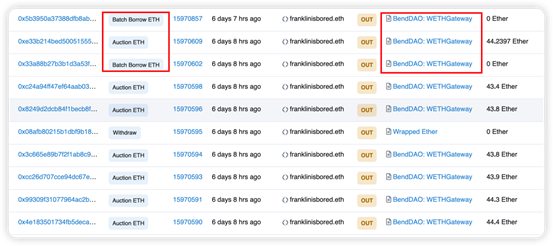
Figure 3. borrowing and lending records of Franklin on BendDAO (source: Etherscan transaction records from franklinisbored.eth)
Step 3, arbitrage activities will be implemented based on the level of solvency within 24 hours. After the above two steps, with the drop in floor price and continuous bids on BendDAO, two scenarios will be commonly seen:
If the owner of BAYC in staking pays off more than half of the debt within 24 hours (BendDAO adjusted the timeline to 24 hours since the last change), Franklin will receive a first bid bonus of 5% of the total debt; the first bid bonus is 2.25 ETH for 45 ETH.
If the debt is not paid within 24 hours, Franklin wins the auction receives the BAYC at extremely low price, and sells it right back on Opensea or X2Y2. An assumption is made that it all happens within a rather short time frame that the floor price does not plunge. If the bid price is 43 ETH and it is sold on OpenSea and other platforms at a floor price of around 49 ETH, 6 ETH will be the profit.
Another situation cannot be ruled out that a third party may win the bid when the borrower cannot pay back within 24 hours, which could possibly happen, and Franklin will reiterate Step 1 and Step 2.
1.2 Dumping with panic or indeed arbitrage?
From the above, it is evident that Franklin has been practicing the strategy for a long time openly, and he continues to do so when the floor price drops. In other words, with a conclusion: he is shorting in the short run and longing in the long run on BAYC; he took advantage of the mechanism of BendDAO to buy low and sell high, enjoying the perk as first bid bonus of the platform. From his name on Twitter (Franklinisbored) and past tweets, he is a strong believer in monkeys rather than FUD. As a result, from his opinions on Twitter Space and his subsequent actions, it is reasonable not to label his actions as dumping with panic.
2. BAYC and FTX: suspicions of money on FTX
According to the above, the plummet of BAYC may be triggered by Franklin, but rumors have been long existed on the market between FTX and BAYC before Franklin’s arbitraging actions. Is the panic on BAYC somewhat related to the FTX incident? After researching on FTX’s investments on BAYC and NNT holdings, in all, the argument remains on 2 perspectives in spite of discussions on the collapse of Yuga Labs under the effect of the FTX incident.
2.1 Does Alameda Research, the sister company of FTX, possess large amount of BAYC in open position?
Alameda Research owns rare NFTs worth millions of dollars, according to a Coindesk, including 31 rare BAYCs and 26 lands on Otherside. BAYC was once part of Alameda’s NFT trading strategy for arbitrage. According to Nikolai Yakovenko, founder of NFT valuation site DeepNFTValue, Alameda's BAYC holdings are estimated to be worth between 4,000 and 5,000 ETH (about $4.7 million to $5.8 million). While not large in the overall size of FTX, this amount is significant for the NFT market and lethal for the BAYC series per se.
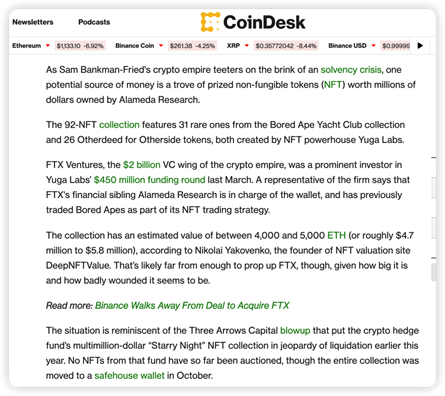
Figure 4. Open position of BAYC held by Alameda Research (Source: Coindesk)
In addition, among the 31 BAYCs, there are 3 super rare "golden monkeys" (with golden hair), which have a floor price of 1000 ETH. There are also 4 "psychedelic fur" monkeys with floor price of 599 ETH. Evidently, FTX has a rather large open position on blue-chip NFTs, which could bring about a selling climax for the NFT market, especially for the BAYC collection in its holdings.
2.2 Does Yuga Labs have significant funds on FTX?
According to publicly available information, FTX participated in the seed round of fundraising for Yuga Labs in March 2022. The seed round of Yuga Labs was for 450 million dollars with total valuation at 4 billion dollars; a16z led the investment, FTX and Animoca Brands followed.
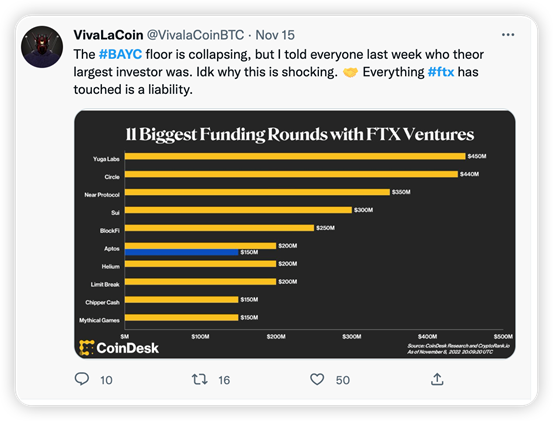
Figure 5. Biggest Funding Rounds with FTX Ventures (Source: Coindesk Research)
In a follow-up report, Garga, co-founder of Yuga Labs, tweeted that FTX was introduced and involved in the seed round, but the investment was small and the investment was received long ago by cheque. Another claim was made to the public and on Discord that the company has never been a user on FTX, and no assets or funds are on FTX (see the following picture for details).
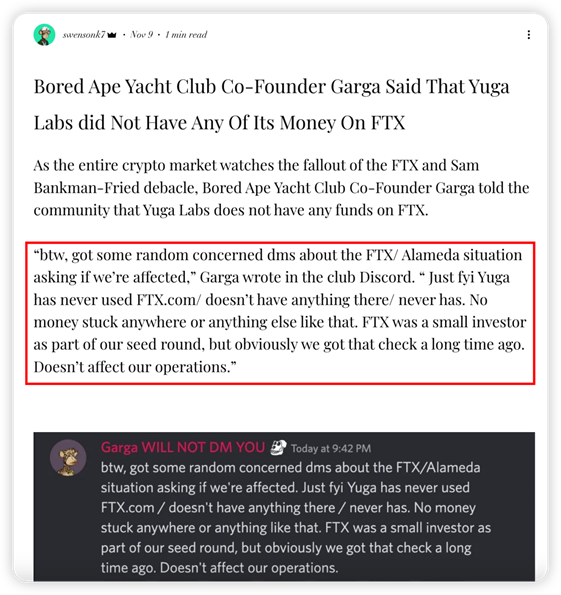
Figure 6. statement of fundings on FTX from Garga, cofounder of BAYC (Source: BAYC DC & Medium)
However, the NFT platform Compass advocated on Twitter that Yuga Labs had 18,000 ETH and 5.7473 million APEs on FTX and published hash transaction records, questioning the above statement made by the co-founder of Yuga Labs.
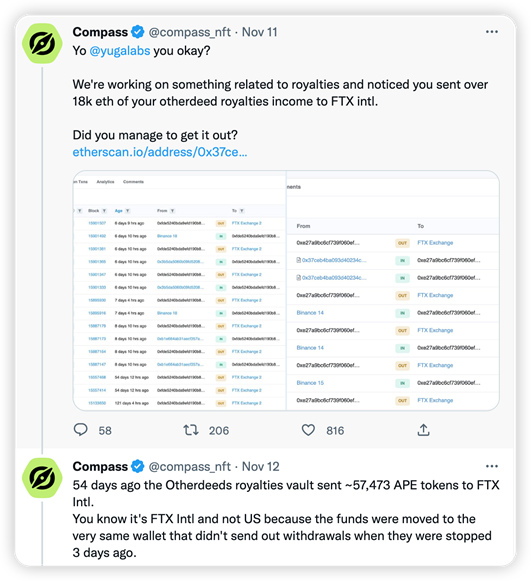
Figure 7. Compass questioning about funds of Yuga Labs (source: twitter @compass_nft)
Obviously, Garga's statement cannot withstand. After questioned by Compass, another co-founder of Yuga Labs made another announcement on Twitter (see the picture below for details) with the link for hash transaction record on Etherscan and claimed the rest of the funds are safe in the bank account and treasury bond.
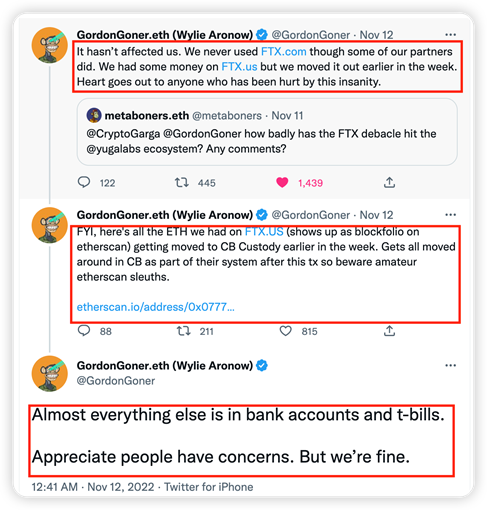
Figure 8. Statement from co-founder of Yuga Labs (source: Twitter)
Thus, combined with the trading records released by the two co-founders of BAYC and the subsequent rebound of BAYC’s price, and assume that FTX will not liquidate the open position of BAYC (it has not been seen so far), Yuga Labs seems to be almost immune from the FTX incident, and the panic is more or less a false alarm.
3. It pours when it rains: will the NFT market collapse in the aftershock of FTX?
3.1 Status quo of the NFT market in panic
Under the impact of the FTX crash, the NFT market has been depressed. Since November 7, a decline has been seen in sales, market capitalization, daily trading volume, and number of traders, among all indicators.
From NFTGO, the Blue-Chip Index has fallen sharply over the past few days, which is composed by the blue-chip NFT collections, including BAYC, Cool Cats, CryptoPunks, Art Blocks and CloneX. Since Nov. 7, the index is cut by 6%. (In the chart below)
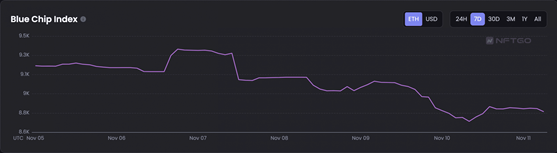
Figure 9. NFTGO Blue-Chip Index (Source: NFTGO.io)
In addition to the decline of the blue-chip index, the NFT market has seen declines in both total market capitalization and sales. From data on NFTGO, the total market capitalization of NFT has fallen by 8% since Nov. 7, while total sales dropped 32% YoY.
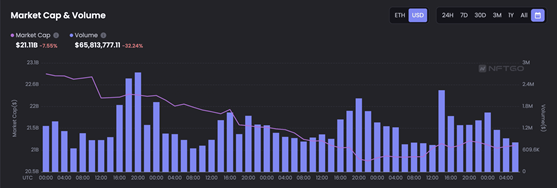
Figure 10. NFT Market Cap & Transaction Volume (Source: NFTGO.io)
Opensea has been in deep contraction that daily trading volume fell by 41%, and other platforms, such as NFTX, LooksRare, etc. are not exempted from sharp declines; LoosRare has suffered a drop of even over 48%. The whole market is enveloped in the panic brought with the aftershock of the FTX incident.
3.2 Follow-up analysis on NFT projects affected by the FTX incident
Given that the BAYC collection has been affected by the aftershock of the FTX incident, we have been following up with some of the prominent projects on the NFT market, and it appears that some NFT projects are still being affected. The influences are demonstrated in the chart below along with the degree affected:
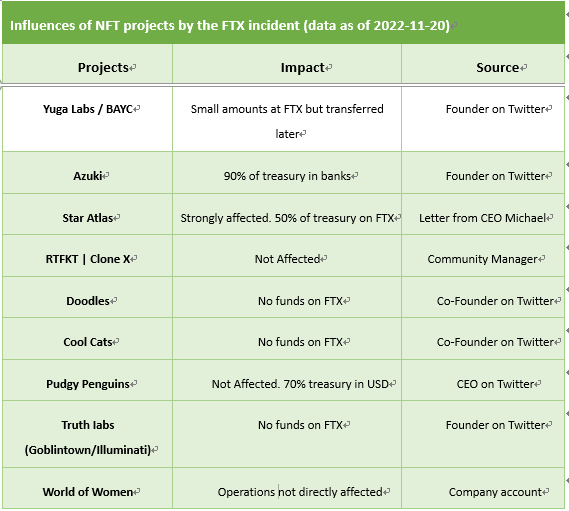
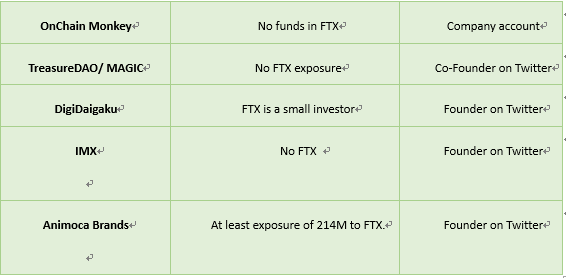
Table 1: Influences of NFT projects by the FTX incident (Source: Huobi Research)
Among them, CloneX, Doodles, CoolCats, Pudgy Penguin have almost no funds involved with FTX, while one of the more affected NFT projects is Star Atlas, which has about 50% of treasury funds stored on FTX and current game development is not yet completed. As we know, NFT gaming projects require large amount of funds for development and operations; in current bearish market, it pours when it rains. By a letter from Michael, CEO of Star Atlas, to the community, the inability for future operations because of insufficient funds is implied.
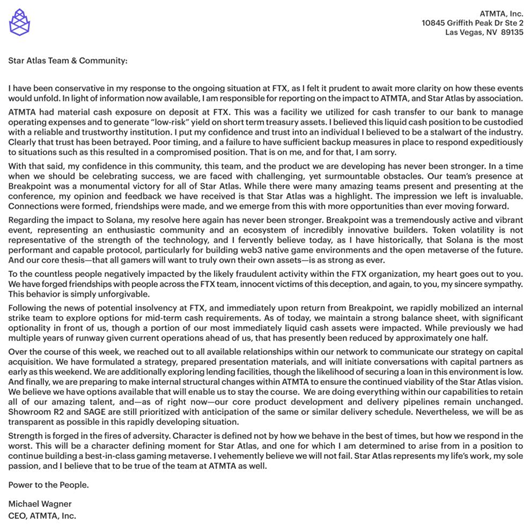
Figure 11. A letter from Star Atlas CEO to the community (Source: StarAtlas Community)
Other projects have had relatively little impact; some of the NFT programs are already publishing documents one after another clarifying on no open position in FTX; Pudgy Penguins have even provided detailed information about how their funds are allocated: 70% of the funds in banks, 20% in multi-signature wallets and the remaining 10% in gnosis wallets.
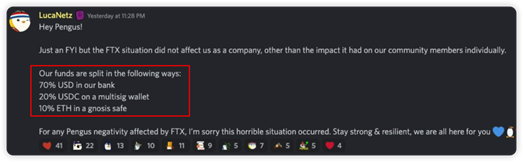
Figure 12. Allocation of funds, Pudgy Penguins (source: PudgyPenguins Discord)
3.3 Summary
To sum up, the plummet of BAYC in the NFT market is nothing more than a false alarm in the bear market; it is inevitably affected by the overall fluctuated market condition but never to a collapse. For other NFT projects, it is admitted that some may be affected by the FTX incident, either by receiving investment from FTX or having deposits stuck on FTX. But from current statistics and analysis, about 80% or more of the NFT projects are not affected (see Table 1).
Therefore, in our humble opinion, not actions should be made related to FUD following the trend, for there are boundaries of the FTX incident. With positive expectations, we should hope for the aftershock of the FTX incident to diminish and the crypto market to be recovered soon. As the NFT market is integrated to every aspect of the crypto market, the next spring of NFT is yet to come.
About Huobi Research Institute
Huobi Blockchain Application Research Institute (referred to as "Huobi Research Institute") was established in April 2016. Since March 2018, it has been committed to comprehensively expanding the research and exploration of various fields of blockchain. As the research object, the research goal is to accelerate the research and development of blockchain technology, promote the application of the blockchain industry, and promote the ecological optimization of the blockchain industry. The main research content includes industry trends, technology paths, application innovations in the blockchain field, Model exploration, etc. Based on the principles of public welfare, rigor and innovation, Huobi Research Institute will carry out extensive and in-depth cooperation with governments, enterprises, universities and other institutions through various forms to build a research platform covering the complete industrial chain of the blockchain. Industry professionals provide a solid theoretical basis and trend judgments to promote the healthy and sustainable development of the entire blockchain industry.
Contact us:
Website: http://research.huobi.com
Email: research@huobi.com
Twitter https://twitter.com/Huobi_Research
Telegram: https://t.me/HuobiResearchOfficial
Medium: https://medium.com/huobi-research
Disclaimer
1. The author of this report and his organization do not have any relationship that affects the objectivity, independence, and fairness of the report with other third parties involved in this report.
2. The information and data cited in this report are from compliance channels. The sources of the information and data are considered reliable by the author, and necessary verifications have been made for their authenticity, accuracy and completeness, but the author makes no guarantee for their authenticity, accuracy or completeness.
3. The content of the report is for reference only, and the facts and opinions in the report do not constitute business, investment and other related recommendations. The author does not assume any responsibility for the losses caused by the use of the contents of this report, unless clearly stipulated by laws and regulations. Readers should not only make business and investment decisions based on this report, nor should they lose their ability to make independent judgments based on this report.
4. The information, opinions and inferences contained in this report only reflect the judgments of the researchers on the date of finalizing this report. In the future, based on industry changes and data and information updates, there is the possibility of updates of opinions and judgments.
5. The copyright of this report is only owned by Huobi Blockchain Research Institute. If you need to quote the content of this report, please indicate the source. If you need a large amount of references, please inform in advance (see "About Huobi Blockchain Research Institute" for contact information) and use it within the allowed scope. Under no circumstances shall this report be quoted, deleted or modified contrary to the original intent.