6% Annual Yield: Musk Declares War on Traditional Banks

marsbitPublicado a 2026-03-06Actualizado a 2026-03-06

Resumen

Elon Musk's X Money, a new financial product, offers a 6% annual percentage yield (APY) on deposits, a rate 600 times higher than traditional U.S. banks like JPMorgan Chase. The product includes a laser-engraved metal debit card linked to users' X handles, instant Visa Direct settlements, zero foreign transaction fees, and FDIC insurance up to $250,000 via Cross River Bank. The high yield is enabled by a low-cost, cloud-native infrastructure without physical branches, leveraging X's over 500 million monthly active users for near-zero customer acquisition costs. This model threatens traditional banks' profit margins, payment intermediaries like PayPal, and remittance services by potentially creating a closed-loop financial ecosystem within X. Key regulatory challenges include pending money transmitter licenses in New York, allegations of data misuse, and compliance with the GENIUS Act, which prohibits stablecoin issuers from paying yields. Integration with AI system Grok aims to transform X into an AI-driven wealth management and content-monetization platform. If successful, X Money could become a U.S. version of China's super-apps like WeChat Pay, though regulatory hurdles may limit its impact. The outcome could significantly disrupt traditional banking and payment industries.

Author: Baihua Blockchain

In early March 2026, American actor William Shatner—Captain Kirk from Star Trek—posted a screenshot on X.
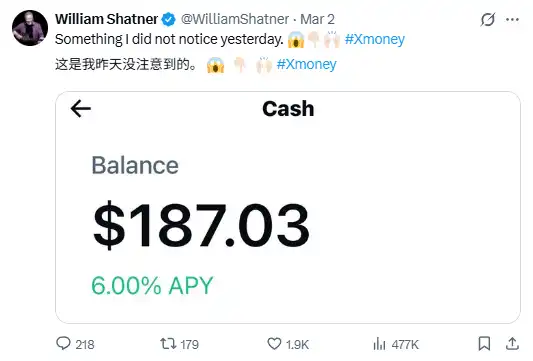
Nothing major, just him testing a new product called X Money.

In the screenshot, there was a line of numbers: Annual Percentage Yield: 6%.

The post didn't go massively viral, but it quietly caused a stir in financial circles.

Not because of William Shatner, but because of that 6%.

If you open a standard savings account at JPMorgan Chase, the deposit interest rate is 0.01%. At Wells Fargo, the answer is about the same. Deposit $100, and a year later the big bank gives you one cent. With X Money, it gives you $6.

A difference of 600 times.

This is how Musk is declaring war on traditional finance—not with a technical whitepaper, nor with regulatory lobbying, but with a screenshot.

01. A Black Metal Card

The appearance of X Money is straightforward: a digital wallet that can send, receive, and store money, paired with a physical debit card.

But every detail reveals ambition.

That debit card is made of black metal, laser-engraved with your X username (Handle). Not your legal name, not an account number, but your social identity on the X platform.

This design is no accident. It binds your social account to your spending power. Every time you pull out the card to pay, you're not just showing a payment tool, but your digital identity. The stickiness of the X ecosystem is built layer by layer like this.

On the settlement level, X Money is integrated with Visa Direct. Traditional bank ACH transfers take 1 to 3 business days to settle; Visa Direct enables near-instant settlement. For the gig economy and content creators, this speed difference is a tangible improvement in experience.

Deposits are custodied by Cross River Bank (a member of the FDIC), with each user insured for up to $250,000 in federal deposit insurance protection.

To summarize the product in one sentence: 6% APY, laser-engraved black metal card, instant settlement, zero foreign transaction fees, $250k insurance cap.

Just looking at the spec sheet, it's hard to find fault.

02. How Can It Offer 6%?

This is the most critical question.

Where does the money for the 6% APY come from? X Money isn't burning cash to subsidize users—at least that's not the current business logic. The answer lies in an inconspicuous difference in cost structure.

Traditional big banks maintain a complete physical network: branch offices, tellers, ATM fleets, IT systems with decades of history. These represent huge fixed costs; regardless of the deposit scale, this overhead remains.

X Money, however, is a cloud-native, API-first platform with no physical branches and no legacy baggage. The front-end user experience is handled by X, while banking compliance and fund custody are handled by Cross River Bank. This embedded finance model—"front-end to the tech company, back-end to the licensed bank"—drastically reduces operational costs. The saved space can then be passed on to users.

This logic itself isn't new. Robinhood, Ally Bank, and SoFi have taken the same path.

But X Money has something most traditional fintech companies lack: over 500 million monthly active users, with a user acquisition cost (CAC) close to zero.

No need to spend money to attract new ones; just need to keep the money of users already on X, within X.

03. Who is Threatened

The competitors X Money aims to squeeze are more numerous than they appear.

First, the traditional deposit market.

The business model of big banks relies on one premise: depositors have no better options, or are too lazy to switch.

The 6% APY shatters this premise. When over 500 million X users have access to this rate, the pressure for fund migration becomes real. To retain depositors, banks will be forced to raise their own deposit rates, compressing net interest margins. About 60% of the US banking industry's revenue comes from net interest income. This is not a small matter; it's a systemic shake-up of the profit structure.

Second, the payment middle layer.

Social payment players like Venmo, PayPal, and Cash App have grown accustomed to their position in this field. But none of them has a social platform with over 500 million users as a traffic entry point.

The core logic of X Money is to build a "closed loop of funds": money comes in, circulates within the X ecosystem for content tipping, subscriptions, merchandise purchases, without needing to flow out. Once this closed loop takes shape, the intermediary role of the PayPals of the world will be marginalized.

Finally, cross-border remittances.

According to World Bank data for Q1 2025, the average cost of global cross-border remittances is about 6.49%, and settlement often takes several days. Leveraging Visa Direct's global network, X Money aims to significantly reduce this cost and achieve near-real-time settlement. The business of Western Union, MoneyGram, and others in markets dense with X users, like India, Indonesia, and Brazil, is X Money's most direct target.

04. The Regulatory Battlefield

However, the biggest variable in whether this threat materializes is regulation.

X Payments LLC has already obtained Money Transmitter Licenses (MTLs) in over 40 states and Washington D.C. But one state hasn't given the nod: New York.

New York state lawmakers have publicly written to the Department of Financial Services (DFS), urging it to deny X a license. Reasons cited include: Musk's historically adversarial stance towards regulators, vulnerabilities in X's platform identity verification mechanisms, and a more sensitive allegation—that during Musk's tenure leading the Government Efficiency Department (DOGE), his staff reportedly accessed consumer payment data from the Consumer Financial Protection Bureau (CFPB), data which theoretically contains competitors' trade secrets.

A regulator simultaneously participating in competition—if this allegation is substantiated, it will trigger a series of antitrust lawsuits.

Another variable is the GENIUS Act. This stablecoin legislation, officially signed into law in July 2025, explicitly prohibits issuers of payment stablecoins from paying any form of yield or interest to holders.

Currently, the 6% APY paid on fiat deposits by X Money operates under traditional banking deposit agreements, which is not directly problematic under the current framework. But if X intends to convert account balances into stablecoin form in the future, or deeply integrate crypto assets like Dogecoin or XRP, the GENIUS Act's yield prohibition will directly block this path.

Musk needs to prove to regulators that the 6% is compliant bank deposit interest, not a disguised form of unregistered security yield, nor prohibited stablecoin dividends.

05. Grok Enters the Fray

If the 6% APY is X Money's entry ticket, Grok is the moat it wants to build.

X's AI, Grok, is being deeply integrated with financial functions. Musk's vision is for Grok to be not just a chatbot, but an "intelligent agent" capable of performing financial duties—recommending buys and sells based on real-time sentiment on the platform, automatically allocating funds between products of different risk levels, and even allowing users to jump directly to a trading interface through the "Smart Cashtags" feature while scrolling through posts.

This is a new product形态 (form): consuming content and managing assets happen within the same interface.

Traditional wealth management firms charge fees based on information asymmetry and human services. When AI can process vast amounts of social data and market signals at millisecond speeds, this information advantage shrinks.

For creators, the change is more direct: tips, subscription revenue shares, and advertising earnings go into the X wallet with 6% APY, without needing to pass through intermediary bank accounts. X is positioning itself as the settlement center for creators— effectively their "bank."

06. Summary

The success of WeChat Pay and Alipay in China made countless American tech companies envious, but replication has always failed. The reasons are multifaceted: US financial regulation is more fragmented, consumer habits favor credit card cashback culture, and barriers exist between different platforms.

X Money is the attempt that has come closest to this goal so far.

It has a user base, AI capabilities, Visa's global network, a founder who doesn't care about established rules—and a bunch of regulators and politicians waiting to cause trouble for it.

The outcome of the博弈 (game/struggle) between these two forces will become clearer over the next 18 months. If X Money can secure the New York license, maintain compliance within the boundaries of the GENIUS Act, and successfully operationalize Grok's wealth management features—it might just complete the experiment of an American super-app.

If not, what it leaves behind is just a sleek black metal card and a memory of a good 6% rate.

For traditional banks and payment giants, the difference between these two outcomes is company fate-level.


Preguntas relacionadas

QWhat is the key feature of X Money that is causing a stir in the financial industry, and how does it compare to traditional banks?

AThe key feature is its 6% Annual Percentage Yield (APY) on deposits. This is 600 times higher than the typical 0.01% interest rate offered by traditional banks like JPMorgan Chase and Wells Fargo on standard savings accounts.

QHow is X Money able to offer such a high 6% APY compared to traditional banks?

AX Money operates as a cloud-native, API-first platform without the high fixed costs of physical branches, tellers, and legacy IT systems that traditional banks have. It uses an embedded finance model, partnering with Cross River Bank for compliance and custody, which drastically lowers operational costs. Additionally, it has a user acquisition cost of nearly zero due to X's over 500 million monthly active users.

QWhich three main groups of competitors are threatened by the launch of X Money?

A1. Traditional deposit markets: Large banks whose profit models rely on low-interest deposits. 2. Payment intermediaries: Services like Venmo, PayPal, and Cash App, which could be marginalized by X's built-in payment ecosystem. 3. Cross-border remittance services: Companies like Western Union and MoneyGram, as X Money aims to lower costs and speed up international transfers using the Visa Direct network.

QWhat are the two major regulatory challenges facing X Money mentioned in the article?

A1. Obtaining a money transmitter license (MTL) in New York State, where lawmakers have raised concerns about Musk's history with regulators and potential data access issues. 2. Navigating the restrictions of the GENIUS Act, which prohibits payment stablecoin issuers from paying interest or yields, potentially blocking future integration of crypto assets like Dogecoin or XRP into the X Money platform.

QWhat role does Grok, X's AI, play in the broader strategy for X Money?

AGrok is being integrated to act as an 'intelligent agent' that can perform financial duties. It is designed to provide real-time trading suggestions based on platform sentiment, automatically allocate funds between products, and allow seamless transitions from viewing content to executing trades via features like 'Smart Cashtags,' essentially merging content consumption with asset management.

Lecturas Relacionadas

GensynAI : Que la IA no repita los errores de Internet

En los últimos meses, el auge de la IA ha atraído talento del sector cripto. Muchos proyectos exploran cómo la blockchain puede integrarse en la infraestructura de IA, pero pocos logran un modelo de negocio cerrado. Gensyn se distingue al enfocarse en el núcleo más costoso: el entrenamiento de modelos. Su propuesta es organizar recursos de GPU dispersos globalmente en una red abierta para entrenamiento de IA. Los desarrolladores pueden enviar tareas, los nodos aportan capacidad de cálculo, y la red verifica los resultados y distribuye incentivos. Esto aborda un problema crítico: la creciente centralización del poder de cálculo en grandes tecnológicas, donde el acceso a GPUs como la H100 se ha convertido en una barrera clave para la innovación. Gensyn destaca por cuatro razones: 1. Ataca la capa de infraestructura central de la IA (entrenamiento), no solo aplicaciones. 2. Ofrece un modelo de colaboración abierto que puede optimizar costes y eficiencia para equipos más pequeños. 3. Su principal barrera tecnológica y ventaja es la capacidad de verificar resultados y garantizar fiabilidad en un entorno distribuido. 4. Responde a una demanda real y creciente en un mercado ya validado, más allá de la narrativa cripto. En conclusión, la frontera entre cripto e IA se desdibuja. La IA necesita coordinación de recursos e incentivos para la colaboración global, áreas donde la tecnología blockchain puede aportar soluciones. Gensyn representa un paso hacia una infraestructura de IA más abierta y accesible, no solo controlada por unos pocos gigantes.

marsbitHace 9 hora(s)

GensynAI : Que la IA no repita los errores de Internet

marsbitHace 9 hora(s)

¿Por qué el desarrollo de la IA en China es tan rápido? La respuesta está dentro de sus laboratorios

El artículo explora las razones del rápido desarrollo de la IA en China, centrándose en la cultura organizativa de sus laboratorios. A diferencia del ecosistema estadounidense, que prioriza la innovación disruptiva, el capital y las "estrellas" científicas individuales, el enfoque chino se caracteriza por un pragmatismo basado en la ejecución en equipo, la ingeniería eficiente, la rápida iteración y un fuerte deseo de controlar la pila tecnológica clave. Los laboratorios chinos sobresalen como "seguidores rápidos", optimizando direcciones ya establecidas. Una cultura que valora menos el ego individual y más el trabajo en equipo, combinada con una gran afluencia de jóvenes investigadores y estudiantes integrados en proyectos centrales, facilita una adaptación ágil y un enfoque en tareas prácticas de mejora de modelos. Existe un respeto general dentro del ecosistema, que se percibe más como una comunidad que como tribus en competencia. En el ámbito industrial, se observa una mentalidad de "construir, no comprar", con muchas grandes empresas tecnológicas desarrollando sus propios modelos LLM fundamentales para mantener la soberanía tecnológica. El apoyo gubernamental existe pero es descentralizado. La demanda interna de IA está creciendo, potencialmente similar al mercado de la nube, y los desarrolladores muestran una fuerte admiración por herramientas como Claude. Aunque hay una gran necesidad de chips de Nvidia, también se utilizan alternativas locales como Huawei para inferencia. El ecosistema de datos es menos maduro que en Occidente, lo que fomenta soluciones internas. En conclusión, se están formando dos trayectorias distintas: una carrera impulsada por el capital y el prestigio en EE.UU. frente a una competencia industrial impulsada por la capacidad de ejecución, el ecosistema de código abierto y la autonomía tecnológica en China. El autor destaca la calidez y el enfoque pragmático de los investigadores chinos, subrayando que la competencia futura dependerá no solo de los modelos, sino también de las capacidades organizativas y la fuerza del ecosistema.

marsbitHace 10 hora(s)

¿Por qué el desarrollo de la IA en China es tan rápido? La respuesta está dentro de sus laboratorios

marsbitHace 10 hora(s)

3 años, 5 veces: el renacimiento de una fábrica de vidrio centenaria

Según CRU, la demanda de fibra óptica en centros de datos de IA creció un 75,9% anual, ampliando el déficit de oferta del 6% al 15%. Los precios de la fibra se triplicaron en meses. NVIDIA invirtió en Corning, Lumentum y Coherent (total 45 mil millones USD) para asegurar la cadena de suministro óptica. Corning, fundada en 1851, ve su valor subir un 316,81% en el último año, alcanzando 160 mil millones USD. Su crecimiento se debe a dos factores clave: la rigidez de la oferta (el proceso de fabricación de preformas es complejo y lento) y la transición forzada de cobre a fibra en infraestructuras de IA para mayor eficiencia y menor consumo energético. La fibra es crucial para la IA: su uso en bastidores de IA es 5-10 veces mayor que en centros tradicionales. Se espera que la demanda de fibra para IA represente el 35% del mercado total para 2027. Corning lidera en fibra especializada de baja pérdida, alta densidad y resistencia a la curvatura, esencial para transmisiones de 800G a 1,6T. Sus ingresos en comunicación óptica para empresas se duplicaron en dos años, superando los 30 mil millones USD en 2025, respaldados por acuerdos a largo plazo con Meta, NVIDIA y otros grandes clientes. Aunque no es el mayor fabricante global, Corning destaca en I+D (más de 10 mil millones USD anuales) y en su enfoque en el segmento premium de centros de datos de IA. El aumento de precios beneficia a toda la industria, como muestran los resultados de empresas chinas. El despliegue de Óptica de Co-Embalaje (CPO) y la posible adopción de fibra hueca son variables futuras clave. Sin embargo, la rápida apreciación de las acciones de Corning (multiplicando por 3 su relación P/E) ya refleja grandes expectativas, lo que podría aumentar la volatilidad si los pedidos no cumplen con el ritmo esperado.

marsbitHace 11 hora(s)

3 años, 5 veces: el renacimiento de una fábrica de vidrio centenaria

marsbitHace 11 hora(s)

Trading

Spot
Futuros
活动图片