$500 to Buy OpenAI Stock: Silicon Valley's Most Respectable Liquidity Invitation

marsbitPublicado a 2026-04-23Actualizado a 2026-04-23

Resumen

Silicon Valley's largest venture capital platform, AngelList, has launched a new fund called USVC, allowing U.S. retail investors to buy into high-profile AI companies like OpenAI, Anthropic, and xAI with a minimum investment of $500—no accredited investor status required. Promoted by AngelList co-founder Naval Ravikant, the fund is framed as an opportunity for ordinary people to access high-growth private tech investments traditionally reserved for VCs. However, critics argue it functions more like an exit vehicle for early insiders. USVC acquires shares not through primary rounds but largely via secondary transactions—purchasing stakes from early investors, VC funds, and employees looking to cash out at peak valuations. With companies like xAI heavily weighted in the portfolio, the fund effectively channels retail money into providing liquidity for insiders who entered at much lower valuations. The fund’s structure raises concerns: shares are illiquid, with no secondary market, and buybacks are limited and discretionary. The actual annual fee reaches 3.61%, far above the advertised 1% management fee. This model parallels the "low float, high fully diluted valuation" strategy seen in crypto, where early investors profit by selling to latecomers at inflated prices. The timing—alongside similar moves by platforms like Robinhood—suggests that Silicon Valley’s sudden interest in retail inclusion may be less about democratizing access and more about securing exits for insider...

Author: David, Shencha TechFlow

When Silicon Valley VCs are finally willing to let ordinary people join the table, it usually means one thing.

The game is almost over.

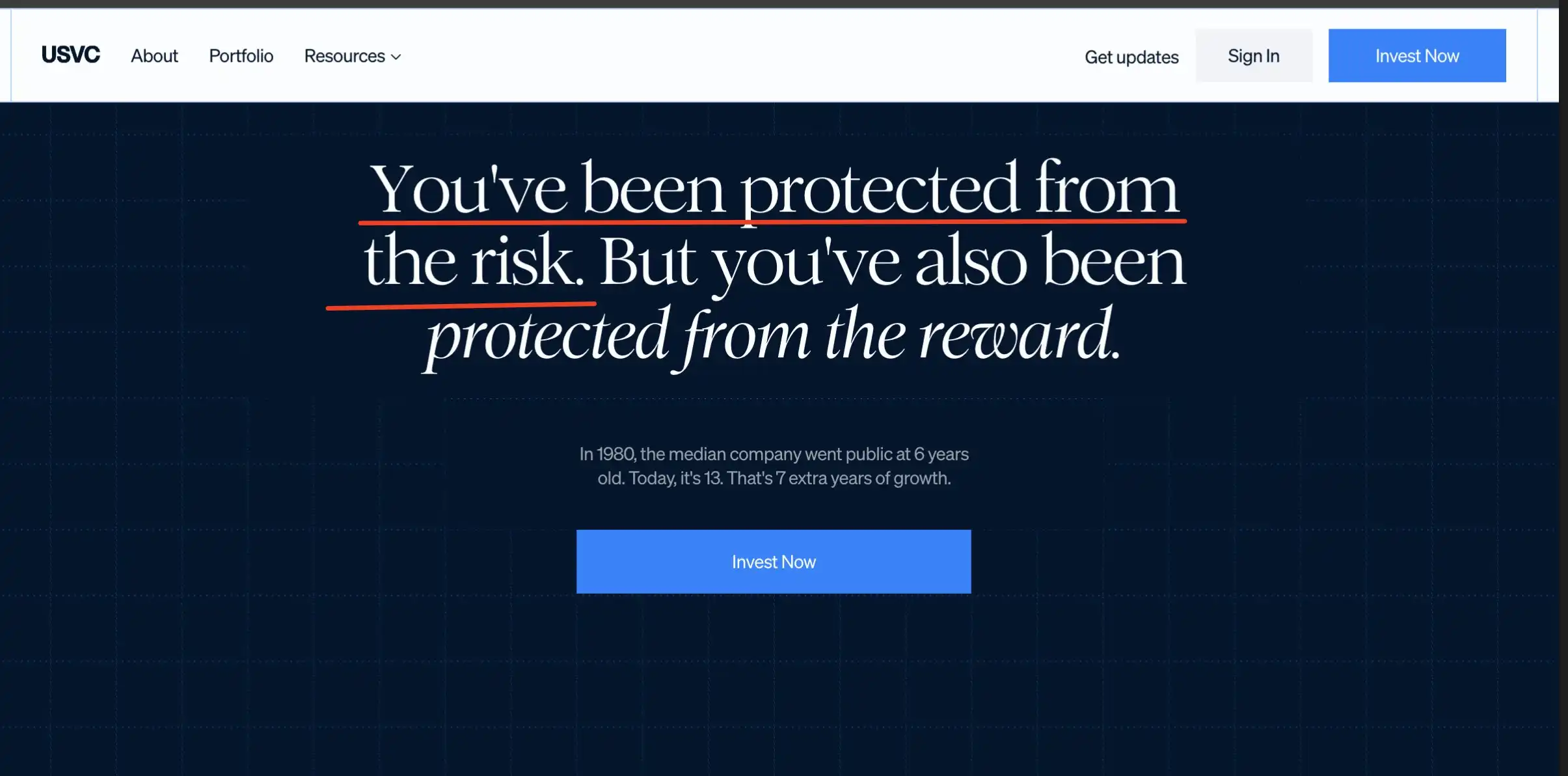
Yesterday, AngelList launched a fund product called USVC. AngelList is Silicon Valley's largest venture capital infrastructure platform. According to its official data, it manages over $125 billion in assets and has served more than 25,000 funds.

It has now opened a door to all US investors: a minimum investment of $500, no accredited investor certification required, directly allowing holders to own shares in seven AI companies, including OpenAI, Anthropic, and xAI.

Promoting this product is Naval, also a co-founder of AngelList. His book "The Almanack of Naval Ravikant" has made him one of the few figures in Silicon Valley with both a strong investment track record and significant public influence.
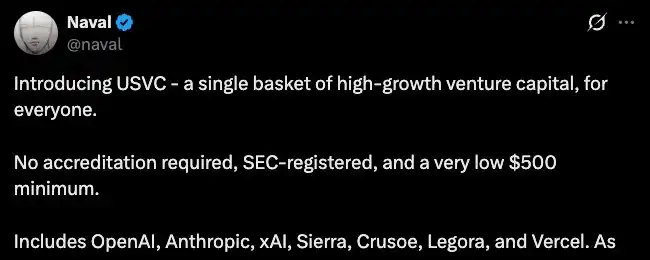
He posted a long thread on X promoting USVC, the gist being that early-stage tech investment is the "adventure capital" of our era, and ordinary people have always been locked out. By the time some great AI companies IPO, their growth is already over. USVC is here to open that door.

Within hours of the tweet, comments emerged asking an uncomfortable question that soured the mood:

These tech companies have been pushed to sky-high valuations, all the explosive growth happened in the private market. Now inviting retail investors to join, what's the difference from looking for exit liquidity?

USVC holds shares in seven companies, with the heaviest weighting in xAI. According to a Decrypt report, as of the end of March, about 44% of USVC's capital had been invested in these seven companies.

However, none of these companies are public. How did they get the shares?

According to the prospectus, USVC has three ways to acquire its targets: investing in emerging fund managers, participating in company growth-round financing, and purchasing secondary shares through AngelList's network.

The first two are straightforward. The third is the key.

Secondary shares mean that the company is not issuing new shares to sell to you; someone who already holds shares is transferring their portion to you. Who is transferring? Early angel investors, VC funds, early employees.

These people might have gotten on board when the company was valued at tens of millions of dollars. Now the company is worth tens or even hundreds of billions. They want to turn paper gains into real money before the IPO. But the private market isn't like a stock exchange; there's no ready queue of buyers waiting to take the other side.

USVC solves this problem perfectly. It raises funds from retail investors and uses that money to buy shares from insiders who want to exit.

AngelList does have a natural advantage for this. According to its website, there are over 4,500 active fund managers on the platform operating more than 25,000 funds, invested in over 13,000 startups.

This network is full of people and shares wanting to be sold, with AngelList sitting right in the middle. This is also the "exclusive access" USVC repeatedly emphasizes.

The access is indeed exclusive, but the direction of the trade doesn't seem to favor retail.

In this trade, the sellers are those who got in when the company was valued at tens of millions. The buyers are those getting in when it's valued at hundreds of billions. The sellers lock in returns of tens or even hundreds of times. The buyers are betting that these already fully-priced companies can still go higher.

Simultaneously, the terms retail investors are getting also say something.

According to the USVC prospectus, the fund is not listed on any exchange, does not anticipate a secondary trading market, may repurchase up to 5% of its net asset value per quarter (solely at the board's discretion, with no guarantees), and has an estimated total annual expense ratio of 3.61%—far higher than the prominently displayed 1% management fee, with the difference coming from layered fees of the underlying funds.
No ability to sell, exit dependent on queuing, and nearly 4% of principal eaten by fees annually. For a product with a $500 minimum investment aimed at ordinary people, this price isn't cheap.

So, the complete picture is likely this.

On one side are the insiders wanting to exit, getting liquidity, locking in profits. On the other side are the retail investors just entering, getting a share that can't be traded, has an exit reliant on queuing, and has an effective fee rate much higher than advertised. The direction of the funds, from start to finish, is only one way: from later arrivals to early arrivals.

The Equity Version of "Low Float, High FDV"

Breaking down the USVC model: insiders accumulate positions at low valuations. After asset prices are pushed high, a channel accessible to retail is packaged, allowing the funds of later arrivals to facilitate the exit of early arrivals.

The crypto industry ran a complete rehearsal of this logic between 2021 and 2024.

During those years, VC-backed token projects had a universal template: seed round valuation a few million, private round rising to tens of millions, and by the time the token listed on exchanges, the Fully Diluted Valuation (FDV) had skyrocketed to tens or even hundreds of billions. But only 2% to 5% of the total supply was in circulation, with the rest locked with VCs and the team, vesting on a schedule.

Low float, high FDV.

What USVC is doing is essentially almost identical to low float, high FDV. Insiders get in when the company is valued at tens of millions. After the company's valuation grows to hundreds of billions, they transfer their shares out through a product aimed at retail.

Naval's own trajectory is also interesting. Last October, he tweeted on X that "Bitcoin is insurance against fiat, Zcash is insurance against Bitcoin." This tweet caused ZEC to surge over 100% in a week. The community then dug up that, according to public reports, Naval had invested $715,000 in the development company behind Zcash as early as 2015 and had served on the Zcash Foundation's board.

The community's conclusion was simple: he was using his personal influence to shill his early investment. Naval did not respond to these质疑 (queries).

From Zcash to USVC, the model hasn't changed. A celebrity uses public credibility to open the demand side and uses a channel to direct that demand towards assets they have a position in.

Of course, in the case of USVC, there doesn't seem to be anything illegal.

USVC is a registered fund, the risk disclosures in the prospectus are ample, and the Zcash tweet didn't constitute investment advice.

But between legal and reasonable, there's always an ambiguous distance. A platform managing a trillion-dollar venture network, using the narrative of "letting ordinary people invest in the future" to raise retail funds, then using those funds to buy out insiders within its own network who want to exit...

Every single part of this is compliant. But all the parts put together easily trigger painful memories for retail investors.

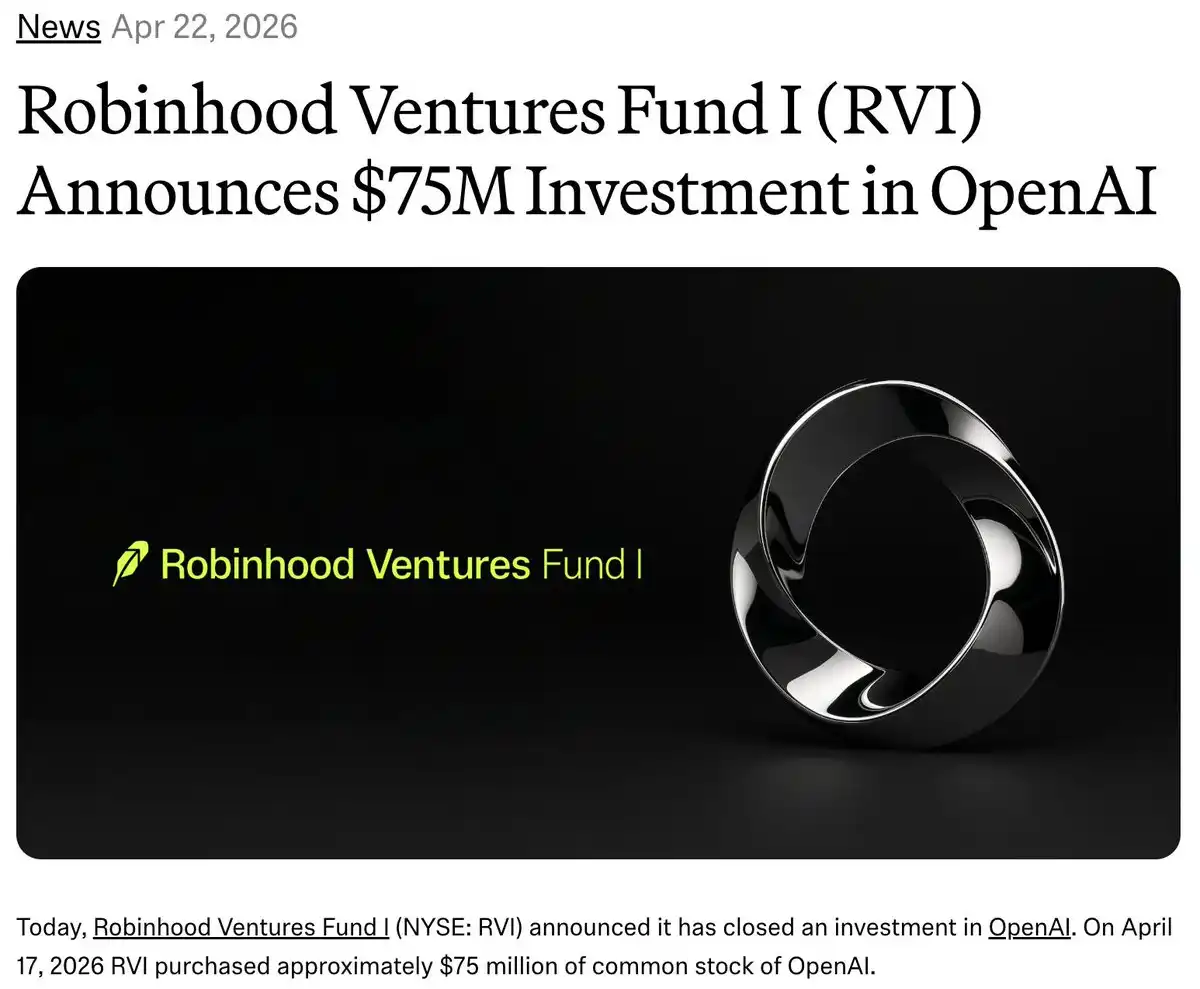
And on the same day USVC launched, Robinhood also announced its fund spent $75 million to buy OpenAI shares, also open to ordinary investors. Two companies did the same thing in the same week: using their respective retail networks to build an exit channel for insiders in the private market.
Every time the financial industry suddenly starts caring about the investment rights of ordinary people, it's often not because the situation for ordinary people has improved, but because the exit channels for insiders have narrowed.

This was true in 2021 when the crypto industry opened its doors wide to retail, and it's true in 2026 when Silicon Valley opens its doors to retail. The timing of the door opening is never decided by those who want to enter.

For ordinary people, there's a simple way to judge if an investment opportunity is meant for you.

Look at the people who got in before you. Are they buying more or are they selling right now? If they are selling, and you are being invited to buy, then you need to think clearly about one question: are you bringing capital, or are you bringing liquidity?


Preguntas relacionadas

QWhat is the main purpose of the USVC fund launched by AngelList, as per the article?

AThe main purpose of the USVC fund is to allow ordinary US investors, with a minimum investment of $500 and without accredited investor certification, to gain exposure to shares of private AI companies like OpenAI, Anthropic, and xAI. However, the article suggests it primarily functions as a mechanism for early investors and insiders to sell their shares and secure liquidity before an IPO.

QHow does the USVC fund primarily acquire shares in companies like OpenAI and xAI?

AThe USVC fund acquires shares through three main methods: investing in emerging fund managers, participating in growth-round financings, and most importantly, purchasing secondary shares from early investors, venture capital funds, and employees within the AngelList network who are looking to exit their positions.

QWhat are some of the significant drawbacks and risks for retail investors in the USVC fund, according to the article?

ASignificant drawbacks include: the fund shares are not listed on any exchange with no expectation of a secondary market; quarterly repurchases of up to 5% of shares are at the board's discretion and not guaranteed; and the estimated total annual expense ratio is 3.61%, which is much higher than the advertised 1% management fee due to layered underlying fund fees.

QWhat parallel does the article draw between the USVC fund model and a recent trend in the cryptocurrency industry?

AThe article draws a parallel to the 'low float, high fully diluted valuation (FDV)' model prevalent in crypto from 2021-2024. In this model, VCs and insiders accumulated tokens at low valuations, and when the FDV became very high at public listing, only a small percentage of the supply was released to retail market, creating an exit path for early investors.

QWhat is the implied motivation behind financial platforms like AngelList and Robinhood suddenly offering retail investors access to pre-IPO companies, as suggested by the article's conclusion?

AThe article implies that the motivation is not to improve investment opportunities for ordinary people, but rather to create an exit channel and provide liquidity for insiders and early investors (like VCs and employees) who want to cash out their highly appreciated shares before an IPO, as their own exit avenues have narrowed.

Lecturas Relacionadas

Un análisis de 10.000 palabras: de 10 a 290 dólares, MRVL ganó toda la era de la IA 'sin hacer GPU'

En junio de 2026, la acción de Marvell Technology (MRVL) alcanzó un máximo histórico de 290 dólares, multiplicándose por 30 desde 2016. Este análisis explora la valoración del mercado, argumentando que Marvell es más que un "pequeño Broadcom". Su valor reside en un nicho único: la **conectividad** para la infraestructura de IA, donde lidera con el 70% del mercado en chips DSP ópticos de alta velocidad. Marvell no fabrica GPU; vende "conexión": el flujo de datos entre chips, servidores y centros de datos a través de la luz. Su estrategia, dirigida por el CEO Matt Murphy desde 2016, se centró en recortar negocios periféricos, adquirir empresas clave (como Inphi y Celestial AI) y asociarse a largo plazo con hiperescaladores como AWS. Su negocio tiene tres pilares: 1) Interconexión óptica (su ventaja más sólida), 2) Chips personalizados de IA para grandes tecnológicas (con 18 proyectos en curso), y 3) Chips de conmutación y almacenamiento empresarial. La inversión estratégica de 20.000 millones de NVIDIA en Marvall subraya su papel crucial en el ecosistema de IA, aunque también introduce una relación compleja de cooperación y competencia. Financieramente, Marvell muestra un crecimiento acelerado (40%+) y apalancamiento operativo, con un PEG atractivo de ~0,6. Los riesgos incluyen la pérdida del diseño Trainium3 para Amazon, márgenes estructuralmente más bajos que Broadcom, la concentración de clientes, ventas de ejecutivos y presiones en la cadena de suministro. Sin embargo, su posición dominante en interconexión óptica y su cartera integral de conectividad "eléctrica + óptica" ofrecen una ventaja competitiva duradera. La tesis central es que, en la era de la IA, el valor de "conectar" superará al de los "nodos" de computación, y Marvell está posicionado de manera única para capitalizar esta tendencia estructural.

marsbitHace 10 min(s)

Un análisis de 10.000 palabras: de 10 a 290 dólares, MRVL ganó toda la era de la IA 'sin hacer GPU'

marsbitHace 10 min(s)

Las estaciones intermedias de IA generan un debate candente en Zhihu: detrás de los Tokens baratos, ¿qué preocupa realmente a los usuarios?

La discusión en Zhihu sobre las "estaciones intermediarias de IA" ha trasladado el tema de los "tokens baratos" desde círculos de desarrolladores a un público más amplio, generando un debate centrado en costos y confianza. Las principales preocupaciones de los usuarios incluyen: - **Autenticidad del modelo**: Existe un temor generalizado de que los servicios intermedios puedan sustituir modelos de alta gama por versiones inferiores o simuladas ("modelos fantasma"), aprovechando la naturaleza aleatoria de las respuestas para enmascarar la diferencia. - **Costos reales**: La percepción de bajo precio suele basarse en la comparación con las tarifas oficiales por uso de API. Sin embargo, para muchos usuarios, suscripciones oficiales, modelos nacionales chinos o cuotas gratuitas podrían resultar más económicas. Se destaca la necesidad de evaluar primero el patrón de uso personal. - **Fuente de los tokens baratos**: Las explicaciones varían desde descuentos por volumen y optimizaciones técnicas hasta fuentes grises como la división de cuentas, explotación de cuotas gratuitas o arbitraje geográfico. Esta opacidad dificulta evaluar los riesgos asociados a cada servicio. - **Seguridad de los datos**: Más allá de la calidad de las respuestas, los usuarios expresan inquietud por la privacidad de *prompts*, fragmentos de código, documentos comerciales o claves API procesados a través de servidores de terceros. Este riesgo se amplifica en contextos empresariales o con agentes autónomos que ejecutan acciones basadas en respuestas del modelo. - **Consenso práctico**: La discusión converge en que estos servicios pueden ser útiles para tareas de bajo riesgo, desechables y no sensibles (como resúmenes o traducciones simples). Sin embargo, no se recomienda su uso por defecto, especialmente para datos confidenciales (código propietario, información legal, financiera o médica) o en flujos de trabajo productivos empresariales. Se aconseja precaución: no realizar grandes recargas, mantener rutas de respaldo, despersonalizar datos y evitar integrarlos en procesos críticos. En resumen, el debate subraya que el costo real del uso de IA no es solo el precio del token, sino una combinación de factores como la transparencia del modelo, la seguridad de los datos, la estabilidad del servicio y los riesgos de cumplimiento normativo.

marsbitHace 44 min(s)

Las estaciones intermedias de IA generan un debate candente en Zhihu: detrás de los Tokens baratos, ¿qué preocupa realmente a los usuarios?

marsbitHace 44 min(s)

Asociación Blockchain insta al Senado a aprobar la Ley CLARITY con carta respaldada por 160 exfuncionarios

La Blockchain Association, un importante grupo de defensa de la industria, ha instado al liderazgo del Senado de EE. UU. a avanzar en la ley CLARITY mediante una carta respaldada por 160 exfuncionarios de seguridad nacional, inteligencia y aplicación de la ley. Los firmantes argumentan que, sin un marco regulatorio federal claro, la actividad relacionada con las criptomonedas podría trasladarse a mercados extraterritoriales más opacos, dificultando la labor de investigación de delitos financieros. La carta destaca que la ley CLARITY reforzaría las capacidades de prevención del crimen financiero, con medidas como la ampliación de las obligaciones contra el financiamiento ilícito y el fortalecimiento de la supervisión de los cajeros de activos digitales. También propone una mejor coordinación y compartición de información entre el Departamento del Tesoro, el Departamento de Justicia y otras agencias. La asociación enfatiza que estas son mejoras para la aplicación de la ley, no una desregulación. El proyecto de ley, cuya parte correspondiente al Comité de Agricultura ya avanzó, podría someterse a votación en el Senado este verano. Sin embargo, aún necesitaría la aprobación de la Cámara de Representantes, lo que probablemente requerirá un proceso de conciliación con una versión anterior aprobada por dicha cámara.

bitcoinistHace 57 min(s)

Asociación Blockchain insta al Senado a aprobar la Ley CLARITY con carta respaldada por 160 exfuncionarios

bitcoinistHace 57 min(s)

微信 AI se pone manos a la obra después de bloquear a su propio proyecto 'Yuanbao'

El título "Cerrado su propio tesoro: WeChat AI entra en escena" refleja un momento decisivo para Tencent. Tras bloquear su propia aplicación de IA "Yuanbao" en WeChat por violar las normas de la plataforma, la compañía ha acelerado el desarrollo de un agente de IA nativo integrado directamente en la aplicación de mensajería. Esta decisión estratégica, motivada por la competencia con rivales como Doubao de ByteDance, busca transformar a WeChat de una plataforma donde los usuarios buscan servicios activamente a un sistema donde la IA ejecuta tareas completas. Según informes, el agente de IA de WeChat se activaría deslizando el dedo hacia la derecha en la pantalla principal, permitiendo a los usuarios dar órdenes en lenguaje natural para realizar acciones como reservar citas, pedir comida o comprar entradas, utilizando directamente los mini-programas y WeChat Pay dentro del ecosistema. Esto aprovecha la ventaja única de WeChat: más de 1.400 millones de usuarios activos mensuales, millones de mini-programas con API estandarizadas y un sistema integrado de identidad y pago. La estrategia marca un cambio crucial. En lugar de competir en el campo de las aplicaciones independientes de IA, donde Yuanbao se quedaba atrás, Tencent apuesta por potenciar su fortaleza principal: el ecosistema cerrado de WeChat. El éxito dependerá de factores como la capacidad del modelo de lenguaje base Hunyuan, la gestión de los costes de computación y, críticamente, de cómo se redefinen los incentivos para los desarrolladores de mini-programas, cuyo modelo de negocio podría verse afectado si la IA omite los pasos de navegación tradicionales. Con esta movida, WeChat no solo busca ponerse al día, sino redefinir la conexión entre las personas y los servicios en la era de la IA.

marsbitHace 1 hora(s)

微信 AI se pone manos a la obra después de bloquear a su propio proyecto 'Yuanbao'

marsbitHace 1 hora(s)

Trading

Spot
Futuros
活动图片