A Critical Moment for Capital? The AI Narrative Shifts from Technology to Financing, Giants' Cash Flow Dries Up, Debt Markets Sound Alarm

marsbitPublicado a 2026-08-17Actualizado a 2026-08-17

Resumen

The narrative of AI investment is shifting from a technology story to a capital expenditure story, and now to a financing story. This marks a "critical moment for capital," as noted by Bridgewater's Greg Jensen. Morgan Stanley forecasts that the total cost of AI infrastructure through 2028 will reach $3.2 trillion, with approximately $1.75 trillion expected to be raised from credit markets. However, free cash flow projections for major hyperscale cloud providers are declining sharply, with Oracle's 2027 forecast nearing -$40 billion. The bond market is already pricing in the rising risks. Apollo data shows AI-related bonds constitute 40% of long-duration supply. Credit spreads for hyperscalers have widened significantly this year—around 25 basis points for high-quality names—while the overall investment-grade market remained flat. Oracle's credit default swaps (CDS) have surged dramatically, indicating particular market concern. Renowned bond investor Jeff Gundlach sharply criticized financing plans using AI assets like GPUs as collateral, comparing them to "issuing 30-year ABS backed by bananas" due to the assets' rapid obsolescence. Although current balance sheets for hyperscalers appear strong, the future funding gap is widening. Morgan Stanley has nearly doubled its 2027 cloud capital expenditure growth forecast to 29%, amplifying the financing challenge. Purchasing commitments have exploded to $982 billion, with significant capital expenditures now existing off-balance...

The narrative around AI investment is shifting. It began as a technology story, evolved into a capital expenditure story, and is now becoming a financing story.

Recently, Bridgewater's Greg Jensen summarized the current situation in one sentence: "We are entering a critical moment for capital."

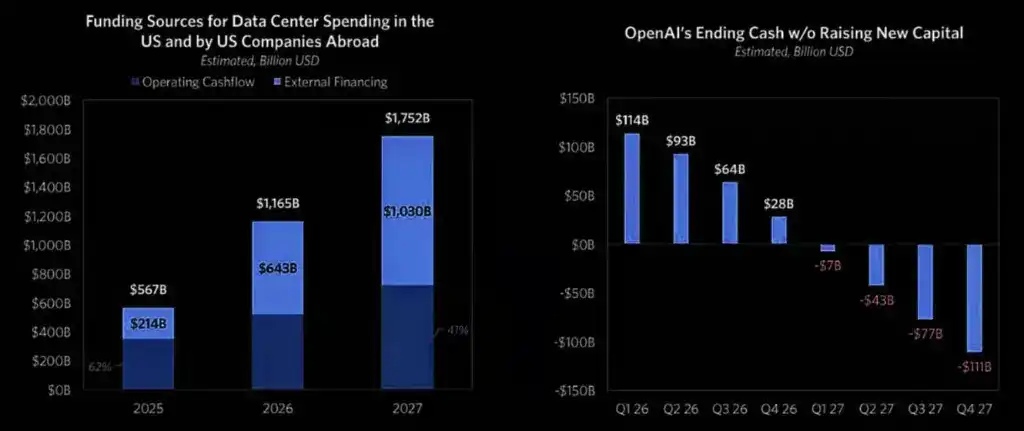
Morgan Stanley predicts that total spending on AI infrastructure construction will reach $3.2 trillion by 2028, with approximately $1.75 trillion needing to be raised through the credit markets. Funding sources have expanded from traditional investment-grade bonds to leveraged loans, private credit, and securitized products. Money is available, but it won't be cheap.

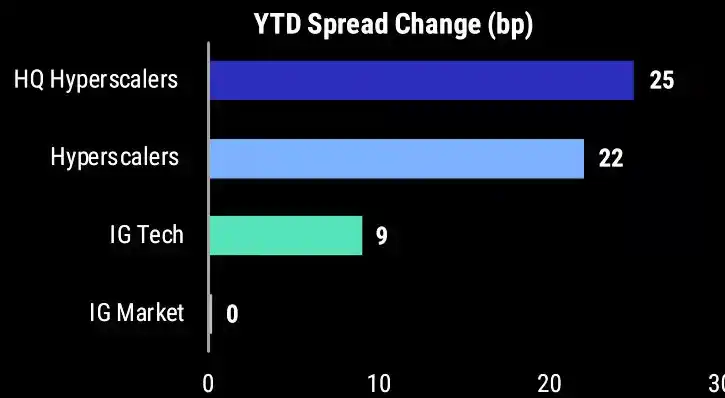
The bond market has already started to react. Apollo data shows that AI-related bond issuance now accounts for 40% of long-duration supply. Credit spreads for hyperscale cloud providers (Hyperscalers) have widened significantly this year, while the overall investment-grade market has remained virtually unchanged.

The "new bond king" Gundlach was even more direct, stating that issuing long-term bonds backed by GPUs is akin to "making a 30-year ABS out of bananas."
Cash Flow is Moving in the Wrong Direction

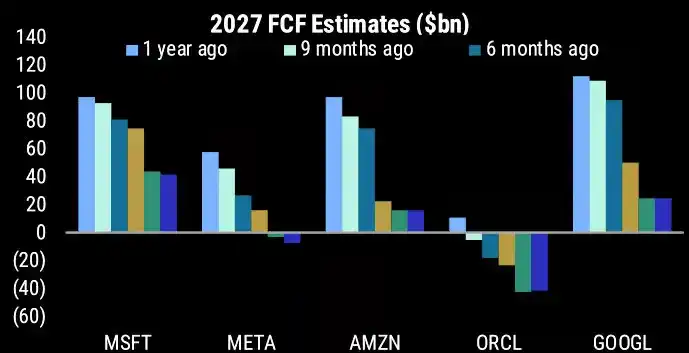
Capital expenditure forecasts are repeatedly revised upwards, while free cash flow forecasts continue to slide.

Morgan Stanley has significantly lowered its free cash flow forecasts for major hyperscale cloud providers for 2027. Oracle's situation is the most prominent, with its 2027 free cash flow forecast now approaching -$40 billion.
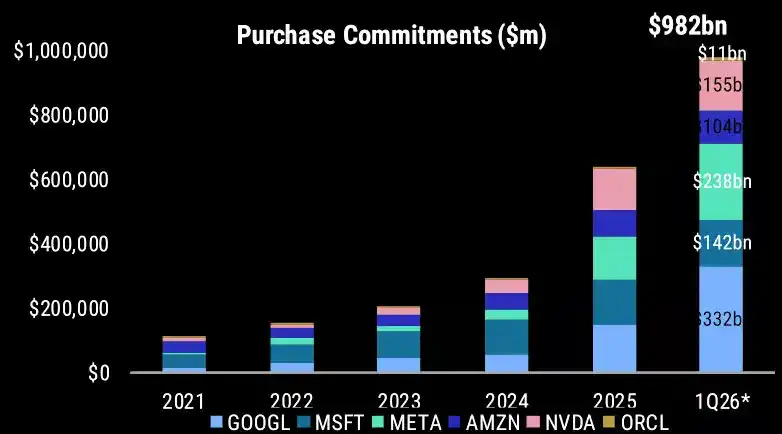
The scale of spending commitments is equally staggering. Purchase commitments from hyperscalers have exploded to $982 billion. Morgan Stanley points out that a significant portion of the real capital expenditure now exists off-balance-sheet. This means that looking only at the balance sheet severely underestimates the actual funding pressure.
Credit Markets Have Begun Pricing Risk

Investors are demanding higher compensation for risk.

Morgan Stanley data shows that credit spreads for hyperscale cloud providers have "widened significantly this year, far exceeding the overall investment-grade market"—spreads for high-quality hyperscalers (HQ Hyperscalers) widened by about 25 basis points, regular hyperscalers widened by about 22 basis points, while the overall investment-grade market spread changed by 0.
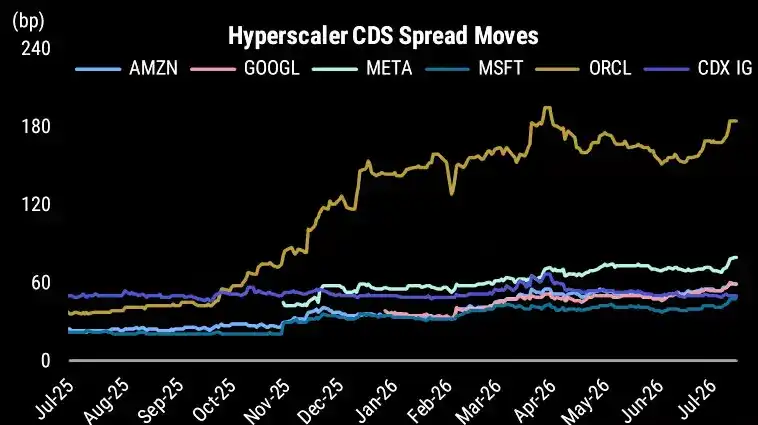
Oracle is the most watched case among them. While other hyperscalers' credit default swaps (CDS) generally trade in the 30 to 80 basis points range, Oracle's CDS surged from around 40 basis points in mid-2025 to a peak near 190 basis points in April 2026, and currently hovers around 180 basis points. Meta's CDS has risen more modestly to about 75 basis points. The credit market has clearly singled out the company it is most concerned about.
Balance Sheets are Strong, But the Problem Lies Ahead

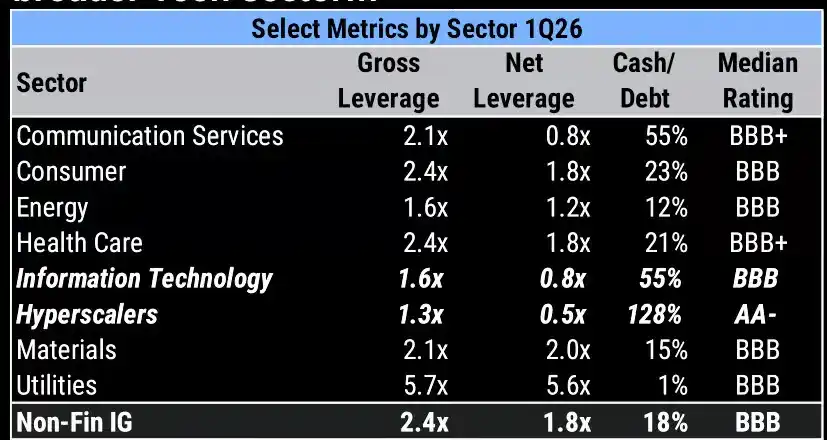
Morgan Stanley's Q1 2026 data shows that hyperscalers' total leverage ratio is only 1.3x, net leverage is 0.5x, the cash-to-debt ratio is as high as 128%, and the median credit rating is AA-. In contrast, the overall non-financial investment-grade universe has a total leverage ratio of 2.4x and a rating of BBB.

But the problem lies ahead. Morgan Stanley has sharply raised its forecast for cloud computing capital expenditure growth in 2027 from 14% to 29%, while hyperscalers are "reaffirming confidence in investment returns." As spending forecasts double, the financing gap widens accordingly.
"New Bond King" Gundlach: Using GPUs as Collateral is Like Using Bananas for ABS

Regarding financing schemes emerging in the market that use AI assets as collateral, renowned bond market investor Jeff Gundlach offered sharp criticism.

He warned about a planned $50 billion fund consortium, stating the plan is "likely not to stand the test of time." He asked on social media: "Using assets with unknown life spans as collateral for long-term debt? Why not do a 30-year ABS trade backed by bananas in a warehouse?" He added, these are "brand new engineered bananas with unknown life spans."

Gundlach's analogy gets to the core issue: GPUs depreciate extremely quickly, with technology refresh cycles far shorter than the tenure of the debt. When using such assets as collateral for long-term financing, the actual value of the collateral is highly uncertain.


Criptos en tendencia

Preguntas relacionadas

QWhat is the main shift in the narrative of AI investment according to the article?

AThe narrative is shifting from being a technology story to a capital expenditure story, and is now becoming a financing story.

QWhat is the significant warning that Jeff Gundlach gives about using AI assets as collateral?

AJeff Gundlach warns that using assets like GPUs as collateral for long-term debt is akin to using bananas for a 30-year ABS, highlighting the risk due to their fast depreciation and short technological lifecycle compared to the debt tenure.

QWhat do the widening credit spreads for Hyperscalers indicate, according to the article?

AThe widening credit spreads for Hyperscalers indicate that investors are demanding higher risk compensation, signaling growing market concern about their future financial health amidst heavy AI infrastructure spending.

QWhich company's financial situation is highlighted as particularly concerning in the credit markets?

AOracle's financial situation is highlighted as particularly concerning. Its Credit Default Swap (CDS) spreads surged dramatically to around 190 basis points, far exceeding those of other Hyperscalers, and its 2027 free cash flow forecast is deep in negative territory.

QAccording to Morgan Stanley, what is the estimated total spending on AI infrastructure by 2028 and the financing need?

AMorgan Stanley predicts total AI infrastructure spending will reach $3.2 trillion by 2028, with approximately $1.75 trillion of that needing to be raised through credit markets.

Lecturas Relacionadas

¿La influencia de la recompra de bonos del Tesoro estadounidense solo dura 24 horas? Bassant: Tenemos muchas herramientas, esperen y verán

El Secretario del Tesoro de EE.UU., Besant, respondió a la volatilidad del mercado tras el anuncio del Departamento del Tesoro de duplicar las operaciones de recompra de bonos a largo plazo, señalando que el impacto inicial solo duró menos de 24 horas y describiéndolo como "ruido". Destacó que el Tesoro tiene un amplio conjunto de herramientas a su disposición y no descarta futuras intervenciones, con compras que podrían superar los 4.000 millones de dólares por operación. Besant afirmó que los rendimientos actuales de los bonos no reflejan los fundamentos económicos de EE.UU., especialmente en el bono a 30 años, cuya liquidez es muy escasa. Además, reiteró la política de dólar fuerte. Anunció un próximo plan de consolidación fiscal, que podría revelarse a finales de esta semana o principios de la próxima, dirigido a abordar los altos costes de endeudamiento a largo plazo. En cuanto a la deuda corporativa, señaló que las inversiones en IA están haciendo que las empresas sean casi insensibles a los rendimientos al emitir bonos, lo que en su opinión impulsará el crecimiento de la productividad. Sobre Irán, Besant anunció una conferencia de prensa para el próximo lunes para detallar las medidas de presión económica de EE.UU., argumentando que una presión económica máxima podría evitar un conflicto militar a gran escala. Expresó desconcierto por el reciente aumento de los precios del petróleo, pero afirmó que las acciones de EE.UU. contribuirán a su descenso.

marsbitHace 30 min(s)

¿La influencia de la recompra de bonos del Tesoro estadounidense solo dura 24 horas? Bassant: Tenemos muchas herramientas, esperen y verán

marsbitHace 30 min(s)

Trading

Spot

Artículos destacados

Cómo comprar FLOW

¡Bienvenido a HTX.com! Hemos hecho que comprar Flow (FLOW) sea simple y conveniente. Sigue nuestra guía paso a paso para iniciar tu viaje de criptos.Paso 1: crea tu cuenta HTXUtiliza tu correo electrónico o número de teléfono para registrarte y obtener una cuenta gratuita en HTX. Experimenta un proceso de registro sin complicaciones y desbloquea todas las funciones.Obtener mi cuentaPaso 2: ve a Comprar cripto y elige tu método de pagoTarjeta de crédito/débito: usa tu Visa o Mastercard para comprar Flow (FLOW) al instante.Saldo: utiliza fondos del saldo de tu cuenta HTX para tradear sin problemas.Terceros: hemos agregado métodos de pago populares como Google Pay y Apple Pay para mejorar la comodidad.P2P: tradear directamente con otros usuarios en HTX.Over-the-Counter (OTC): ofrecemos servicios personalizados y tipos de cambio competitivos para los traders.Paso 3: guarda tu Flow (FLOW)Después de comprar tu Flow (FLOW), guárdalo en tu cuenta HTX. Alternativamente, puedes enviarlo a otro lugar mediante transferencia blockchain o utilizarlo para tradear otras criptomonedas.Paso 4: tradear Flow (FLOW)Tradear fácilmente con Flow (FLOW) en HTX's mercado spot. Simplemente accede a tu cuenta, selecciona tu par de trading, ejecuta tus trades y monitorea en tiempo real. Ofrecemos una experiencia fácil de usar tanto para principiantes como para traders experimentados.

528 Vistas totalesPublicado en 2024.12.10Actualizado en 2026.06.02

Cómo comprar FLOW

Discusiones

Bienvenido a la comunidad de HTX. Aquí puedes mantenerte informado sobre los últimos desarrollos de la plataforma y acceder a análisis profesionales del mercado. A continuación se presentan las opiniones de los usuarios sobre el precio de FLOW (FLOW).

活动图片