In this round of the U.S. technology stock rebound, one of the strongest trends comes from NeoCloud: CoreWeave, Nebius, and some AI infrastructure companies possessing power and data center resources.
Logically, capital is pricing an AI infrastructure equity instrument with multiple layers of leverage: computing power capacity that is already contractually locked in and can be delivered rapidly.
If AI demand is revised upward, NeoCloud's revenue expectations, financing capabilities, and shareholder equity value may all shift upward simultaneously. This gives it strong upside elasticity during the tech stock rebound phase; the elasticity of power, data centers, financing, and valuation collectively constitutes this layer of leverage.
The bottleneck for AI is shifting. In the early stages, the most critical shortage was GPUs, followed by HBM and high-speed networking. Now, what customers truly lack is a complete set of deployable capabilities: acquiring GPUs, securing sufficient power, completing data center construction, network interconnection, and delivering clusters at scale within a few months.
NeoCloud is positioned precisely at this gap.
Capital is Buying "Already Powered Compute Factories"
NeoCloud's offerings typically include GPU clusters, networking, liquid cooling, data centers, power connectivity, and operational services. Customers are buying a block of large-scale compute capacity that can directly run AI training and inference workloads.
This point is crucial. GPUs can be procured, but power capacity, land, substations, data center permits, and network connectivity cannot be replicated in the short term. While large cloud providers have capital and customers, they are also constrained by construction cycles. Some AI companies seek greater flexibility and are reluctant to concentrate all their demand with a single hyperscaler.
Therefore, NeoCloud firms with readily available power and rapid deployment capabilities have become "accelerators" for AI infrastructure investment.
The market is willing to assign them higher valuations, primarily because such resources have two characteristics:
· Scarcity: Available power and deliverable data center capacity are limited.
· Contractable: Customers are willing to sign multi-year capacity contracts with minimum commitments.
When scarce resources can be locked in with long-term contracts, the market reinterprets them from ordinary IT service revenue into cash-flow assets with infrastructure-like characteristics.
Earnings Reports Changed the Market's View of the Business Model
Previously, the market's primary question for NeoCloud was direct: Buying GPUs and building data centers require massive Capex. Would these companies fall into a cycle of "continuous financing, continuous cash burn"?
Recent earnings reports have provided a more positive answer.
CoreWeave's Q2 revenue reached $2.575 billion, disclosing a backlog (contracted but not yet recognized expected revenue) of approximately $104 billion. Nebius's AI Cloud ARR (Annualized Recurring Revenue) reached $3 billion, disclosing multiple large, long-term contracts. The market focuses on quarterly revenue but pays even more attention to the complete commercial loop emerging from these numbers:
AI clients sign long-term capacity contracts
→ Some clients provide upfront payments or minimum payment commitments
→ Companies find it easier to obtain debt and equipment financing
→ New GPU, data center, and power capacity come online
→ Revenue and EBITDA (Earnings Before Interest, Taxes, Depreciation, and Amortization) grow
→ Financing capacity and expansion ability continue to increase
This shifts NeoCloud's narrative from "high-Capex GPU lessor" progressively towards "AI infrastructure operator supported by orders for expansion."
As long as orders, financing, and delivery can sustainably connect, growth exhibits a clear flywheel effect.
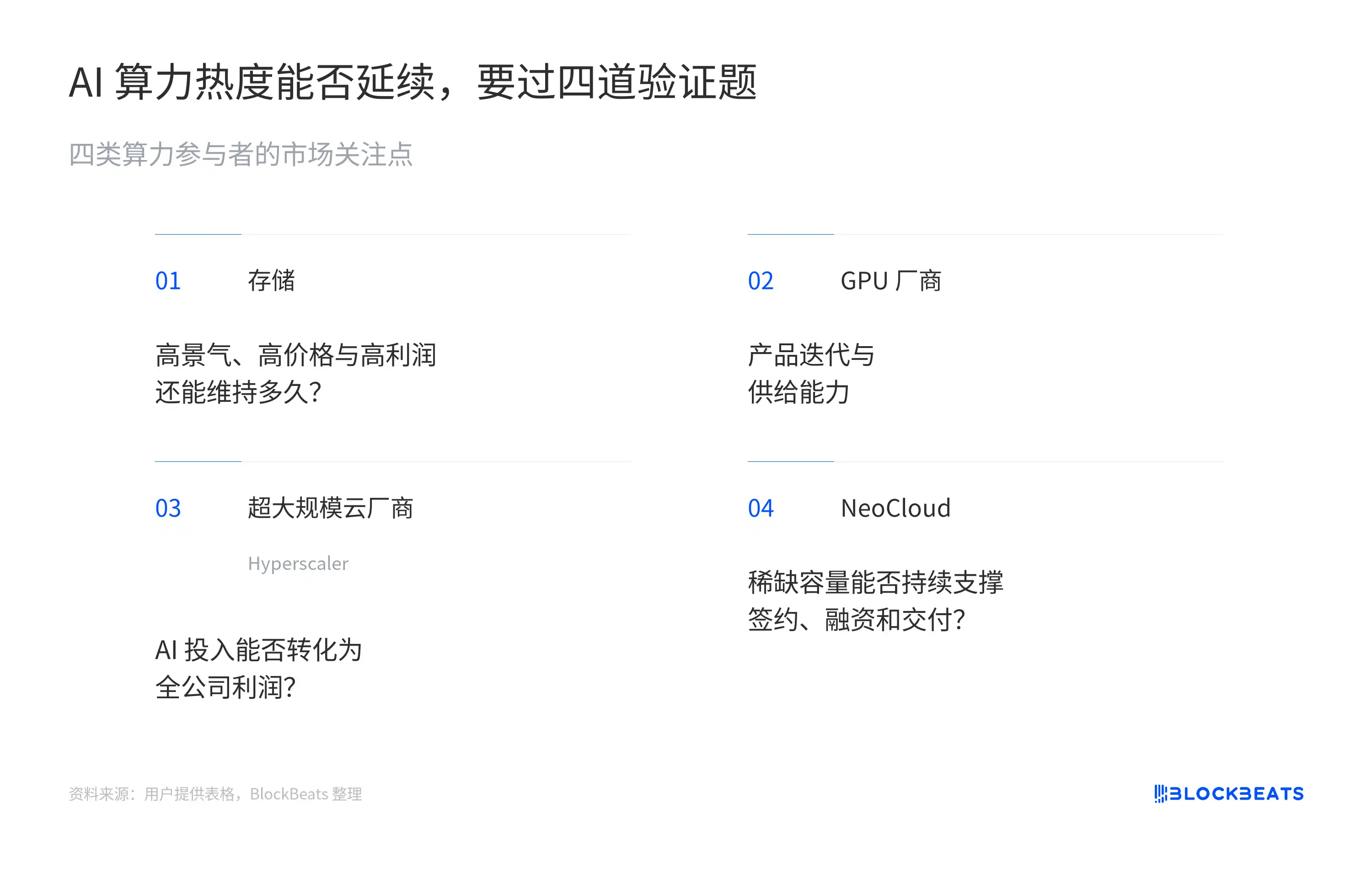
Why Didn't Capital Prioritize Memory and the Big Three Clouds?
Capital's choice reflects the variation in expectations across different segments.
Memory leaders benefit from AI demand, and the outlook for products like HBM and DRAM remains strong. However, the market has already begun to worry about supply ramp-ups, peak prices, margin ceilings, and whether earlier optimistic expectations are fully reflected in stock prices. Strong earnings reports, if not accompanied by upward revisions to future guidance, can easily pressure stock prices.
The challenge for memory companies lies in their cyclical nature. The market trades based on the future path of prices, shipment volumes, and gross margins over the next few quarters. When supply might catch up with demand and average selling prices may decline, strong current earnings find it hard to persistently drive valuation expansion. HBM/DRAM, NAND/SSD, and HDD also belong to different sub-cycles, so the performance of all memory company stocks cannot be attributed to the same single reason.
The Big Three Clouds—Microsoft Azure, Amazon AWS, and Google Cloud—have more robust cash flows, customers, and technical capabilities and are also core beneficiaries of AI investment. Their AI business is diluted by massive revenue bases from advertising, enterprise software, e-commerce, and consumer businesses; the impact of new AI capital expenditures also takes longer to manifest as margin improvements for the entire group. For capital seeking elasticity, a major NeoCloud contract's marginal impact on revenue and valuation is often greater than that of a similarly sized order on the overall valuation of the Big Three Clouds.
NeoCloud sits between these two: lower revenue base, pure AI exposure, fast order growth, and each new large long-term contract can directly support the next round of financing and expansion. Capital easily views it as a high-elasticity AI infrastructure play.
The logic currently traded by the market can be summarized as:
NeoCloud is Essentially a Form of AI Infrastructure Leverage
Understanding NeoCloud's leading gains lies in understanding its leverage effect. Buying shares in these companies is essentially holding an equity asset highly sensitive to AI compute demand, deliverable capacity pricing, and the financing environment. This leverage has three layers of meaning.
The first is operating leverage. Upfront investments in GPUs, data centers, power connectivity, networking, and operations are high, and many costs are relatively fixed once capacity is online. As utilization of active clusters rises and unit capacity pricing improves, incremental revenue can convert into profits relatively quickly, and marginal improvement in profit margins can be significant.
The second is financing leverage. Long-term contracts, non-recourse "take-or-pay" commitments, and customer prepayments enhance the project's attractiveness to lenders and equipment financiers. Companies can thus leverage equity capital to finance larger-scale investments in GPUs, facilities, and power; once new capacity begins billing, revenue can support the next construction cycle.
The third is equity leverage. NeoCloud companies typically have smaller revenue bases and market capitalizations than the Big Three Clouds but have a higher proportion of fixed assets and debt on their balance sheets. If a major contract simultaneously lifts revenue expectations, utilization, and financing accessibility, the market's reassessment of shareholder equity value can be very steep. The rapid post-earnings stock price appreciation often comes from a combination of upward revisions to profit expectations and valuation multiples.
These three layers of leverage create a positive feedback loop in the uptrend:
Larger long-term contracts
→ Easier access to financing and capacity expansion
→ Higher utilization and operating profits
→ Improved equity value and financing ability
→ Securing more contracts and the next expansion opportunity
The same mechanism also magnifies downside risks. If customers delay, utilization falls, GPU or power delivery lags, or debt costs rise, fixed costs and financing obligations can compress shareholder returns. Therefore, the high elasticity priced into NeoCloud by the market also reflects the high execution demands placed on it.
Order Visibility is the Core of This Re-rating
The most attractive aspect of NeoCloud is the visibility of its revenue.
If customers sign non-recourse take-or-pay contracts, even if actual usage fluctuates short-term, customers remain obligated to make certain minimum payments. For operators, this type of revenue is more predictable; for creditors, these contracts also improve the feasibility of asset-based financing.
Therefore, the market will continuously track several metrics:
· Duration, enforceability, and customer creditworthiness of signed contracts;
· Gap between activated MW (Megawatts) and committed MW;
· Revenue per MW and Capex per MW;
· Proportion and payment schedule of customer prepayments;
· Utilization rate, renewal rate, and customer concentration;
· Debt interest rates, debt maturity, and follow-on financing capacity.
Among these, "Activated Capacity" is particularly crucial. Committed MW represents demand; only MW that are powered, equipped, and begin billing enter revenue and cash flow.
This is Also a Re-rating of Power Assets
The most valuable insight from the community regarding NeoCloud shifts the focus from GPU counts to Power (power capacity).
GPU supply will expand with procurement by NVIDIA, AMD, and cloud providers; the formation of high-quality power capacity is slower. It involves the power grid, substations, land, permits, data center construction, and regional network conditions.
Whoever secures sufficient power earlier can convert GPUs into salable compute power sooner.
This is also why some companies transitioning from Bitcoin mining can enter this theme: they already possess some power resources, land, and infrastructure, needing only to shift assets from mining loads to AI loads. Of course, a resource base does not guarantee commercial success; it ultimately still depends on customer acquisition, financing, and delivery capabilities.
NeoCloud's leading gains in the tech stock rebound reflect a market reordering of the AI infrastructure value chain.
The asset currently most valued by capital is computing capacity that can combine GPUs, power, data centers, and long-term customer contracts and deliver rapidly. It captures AI capital expenditure while possessing more contractible characteristics than pure chips and components; it offers both high growth elasticity and a premium for infrastructure scarcity.
Going forward, whether NeoCloud can continue to outperform depends on a straightforward question: Can these massive orders be transformed on time into powered clusters, recognized revenue, and cash flow covering the cost of capital?