Home Furnishing Listed Companies Are Trying to Turn Around with AI and Semiconductors

marsbitPublicado a 2026-08-06Actualizado a 2026-08-06

Resumen

Chinese home furnishing listed companies are increasingly turning to AI and semiconductor cross-border ventures to revive their fortunes amid declining core businesses. A prominent example is PVC flooring giant **Elegant Home Furnishing**, whose stock price skyrocketed with 10 consecutive trading limits after announcing a plan to acquire a majority stake in **Ou Kang Nuo**, a semiconductor storage testing equipment and services company. Despite Elegant Home's own financial struggles—including recent losses and tight cash flow—the acquisition, funded through asset sales and loans, has dramatically boosted its market value. The deal involves a cross-shareholding structure with Ou Kang Nuo's controlling shareholder. This trend is widespread. Over the past year, numerous home furnishing firms with stagnant main operations have seen their stock prices surge after announcing moves into hot sectors like AI, semiconductors, or computing power. Key cases include: * **Markor Home Furnishings** ("high-end home furnishing first share"), after years of heavy losses, acquired an AI server high-speed copper cable company and later introduced AI computing power investors. * **Zhenai Meijia** ("blanket king") became the first A-listed manufacturer controlled by an AI large model company following a takeover. * **Fasilon** (integrated ceiling) saw its stock soar after establishing an AI subsidiary. * **Jinlong Decoration** experienced multiple trading limits after being linked to "c...

Another home furnishing listed company's stock price has skyrocketed due to a cross-border venture into semiconductors.

On August 6, PVC flooring giant Elysium Home Furnishings resumed trading with another daily limit-up, marking its 10th consecutive daily limit-up. Wind data shows that from July 21 to August 6, the company's stock price has surged by 159.31% cumulatively.

This struggling flooring company achieved a turnaround solely through a cross-border capital operation.

On the evening of July 20, Elysium Home Furnishings announced that it had signed an "Equity Acquisition Intent Agreement" with shareholders Zhao Ming, Tong Shujuan, Anhui Mingde Zhonghe, and Anhui Zhonghe of OCONOR, intending to acquire no less than 77.08% of OCONOR's equity with cash and make it a controlling subsidiary.

OCONOR is mainly engaged in storage testing equipment and related testing services. Its product series include GA300, SW400, MS200, and ES100, covering test scenarios such as SSD modules, DDR modules, storage chips, and embedded memory. It boasts a complete solution centered on system-level testing (SLT) while also providing professional testing services.
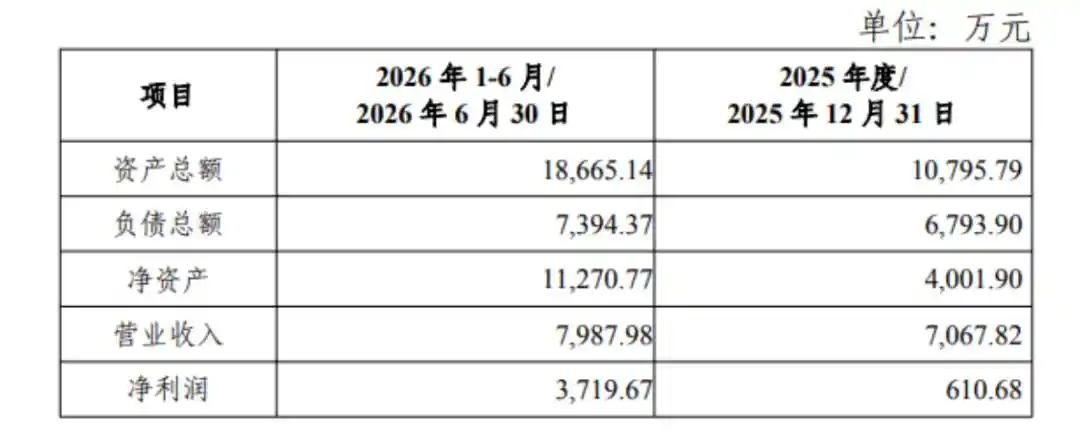
OCONOR Financial Data | Screenshot from the Announcement

This acquisition involves many clever transaction details: Elysium Home Furnishings acquires OCONOR, while OCONOR's actual controller Zhao Ming simultaneously acquires 20% of Elysium Home Furnishings' shares. You buy me, I buy you, a two-way binding. Additionally, OCONOR has made a performance commitment: cumulative non-GAAP net profit over four years shall be no less than 230 million yuan.

The key question is: where does Elysium Home Furnishings' acquisition funding come from?

The announcement shows that the acquisition funds will come from the company's own funds and self-raised funds through methods such as disposing of idle assets (valued at approximately 200 million to 300 million yuan), bank loans, and loans from major shareholders.

Currently, Elysium Home Furnishings does not have much cash on its books.

According to its Q1 2026 report, Elysium Home Furnishings had only 259 million yuan in cash and cash equivalents on its books, while short-term interest-bearing debt reached 277 million yuan. The acquisition requires 500 million yuan.

The reason for the limited cash on hand is that Elysium Home Furnishings' "flooring business" has long been in the red.

In 2025, the company's revenue and net profit attributable to shareholders both declined, with net profit attributable to shareholders plummeting 87.6% year-on-year to 17.17 million yuan. Entering 2026, losses continued to widen, with a loss of 14.82 million yuan in Q1 and a projected loss for the first half of the year increasing to 34.5 million to 40.5 million yuan.
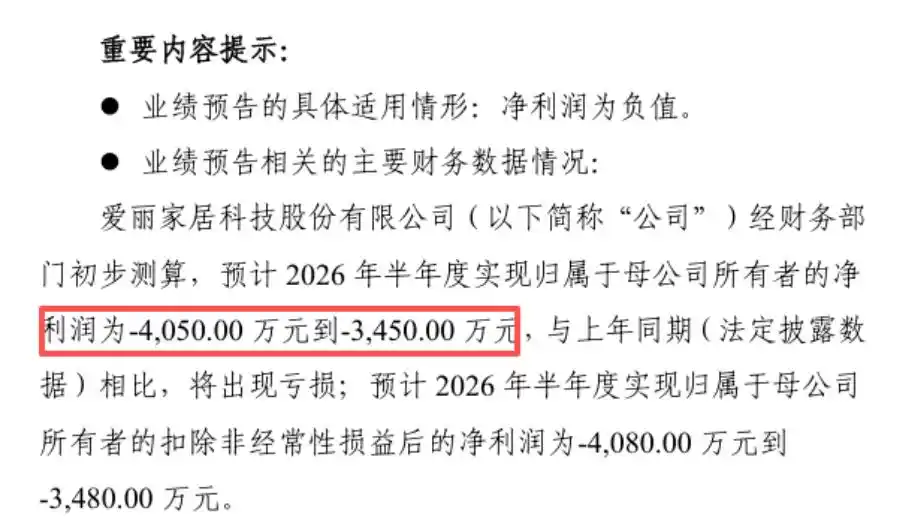
Image Source: Elysium Home Furnishings Announcement

However, Elysium Home Furnishings did not persist in returning to its core business. Instead, it set its sights on cross-border mergers and acquisitions, which have yielded positive effects so far—its stock price has soared, with nine consecutive daily limit-ups, and its market capitalization skyrocketed from 2.3 billion to 5.46 billion yuan. As of the close on August 6, its total market capitalization had increased to 6 billion yuan.

Elysium Home Furnishings is not an isolated case.

Over the past year or more, home furnishing listed companies have collectively staged a drama of "cross-border survival." The script is almost identical: sluggish growth in the core business leads to targeting AI, semiconductor, or computing power concepts. Once announced, stock prices soar.

Once the "first stock in high-end home furnishings," Markor Home Furnishings, accumulated losses exceeding 3.7 billion yuan over four years. At the end of 2025, the company announced the acquisition of 100% equity in AI server high-speed copper cable company Wandetai Optoelectronics. After resuming trading, its stock price surged continuously. Subsequently, it also introduced AI computing power industry investors to participate in its restructuring.

The Yiwu "Blanket King," Zhenai Meijia, saw AI unicorn Tanji Technology acquire 44.99% of its shares through "agreement transfer + tender offer" for approximately 1.8 billion yuan in Q4 2025, making it the first A-share manufacturing company controlled by an AI large model company. Its stock price immediately hit consecutive daily limit-ups.

Integrated ceiling giant Fasilon announced in September 2025 that it would invest 250 million yuan to establish an AI subsidiary, leading to eight consecutive daily gains and a rise of over 380% within a year. The company, with only 900 million yuan in assets, supported a market capitalization of nearly 9 billion yuan.

Home decoration leader Gold Mantis, after associating itself with "commercial aerospace" and "AI computing power," secured 11 daily limit-ups in 15 trading days, with a cumulative increase of 136.8%. However, the company clarified that the related business accounts for less than 1% of its total.

Preliminary statistics show that in 2025, over 20 A-share listed companies announced cross-border ventures into the semiconductor sector, with home furnishing and building materials companies accounting for the highest proportion. The downturn in the real estate industry, stagnation in core business growth, and continuous profit shrinkage have forced these companies to flock to popular sectors, attempting to turn around with trending concepts.

The ultimate outcome of countless cross-border speculation cases is consistent: the concept fades, the bubble bursts, and the stock price returns to fundamentals. For example, Gold Mantis' stock price quickly retreated after market sentiment cooled. As of the close on August 6, its stock price had been halved from its peak.

This is also the case with Elysium Home Furnishings this time. A letter of intent for acquisition that has not yet led to a formal agreement; the company has repeatedly issued announcements warning that "the formal agreement has not been signed and there is uncertainty." How can fundamentals showing a half-year loss exceeding 40 million yuan support a market capitalization of 6 billion yuan?

Home furnishing companies continue to cross borders and ride hype waves, more out of helpless survival tactics amid slowing core business.

The downturn in real estate, shrinking overseas demand, and tariff impacts have continuously lowered the ceiling for traditional home furnishing manufacturing. Rather than competing fiercely in a red ocean, it seems better to embrace a cutting-edge concept, let the stock price rise, and allow major shareholders to find more possibilities within it.

However, after the狂欢狂欢 (carnival), someone always has to be left behind.

Note: Article materials sourced from official reports and public information; views are for reference only. | Some images sourced from the internet; please inform for deletion if there is any infringement.

This article is from the WeChat public account "Yuan Mei Hui," author: Xie Chunsheng

Criptos en tendencia

Preguntas relacionadas

QWhat caused Aili Home Furnishing's stock price to soar by nearly 160% in recent weeks?

AAili Home Furnishing's stock price skyrocketed due to its announcement of a cross-border acquisition plan to purchase a majority stake (over 77.08%) in Oukangnuo, a company specializing in semiconductor storage testing equipment and services.

QHow does the financial performance of Aili Home Furnishing's core business compare to its recent market valuation surge?

AThe core business (PVC flooring) of Aili Home Furnishing is performing poorly, with significant profit declines in 2025 and an expanding net loss forecast for the first half of 2026. This weak fundamental performance sharply contrasts with its soaring market valuation, which increased from 2.3 billion to 6 billion RMB following the acquisition news.

QWhat is a common strategy among home furnishing listed companies in China to revitalize their business and stock performance, as illustrated in the article?

AA common strategy is cross-border M&A or investment into hot technology sectors like AI, semiconductors, and computing power. When companies announce such moves, their stock prices often surge significantly, even if their core businesses are struggling.

QBeyond Aili Home Furnishing, name two other home furnishing companies mentioned that used cross-sector moves related to AI or tech to boost their market performance.

ATwo other examples are: 1) Markor Furnishings (美克家居), which acquired an AI server high-speed copper cable company and introduced AI computing power investors. 2) Faslong (法狮龙), which established an AI subsidiary, leading to a stock price increase of over 380% within a year.

QWhat does the article suggest is the primary driver behind this trend of home furnishing companies pursuing cross-border acquisitions in tech sectors?

AThe primary driver is the struggle and stagnation of their core home furnishing businesses, exacerbated by the downturn in the real estate sector, shrinking overseas demand, and tariff impacts. Facing a limited ceiling in their traditional industry, they turn to hot tech concepts as a means to seek survival and boost stock prices.

Lecturas Relacionadas

Grayscale: 'Si se aceptan estas propuestas, el precio de estos dos altcoins podría subir'

El jefe de investigación de Grayscale, Zack Pandl, señaló que si se implementan los cambios en la tokenómica discutidos en las comunidades de Ethereum ($ETH) y Solana ($SOL), la tasa de crecimiento de la oferta de ambos activos podría ralentizarse significativamente, lo que podría tener un impacto positivo en sus precios. Según Pandl, las modificaciones propuestas en los ecosistemas de Ethereum y Solana buscan reducir la tasa de inflación anual de los tokens $ETH y $SOL. En igualdad de condiciones, una desaceleración en el crecimiento de la oferta podría disminuir la cantidad de nuevos tokens que ingresan al mercado, aumentando la escasez de los activos existentes. Grayscale estima que, si se aplican estas reglas, la inflación anual de la oferta de Ethereum podría caer a aproximadamente un 0,4 % para fines de 2031, cifra cercana a la tasa de crecimiento de Bitcoin. Se proyecta que la inflación anual de Solana se reduciría a alrededor de un 1,1 %. En comparación, el aumento anual de la oferta de oro es de aproximadamente un 1,8 % y la inflación del IPC en EE.UU. ronda el 3,3 %. Los cambios propuestos aún se están debatiendo y no han sido aprobados definitivamente. Pandl indicó que las propuestas para Solana parecen tener una aceptación más amplia y, por tanto, una mayor probabilidad de implementación. No obstante, una menor inflación de tokens también podría reducir las recompensas para los inversores que realizan staking, ya que una parte importante de sus ingresos proviene de la emisión de nuevos tokens. Pandl destacó que la ralentización del crecimiento de la oferta podría aumentar la escasez, ejerciendo presión al alza sobre los precios de $ETH y $SOL, beneficiando especialmente a los inversores que poseen los tokens sin hacer staking. *Esto no es una recomendación de inversión.

cryptonews.ruHace 4 hora(s)

Grayscale: 'Si se aceptan estas propuestas, el precio de estos dos altcoins podría subir'

cryptonews.ruHace 4 hora(s)

Trading

Spot

Artículos destacados

Cómo comprar HOME

¡Bienvenido a HTX.com! Hemos hecho que comprar Defi.app (HOME) sea simple y conveniente. Sigue nuestra guía paso a paso para iniciar tu viaje de criptos.Paso 1: crea tu cuenta HTXUtiliza tu correo electrónico o número de teléfono para registrarte y obtener una cuenta gratuita en HTX. Experimenta un proceso de registro sin complicaciones y desbloquea todas las funciones.Obtener mi cuentaPaso 2: ve a Comprar cripto y elige tu método de pagoTarjeta de crédito/débito: usa tu Visa o Mastercard para comprar Defi.app (HOME) al instante.Saldo: utiliza fondos del saldo de tu cuenta HTX para tradear sin problemas.Terceros: hemos agregado métodos de pago populares como Google Pay y Apple Pay para mejorar la comodidad.P2P: tradear directamente con otros usuarios en HTX.Over-the-Counter (OTC): ofrecemos servicios personalizados y tipos de cambio competitivos para los traders.Paso 3: guarda tu Defi.app (HOME)Después de comprar tu Defi.app (HOME), guárdalo en tu cuenta HTX. Alternativamente, puedes enviarlo a otro lugar mediante transferencia blockchain o utilizarlo para tradear otras criptomonedas.Paso 4: tradear Defi.app (HOME)Tradear fácilmente con Defi.app (HOME) en HTX's mercado spot. Simplemente accede a tu cuenta, selecciona tu par de trading, ejecuta tus trades y monitorea en tiempo real. Ofrecemos una experiencia fácil de usar tanto para principiantes como para traders experimentados.

614 Vistas totalesPublicado en 2025.06.10Actualizado en 2026.06.10

Cómo comprar HOME

Discusiones

Bienvenido a la comunidad de HTX. Aquí puedes mantenerte informado sobre los últimos desarrollos de la plataforma y acceder a análisis profesionales del mercado. A continuación se presentan las opiniones de los usuarios sobre el precio de HOME (HOME).

活动图片