What’s next as GENIUS Act misses first major rulemaking deadline?

ambcryptoPublicado a 2026-07-18Actualizado a 2026-07-18

Resumen

The GENIUS Act, the U.S. stablecoin framework passed in July 2027, has missed its first major rulemaking deadline. Regulators, including the Federal Reserve, were required to finalize rules by July 18, 2027, but none of the 10 related proposals have been officially completed. Six are past the comment period, while four remain open. Federal Reserve Chairman Kevin Warsh indicated final rules could be issued imminently. The banking industry has expressed concerns about the legislation creating an uneven playing field. Despite the regulatory delay, the stablecoin market has responded positively, with total supply growing from $250 billion to over $300 billion since the law's passage, and firms like Fidelity launching new offerings. Senator Bill Hagerty, a co-sponsor, hailed the act as a "watershed moment" for U.S. leadership in digital assets.

The U.S. stablecoin framework, the GENIUS Act, has hit the initial deadline of the 18th of July. Passed into law on the 18th of July 2027, the framework set multiple milestones for its progressive enactment.

For the first year after passage, regulators, including the Federal Reserve and the OCC, were mandated to finalize rulemakings for the GENIUS Act by the 18th of July, 2027.

In 18 months, or by January 2027, the framework should begin taking effect after the regulators publish final rules.

Finally, the transition period will end after three years, by mid-2028. After this, there will be no firm allowed to offer or handle stablecoins in the U.S. without GENIUS Act compliance.

Why are the final rules delayed?

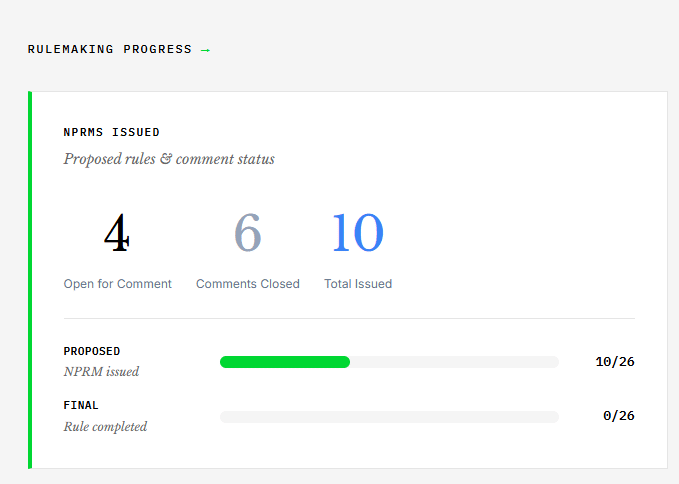
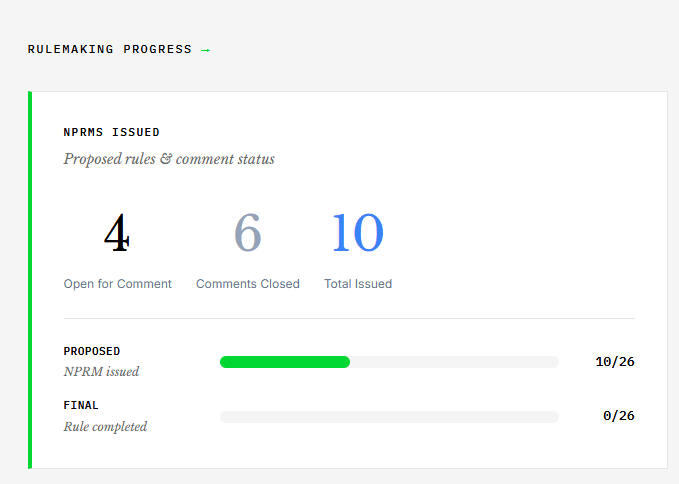
Six regulators have issued 10 rulemaking proposals related to the law. But none of the proposals have been officially completed, at least as of writing. Only six of the proposals have closed their comment period, meaning the regulators could issue final rulings for them.
Source: Paradigm

Still, four other proposals, including Bank Secrecy Act and sanction compliance for FDIC-supervised stablecoin issuers, are still open for comment.

In other words, despite hitting the rulemaking deadline, the GENIUS Act was still far from finalizing key rules.

What’s next for the GENIUS Act?

However, it’s worth noting that in a recent Congress hearing, Kevin Warsh, the chairman of the Federal Reserve, said that the final rules could be issued soon.

We’re racing to put that out (GENIUS Act final rules) by this deadline, this Saturday.

For the banking industry, which has opposed the legislation due to the stablecoin yield loophole, it called for a review of the proposed rules to avoid.

Uneven playing field or opportunities for regulatory arbitrage, unintended policy consequences, or unworkable or incongruous requirements.

How has the stablecoin market responded?

The GENIUS Act is the first formal stablecoins framework in the U.S that aims to advance innovation and protect consumers. To achieve this, it has reserve requirements and anti-money laundering provisions.

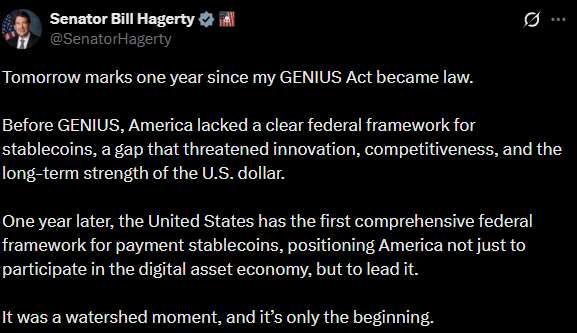
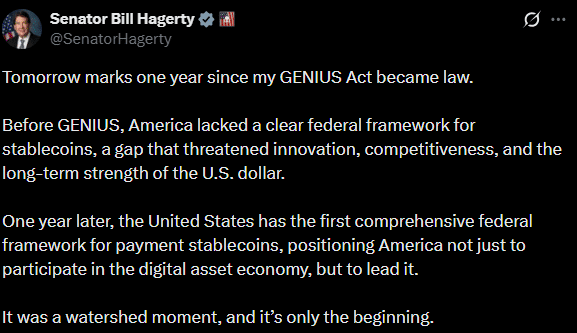
Commenting on the legislation, Senator Bill Hagerty, who co-sponsored it, said,

The United States has the first comprehensive federal framework for payment stablecoins, positioning America not just to participate in the digital asset economy, but to lead it. It was a watershed moment, and it’s only the beginning.
Source: X

Since the law, the stablecoin market supply surged from $250B to over $300B. Even several firms like Fidelity have begun their stablecoin offerings.

Additionally, some crypto platforms like Phantom recorded a 20% increase in stablecoin balance from $2.33B to $2.82B since the GENIUS Act was passed.

It remains to be seen how the growth will accelerate when regulators publish final rules as the legislation enters its second year.


Final SummaryThe

  • GENIUS Act has entered its second year, but final rules will likely stretch beyond the rulemaking deadline
  • Stablecoin market supply increased by over $50B after legislation became law, with Sen. Hagerty calling ‘watershed moment’


Criptos en tendencia

Preguntas relacionadas

QWhat is the first major rulemaking deadline that the GENIUS Act has missed, and who was responsible for meeting it?

AThe first major rulemaking deadline was July 18, 2027. Regulators, including the Federal Reserve and the OCC, were mandated to finalize rules for the GENIUS Act by this date, but none of the proposals have been officially completed.

QAccording to the article, what are two key reasons why the final rules for the GENIUS Act have been delayed?

ATwo reasons for the delay are: 1) Only six out of ten rulemaking proposals have closed their comment period, meaning regulators could only potentially issue final rules for those. 2) Four proposals, including those on Bank Secrecy Act and sanction compliance for FDIC-supervised issuers, are still open for comment.

QWhat specific market impact has the passage of the GENIUS Act had on the stablecoin sector?

ASince the GENIUS Act became law, the stablecoin market supply has surged from $250 billion to over $300 billion, an increase of over $50 billion. Firms like Fidelity have launched stablecoin offerings, and platforms like Phantom saw a 20% increase in stablecoin balances.

QWhat did Federal Reserve Chairman Kevin Warsh recently indicate about the timing of the final rules for the GENIUS Act?

AIn a recent Congress hearing, Federal Reserve Chairman Kevin Warsh said that the final rules could be issued soon, stating, "We're racing to put that out (GENIUS Act final rules) by this deadline, this Saturday."

QWhat is the banking industry's primary concern regarding the GENIUS Act, as mentioned in the article?

AThe banking industry opposes the legislation due to the stablecoin yield loophole. They have called for a review of the proposed rules to avoid an uneven playing field, opportunities for regulatory arbitrage, unintended policy consequences, or unworkable requirements.

Lecturas Relacionadas

S&P Dow Jones se une a Pantera para lanzar un índice cripto, pero excluye a Bitcoin por "no generar ingresos"

**Resumen: S&P y Pantera lanzan índice cripto basado en 'rentabilidad', excluyendo a Bitcoin** S&P Dow Jones Indices, en colaboración con Pantera Capital, ha lanzado el **Índice de Activos Digitales S&P Pantera**. Este nuevo índice introduce un marco de selección basado en los **fundamentos financieros**, inspirado en los criterios del S&P 500. La premisa central es simple: los activos incluidos deben demostrar **rentabilidad sostenida y tangible**. **Criterios de Selección:** Para ser considerado, un protocolo debe haber generado **ingresos positivos por protocolo durante múltiples trimestres consecutivos** (verificados por la firma Artemis), superando un umbral mínimo. Además, estos ingresos deben fluir hacia los tenedores del token a través de mecanismos como recompras, recompensas de staking (ajustadas por inflación) o distribuciones desde una tesorería controlada por la comunidad. **Exclusión Notable: Bitcoin** Bitcoin ha sido **excluido explícitamente** del índice. Pantera argumenta tres razones principales: 1. Bitcoin es un **activo monetario** (como el oro digital), para el cual los inversores institucionales ya tienen vías de exposición específicas (como los ETF). 2. No genera **ingresos por protocolo**, por lo que no cumple el criterio fundamental de "viabilidad financiera". 3. El índice busca diferenciar claramente entre protocolos con modelos de negocio reales y tokens sin fundamentos económicos, evitando mezclar Bitcoin con memecoins. **Componentes del Índice:** El índice incluye inicialmente **18 activos**, seleccionados y ponderados según su capitalización de mercado ajustada por flotación. Los **cinco principales componentes** son: Ethereum (ETH), BNB, Solana (SOL), Tron (TRX) e Hyperliquid (HYPE). Se confirma que Aave también forma parte. Todos los protocolos incluidos reportan colectivamente ingresos anualizados superiores a los **30.000 millones de dólares**. **Contexto y Próximos Pasos:** Este lanzamiento responde a una **brecha de productos** identificada por Pantera para inversores institucionales, que demandan vehículos de inversión que distingan activos por su utilidad y generación de valor. El índice se presenta primero como un **benchmark o referencia**. Pantera ya está en conversaciones con gestoras de activos para desarrollar **ETF u otros productos** basados en este índice, potenciado por su relación con Morgan Stanley. **Discusión en la Comunidad:** La exclusión de Bitcoin ha generado debate. Algunos ven una oportunidad para que las altcoins obtengan mayor exposición institucional por separado. Otros argumentan que esto refuerza la narrativa de Bitcoin como **reserva de valor pura** ("oro digital"), mientras que otros criptoactivos son categorizados como **plataformas tecnológicas o redes de utilidad** generadoras de ingresos.

marsbitHace 14 min(s)

S&P Dow Jones se une a Pantera para lanzar un índice cripto, pero excluye a Bitcoin por "no generar ingresos"

marsbitHace 14 min(s)

Claude presenta una función revolucionaria: Grabar pantalla + voz, destila tu habilidad en un Skill para que trabaje por ti

Anthropic ha presentado una nueva función "Record a Skill" en la versión de escritorio de Claude. Esta herramienta permite a los usuarios grabar su pantalla mientras realizan una tarea y la complementan con una explicación de voz. A continuación, Claude analiza la grabación y la convierte automáticamente en una Skill reutilizable. Actualmente, esta función está disponible para usuarios Pro, Max y Team. La creación de estas Skills ahora se simplifica enormemente: en lugar de redactar manualmente instrucciones complejas en formato Markdown, los usuarios solo necesitan ejecutar y describir su flujo de trabajo. Esto reduce significativamente la barrera de entrada, especialmente para usuarios no técnicos, y captura no solo los pasos visibles, sino también la lógica de decisión y el conocimiento tácito que se comunica verbalmente. Aunque esta innovación se promociona como una herramienta de eficiencia, también plantea implicaciones más profundas. Facilita la externalización y automatización de conocimientos especializados, lo que podría transformar la gestión del conocimiento dentro de las empresas y afectar la naturaleza de ciertos roles laborales. La barrera competitiva podría desplazarse de simplemente "saber hacer" una tarea a poseer habilidades únicas y complejas que sean difíciles de automatizar.

marsbitHace 18 min(s)

Claude presenta una función revolucionaria: Grabar pantalla + voz, destila tu habilidad en un Skill para que trabaje por ti

marsbitHace 18 min(s)

Trading

Spot

Artículos destacados

Cómo comprar GENIUS

¡Bienvenido a HTX.com! Hemos hecho que comprar Genius (GENIUS) sea simple y conveniente. Sigue nuestra guía paso a paso para iniciar tu viaje de criptos.Paso 1: crea tu cuenta HTXUtiliza tu correo electrónico o número de teléfono para registrarte y obtener una cuenta gratuita en HTX. Experimenta un proceso de registro sin complicaciones y desbloquea todas las funciones.Obtener mi cuentaPaso 2: ve a Comprar cripto y elige tu método de pagoTarjeta de crédito/débito: usa tu Visa o Mastercard para comprar Genius (GENIUS) al instante.Saldo: utiliza fondos del saldo de tu cuenta HTX para tradear sin problemas.Terceros: hemos agregado métodos de pago populares como Google Pay y Apple Pay para mejorar la comodidad.P2P: tradear directamente con otros usuarios en HTX.Over-the-Counter (OTC): ofrecemos servicios personalizados y tipos de cambio competitivos para los traders.Paso 3: guarda tu Genius (GENIUS)Después de comprar tu Genius (GENIUS), guárdalo en tu cuenta HTX. Alternativamente, puedes enviarlo a otro lugar mediante transferencia blockchain o utilizarlo para tradear otras criptomonedas.Paso 4: tradear Genius (GENIUS)Tradear fácilmente con Genius (GENIUS) en HTX's mercado spot. Simplemente accede a tu cuenta, selecciona tu par de trading, ejecuta tus trades y monitorea en tiempo real. Ofrecemos una experiencia fácil de usar tanto para principiantes como para traders experimentados.

694 Vistas totalesPublicado en 2026.04.29Actualizado en 2026.06.02

Cómo comprar GENIUS

Discusiones

Bienvenido a la comunidad de HTX. Aquí puedes mantenerte informado sobre los últimos desarrollos de la plataforma y acceder a análisis profesionales del mercado. A continuación se presentan las opiniones de los usuarios sobre el precio de GENIUS (GENIUS).

活动图片