Don't Be Misled by the $1.25 Billion Cap: MicroStrategy's Three-Pronged Bitcoin Sale Pools Hide Massive Selling Pressure

Foresight NewsPublicado a 2026-07-08Actualizado a 2026-07-08

Resumen

Don't Be Misled by the $1.25B Cap: Strategy's Three-Tier Bitcoin Sales Plan Hides Massive Potential Selling Pressure Strategy recently sold 3,588 BTC (~$216M) to fund a dividend and replenish its dollar reserve, while claiming its $1.25B "reserve build" capacity remains fully available. This highlights a key nuance: the widely cited $1.25B limit applies only to sales for "Building" the reserve. Strategy's broader capital framework, however, allows Bitcoin sales for three primary purposes, each with different scales: 1. **Building the Reserve:** Selling BTC to raise up to $1.25B for the reserve. 2. **Covering Priority Share Expenses:** Selling BTC to pay dividends/interest or to replenish the reserve after such payments are made from it (no specified limit). 3. **Share Repurchase Funding:** Selling BTC to fund up to $1B each in convertible note and common stock repurchases (totaling $2B potential). Combined, just the capped "Build" and "Repurchase" channels could facilitate over $3B in Bitcoin sales, excluding the uncapped "Cover Expenses" channel. The accounting distinction between "Building" (adding cash before a payout) and "Replenishing" (adding cash after a payout) is operationally blurry but allows sales like the recent $216M transaction without touching the $1.25B "Build" quota. This gives Strategy significant flexibility. The move signifies a strategic shift: Strategy is transforming from a simple Bitcoin accumulator into an active capital manager, akin to a he...


Author: David Christopher

Compiler: Saoirse, Foresight News


Recently, MicroStrategy disclosed that between June 29 and July 5, the company sold 3,588 bitcoins for a total value of approximately $216 million. The proceeds from this sale were used to distribute STRC dividends and to replenish the U.S. dollar reserves that had been depleted by previous dividend payments. Even after completing this sale, MicroStrategy publicly stated that its $1.25 billion reserve construction capacity remains fully available.


In other words, this $216 million bitcoin sale, intended to replenish reserves, does not consume the $1.25 billion quota allocated for building reserves. Financially, there is a distinction between "replenishing reserves" and "building reserves." However, both operations essentially serve the same purpose: injecting funds into the same pool of dollar reserves, differing only in their accounting classification.


Put differently, this bitcoin monetization plan never locks the total potential bitcoin sale volume at $1.25 billion. That cap only limits one type of operation: raising new funds through bitcoin sales to build up the dollar reserve. Beyond that, the plan allows MicroStrategy to sell bitcoin for other purposes, with the recent sale being a prime example.


Three Major Funding Pools


On June 29, after several weeks of sustained pressure on MSTR and STRC stock prices, MicroStrategy launched a bitcoin monetization plan as part of its overall Digital Credit Capital framework. This plan permits the company to sell bitcoin for three core purposes:


  1. Build Reserve: Sell bitcoin to raise up to $1.25 billion to bolster the dollar reserve;
  2. Cover Preferred Stock-Related Expenses: Sell bitcoin to pay fixed dividends on preferred stock and debt interest; or, after using reserve funds to make payments, sell bitcoin to refill the reserve — a method management may choose when selling bitcoin is deemed more advantageous than issuing common stock;
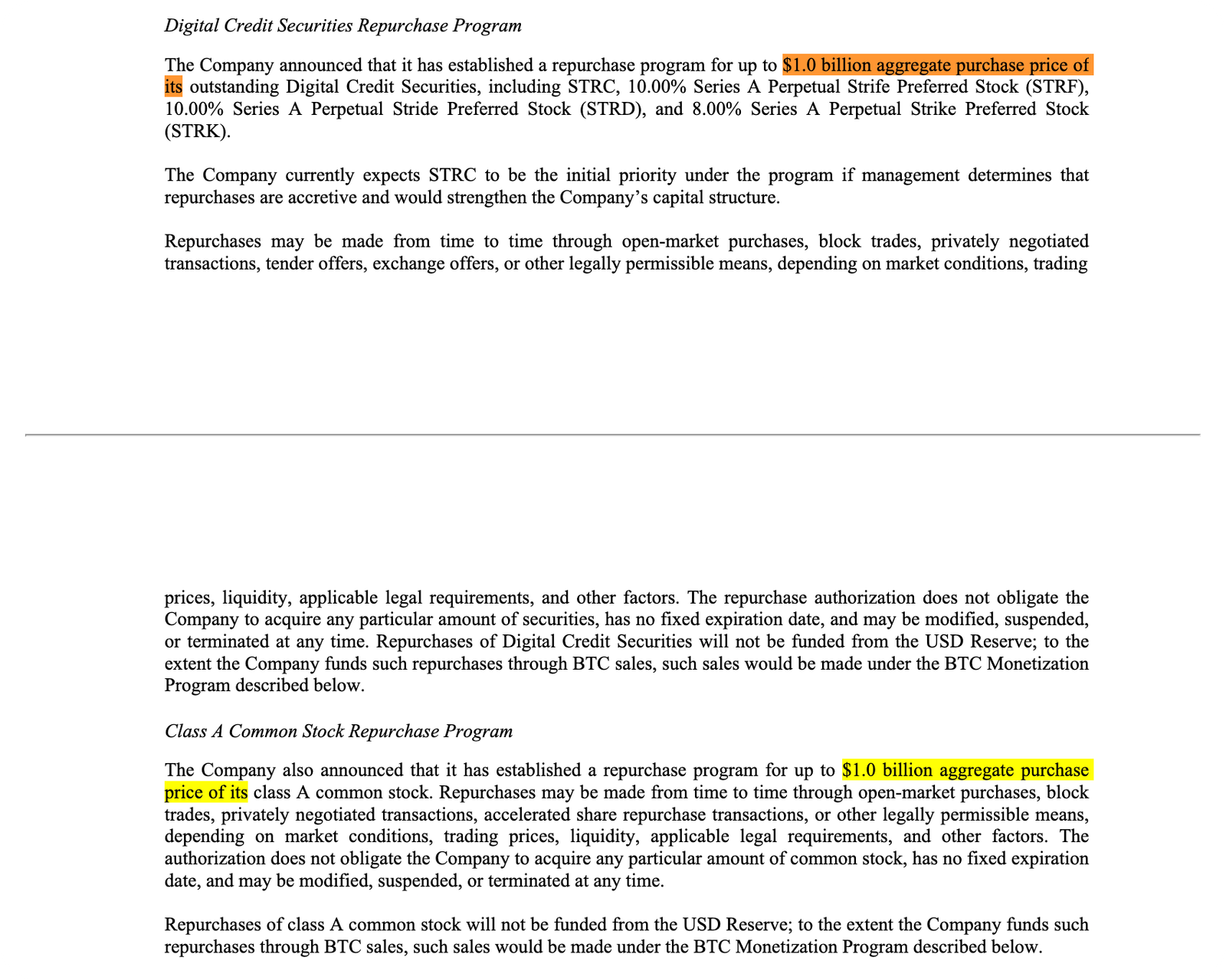
  3. Fund Share Repurchases: Sell bitcoin to repurchase preferred stock or MSTR common stock, with each repurchase channel capped at $1 billion, totaling $2 billion. Sale proceeds can also cover taxes, fees, and related expenses from the repurchases.


Only the first funding pool has the widely reported $1.25 billion limit; the third repurchase channel alone could monetize up to $2 billion worth of bitcoin. Just these two channels with explicit caps could lead to the sale of over $3 billion in bitcoin, not even counting the unlimited funding pool for dividend payments and reserve replenishment.


Distinguishing 'Building' from 'Replenishing': Blurry-Lined Accounting Operations


The sole purpose of the dollar reserve is to fund preferred stock dividends and debt interest payments. Under current rules, this money cannot be used for stock buybacks. As of June 28, the dollar reserve balance was $2.55 billion, sufficient to cover the company's annual $1.76 billion in mandatory payments for approximately 17 months. The board has set a floor: the reserve must cover at least 12 months of payments, unless the board approves a lower threshold.


This is why the distinction between "building reserve" and "replenishing reserve" deserves close scrutiny:


  • Selling bitcoin *before* a dividend payment and depositing the new cash into the reserve: defined as building reserve;
  • First using the reserve to pay a dividend, then later selling bitcoin to make up the shortfall: defined as replenishing reserve.


The plan categorizes them as two distinct operations, but their ultimate purpose is identical: selling bitcoin for cash to fund preferred stock dividends and interest payments. The relevant details were publicly disclosed, but this recent sale event vividly demonstrates how convenient this classification system is for the company. MicroStrategy sold $216 million worth of bitcoin, used the funds for dividends and to refill the reserve, yet publicly maintains that the $1.25 billion reserve-building quota remains untouched.


The market must now learn to read this "MicroStrategy-specific vernacular." "Building" and "replenishing" are merely nuanced accounting terms, yet they directly determine whether a bitcoin sale counts against the publicly stated cap.


From Simple Accumulation to Active Capital Management


In the June 29 announcement, Michael Saylor stated that this capital framework was designed to meet the company's needs for liquidity, standardized operations, and active capital management. CEO Phong Le was more direct: MicroStrategy is transitioning from a one-way street of issuing stock to buy bitcoin to a comprehensive, active capital operation.


As Matt Walsh and Jeff Dorman of Castle Island Ventures analyzed on a podcast last week, MicroStrategy has effectively become an actively managed hedge fund.


The market's narrative for MicroStrategy used to be simple: issue MSTR common stock, buy bitcoin, providing investors with leveraged bitcoin exposure. The new framework fundamentally alters this logic: the company will now actively buy and sell its own various capital instruments to balance the multiple pressures between common stock, preferred stock, dollar reserves, and bitcoin assets.


Walsh and Dorman pointed out that this operating model is internally contradictory: issuing common stock can secure preferred stock dividends but suppresses MSTR's valuation premium relative to its bitcoin holdings; selling bitcoin can extend the cash runway but fundamentally undermines the core "never sell" narrative; fully funding preferred dividends can stabilize market confidence but continuously depletes cash reserves; cutting preferred dividends preserves liquidity but could trigger a sharp drop in preferred stock prices.


The accounting loophole in the reserve quota is a microcosm of this strategic shift. Bitcoin is no longer the core asset held for the long term but a financial lever to adjust the balance sheet and maintain the functioning of the preferred stock payment system.


Conclusion


Investors must now anticipate the risks in Michael Saylor's capital management model: every action benefits one part of the capital structure while harming another.


This is also the key signal from the July 6 announcement: MicroStrategy is not short on room to sell bitcoin; its potential sale volume far exceeds the number the market superficially sees. The $1.25 billion figure only represents the company prioritizing the preservation of its bitcoin holdings if investors mistakenly believe it's the total sales cap; don't fall into this cognitive trap.


Today's MicroStrategy is a financial institution whose rules the market must parse word by word. Every professional term is critical: build, replenish, issue, repurchase, stabilize. Investors must dissect every term, like Fed watchers parsing policy statements, to gauge the potential scale of its future bitcoin sales.


This monetization plan gives MicroStrategy operational flexibility, but the underlying internal contradictions remain. It is no longer a simple, clear leveraged bitcoin investment vehicle; betting on this company is essentially a wager on its active capital management capabilities — betting it can continuously sell, refill, issue, repurchase, and stabilize its various capital tools without one link breaking and causing a systemic collapse.


Personally, I wouldn't take that bet.

Criptos en tendencia

Preguntas relacionadas

QWhat are the three main purposes for which MicroStrategy can sell Bitcoin under its capital framework?

AThe three main purposes are: 1) To build a reserve, with an upper limit of $1.25 billion in funds raised; 2) To cover preferred share-related expenses, such as paying fixed dividends and debt interest; 3) To fund share repurchases, with a combined upper limit of $2 billion for repurchasing preferred shares and MSTR common stock.

QHow does MicroStrategy's recent sale of 3,588 bitcoins not deplete the widely reported $1.25 billion 'reserve building' limit?

AThe recent sale was categorized as 'reserve replenishment,' not 'reserve building.' According to MicroStrategy's accounting rules, only sales that add new cash to the reserve before dividends are paid count against the $1.25 billion 'building' limit. Sales that refill the reserve after it has been used for payouts are classified as 'replenishment' and do not count against that limit.

QWhat is the fundamental shift in MicroStrategy's corporate strategy as highlighted in the article?

AMicroStrategy has shifted from being a simple 'Bitcoin accumulator' that primarily issued shares to buy Bitcoin, to a company engaged in active capital management. It now strategically buys and sells various capital instruments (Bitcoin, preferred shares, common stock) to balance pressures across its balance sheet and maintain its payout systems.

QWhat is the 'intrinsic contradiction' within MicroStrategy's new operational model, according to the analysts cited?

AThe model is internally contradictory: issuing common stock ensures preferred share dividends but lowers MSTR's valuation premium over its Bitcoin holdings; selling Bitcoin extends cash runway but breaks the 'never sell' narrative; fully paying preferred dividends maintains market confidence but depletes cash reserves; cutting preferred dividends preserves liquidity but could cause the preferred stock price to crash.

QWhat key signal does the author suggest was released in MicroStrategy's July 6th announcement?

AThe announcement signaled that MicroStrategy has far more room to sell Bitcoin than the market's superficial focus on the $1.25 billion 'reserve building' limit suggests. The total potential selling capacity is much higher, and the $1.25 billion figure only represents a limit on one specific purpose, not the company's total Bitcoin sales capacity.

Lecturas Relacionadas

Charla informal del equipo editorial de Odaily (8 de julio)

**Resumen del Coloquio Editorial de Odaily (8 de julio):** Esta es una sección informal del equipo editorial de Odaily. Los miembros comparten reflexiones y perspectivas personales sobre noticias, datos, eventos candentes e ideas de inversión aún en etapa de desarrollo. El contenido se basa en experiencias reales y no es consejo financiero; su objetivo es ampliar perspectivas y fuentes de información. **Contribuciones principales:** **Wenser (@wenser2010):** * **Mercados bursátiles:** Cree que las acciones de memoria (DRAM), tras una fuerte corrección, siguen en una fase de oferta limitada. Es proclive a vender en corto acciones de empresas relacionadas con criptomonedas (especialmente DAT), pero ve a Circle y Coinbase como posibles activos de rebote. * **Mercados de predicción (Mundial):** Advierte que apostar ciegamente por equipos favoritos es riesgoso. Cita ejemplos donde equipos más débiles tuvieron buen desempeño, sugiriendo que los intereses comerciales influyen. Reafirma su apuesta por la victoria de Francia. * **Software:** Observa un reciente buen desempeño de acciones de software (Microsoft, Salesforce, ServiceNow), pero duda si es un rebote temporal o un cambio fundamental. **Bcxiongdi (@bcxiongdi):** * **Meme coins:** Nota actividad en las cadenas SOL y BSC, pero con un carácter especulativo de bajo volumen (PVP). Recomienda observar la cadena Robinhood. * **Mundial:** Encuentra los mercados de predicción difíciles. Sugiere no comprar antes del partido, sino buscar oportunidades de "compra en mínimos" durante el desarrollo del juego. **Azuma (@azuma_eth):** * **Semiconductores:** Atribuye la corrección del sector a la incertidumbre sobre los planes de gasto de capital (capex) de los gigantes. Confía en que la demanda se mantendrá y considera comprar en caídas (especialmente DRAM). * **Rotación sectorial:** Señala que los fondos de cobertura están comprando acciones tecnológicas de forma concentrada, lo que podría ser una señal de rotación de mercado. * **RKLB (Rocket Lab):** El período de venta de acciones por parte del fundador ha terminado. Considera que la acción, en sus niveles actuales, tiene un riesgo limitado a la baja y un buen potencial alcista. Planea seguir comprando.

Odaily星球日报Hace 18 min(s)

Charla informal del equipo editorial de Odaily (8 de julio)

Odaily星球日报Hace 18 min(s)

SemiAnalysis: Las ganancias de Anthropic superarán los 10 mil millones de dólares en el tercer trimestre

El último análisis de SemiAnalysis revela que Anthropic está transformando el panorama comercial de la IA con una rentabilidad y un crecimiento que superan ampliamente a los de sus competidores. Gracias a su modelo comercial de alto margen centrado en API, Anthropic se ha convertido en líder del mercado de IA B2B. Se prevé que Anthropic alcance 10.000 millones de dólares de beneficio EBIT GAAP en el tercer trimestre de 2026, con una tasa de beneficio del 6%. Su ingreso anual recurrente (ARR) ha aumentado drásticamente, de 9.000 millones de dólares a finales de 2025 a más de 60.000 millones actualmente. Si mantiene el ritmo actual de 15.000 millones de dólares de nuevo ARR neto mensual, su ARR podría alcanzar los 300.000 millones para finales de 2027, lo que supondría una valoración empresarial de 6 billones de dólares. La adopción masiva de Claude Code, que representa más del 7% de todos los commits en GitHub, fue un punto de inflexión. La estructura de ingresos de Anthropic difiere significativamente de la de OpenAI, con aproximadamente entre el 75% y el 85% de su ARR proveniente de API de pago por uso. Esta ventaja del modelo API se refleja en un tasa de retención de ingresos neta del 500% y en un margen bruto que ha pasado de ser negativo en 2024 a situarse actualmente en torno al 60%. SemiAnalysis destaca la ciberseguridad como el próximo sector de crecimiento explosivo, tras la programación. Un factor limitante clave es el suministro de capacidad de computación; se prevé una gran brecha entre la demanda y la oferta para 2030. La OPV planeada por Anthropic tiene como objetivo recaudar fondos para cerrar esta brecha y asegurar recursos. Los principales riesgos incluyen posibles recortes de precios por parte de la competencia, presión regulatoria y la erosión del margen por el creciente modelo de 'Token como Servicio'.

marsbitHace 1 hora(s)

SemiAnalysis: Las ganancias de Anthropic superarán los 10 mil millones de dólares en el tercer trimestre

marsbitHace 1 hora(s)

Trading

Spot

Artículos destacados

Cómo comprar CAP

¡Bienvenido a HTX.com! Hemos hecho que comprar Cap (CAP) sea simple y conveniente. Sigue nuestra guía paso a paso para iniciar tu viaje de criptos.Paso 1: crea tu cuenta HTXUtiliza tu correo electrónico o número de teléfono para registrarte y obtener una cuenta gratuita en HTX. Experimenta un proceso de registro sin complicaciones y desbloquea todas las funciones.Obtener mi cuentaPaso 2: ve a Comprar cripto y elige tu método de pagoTarjeta de crédito/débito: usa tu Visa o Mastercard para comprar Cap (CAP) al instante.Saldo: utiliza fondos del saldo de tu cuenta HTX para tradear sin problemas.Terceros: hemos agregado métodos de pago populares como Google Pay y Apple Pay para mejorar la comodidad.P2P: tradear directamente con otros usuarios en HTX.Over-the-Counter (OTC): ofrecemos servicios personalizados y tipos de cambio competitivos para los traders.Paso 3: guarda tu Cap (CAP)Después de comprar tu Cap (CAP), guárdalo en tu cuenta HTX. Alternativamente, puedes enviarlo a otro lugar mediante transferencia blockchain o utilizarlo para tradear otras criptomonedas.Paso 4: tradear Cap (CAP)Tradear fácilmente con Cap (CAP) en HTX's mercado spot. Simplemente accede a tu cuenta, selecciona tu par de trading, ejecuta tus trades y monitorea en tiempo real. Ofrecemos una experiencia fácil de usar tanto para principiantes como para traders experimentados.

32 Vistas totalesPublicado en 2026.06.26Actualizado en 2026.06.26

Cómo comprar CAP

Discusiones

Bienvenido a la comunidad de HTX. Aquí puedes mantenerte informado sobre los últimos desarrollos de la plataforma y acceder a análisis profesionales del mercado. A continuación se presentan las opiniones de los usuarios sobre el precio de CAP (CAP).

活动图片