Chain Gaming Giant YGG Capitulates, Losing $15 Billion in Value Over 5 Years

Foresight NewsPublicado a 2026-07-07Actualizado a 2026-07-07

Resumen

The leading blockchain gaming guild Yield Guild Games (YGG) is shutting down its publishing arm, YGG Play, announced on July 6th by its official account and co-founder Gabby Dizon. The platform and its supported games will be phased out by July 31st. While YGG Play successfully validated a market for casual, crypto-native mobile games—generating over $9M in total revenue, including $876,000 in Q1 2026—Dizon stated the closure was a market-driven decision. He cited insufficient liquidity and declining user confidence in the macroeconomic environment, making the business commercially unsustainable. Founded in 2020, YGG rose to prominence during the Play-to-Earn (P2E) boom, particularly with Axie Infinity, organizing players and managing assets. Its token price soared above $10 during the 2021 bull market. However, the 2022 crypto downturn exposed the fragility of P2E economic models. YGG attempted to pivot in 2025 with the YGG Play publishing initiative, focusing on short-session casual games. The shutdown reflects broader struggles in the Web3 gaming sector. An April 2026 report highlighted a "structural mismatch" between speculative financial designs and genuine player entertainment needs, leading to an estimated $15 billion in destroyed capital. The report noted that 93% of roughly 3,200 tracked blockchain game projects are now "functionally dead," with token prices down an average of 95% from 2022 peaks. YGG itself is now pivoting its strategy entirely towards the AI Data...


By Ma He, Foresight News


On July 6th, both the official account of Yield Guild Games (YGG) and its co-founder Gabby Dizon simultaneously announced the decision to shut down its game publishing division, YGG Play. The team will gradually phase out the platform and certain games by July 31st according to plan, with 35 employees receiving an additional 8 weeks of salary compensation. Some games, like GIGACHADBAT, will be transferred to the developer Delabs for continued operation. Others, such as LOL Land and Waifu Sweeper, will be officially retired. Games published by YGG Play have generated cumulative revenue exceeding $9 million, with a single quarter in Q1 2026 contributing $876,000.
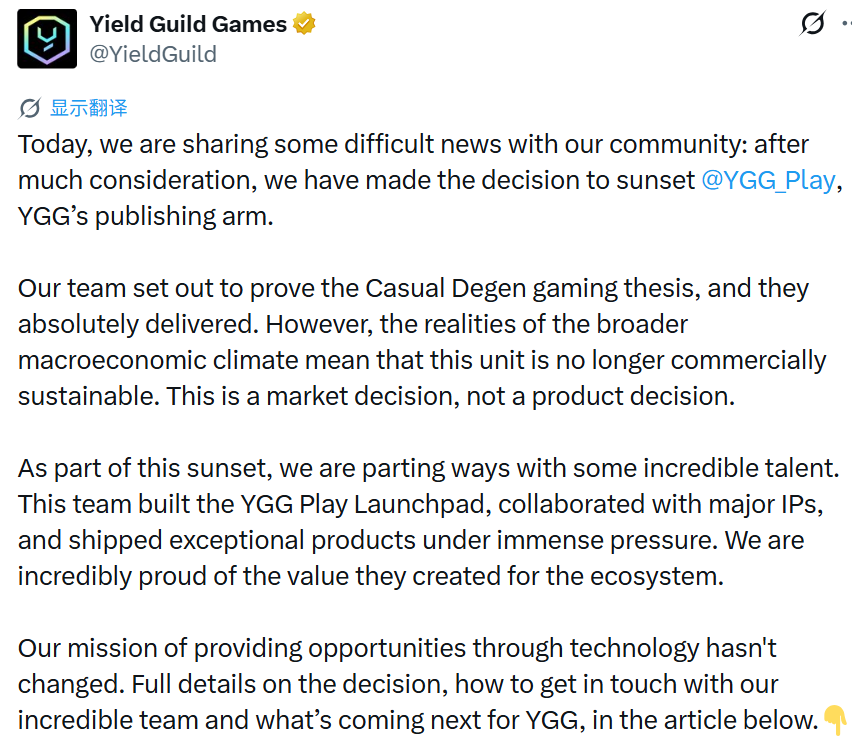


In the statement, Gabby Dizon stated: This is a market decision, not a product decision. Although the team successfully validated the casual gaming segment—short sessions, high engagement, and rapid feedback loops for crypto-native users—the lack of liquidity and declining user confidence in the macroeconomic environment have rendered this business commercially unsustainable.


Alongside shutting down YGG Play, YGG also announced a full pivot to the AI Data Economy, aiming to capture the multibillion-dollar market for AI training datasets, initially focusing on building B2B pipelines around gaming datasets.


The Chain Game Publishing Platform YGG Play


Launched by YGG in 2025, YGG Play was its Web3 game publishing arm, dedicated to serving the casual player community in the crypto space. It targeted short, quick, mobile-friendly games with a touch of social interaction and rewards, helping independent studios quickly go on-chain for distribution and acquire and operate users through YGG's community network. These games accumulated significant revenue during 2025-2026, proving that specific vertical segments could still generate genuine revenue even at the tail end of a bear market.


However, revenue peaked around October 2025. The large-scale liquidation event in October's crypto market further dampened the payment willingness and retention of target users. The closure of YGG Play marks a strategic contraction for YGG, moving away from the dual-engine drive of "guild operations + publishing."


To understand the weight of this closure, one must trace YGG's complete trajectory.


In 2020, veteran Philippine gaming industry figures Gabby Dizon, Beryl Li, and anonymous partner Owl of Moistness co-founded YGG. This was during the peak of the COVID-19 pandemic when many service industry workers in the Philippines were unemployed. Axie Infinity, the hottest Play-to-Earn (P2E) game at the time, was enabling players to borrow Axie NFTs for free to battle and share earnings through its "scholarship" model.


YGG seized this window, starting as a small guild, raising funds to purchase Axie assets, organizing and training players, and rapidly becoming one of the largest and most scalable guilds within the Axie ecosystem.
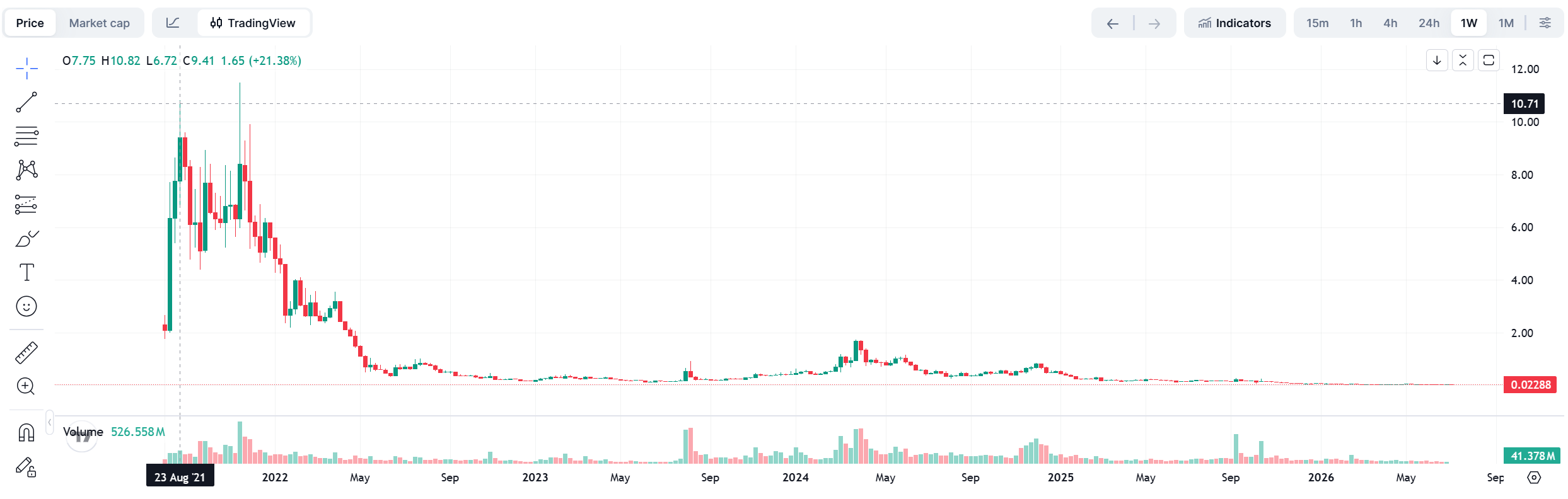


2021 was YGG's peak year. Driven by both the bull market and the P2E narrative, its token price soared, exceeding $10 at its highest. YGG expanded from a single Axie guild into a global network covering dozens of regional sub-guilds and partnered with over 80 blockchain games and infrastructure projects. It moved beyond mere asset lending, helping players maximize earnings through quests, events, and community operations. In places like the Philippines, the real economic phenomenon of "playing games as work" emerged, and YGG became a benchmark for the P2E model.


At its peak, YGG's model was widely replicated: guilds became crucial intermediaries connecting players, assets, and games, with DAO governance and token incentives allowing participants to share in growth benefits. YGG evolved from a simple "asset manager" into an investment, content, and community platform.


When the crypto bear market arrived in 2022, the fragility of Axie Infinity's economic model was laid bare—new user inflow slowed, token prices crashed, and player churn was severe. Many guilds and P2E projects vanished outright, and the entire industry entered a deep trough. YGG did not collapse but began a long adaptation. In 2025, YGG bet on a new direction: launching YGG Play and formally entering the game publishing arena, as heavy P2E was no longer viable, while crypto users naturally gravitated towards high-frequency, instant-feedback casual experiences.


This shutdown comes barely a year after that last pivot.


A Microcosm of the Chain Gaming Industry


The closure of YGG Play can be seen as a concentrated reflection of the chain gaming industry's development trajectory over the past five years.


In April this year, the crypto quantitative trading and market-making firm Caladan reviewed the five-year journey of the Web3 gaming sector from frenzied explosion to comprehensive collapse. Its core conclusion was that the decline of Web3 games is not a normal cyclical downturn but stems from a fundamental "structural misalignment" between the underlying speculative financial design and the genuine entertainment needs of players, leading to a staggering $15 billion in capital being obliterated.


Examples abound: Pixelmon, which raised $70 million but failed to launch public beta in 4 years; Ember Sword, which burned through $18 million and was liquidated; and Hamster Kombat, which lost 96% of its users within 6 months.


As of April 2026, in the roughly 3,200 chain gaming projects tracked by the report, 93% have been categorized as "practically dead" or have completely lost activity. The average decline in the crypto token prices for the entire gaming sector compared to the 2022 all-time highs reached 95%.


The prosperity of chain gaming was entirely built upon the Ponzi-like dividend logic of "Play-to-Earn." This model is inherently an unsustainable speculative financial closed loop: the earnings of early players and token prices entirely depend on a constant influx of new players buying tokens or NFTs to sustain the system. Once new user growth slows and external capital inflow decreases, the token's severe inflation rapidly breaches economic equilibrium, triggering a "death spiral" of token crashes, shrinking earnings, and a mass exodus of users.


YGG Play was not a failure in terms of product delivery or revenue figures but was defeated by "market timing."


The story of chain gaming may be nearing its end.

Criptos en tendencia

Preguntas relacionadas

QWhy did YGG decide to shut down its YGG Play division?

AYGG decided to shut down its YGG Play division due to market conditions, specifically insufficient market liquidity and declining user confidence in the macroeconomic environment, which made the business commercially unsustainable, despite having validated the casual gaming niche.

QWhat was the original core business model of Yield Guild Games (YGG) at its peak?

AAt its peak during the 2021 bull market, YGG's core model was operating as a major guild within the Play-to-Earn (P2E) ecosystem, most notably for Axie Infinity. It provided asset lending (scholarships), player training, and community management to help players maximize earnings, evolving into a global network and a platform for investment, content, and community.

QWhat new strategic direction has YGG announced alongside the closure of YGG Play?

AAlongside the closure of YGG Play, YGG announced a full-scale pivot into the AI Data Economy, aiming to capture a share of the multi-billion dollar AI training dataset market, with an initial focus on building B2B pipelines around gaming datasets.

QAccording to the article, what is the fundamental structural flaw of most Web3/blockchain games as identified by Caladan's report?

AAccording to Caladan's report cited in the article, the fundamental structural flaw of most Web3 games is a 'structural misalignment' between their underlying speculative financial design and genuine player entertainment needs. Their models rely on an unsustainable Ponzi-like financial loop where early player returns depend on constant new user inflow to buy tokens/NFTs, leading to a 'death spiral' when growth slows.

QWhat statistics does the article provide to illustrate the scale of failure in the blockchain gaming sector over the past five years?

AThe article provides several statistics illustrating the sector's failure: a collective loss of $150 billion in capital, 93% of tracked projects (~3200) being 'effectively dead' or inactive by April 2026, and an average token price decline of 95% from the 2022 highs for the gaming sector. It also cites specific failed projects like Pixelmon and Ember Sword.

Lecturas Relacionadas

Gana 7.2 millones de dólares en una semana, ¿de qué gana dinero pump.fun exactamente?

**Resumen:** Durante la semana del 29 de junio al 5 de julio, pump.fun generó ingresos récord de 7,2 millones de dólares. El protocolo obtiene sus ingresos principalmente de tres áreas: la curva de vinculación (bonding curve) —su mecanismo central para la emisión de tokens—, PumpSwap (su intercambio interno) y Terminal (herramientas de desarrollo y análisis). Un aspecto clave es el modelo económico del token PUMP: el 50% de los ingresos netos del protocolo se destina a recomprar y quemar tokens PUMP, habiendo ya eliminado el 41,8% de la oferta circulante. Esto crea un vínculo directo entre el rendimiento de la plataforma y el valor del token, estableciendo un ciclo de retroalimentación positivo similar al de las recompras de acciones en empresas tradicionales. Más allá de las finanzas, pump.fun está evolucionando de una simple plataforma de lanzamiento de memes a un ecosistema integral. Ha mejorado la velocidad de sus swaps, facilitado la entrada de fondos para nuevos usuarios y reforzado sus herramientas para desarrolladores. Además, funciones como “GO” han impulsado la participación comunitaria mediante recompensas. En conclusión, estos datos muestran que pump.fun está transitando hacia un modelo de negocio sostenible, con flujos de efectivo estables, una economía de token bien definida y una expansión constante de su ecosistema.

marsbitHace 36 min(s)

Gana 7.2 millones de dólares en una semana, ¿de qué gana dinero pump.fun exactamente?

marsbitHace 36 min(s)

Tiger Research: Tres estrategias para que las instituciones financieras se sumen a la ola de tokenización

**Informe de Tiger Research: Tres estrategias para que las instituciones financieras se sumen a la ola de tokenización** El mercado de tokenización de activos del mundo real (RWA) está creciendo rápidamente, pero muchos países carecen de marcos regulatorios completos. Las instituciones financieras deben elegir entre esperar a la legislación local, experimentar en "sandboxes" regulatorios o ser pioneras en mercados extranjeros más maduros para ganar experiencia y ventaja competitiva. Antes de entrar, es crucial prepararse en seis áreas clave: elegir jurisdicción, obtener licencias, definir el activo a tokenizar, determinar los inversores objetivo, diseñar mecanismos de liquidación y establecer operaciones. El objetivo central es acumular experiencia real lo antes posible. Existen dos vías principales: la **vía jurisdiccional directa** (establecerse en una jurisdicción con regulación madura como Hong Kong, Singapur o EE.UU., a menudo utilizando plataformas locales) y la **vía nativa en cadena** (estructurar emisiones directamente para entornos blockchain, utilizando plataformas como Ondo Global o Plume Nest para agilizar la entrada y acceder a liquidez DeFi). El caso práctico de una "Empresa A" muestra que el proceso puede llevar de 6 meses a más de un año, implicando evaluación de entidades existentes, selección de plataforma, diseño de productos, estructuras de custodia y ejecución final. El mensaje clave es que **el mercado no espera**. Las grandes instituciones ya están actuando. En lugar de esperar por una regulación perfecta, es fundamental trazar una ruta factible, superar los desafíos legales y operativos, y empezar a ejecutar para ganar experiencia, ya que el éxito final reside en completar el ciclo completo de venta a inversores.

Foresight NewsHace 57 min(s)

Tiger Research: Tres estrategias para que las instituciones financieras se sumen a la ola de tokenización

Foresight NewsHace 57 min(s)

Unitree corre a la bolsa: el verdadero misterio es en qué gastará los 4.200 millones tras su OPV

La empresa china de robótica Unitree ha obtenido la aprobación para cotizar en el mercado STAR de la Bolsa de Shanghai, con planes de recaudar 4.202 millones de yuanes (unos 42 mil millones de RMB). Fundada en 2016, la compañía se hizo conocida por sus robots cuadrúpedos asequibles y en 2023 dio el salto al campo de los humanoides con el modelo H1. Su estrategia se ha basado en una rápida iteración de productos y una agresiva reducción de precios, con modelos como el R1 (29.900 yuanes) y el G1 (99.000 yuanes). Los datos financieros muestran un crecimiento explosivo, pasando de 159 millones de yuanes en ingresos en 2023 a 1.710 millones en 2025, con una rentabilidad neta positiva desde 2024. Cerca del 40% de sus ventas provienen del extranjero, y tiene casos piloto en operación, como el robot G1 en el aeropuerto de Haneda (Tokio). Con los fondos de la OPV, Unitree planea reforzar la I+D, desarrollar nuevos productos y construir una nueva base de fabricación. Sin embargo, se enfrenta a un mercado cada vez más competitivo, con rivales como Ubtech (que apuesta por el segmento de compañía emocional), Tesla Optimus, Fourier y 1X. El principal desafío de Unitree será transformar sus pilotos industriales en contratos estables, mantener su ventaja en costes frente a la creciente presión competitiva y desarrollar capacidades robustas de inteligencia artificial embebida, como las que explora con su modelo H2 Plus en colaboración con NVIDIA. Su probable camino será una combinación de productos de bajo costo para ganar escala y cuota de mercado, con plataformas avanzadas para establecer estándares tecnológicos y casos de referencia en la industria. El éxito dependerá de su capacidad para convertir el volumen de ventas y la experiencia acumulada en una ventaja sostenible a largo plazo.

marsbitHace 2 hora(s)

Unitree corre a la bolsa: el verdadero misterio es en qué gastará los 4.200 millones tras su OPV

marsbitHace 2 hora(s)

Trading

Spot

Artículos destacados

Cómo comprar YGG

¡Bienvenido a HTX.com! Hemos hecho que comprar Yield Guild Games (YGG) sea simple y conveniente. Sigue nuestra guía paso a paso para iniciar tu viaje de criptos.Paso 1: crea tu cuenta HTXUtiliza tu correo electrónico o número de teléfono para registrarte y obtener una cuenta gratuita en HTX. Experimenta un proceso de registro sin complicaciones y desbloquea todas las funciones.Obtener mi cuentaPaso 2: ve a Comprar cripto y elige tu método de pagoTarjeta de crédito/débito: usa tu Visa o Mastercard para comprar Yield Guild Games (YGG) al instante.Saldo: utiliza fondos del saldo de tu cuenta HTX para tradear sin problemas.Terceros: hemos agregado métodos de pago populares como Google Pay y Apple Pay para mejorar la comodidad.P2P: tradear directamente con otros usuarios en HTX.Over-the-Counter (OTC): ofrecemos servicios personalizados y tipos de cambio competitivos para los traders.Paso 3: guarda tu Yield Guild Games (YGG)Después de comprar tu Yield Guild Games (YGG), guárdalo en tu cuenta HTX. Alternativamente, puedes enviarlo a otro lugar mediante transferencia blockchain o utilizarlo para tradear otras criptomonedas.Paso 4: tradear Yield Guild Games (YGG)Tradear fácilmente con Yield Guild Games (YGG) en HTX's mercado spot. Simplemente accede a tu cuenta, selecciona tu par de trading, ejecuta tus trades y monitorea en tiempo real. Ofrecemos una experiencia fácil de usar tanto para principiantes como para traders experimentados.

120 Vistas totalesPublicado en 2024.12.11Actualizado en 2026.06.02

Cómo comprar YGG

Discusiones

Bienvenido a la comunidad de HTX. Aquí puedes mantenerte informado sobre los últimos desarrollos de la plataforma y acceder a análisis profesionales del mercado. A continuación se presentan las opiniones de los usuarios sobre el precio de YGG (YGG).

活动图片