Can Ethereum’s $150B stablecoin liquidity help ETH bulls reclaim control?

ambcryptoPublicado a 2026-07-07Actualizado a 2026-07-07

Resumen

Ethereum has established itself as a leading infrastructure for digital dollars, now holding over $150 billion in on-chain stablecoin liquidity, a sign of real economic activity. Despite trading at $1,748.47 with an 11% weekly gain, it faces a key resistance zone between $1,750 and $1,800, where selling pressure has historically capped rallies. However, recent inflows into ETH ETFs and a potential technical "double bottom" pattern suggest buyers may be regaining momentum. Analysts link long-term bullish prospects, with price targets as high as $8,500 by mid-2027, to the growth of stablecoins and real-world asset (RWA) tokenization on Ethereum. The ongoing "Lean Ethereum" protocol redesign further underscores the network's evolving utility beyond speculation.

According to a recent update, Ethereum has already taken the lead in the financial infrastructure for digital dollars and tokenized assets, and this is not just hype.

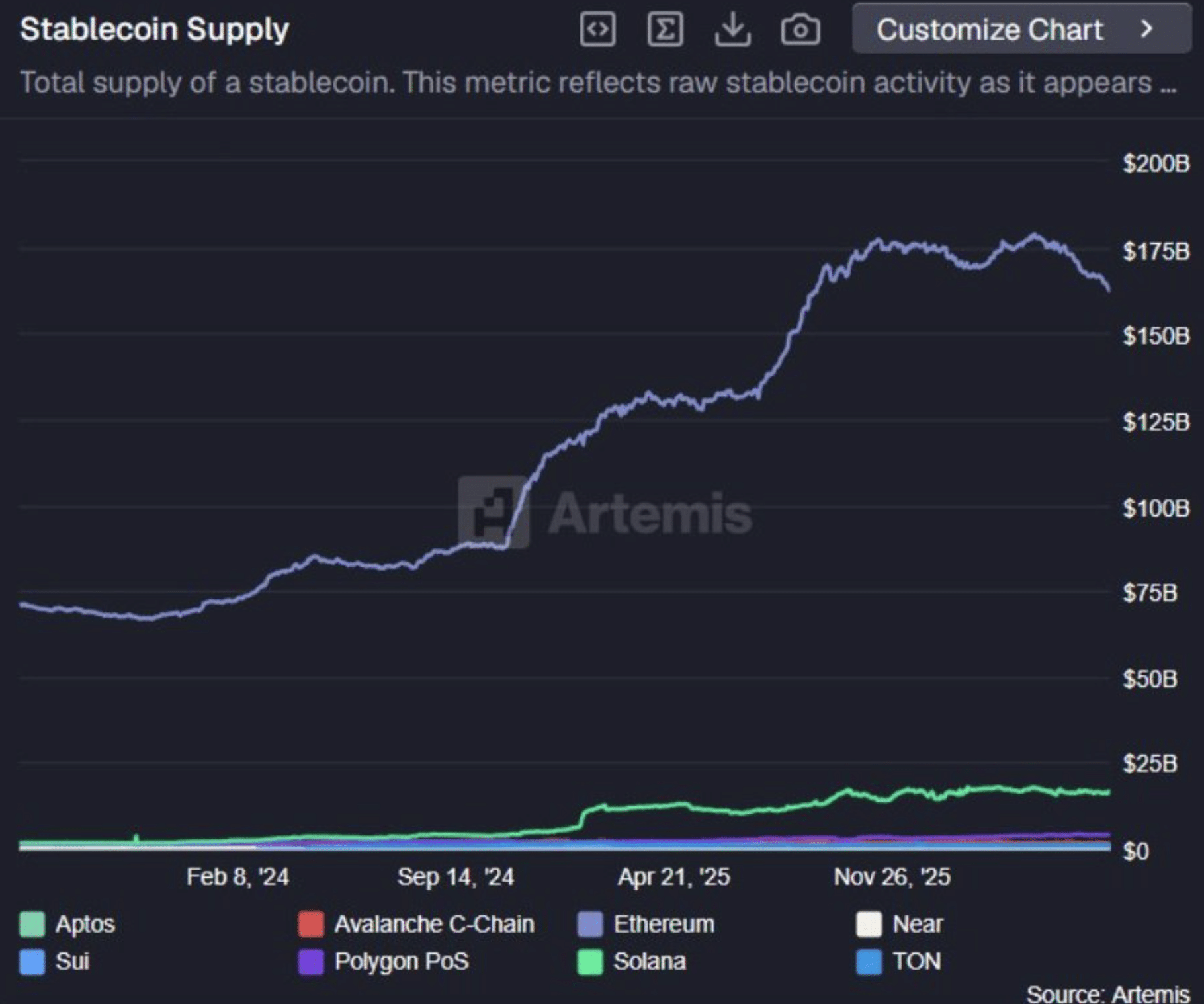
Artemis reported that Ethereum has more than $150 billion in on-chain stablecoin liquidity. This is noteworthy because stablecoins represent actual economic activity rather than speculative activity.
Source: Whale Factor/X

Ethereum’s market dynamics

This occurred at a time when the price of Ethereum [ETH] was trading at $1,748.47 at press time, following an 11% increase over the previous week.
Source: SoSo Value

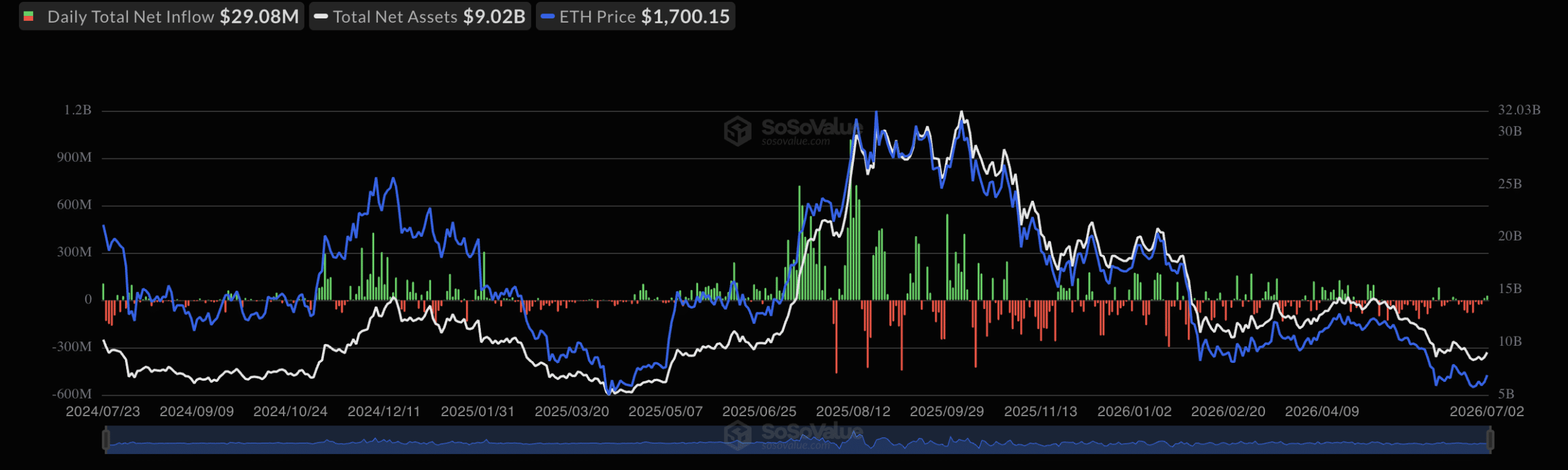
The ETH ETF, on the other hand, has been experiencing a prolonged period of outflows with a few exceptions.

However, on the 1st and 2nd of July, ETH ETFs recorded inflows worth $14.8 million and $29 million, respectively, highlighting renewed momentum.

Is buying momentum slowly rearing or ETH?

At the same time, many analysts are eyeing the $1,750–$1,800 range as a critical level because it has frequently served as a barrier where sellers have intervened to stop additional gains.


Ethereum has retreated in price every time it has approached this zone lately due to increased selling pressure from traders aiming to short the asset or take profits.

This shows that at those levels, supply has outpaced demand. However, Ethereum has the potential to indicate that buyers have absorbed the available selling pressure, provided it were to hold above $1,750–$1,800 with strong trading volume.

Community sentiments echo bullish notions for the altcoin

Interestingly, echoing somewhat similar sentiment, another analyst added,

ETH just double bottomed.

In other words, a double bottom occurs when the price of Ethereum hits a support level, bounces back, falls back to about the same level without breaking lower, and then rises once more. It is often seen as an indication that buyers are starting to regain control despite the selling pressure trying to barge in.

Therefore, the analyst predicted it best when he added,

~8,500 for ETH by mid 2027, thanks to stablecoins and RWA moving onchain.

What’s more?

Meanwhile, Ethereum has also entered a new stage of development with Lean Ethereum, a multi-year plan to completely redesign the network’s core protocol over the course of the next three to four years.

Ergo, as the gap between speculative capital inflow and network utility becomes more pronounced, it may result in further price appreciation.


Final Summary

  • Ethereum’s on-chain stablecoin liquidity skyrockets with its price trading at $1,748.47, and ETH ETF, experiencing a prolonged period of outflows.
  • Analysts consider the $1,750–$1,800 range as a critical price zone because it has frequently served as a barrier where sellers have intervened to stop additional gains.

Preguntas relacionadas

QAccording to the article, what is the significance of Ethereum's $150 billion on-chain stablecoin liquidity?

AThe significance is that stablecoins represent actual economic activity rather than just speculative activity, highlighting Ethereum's role in the financial infrastructure for digital dollars and tokenized assets.

QWhat was the price of Ethereum (ETH) at the time of writing, and what was its recent weekly performance?

AAt press time, Ethereum's price was $1,748.47, following an 11% increase over the previous week.

QWhy do analysts consider the $1,750–$1,800 price range as a critical level for Ethereum?

AAnalysts consider the $1,750–$1,800 range as critical because it has frequently acted as a barrier where sellers have intervened to stop additional gains, indicating supply has outpaced demand at those levels.

QWhat is a 'double bottom' pattern in technical analysis, and what does the analyst suggest it indicates for ETH?

AA 'double bottom' occurs when an asset's price hits a support level, bounces back, falls back to a similar level without breaking lower, and then rises again. The analyst suggests it indicates that buyers are starting to regain control despite selling pressure.

QWhat future development plan for Ethereum, mentioned in the article, aims to redesign its core protocol?

AThe future development plan is called 'Lean Ethereum,' which is a multi-year initiative aiming to completely redesign the network's core protocol over the next three to four years.

Lecturas Relacionadas

Unitree corre a la bolsa: el verdadero misterio es en qué gastará los 4.200 millones tras su OPV

La empresa china de robótica Unitree ha obtenido la aprobación para cotizar en el mercado STAR de la Bolsa de Shanghai, con planes de recaudar 4.202 millones de yuanes (unos 42 mil millones de RMB). Fundada en 2016, la compañía se hizo conocida por sus robots cuadrúpedos asequibles y en 2023 dio el salto al campo de los humanoides con el modelo H1. Su estrategia se ha basado en una rápida iteración de productos y una agresiva reducción de precios, con modelos como el R1 (29.900 yuanes) y el G1 (99.000 yuanes). Los datos financieros muestran un crecimiento explosivo, pasando de 159 millones de yuanes en ingresos en 2023 a 1.710 millones en 2025, con una rentabilidad neta positiva desde 2024. Cerca del 40% de sus ventas provienen del extranjero, y tiene casos piloto en operación, como el robot G1 en el aeropuerto de Haneda (Tokio). Con los fondos de la OPV, Unitree planea reforzar la I+D, desarrollar nuevos productos y construir una nueva base de fabricación. Sin embargo, se enfrenta a un mercado cada vez más competitivo, con rivales como Ubtech (que apuesta por el segmento de compañía emocional), Tesla Optimus, Fourier y 1X. El principal desafío de Unitree será transformar sus pilotos industriales en contratos estables, mantener su ventaja en costes frente a la creciente presión competitiva y desarrollar capacidades robustas de inteligencia artificial embebida, como las que explora con su modelo H2 Plus en colaboración con NVIDIA. Su probable camino será una combinación de productos de bajo costo para ganar escala y cuota de mercado, con plataformas avanzadas para establecer estándares tecnológicos y casos de referencia en la industria. El éxito dependerá de su capacidad para convertir el volumen de ventas y la experiencia acumulada en una ventaja sostenible a largo plazo.

marsbitHace 1 hora(s)

Unitree corre a la bolsa: el verdadero misterio es en qué gastará los 4.200 millones tras su OPV

marsbitHace 1 hora(s)

Analizando la Lista de Socios de Open USD: Ver quién se une revela hacia dónde fluyen los fondos

Open USD, un nuevo stablecoin, se presenta como una solución integral para los problemas de liquidación de monedas estables. Su lanzamiento cuenta con el respaldo de más de 150 socios de diversos sectores financieros y tecnológicos, lo que pone de manifiesto su ambición de convertirse en una infraestructura compartida en lugar de un producto propiedad de una sola empresa. La lista de socios fundadores incluye nombres destacados como Stripe, Coinbase, Mastercard, Visa y BlackRock. El grupo más amplio abarca desde bancos globales (BNY Mellon, Standard Chartered, Bank of America) y plataformas de comercio (Shopify) hasta gigantes tecnológicos (Google, IBM) y empresas de cripto (Ripple, Aave, MetaMask). Esta alianza refleja una estrategia deliberada: garantizar una adopción amplia haciendo que los futuros usuarios sean también dueños del proyecto. El artículo analiza los motivos de esta participación masiva. Gestoras de activos como BlackRock ven la oportunidad de administrar las grandes reservas del stablecoin. Comerciantes y plataformas como Shopify buscan reducir costes de transacción y obtener rendimiento de sus saldos. Los bancos participan de forma defensiva, para proteger sus depósitos y mantener un papel en la custodia y liquidación. Las empresas de tecnología apuestan por un dódigital programable para pagos automatizados, y las firmas de cripto ganan legitimidad y acceso a una distribución masiva. La presencia de competidores directos (Visa vs. Mastercard, Coinbase vs. Ripple) es particularmente significativa. Indica que el miedo a quedarse fuera de una futura infraestructura clave supera la incomodidad de colaborar con rivales. Para las redes de pago, es una forma de adaptarse y seguir siendo relevantes en un flujo de fondos que se traslada a la cadena de bloques. Esta coalición representa una amenaza directa para stablecoins establecidos como Circle (USDC) y Tether (USDT), cuya naturaleza "independiente" es precisamente lo que el consorcio de Open USD pretende superar. La ausencia de los grandes bancos minoristas estadounidenses, que desarrollan sus propias redes, también es reveladora. En resumen, la lista de socios de Open USD señala una evolución: el stablecoin ya no se ve como un simple producto, sino como una utilidad pública financiera. Las empresas que primero han reconocido este cambio se están posicionando para ser dueñas, y no meras inquilinas, de esta nueva capa de infraestructura.

Foresight NewsHace 1 hora(s)

Analizando la Lista de Socios de Open USD: Ver quién se une revela hacia dónde fluyen los fondos

Foresight NewsHace 1 hora(s)

Trading

Spot
活动图片