Can Open USD Support Stripe's Ambitions?

marsbitPublicado a 2026-07-07Actualizado a 2026-07-07

Resumen

Can Open USD support Stripe's ambition? The article argues that OUSD represents a pivotal strategic move for Stripe, shifting its narrative from being a superior payments API company to becoming a "money movement network." Unlike simply facilitating payments, this new model aims to organize and define the settlement layer, default assets, and economic distribution rules for future commerce. The analysis highlights OUSD's role in giving Stripe a potential default settlement asset, enabling deeper economics through reserve earnings, and providing a programmable money layer for emerging use cases like AI agentic commerce. Crucially, OUSD is presented not as a direct "USDC killer" but as an attempt to redefine the business model of stablecoins, proposing a collaborative governance structure where contributing partners share in the network's economic benefits and governance. For Stripe, this is about evolving from a powerful "abstraction layer" over traditional financial rails into an active participant and potential architect of the next-generation global settlement network. While OUSD alone cannot immediately realize this ambition, it signals Stripe's intent to move closer to the money layer itself, positioning itself at the center of future money flows in an increasingly automated, platform-driven, and AI-powered economy. The ultimate question is whether Stripe can transition from being a best-in-class payment processor to becoming the foundational infrastructure for internet...

Author: Yokiiiya Stablehunter

Five months ago, I wrote an article titledStripe|AWS of the Financial World: Why It Becomes the Biggest Winner in the AI + Stablecoin Era, where I argued that Money will run on Stripe. Stripe is not just building a better payment button; it is turning financial capabilities like collecting payments, making payouts, issuing cards, managing fund accounts, handling taxes, and billing into infrastructure that developers can call, much like cloud services.

But with the emergence of Open USD, we see that Stripe wants to prove not just that money will run on Stripe. It aims to show that:

Money will not only run through Stripe.

Money may settle on a network Stripe helped define.

I. OUSD is a Key Step for Stripe's Transformation into a Money Movement Network

The significance of OUSD lies not in it being just another stablecoin, but in it providing Stripe with a bigger narrative: transforming from a payments API company into a money movement network.

It won't replace USDC in the short term, nor can it bypass all traditional financial systems. However, it gives Stripe the opportunity not just to connect payments but to reorganize settlement, liquidity, and yield distribution. In the past, we often understood Stripe as a better payment gateway, but more accurately, Stripe is an aggregation layer built upon card networks, bank account systems, local clearing networks, acquiring/issuing licenses, and various traditional payment rails.

This is also its limitation.

What Stripe truly wants to break through is the strategic constraint of being "just the API layer on top of traditional payment networks." If Stripe were merely a better payments API, no matter how big it gets, it could easily be framed against competitors like Adyen, PayPal, Fiserv, Checkout.com, and acquiring banks. The market would focus on transaction volume, take rate, whether gross margins can be maintained, if card network costs will continue to rise, and whether regulations and local licenses will limit expansion.

This would still be a very good company, but not yet a truly financial network. The significance of OUSD is that it gives Stripe the chance to advance its narrative from "we help merchants connect payment methods" to "we participate in defining the next-generation commercial settlement network."
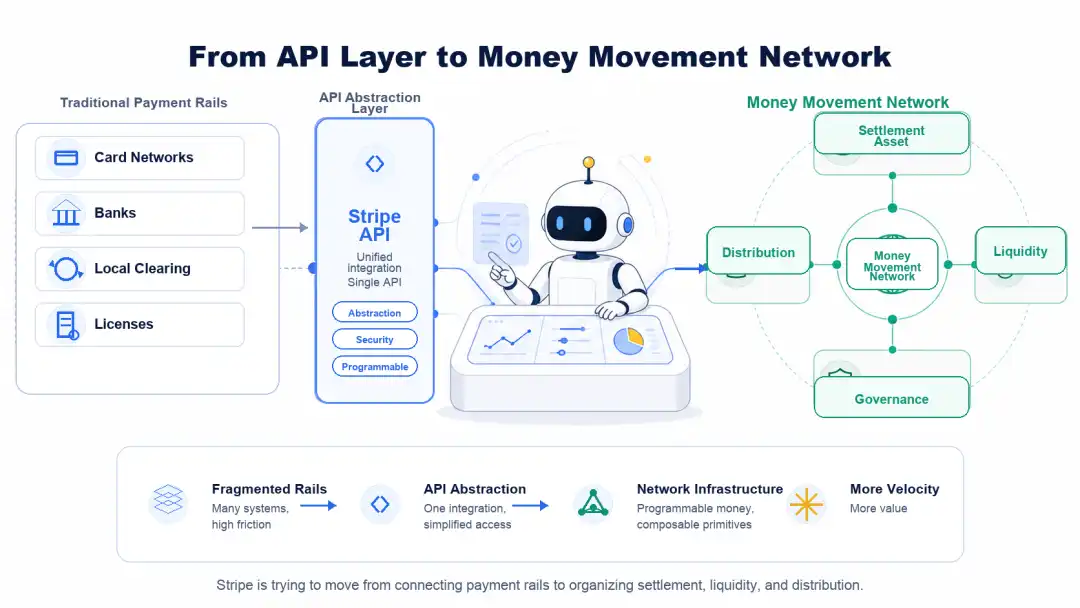
The valuation logic for these two things is completely different. The former is software and payment aggregators, the latter is a network.

What is most valuable in the payments industry has never been just the API, but network effects. Visa and Mastercard are valuable not because they have prettier payment buttons, but because they organize a multi-sided network: issuers, acquirers, merchants, consumers, risk rules, dispute resolution, and clearing paths all operate within the same rule system.

If Stripe wants to tell a bigger story than "payments API," it must answer one question: Can it not only connect others' networks but also organize its own network? OUSD provides the narrative entry point. What attracts Stripe to OUSD is not whether it's another dollar stablecoin, but that it points to four things simultaneously.
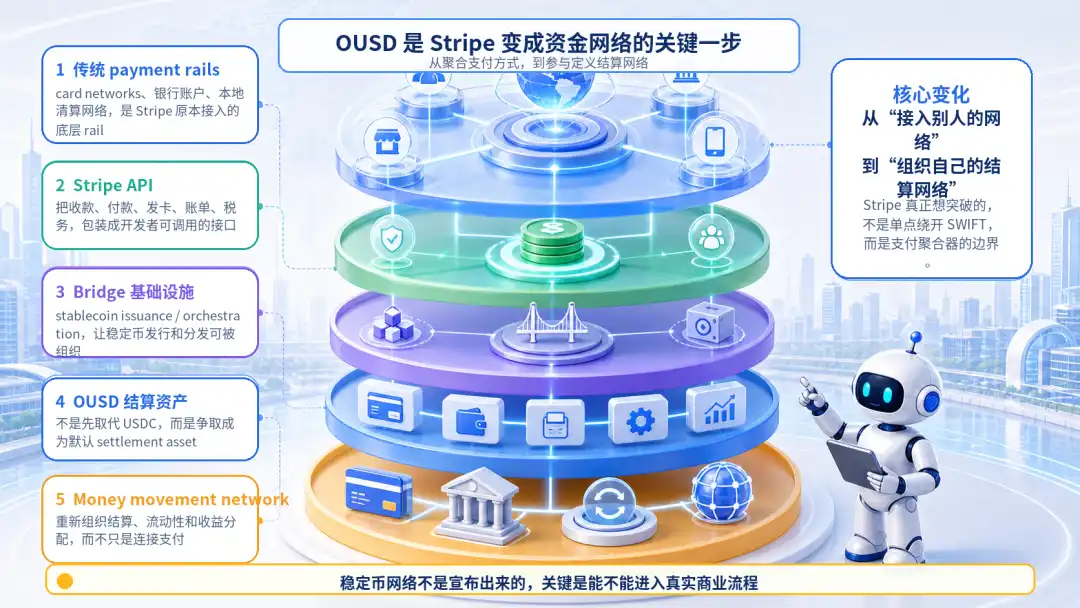
First, it gives Stripe the opportunity to have a default settlement asset.

In the past, Stripe helped merchants connect to Visa, Mastercard, ACH, local wallets, and bank transfers. In the future, if OUSD can become the default settlement asset for Stripe's merchants, platforms, marketplaces, and AI agents, Stripe would not just be connecting others' networks but organizing its own.

Second, it changes economic distribution.

In traditional payments, Stripe can charge processing fees, but underlying network fees, bank fees, card network fees, and some fund yields remain with others. If stablecoin reserve yields, minting/redeeming, liquidity, wallets, cards, and on/off-ramps are all organized within the Stripe/Bridge system, Stripe has a chance to tap into deeper economics.

Third, it provides a programmable money layer for agentic commerce.

If the underlying layer remains just credit cards and bank transfers, what agents can do will be constrained by authorization, risk controls, settlement delays, cross-border costs, and reconciliation processes. Stablecoins don't solve all problems, but they are closer to a money rail that machines can call.

Fourth, it moves Stripe from a software company toward a network company.

If OUSD succeeds, Stripe's story could shift from "we make payments easier" to "we are organizing the next-generation global commercial settlement network." This is its truly important aspect. But we must also look at it calmly.

Currently, OUSD is more like the narrative starting point for this ambition, rather than a completed infrastructure. Stablecoin networks aren't announced; they need deep enough liquidity, stable and low-friction redemption, bank and regulatory acceptance, merchants willing to hold or auto-settle, integration with enterprise ERP, treasury, and reconciliation systems, stable cross-chain and cross-region experiences, and participant governance that doesn't become a slow-decision alliance.

Therefore, OUSD is not a USDC killer in the short term. It's more like Stripe asking the market a question: If future money movement doesn't just rely on traditional payment networks, then who will organize the new settlement assets, distribution networks, and economic distribution mechanisms?

II. What OUSD Actually Aims to Do: Not a USDC Killer, But Rewriting Stablecoin Benefit Distribution

Open USD, abbreviated as OUSD, is a new dollar stablecoin announced by Open Standard on June 30, 2026. The official definition is: a shared stablecoin for global financial activity, i.e., a stablecoin for global financial activities.

It is not a "private stablecoin" issued solely by Stripe. It is governed and operated by Open Standard, an independent company, with participation from a group of payment companies, banks, fintech companies, crypto infrastructure firms, and merchant platforms. Official participants listed include Stripe, Visa, Mastercard, BlackRock, BNY, Coinbase, Shopify, Bridge, Tempo, Privy, etc.
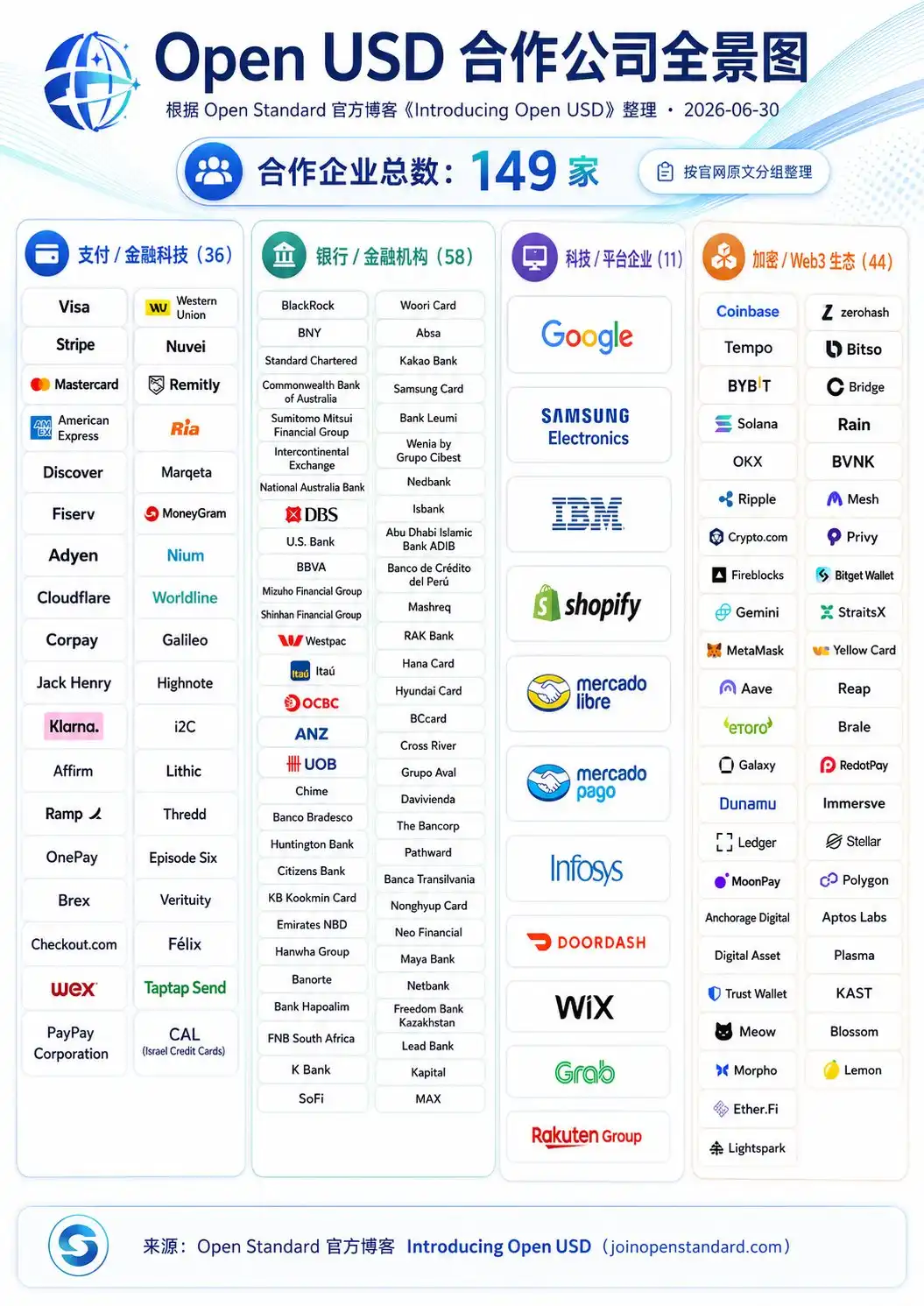
There's an interesting detail here: OUSD was not directly launched by Stripe officially. It was announced by Open Standard, and Open Standard's founding CEO is Zach Abrams. Zach Abrams is also the co-founder/CEO of Bridge, which has been acquired by Stripe.

Organizationally, OUSD is not unrelated to Stripe. On the contrary, it clearly lies on the strategic extension line of Stripe/Bridge's stablecoin strategy. But from a product and governance narrative perspective, it cannot be packaged as Stripe's private stablecoin.

This is precisely where OUSD is delicate: It needs Stripe and Bridge's execution capabilities, payment network understanding, and future distribution power, but it must present itself as a stablecoin network with multi-party participation, co-governance, and shared economic benefits through the independent entity Open Standard.
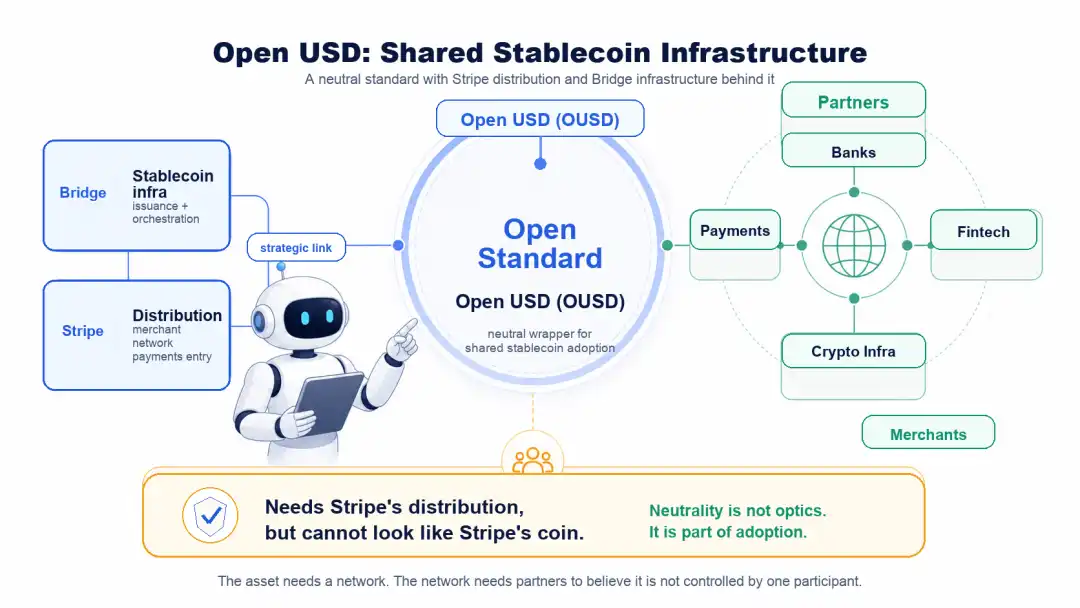
In other words, it needs Stripe's strength, but it mustn't appear to be just Stripe's coin. OUSD's design focuses on three aspects.

First, minting and redeeming are free, with no artificially set scale limits.

Second, the yield generated by OUSD's reserve assets, after deducting a small management fee, will be distributed to partners who drive adoption and distribution.

Third, it adopts collaborative governance. Open Standard's board is composed of OUSD partners. The official vision is for it not to be a private network of any single company, but a stablecoin infrastructure shaped by participants. OUSD is not just another dollar stablecoin; it attempts to answer a more commercial question:

If stablecoins become the infrastructure for global money movement, should the companies that use, distribute, and bring transaction scenarios to them also participate in governance and benefit distribution?

So, what does OUSD actually aim to do? I don't believe it is a USDC killer in the short term.
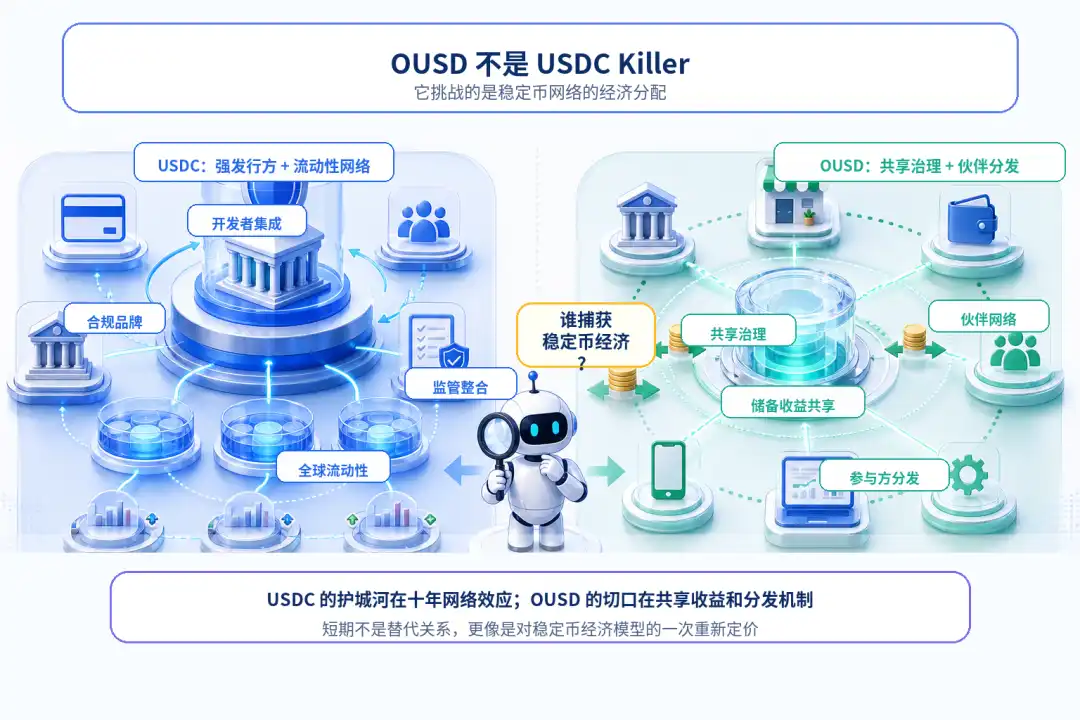
USDC's first-mover advantage is very real. It has liquidity, exchange and DeFi use cases, institutional trust, a compliance brand, and many completed integrations. Stablecoins aren't something you can migrate just by changing the name; behind them lies redemption trust, liquidity depth, counterparty acceptance, and operational inertia.

After OUSD's announcement, Circle CEO Jeremy Allaire quickly responded to competition concerns raised by OUSD. His core point wasn't "anyone can issue a stablecoin," but quite the opposite: stablecoins are a long-term accumulation of platform and network effects.

He emphasized that USDC's moat comes mainly from three things: developer and application integrations, global liquidity, and regulatory and financial system integration.

In Circle's official Q1 2026 data, USDC's circulating supply is $77 billion, with quarterly on-chain transaction volume of $21.5 trillion. This number may not fully reflect real commercial payment penetration, but it's enough to show one thing: USDC is not a ticker that can be easily replaced; it's already an operational stablecoin network.

This is also why framing OUSD as a "USDC killer" would be an oversimplification. What's truly interesting about OUSD is not that it will immediately replace someone, but that it has chosen a different path: It doesn't start by competing for trading liquidity in the crypto-native world, but cuts in from enterprise payments, platform settlement, merchant distribution, and reserve yield distribution.

In existing stablecoin models, many users are actually just distributors or channels. The more a stablecoin is used, the more the issuer benefits from reserve yields. While payment companies, platforms, merchants, wallets, banks, and fintech contribute to distribution and use cases, they may not fully participate in the underlying economics.

This is what OUSD wants to change. It tries to persuade enterprises: You're not just using a stablecoin; you can also participate in the governance and economic distribution of this stablecoin network.

Therefore, what OUSD challenges is not just USDC's market share. It challenges a more fundamental issue in the stablecoin industry: Who contributes to the stablecoin's use cases, and who should share how much of its economic benefits?

From this perspective, USDC's advantages remain strong, but what OUSD proposes is not a simple replacement relationship, but a new benefit distribution model. This also explains why it emphasizes open, neutral governance, and shared economics.

Open, to reduce the psychological cost for enterprises to join and exit. Neutral governance, to make participants believe this isn't a private stablecoin of any single company. Shared economics, to allow companies that truly bring distribution and transaction volume to participate in reserve yield and network value distribution.

This is not purely a technical issue; it's a commercial organization issue. Of course, this path is also harder. The larger the alliance, the higher the coordination costs. The more participants, the more complex the governance. The more a stablecoin wants to become public infrastructure, the more it must address who is responsible, who benefits, who bears liability, and who makes final decisions.

Allaire's rebuttal to "everyone sharing benefits" precisely touches this contradiction: If all revenue is distributed, who will continuously invest in infrastructure? This isn't just Circle's defensive rhetoric. It is indeed a question OUSD must answer in the future.

Circle's logic is: A strong issuer needs to retain sufficient profits to continuously build compliance, liquidity, redemption, and global financial infrastructure.

OUSD's logic is: If stablecoins are to become shared infrastructure, then participants contributing distribution, use cases, and transaction volume should also share more reserve economics and governance rights.

Therefore, this isn't a simple competition of "who is cheaper." It's competition between two ways of organizing stablecoins. OUSD is not a USDC killer in the short term.

It is more like a commercial counter-question to the USDC model: If stablecoins truly become the next-generation global payment infrastructure, should they be dominated by a strong issuer, or co-governed by a group of commercial networks that genuinely contribute traffic, use cases, and trust?

III. Stripe Needs More Than Growth; It Needs a Larger Company Narrative

Stripe is already a very large company, serving a vast number of global internet companies, SaaS, platform businesses, marketplaces, and emerging AI companies. Its products have long been more than just payment buttons, covering a whole suite of financial infrastructure including payments collection, payouts, billing, taxes, risk controls, card issuing, fund accounts, and business registration.

But the problem is, the capital market doesn't just ask if a company is big. It also asks: What exactly is this company? This is a question Stripe has always needed to answer.

If Stripe is understood as a payments company, it gets valued within the framework of payments companies. The market will look at its transaction processing volume, take rate, gross margin, card network costs, competitive intensity, regulatory pressure, and whether it can sustain high growth long-term.

If Stripe is understood as a software company, it faces another problem: Its revenue structure includes a large portion driven by payment volume, unlike pure SaaS with very clear subscription revenue and software margin models.

Therefore, Stripe's most imaginative narrative has never been "we are a payments company," nor simply "we are a SaaS company."

It is: We are the financial infrastructure for the internet economy. Five months ago, I wrote about it being the "AWS of the Financial World," which is exactly this point.

AWS's core isn't that it has many APIs, but that enterprises run their computing, storage, databases, networking, security, and deployment processes on it. It provides not a point tool, but the default runtime environment.

What Stripe wants to become isn't a point payment tool either. It wants to become the default financial runtime environment for internet commerce, which is also why OUSD is important to Stripe.

Because if Stripe continues just packaging more traditional financial capabilities as APIs, it remains an abstraction on top of the existing financial system. It can become more user-friendly, more complete, more like a financial OS, but the settlement assets, clearing networks, and part of the economic benefits it depends on remain in others' hands.

What OUSD gives it is an opportunity to move down into the money layer. From this perspective, actions like Bridge, Open Issuance, OUSD, Privy, agentic commerce, and Tempo are not isolated. Bridge gives Stripe stablecoin issuance/orchestration capabilities. Open Issuance allows enterprises to issue and manage their own stablecoins. OUSD provides an entry point for a shared stablecoin and alliance network. Privy brings Stripe closer to wallet, identity, and user-side crypto-native onboarding. Tempo is a payments-focused blockchain incubated by Stripe and Paradigm, pointing to stablecoin payment and settlement rails. Agentic commerce provides a new use case for all this: If AI agents in the future truly represent users, enterprises, and software systems to initiate purchases, subscriptions, service calls, and complete settlements, then payments will no longer be just human actions of clicking checkout buttons, but ongoing fund flows between software.

Looking at these actions together, the story Stripe wants to tell is not just: We make payments easier. It is: We enable the money movement in the next-generation internet economy to be callable by software, manageable by enterprises, and settled globally.

This is the money movement network narrative. It is bigger than payments API, and bigger than "supporting stablecoin payments."

Of course, this story is still just a story for now. OUSD hasn't become a real default settlement asset, and agentic commerce hasn't entered large-scale commercialization. Whether enterprises are willing to hold stablecoins, whether financial systems can integrate, how regulators view it, how traditional payment networks will react—none of these have answers yet.

But a company narrative doesn't emerge only after everything is done; it often appears when a company is about to cross its existing boundaries.

The boundary Stripe is now crossing is from "I help you connect to payments" to "I help you organize money movement."

OUSD is not just another competitor in the stablecoin market. It is a signal of Stripe pushing itself from a payment company toward a money movement network.

IV. Agentic Payment Isn't Competing for the Payment Gateway; It's Competing for the Settlement Layer of Machine Transactions

OUSD is worth examining alongside agentic payment, not because AI agents will definitely only use OUSD for payments in the future.

In fact, the most common and mature stablecoin asset in agentic payment today is still USDC. Many agent wallet, x402, and on-chain micropayment solutions are more easily built around USDC by default. USDC's advantage isn't just its compliance brand, but its integration into developer tools, wallets, exchanges, payment infrastructure, and on-chain liquidity networks.

Visa and Mastercard aren't bystanders either. They won't sit back and wait for stablecoins to replace them. A more realistic scenario is that card networks are also transforming themselves into payment networks usable by agents: finer-grained authorization, stronger tokenized credentials, risk controls, limits, and settlement rules more suitable for machine transactions.

In June 2026, Visa announced a set of AI, stablecoin, and token innovations to support more intelligent, programmable commercial transactions. Mastercard also launched Agent Pay for Machines, explicitly supporting multi-rail settlement with cards, accounts, and stablecoins.

Therefore, the future of agentic payment won't be a simple story of "stablecoins replacing card networks."
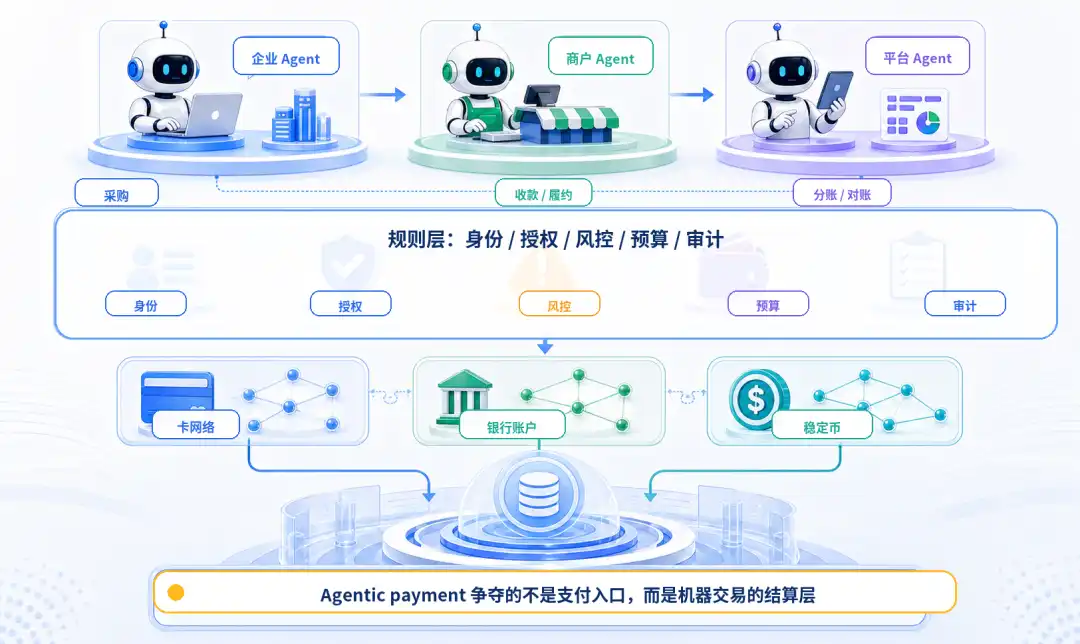
What is more likely to happen is: Card networks, bank accounts, stablecoins, wallets, on-chain settlement, and merchant systems will simultaneously compete for the same position: Who will become the settlement layer that agents can call, enterprises can control, merchants can accept, and finance departments can reconcile?

This is also why Stripe's moves are worth looking at together:

OUSD is an attempt at a settlement asset.

Tempo is an attempt at a payment chain and stablecoin settlement rail.

Bridge is infrastructure for stablecoin issuance/orchestration.

Privy is an entry point for wallets, identity, and user onboarding.
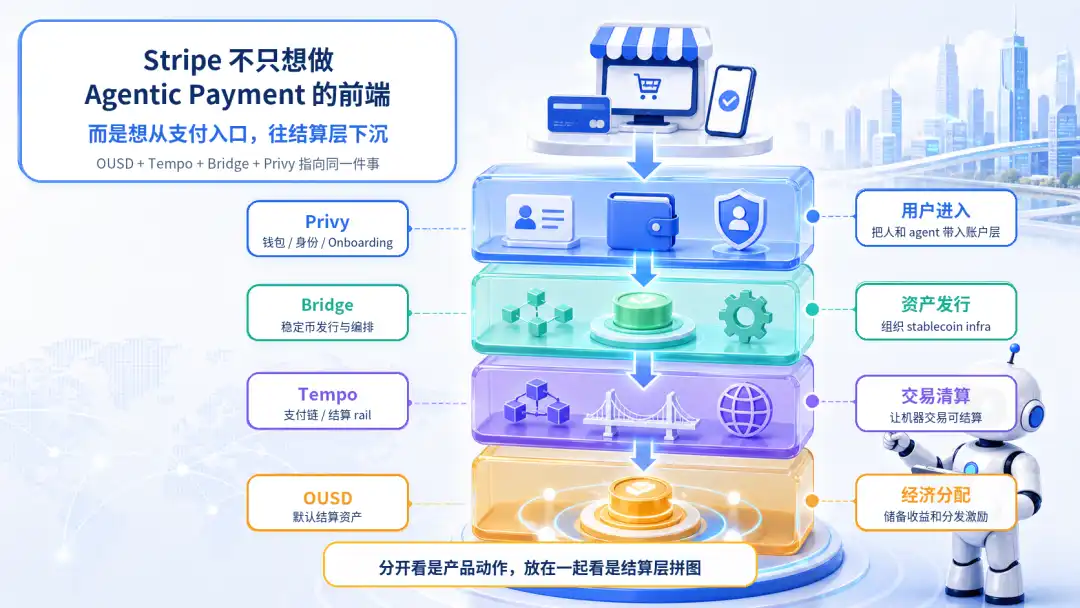
If viewed separately, these are just product moves. But viewed together, they point to the same question: Stripe doesn't just want to participate in the front-end checkout of agentic payment. It wants to move from the payment gateway down to the settlement layer. This is also the truly interesting aspect between Stripe and traditional card networks.

Visa and Mastercard's advantage is that they already have global merchant networks, issuer networks, risk rules, and dispute resolution systems. Their most natural path is to transform their existing networks into payment networks that agents can also call.

Stripe's strength isn't owning the card network itself, but standing on the side of merchants, developers, platforms, and emerging software companies, packaging complex financial capabilities into APIs. It is closer to the application layer and merchant side, and more easily integrated into the workflows of AI-native companies, agent tools, SaaS, and marketplaces.

Therefore, if agentic payment truly develops, Stripe won't be satisfied just helping agents call Visa or Mastercard.

What it wants to do more is: Enable agents to use money securely within Stripe's rule system. The key here isn't "can it pay," but the whole set of questions after payment:

Who authorizes? Who sets the budget? Who bears the risk? Who does KYC? Who handles refunds and disputes? Who syncs transactions into the enterprise's accounting system? Who decides how much an agent can spend, on which services, and with which assets to settle?

This is where machine transactions become truly complex. An agent purchasing APIs, calling data, subscribing to tools, paying for compute, completing cross-border tasks—superficially, it's a payment, but behind it lies a set of permission, identity, risk, budget, audit, and reconciliation issues.

Stablecoins can solve part of the settlement efficiency problem, but they can't solve all commercial payment issues alone. Card networks can continue providing authorization, risk controls, and merchant acceptance, but they also need to adapt to low-value, high-frequency, cross-platform, software-initiated transaction patterns.

What Stripe wants to compete for is precisely the middle layer between these two:

On one side, connecting merchants and developers; on the other, organizing stablecoins, wallets, identity, risk controls, settlement, and reconciliation.

From this perspective, OUSD isn't the entire answer to agentic payment; it is a piece of the puzzle for Stripe moving down to the settlement layer.

The real ambition is to turn agentic payment into a money movement network that Stripe can organize.

V. So, Can OUSD Support Stripe's Ambitions?

Returning to the initial question: Can Open USD support Stripe's ambitions? My answer is: Not in the short term, but it makes this ambition more concrete for the first time.

It can't immediately free Stripe from traditional payment networks. Visa, Mastercard, ACH, local banks, card organizations, acquirers, issuers, regulatory licenses, KYC, AML, taxes, reconciliation—these things won't disappear just because a stablecoin is announced. Real-world commercial payments are never as simple as "money moves from A to B."

Stablecoins can solve part of the transmission problem; they can make funds move faster, cheaper, and more programmably, but they can't automatically solve the landing problem.

After the money arrives, who is responsible for booking it? Who does KYC? Who bears fraud risk? Who handles refunds and disputes? Who ensures the merchant receives funds they can use? Who integrates this transaction into the enterprise's ERP, financial system, and tax processes?

These problems still require a lot of traditional financial and commercial infrastructure, which is also why Stripe won't become a pure crypto company because of OUSD.

The more likely path it will take is another: making stablecoins part of its existing financial infrastructure. That is, if OUSD succeeds, it won't be because it makes Stripe leave the traditional financial system, but because it gives Stripe an additional settlement network, defined with its participation, outside the traditional system.

This network may not replace everything, but it can change Stripe's position in money movement.

In the past, Stripe was more like an excellent translator, translating complex financial systems into APIs developers could call, turning capabilities like payments, billing, taxes, card issuing, risk controls, and fund accounts into modules enterprises could embed into their products.

But OUSD points to something else: Stripe isn't just translating existing financial systems. It is starting to participate in defining new financial systems. This is why I think it's worth writing about. Not because OUSD will definitely win, but because it exposes the most important strategic question for Stripe's next stage:

Does Stripe want to become a better payment processor, or does it want to become the money movement network for the next generation of internet commerce?

These two things seem close but are actually far apart. A payment processor's value comes from transaction processing, risk controls, integration efficiency, and merchant coverage. A money movement network's value comes from network effects, default settlement assets, rule-making capabilities, liquidity organization capabilities, and economic distribution mechanisms.

The former is a service; the latter is infrastructure.

What Stripe has done best over the past fifteen years is turning financial services into software interfaces. But if it wants to support AI commerce, global platform economies, cross-border payouts, stablecoin settlement, and agentic payment in the future, it cannot just stay at the interface layer.

It needs to get closer to the money itself. OUSD gives it an entry point to get closer to the money. Of course, whether this entry point becomes a real network depends on the coming years. It depends on whether OUSD has real use cases, whether Stripe deeply embeds it into merchant, platform, and developer tools, whether participants truly bring distribution rather than just putting logos on the announcement page, whether regulators accept this alliance stablecoin structure, and also how Circle, Tether, banks, card networks, and other payment companies respond.

This won't be answered quickly, but it has already made one thing clear: Stablecoins are no longer just trading assets in the crypto world. They are becoming tools for payment companies, banks, platforms, merchants, and AI companies to compete for the entry point of the next-generation money network.

From this perspective, OUSD isn't Stripe's endpoint; it's a signal of Stripe trying to push itself from a payments API company toward a money movement network.

Five months ago, I wrote: Money will run on Stripe.

Looking today, this statement can be pushed one step further. What Stripe wants to prove is:

Money may settle on a network Stripe helped define.

Criptos en tendencia

Preguntas relacionadas

QAccording to the article, what is the core strategic significance of Open USD (OUSD) for Stripe, beyond being just another stablecoin?

AThe article argues that OUSD's core significance for Stripe is not as another stablecoin, but as a narrative vehicle for a larger strategic shift. It moves Stripe's story from being a "payments API company" to becoming a "money movement network." This transition means Stripe would no longer just be an aggregator/abstraction layer on top of existing card and banking networks, but a participant in defining the settlement assets, distribution networks, and economic distribution mechanisms for the next generation of global commerce. This shift has a fundamentally different valuation logic, from a software/payments aggregator to a network.

QHow does the design of OUSD attempt to rewrite the profit-sharing model of the stablecoin industry?

AOUSD attempts to rewrite the stablecoin profit-sharing model through three key design principles: 1) No fees for minting and redeeming, with no artificial caps. 2) The yield generated by OUSD's reserve assets, after a small management fee, is distributed to the partners who drive its adoption and distribution. 3) It employs collaborative governance through the Open Standard entity, involving partners in its board. The core idea is that companies contributing to the stablecoin's usage, distribution, and transaction volume should share in the governance rights and the economic benefits (reserve yield) of the network, rather than having those benefits primarily accrue to a single issuer.

QWhat are the four key areas that OUSD points towards, which collectively support Stripe's ambition to build a 'money movement network'?

AThe article states that OUSD points towards four key areas for Stripe's ambition: 1) **Owning a default settlement asset**: It gives Stripe the chance to have OUSD as the default settlement asset for its merchants, platforms, and AI agents, moving beyond just connecting to others' networks. 2) **Changing economic distribution**: It allows Stripe to capture a deeper layer of economics, including reserve yield and liquidity, beyond just processing fees. 3) **Providing a programmable money layer for agentic commerce**: It offers a financial rail more suitable for machine-initiated transactions compared to traditional systems. 4) **Moving from a software company to a network company**: It enables the narrative of organizing the next-generation global commercial settlement network.

QIn the context of agentic payments, what is the critical layer that Stripe, according to the article, is competing to own, beyond just the payment checkout?

AIn the context of agentic payments, the article suggests Stripe is competing to own the **settlement layer**. This goes beyond the front-end payment checkout. It's about the comprehensive system that handles authorization, budgeting, risk management, KYC, refunds/disputes, transaction reconciliation with enterprise systems (like ERP), and deciding which assets settle a transaction. Stripe aims to be the middle layer that connects merchants/developers on one side and organizes stablecoins, wallets, identity, risk controls, settlement, and reconciliation on the other, making agentic payments a part of its 'money movement network.'

QWhat is the article's final assessment on whether OUSD can support Stripe's ambition in the short term and what is its symbolic importance?

AThe article's final assessment is that OUSD **cannot** fully support Stripe's ambition in the short term, as it faces significant challenges like building liquidity, gaining regulatory acceptance, and integrating with real-world business processes (KYC, accounting, etc.). However, its symbolic importance is that it makes Stripe's ambition much more concrete for the first time. OUSD serves as a signal and an entry point for Stripe to move from being a 'payments API company' to a 'money movement network.' It represents Stripe's attempt to participate in defining a new financial layer (a settlement network) alongside, not in full replacement of, the traditional financial system.

Lecturas Relacionadas

Claude Code revela su increíble origen: surgió de la alineación de seguridad, Boris: "Solo hemos completado el 1%"

**Claude Code: El origen inesperado y su futuro infinito** La historia de Claude Code, la herramienta de IA que está transformando la forma de programar, comienza de forma insólita: nació de un proyecto interno de *alineación de seguridad* (Alignment) en Anthropic. Su creador, Boris Cherny, revela que, a pesar de su impacto, solo han completado "el 1%". Todo empezó en 2021 con un equipo liderado por Ben Mann, que construyó una extensión inicial para VS Code. Investigadores como Dawn Drain y Shauna Kravec trabajaban en una visión más ambiciosa: la *ingeniería de software autónoma*. Sin embargo, los desafíos técnicos, como crear un entorno seguro para ejecutar código, fueron una pesadilla, y el proyecto quedó temporalmente en el olvido. Para 2022-2023, el equipo interno desarrolló *clide*, una herramienta de línea de comandos donde los usuarios podían "chatear" con Claude para editar código. Era potente pero demasiado adelantada a su tiempo: lenta, frágil e inestable. El punto de inflexión llegó en septiembre de 2024 con la incorporación de Boris Cherny. Con la misión de crear un sistema de "coding agéntico", Cherny construyó un prototipo de CLI. Un momento clave fue cuando copió un problema en *clide* y este escribió automáticamente un *pull request* completo de 5-10 líneas. La reacción fue de asombro: tenían todas las piezas, solo faltaba ensamblarlas. En diciembre, un pequeño equipo inició un sprint de dos semanas que culminó en el lanzamiento de Claude CLI en febrero de 2025, pronto renombrado como Claude Code. Su icónico logo en ASCII se volvió emblemático. El lanzamiento de modelos más potentes como Claude 4 Sonnet fue decisivo para su adopción masiva, conquistando a líderes tecnológicos y cambiando la forma de trabajar en Silicon Valley. Hoy, Cherny declara que ya no escribe código manualmente; Claude Code lo hace todo en segundo plano. Los usuarios han pasado de revisar cada solicitud de permiso a aceptarlas automáticamente, señal de una creciente confianza. Sin embargo, Cherny insiste en que solo están en el 1%. El futuro del 99% incluye capacidades como autonomía de larga duración, memoria persistente, gestión de contextos complejos y planificación en mundo abierto. El rol del ingeniero humano está evolucionando de arquitecto de código a supervisor de IA, marcando solo el comienzo de cómo los agentes de IA resolverán problemas complejos del mundo real.

marsbitHace 34 min(s)

Claude Code revela su increíble origen: surgió de la alineación de seguridad, Boris: "Solo hemos completado el 1%"

marsbitHace 34 min(s)

Trading

Spot

Artículos destacados

Qué es $S$

Entendiendo SPERO: Una Visión General Completa Introducción a SPERO A medida que el panorama de la innovación sigue evolucionando, la aparición de tecnologías web3 y proyectos de criptomonedas juega un papel fundamental en la configuración del futuro digital. Un proyecto que ha llamado la atención en este campo dinámico es SPERO, denotado como SPERO,$$s$. Este artículo tiene como objetivo recopilar y presentar información detallada sobre SPERO, para ayudar a entusiastas e inversores a comprender sus fundamentos, objetivos e innovaciones dentro de los dominios web3 y cripto. ¿Qué es SPERO,$$s$? SPERO,$$s$ es un proyecto único dentro del espacio cripto que busca aprovechar los principios de descentralización y tecnología blockchain para crear un ecosistema que promueva la participación, la utilidad y la inclusión financiera. El proyecto está diseñado para facilitar interacciones entre pares de nuevas maneras, proporcionando a los usuarios soluciones y servicios financieros innovadores. En su esencia, SPERO,$$s$ tiene como objetivo empoderar a los individuos al proporcionar herramientas y plataformas que mejoren la experiencia del usuario en el espacio de las criptomonedas. Esto incluye habilitar métodos de transacción más flexibles, fomentar iniciativas impulsadas por la comunidad y crear caminos para oportunidades financieras a través de aplicaciones descentralizadas (dApps). La visión subyacente de SPERO,$$s$ gira en torno a la inclusividad, buscando cerrar brechas dentro de las finanzas tradicionales mientras aprovecha los beneficios de la tecnología blockchain. ¿Quién es el Creador de SPERO,$$s$? La identidad del creador de SPERO,$$s$ sigue siendo algo oscura, ya que hay recursos públicos limitados que proporcionan información de fondo detallada sobre su(s) fundador(es). Esta falta de transparencia puede derivarse del compromiso del proyecto con la descentralización, una ética que muchos proyectos web3 comparten, priorizando las contribuciones colectivas sobre el reconocimiento individual. Al centrar las discusiones en torno a la comunidad y sus objetivos colectivos, SPERO,$$s$ encarna la esencia del empoderamiento sin señalar a individuos específicos. Como tal, entender la ética y la misión de SPERO es más importante que identificar a un creador singular. ¿Quiénes son los Inversores de SPERO,$$s$? SPERO,$$s$ cuenta con el apoyo de una diversa gama de inversores que van desde capitalistas de riesgo hasta inversores ángeles dedicados a fomentar la innovación en el sector cripto. El enfoque de estos inversores generalmente se alinea con la misión de SPERO, priorizando proyectos que prometen avances tecnológicos sociales, inclusividad financiera y gobernanza descentralizada. Estas fundaciones de inversores suelen estar interesadas en proyectos que no solo ofrecen productos innovadores, sino que también contribuyen positivamente a la comunidad blockchain y sus ecosistemas. El respaldo de estos inversores refuerza a SPERO,$$s$ como un contendiente notable en el rápidamente evolutivo dominio de los proyectos cripto. ¿Cómo Funciona SPERO,$$s$? SPERO,$$s$ emplea un marco multifacético que lo distingue de los proyectos de criptomonedas convencionales. Aquí hay algunas de las características clave que subrayan su singularidad e innovación: Gobernanza Descentralizada: SPERO,$$s$ integra modelos de gobernanza descentralizada, empoderando a los usuarios para participar activamente en los procesos de toma de decisiones sobre el futuro del proyecto. Este enfoque fomenta un sentido de propiedad y responsabilidad entre los miembros de la comunidad. Utilidad del Token: SPERO,$$s$ utiliza su propio token de criptomoneda, diseñado para servir a diversas funciones dentro del ecosistema. Estos tokens permiten transacciones, recompensas y la facilitación de servicios ofrecidos en la plataforma, mejorando la participación y utilidad general. Arquitectura en Capas: La arquitectura técnica de SPERO,$$s$ soporta la modularidad y escalabilidad, permitiendo la integración fluida de características y aplicaciones adicionales a medida que el proyecto evoluciona. Esta adaptabilidad es fundamental para mantener la relevancia en el siempre cambiante paisaje cripto. Participación de la Comunidad: El proyecto enfatiza iniciativas impulsadas por la comunidad, empleando mecanismos que incentivan la colaboración y la retroalimentación. Al nutrir una comunidad sólida, SPERO,$$s$ puede abordar mejor las necesidades de los usuarios y adaptarse a las tendencias del mercado. Enfoque en la Inclusión: Al ofrecer tarifas de transacción bajas y interfaces amigables para el usuario, SPERO,$$s$ busca atraer a una base de usuarios diversa, incluyendo a individuos que anteriormente pueden no haber participado en el espacio cripto. Este compromiso con la inclusión se alinea con su misión general de empoderamiento a través de la accesibilidad. Cronología de SPERO,$$s$ Entender la historia de un proyecto proporciona información crucial sobre su trayectoria de desarrollo y hitos. A continuación, se presenta una cronología sugerida que mapea eventos significativos en la evolución de SPERO,$$s$: Fase de Conceptualización e Ideación: Las ideas iniciales que forman la base de SPERO,$$s$ fueron concebidas, alineándose estrechamente con los principios de descentralización y enfoque comunitario dentro de la industria blockchain. Lanzamiento del Whitepaper del Proyecto: Tras la fase conceptual, se publicó un whitepaper completo que detalla la visión, objetivos e infraestructura tecnológica de SPERO,$$s$ para generar interés y retroalimentación de la comunidad. Construcción de Comunidad y Primeras Interacciones: Se realizaron esfuerzos de divulgación activa para construir una comunidad de primeros adoptantes e inversores potenciales, facilitando discusiones en torno a los objetivos del proyecto y obteniendo apoyo. Evento de Generación de Tokens: SPERO,$$s$ llevó a cabo un evento de generación de tokens (TGE) para distribuir sus tokens nativos a los primeros seguidores y establecer liquidez inicial dentro del ecosistema. Lanzamiento de la dApp Inicial: La primera aplicación descentralizada (dApp) asociada con SPERO,$$s$ se puso en marcha, permitiendo a los usuarios interactuar con las funcionalidades centrales de la plataforma. Desarrollo Continuo y Alianzas: Actualizaciones y mejoras continuas en las ofertas del proyecto, incluyendo alianzas estratégicas con otros actores en el espacio blockchain, han moldeado a SPERO,$$s$ en un jugador competitivo y en evolución en el mercado cripto. Conclusión SPERO,$$s$ se erige como un testimonio del potencial de web3 y las criptomonedas para revolucionar los sistemas financieros y empoderar a los individuos. Con un compromiso con la gobernanza descentralizada, la participación comunitaria y funcionalidades diseñadas de manera innovadora, allana el camino hacia un paisaje financiero más inclusivo. Como con cualquier inversión en el rápidamente evolutivo espacio cripto, se anima a los potenciales inversores y usuarios a investigar a fondo y participar de manera reflexiva con los desarrollos en curso dentro de SPERO,$$s$. El proyecto muestra el espíritu innovador de la industria cripto, invitando a una exploración más profunda de sus innumerables posibilidades. Aunque el viaje de SPERO,$$s$ aún se está desarrollando, sus principios fundamentales pueden, de hecho, influir en el futuro de cómo interactuamos con la tecnología, las finanzas y entre nosotros en ecosistemas digitales interconectados.

142 Vistas totalesPublicado en 2024.12.17Actualizado en 2024.12.17

Qué es $S$

Qué es AGENT S

Agent S: El Futuro de la Interacción Autónoma en Web3 Introducción En el paisaje en constante evolución de Web3 y las criptomonedas, las innovaciones están redefiniendo continuamente cómo los individuos interactúan con las plataformas digitales. Uno de estos proyectos pioneros, Agent S, promete revolucionar la interacción humano-computadora a través de su marco agente abierto. Al allanar el camino para interacciones autónomas, Agent S tiene como objetivo simplificar tareas complejas, ofreciendo aplicaciones transformadoras en inteligencia artificial (IA). Esta exploración detallada se adentrará en las complejidades del proyecto, sus características únicas y las implicaciones para el dominio de las criptomonedas. ¿Qué es Agent S? Agent S se presenta como un marco agente abierto revolucionario, diseñado específicamente para abordar tres desafíos fundamentales en la automatización de tareas informáticas: Adquisición de Conocimiento Específico del Dominio: El marco aprende de manera inteligente a partir de diversas fuentes de conocimiento externas y experiencias internas. Este enfoque dual le permite construir un rico repositorio de conocimiento específico del dominio, mejorando su rendimiento en la ejecución de tareas. Planificación a Largo Plazo de Tareas: Agent S emplea planificación jerárquica aumentada por la experiencia, un enfoque estratégico que facilita la descomposición y ejecución eficiente de tareas intrincadas. Esta característica mejora significativamente su capacidad para gestionar múltiples subtareas de manera eficiente y efectiva. Manejo de Interfaces Dinámicas y No Uniformes: El proyecto introduce la Interfaz Agente-Computadora (ACI), una solución innovadora que mejora la interacción entre agentes y usuarios. Utilizando Modelos de Lenguaje Multimodal Grandes (MLLMs), Agent S puede navegar y manipular diversas interfaces gráficas de usuario sin problemas. A través de estas características pioneras, Agent S proporciona un marco robusto que aborda las complejidades involucradas en la automatización de la interacción humana con las máquinas, preparando el terreno para innumerables aplicaciones en IA y más allá. ¿Quién es el Creador de Agent S? Aunque el concepto de Agent S es fundamentalmente innovador, la información específica sobre su creador sigue siendo elusiva. El creador es actualmente desconocido, lo que resalta ya sea la etapa incipiente del proyecto o la elección estratégica de mantener a los miembros fundadores en el anonimato. Independientemente de la anonimidad, el enfoque sigue siendo las capacidades y el potencial del marco. ¿Quiénes son los Inversores de Agent S? Dado que Agent S es relativamente nuevo en el ecosistema criptográfico, la información detallada sobre sus inversores y patrocinadores financieros no está documentada explícitamente. La falta de información disponible públicamente sobre las bases de inversión u organizaciones que apoyan el proyecto plantea preguntas sobre su estructura de financiamiento y hoja de ruta de desarrollo. Comprender el respaldo es crucial para evaluar la sostenibilidad del proyecto y su posible impacto en el mercado. ¿Cómo Funciona Agent S? En el núcleo de Agent S se encuentra tecnología de vanguardia que le permite funcionar de manera efectiva en diversos entornos. Su modelo operativo se basa en varias características clave: Interacción Humano-Computadora: El marco ofrece planificación avanzada de IA, esforzándose por hacer que las interacciones con las computadoras sean más intuitivas. Al imitar el comportamiento humano en la ejecución de tareas, promete elevar las experiencias de los usuarios. Memoria Narrativa: Empleada para aprovechar experiencias de alto nivel, Agent S utiliza memoria narrativa para hacer un seguimiento de las historias de tareas, mejorando así sus procesos de toma de decisiones. Memoria Episódica: Esta característica proporciona a los usuarios orientación paso a paso, permitiendo que el marco ofrezca apoyo contextual a medida que se desarrollan las tareas. Soporte para OpenACI: Con la capacidad de funcionar localmente, Agent S permite a los usuarios mantener el control sobre sus interacciones y flujos de trabajo, alineándose con la ética descentralizada de Web3. Fácil Integración con APIs Externas: Su versatilidad y compatibilidad con diversas plataformas de IA aseguran que Agent S pueda integrarse sin problemas en ecosistemas tecnológicos existentes, convirtiéndolo en una opción atractiva para desarrolladores y organizaciones. Estas funcionalidades contribuyen colectivamente a la posición única de Agent S dentro del espacio cripto, ya que automatiza tareas complejas y de múltiples pasos con una intervención humana mínima. A medida que el proyecto evoluciona, sus aplicaciones potenciales en Web3 podrían redefinir cómo se desarrollan las interacciones digitales. Cronología de Agent S El desarrollo y los hitos de Agent S pueden encapsularse en una cronología que destaca sus eventos significativos: 27 de septiembre de 2024: Se lanzó el concepto de Agent S en un documento de investigación integral titulado “Un Marco Agente Abierto que Utiliza Computadoras como un Humano”, mostrando las bases del proyecto. 10 de octubre de 2024: El documento de investigación se hizo disponible públicamente en arXiv, ofreciendo una exploración en profundidad del marco y su evaluación de rendimiento basada en el benchmark OSWorld. 12 de octubre de 2024: Se publicó una presentación en video, proporcionando una visión visual de las capacidades y características de Agent S, involucrando aún más a posibles usuarios e inversores. Estos hitos en la cronología no solo ilustran el progreso de Agent S, sino que también indican su compromiso con la transparencia y el compromiso comunitario. Puntos Clave Sobre Agent S A medida que el marco Agent S continúa evolucionando, varios atributos clave destacan, subrayando su naturaleza innovadora y potencial: Marco Innovador: Diseñado para proporcionar un uso intuitivo de las computadoras similar a la interacción humana, Agent S aporta un enfoque novedoso a la automatización de tareas. Interacción Autónoma: La capacidad de interactuar de manera autónoma con las computadoras a través de GUI significa un avance hacia soluciones informáticas más inteligentes y eficientes. Automatización de Tareas Complejas: Con su metodología robusta, puede automatizar tareas complejas y de múltiples pasos, haciendo que los procesos sean más rápidos y menos propensos a errores. Mejora Continua: Los mecanismos de aprendizaje permiten a Agent S mejorar a partir de experiencias pasadas, mejorando continuamente su rendimiento y eficacia. Versatilidad: Su adaptabilidad en diferentes entornos operativos como OSWorld y WindowsAgentArena asegura que pueda servir a una amplia gama de aplicaciones. A medida que Agent S se posiciona en el paisaje de Web3 y criptomonedas, su potencial para mejorar las capacidades de interacción y automatizar procesos significa un avance significativo en las tecnologías de IA. A través de su marco innovador, Agent S ejemplifica el futuro de las interacciones digitales, prometiendo una experiencia más fluida y eficiente para los usuarios en diversas industrias. Conclusión Agent S representa un audaz avance en la unión de la IA y Web3, con la capacidad de redefinir cómo interactuamos con la tecnología. Aunque aún se encuentra en sus primeras etapas, las posibilidades para su aplicación son vastas y atractivas. A través de su marco integral que aborda desafíos críticos, Agent S tiene como objetivo llevar las interacciones autónomas al primer plano de la experiencia digital. A medida que nos adentramos más en los reinos de las criptomonedas y la descentralización, proyectos como Agent S sin duda desempeñarán un papel crucial en la configuración del futuro de la tecnología y la colaboración humano-computadora.

928 Vistas totalesPublicado en 2025.01.14Actualizado en 2025.01.14

Qué es AGENT S

Cómo comprar S

¡Bienvenido a HTX.com! Hemos hecho que comprar Sonic (S) sea simple y conveniente. Sigue nuestra guía paso a paso para iniciar tu viaje de criptos.Paso 1: crea tu cuenta HTXUtiliza tu correo electrónico o número de teléfono para registrarte y obtener una cuenta gratuita en HTX. Experimenta un proceso de registro sin complicaciones y desbloquea todas las funciones.Obtener mi cuentaPaso 2: ve a Comprar cripto y elige tu método de pagoTarjeta de crédito/débito: usa tu Visa o Mastercard para comprar Sonic (S) al instante.Saldo: utiliza fondos del saldo de tu cuenta HTX para tradear sin problemas.Terceros: hemos agregado métodos de pago populares como Google Pay y Apple Pay para mejorar la comodidad.P2P: tradear directamente con otros usuarios en HTX.Over-the-Counter (OTC): ofrecemos servicios personalizados y tipos de cambio competitivos para los traders.Paso 3: guarda tu Sonic (S)Después de comprar tu Sonic (S), guárdalo en tu cuenta HTX. Alternativamente, puedes enviarlo a otro lugar mediante transferencia blockchain o utilizarlo para tradear otras criptomonedas.Paso 4: tradear Sonic (S)Tradear fácilmente con Sonic (S) en HTX's mercado spot. Simplemente accede a tu cuenta, selecciona tu par de trading, ejecuta tus trades y monitorea en tiempo real. Ofrecemos una experiencia fácil de usar tanto para principiantes como para traders experimentados.

1.6k Vistas totalesPublicado en 2025.01.15Actualizado en 2026.06.02

Cómo comprar S

Discusiones

Bienvenido a la comunidad de HTX. Aquí puedes mantenerte informado sobre los últimos desarrollos de la plataforma y acceder a análisis profesionales del mercado. A continuación se presentan las opiniones de los usuarios sobre el precio de S (S).

活动图片