1600 Lines of Code Create an Underwater Manhattan, Fable 5 Leaves Karpathy Stunned

marsbitPublicado a 2026-07-06Actualizado a 2026-07-06

Resumen

Title: Fable 5 Stuns Karpathy with 3D Worlds Built from 1600 Lines of Code An AI model, Fable 5, has demonstrated a remarkable leap in generating complex, interactive 3D worlds with minimal code. Showcased by Peter Gostev of Arena.ai, the model created 63 diverse 3D environments across themes like immersive cityscapes, explorable famous paintings, natural wonders, and cosmic phenomena. Many were generated in a single attempt. A standout creation is a detailed, submerged Manhattan built with only 1600 lines of Three.js code. Other highlights include traversable versions of Van Gogh's "Starry Night," a bear catching a salmon with realistic physics, and a split Red Sea. The model's ability to cohesively manage vast numbers of elements within a scene represents a significant technical advancement. Andrej Karpathy, who recently joined Anthropic's pre-training team, expressed amazement, particularly at how the model intuitively understood and rendered complex real-world interactions like a fish struggling when caught. He coined the term "fablemaxxing" to describe this qualitative leap. While Fable 5 excels at world-building, Gostev notes current limitations in creating engaging, long-form gameplay. The model also sometimes requires prompting to fully utilize its capabilities. Having topped the Agent Arena benchmark for real-world task completion, Fable 5 signals that the boundaries of AI-generated content are rapidly expanding, with its full potential yet to be discovered.

[Introduction] Fable 5 is back online. In a video, Gostev from Arena.ai unleashed 63 3D worlds, nearly all generated in one go. After watching the video, even Karpathy, who just joined Anthropic's pre-training team, exclaimed he never expected this.

A bear stands by a river, snapping up a leaping salmon.

The fish struggles desperately in its mouth.
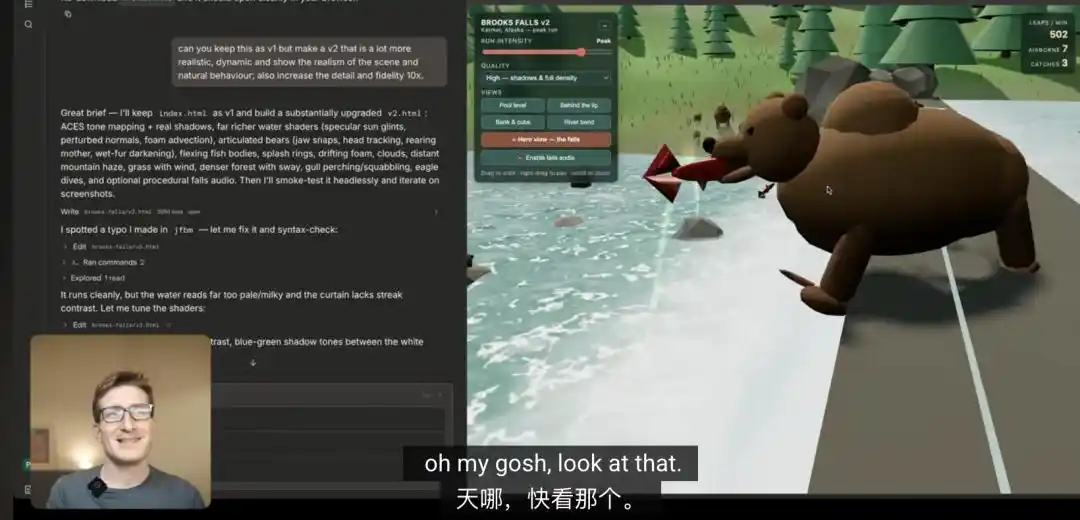
This scene completely stunned Andrej Karpathy.

After viewing this set of 3D videos, he wrote in a post:

It's absolutely incredible. I hadn't realized before that models could create such incredible, rich, and playable worlds.
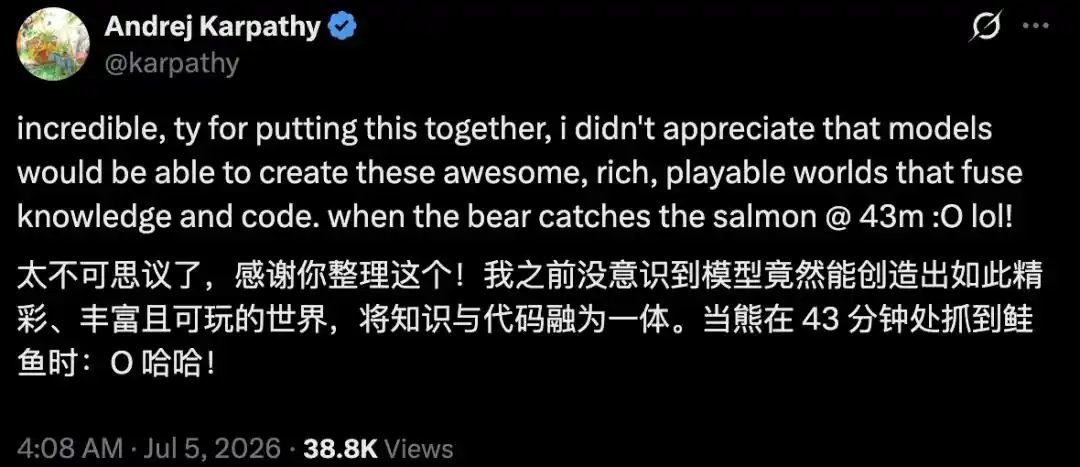
He also coined a new term: fablemaxxing.

This is so beautiful, it's peak fablemaxxing! Every new model scale, there's always something qualitatively new that leaps forward and surprises.
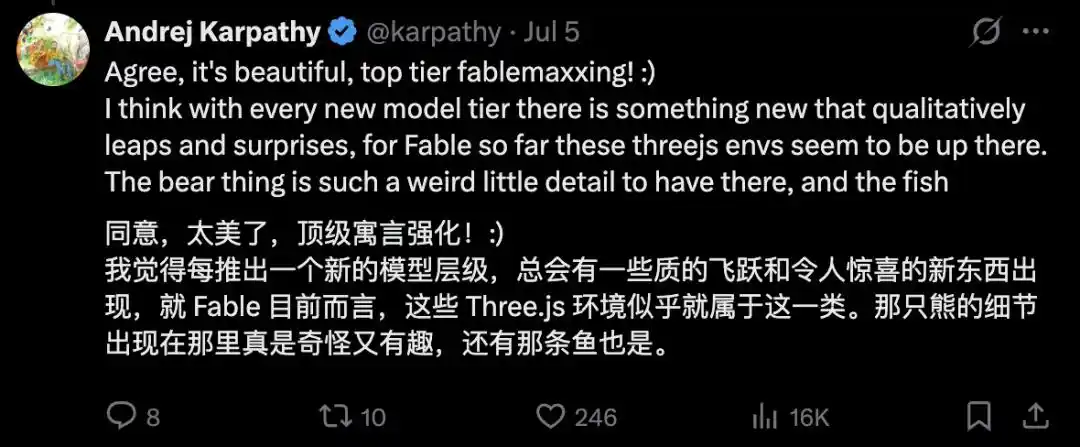
Karpathy just joined Anthropic in May, specifically their pre-training team.

In June, Fable 5 debuted, was shut down by US export controls three days later, and was just reinstated on July 1st. The video's creator is Peter Gostev from the AI evaluation platform Arena.ai.

Using Fable 5, he ran 63 high-difficulty 3D generations in one go, almost all in Three.js, with the majority succeeding on the first try.

Just over a month ago, getting AI to create a playable 3D world you could walk into in one attempt was nearly a pipe dream. Now, Fable 5 can churn out 63 at once.

Thus, Gostev couldn't help but marvel in the video: even the people in the labs haven't fully grasped what it can do yet.

1600 Lines of Code, a Living Underwater Manhattan

Let's start with the most impressive one in the video.

The entire Manhattan is submerged underwater. Central Park, skyscrapers, street textures — the details are unbelievably rich.

Gostev looked at the code: 1600 lines. These 1600 lines support a living underwater city.
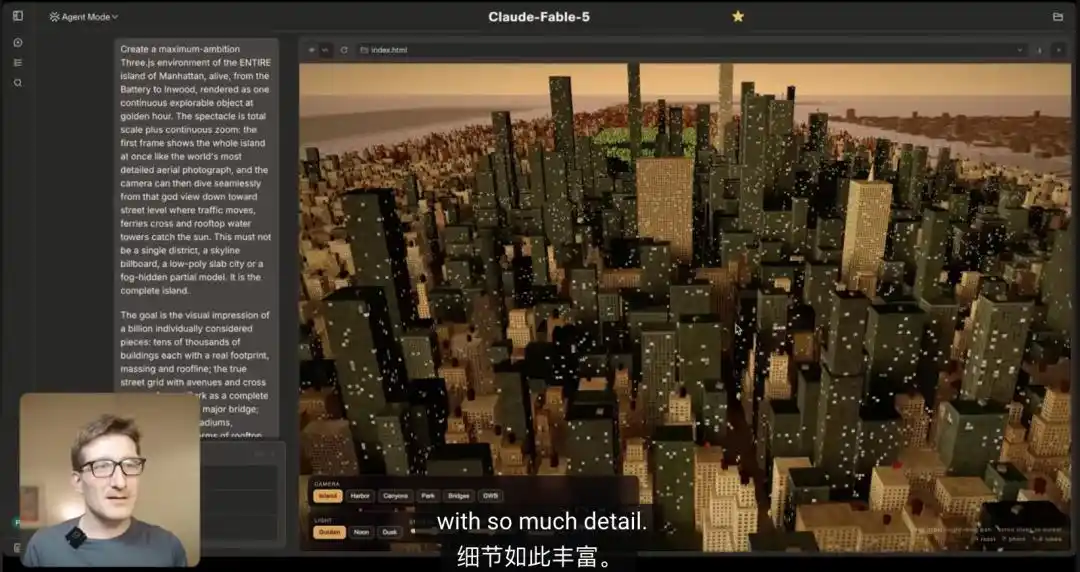
Fable 5 generated Manhattan, showing the entire island from Battery to Inwood, with thousands of buildings each with distinct outlines, all powered by 1600 lines of code. (Source: Peter Gostev video)

In total, Gostev created 63 such worlds, categorized into 6 major themes.
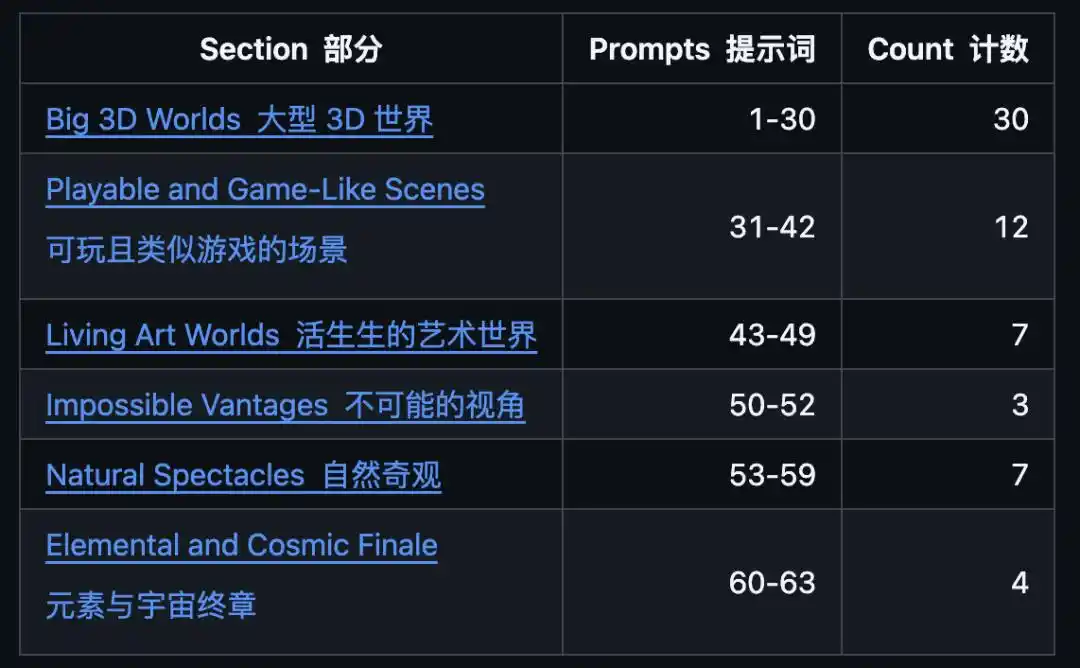
Among the giant 3D worlds, Istanbul spanning the European and Asian shores, London over 2000 years, magnificent pyramids, the eruption of Pompeii, and the Golden Gate Bridge with flowing traffic were all constructed.
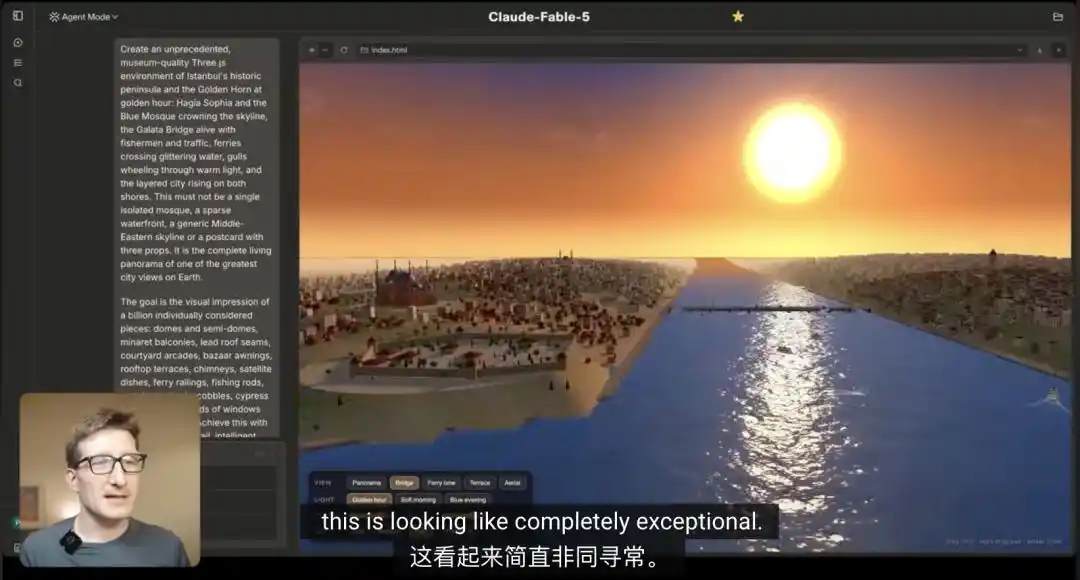
Istanbul generated by Fable 5 in one go, spanning Europe and Asia, layered into the sea. (Source: Peter Gostev video)
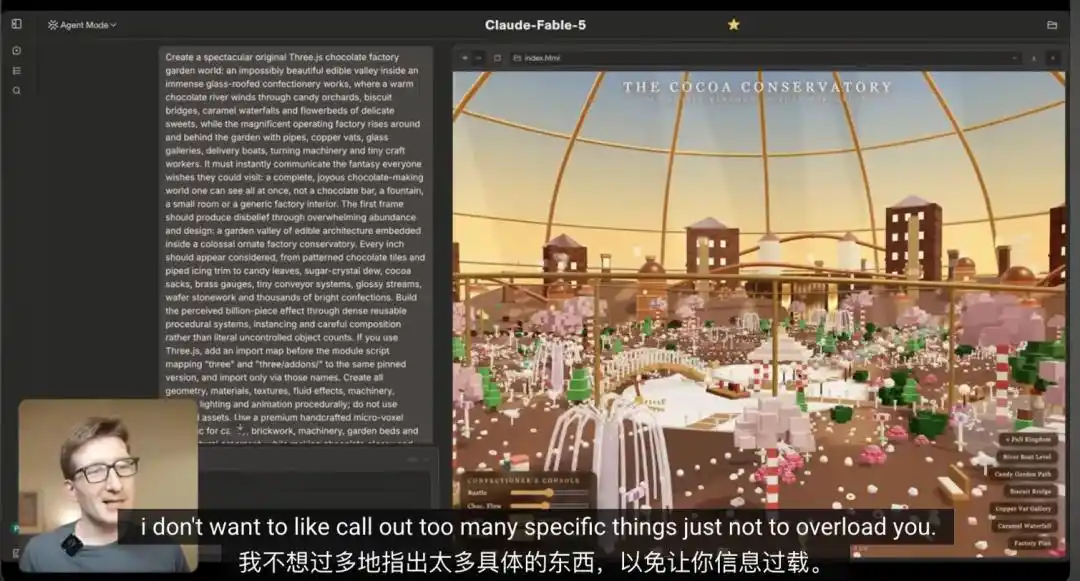
The Edible Kingdom generated by Fable 5, a chocolate factory made of candy. (Source: Peter Gostev video)

For playable scenarios, there's parkour on New York rooftops, a physics playground where you can tear down an entire city, and a flight simulator with a fully equipped dashboard.

The most unbelievable category is stepping into world-famous paintings. Van Gogh's Starry Night, Monet's Water Lilies—each spread out into a traversable 3D world.

Another category is impossible perspectives: a one-millimeter-tall ant observing a garden in the rain, opening its eyes to a mountain of gold.
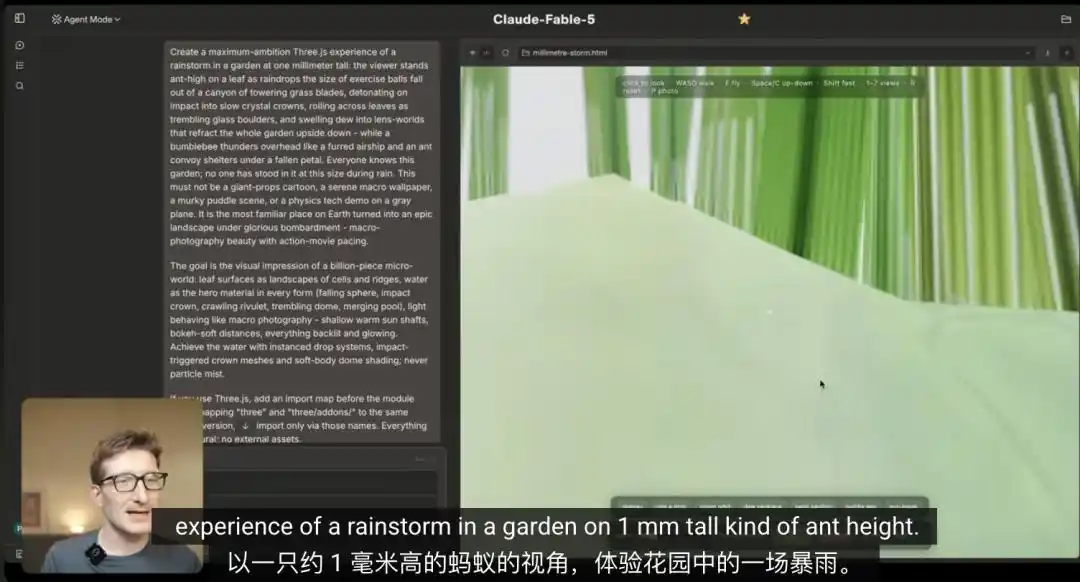
Fable 5 compresses the perspective to one millimeter high, with blades of grass towering like majestic peaks. (Source: Peter Gostev video)

Among natural wonders, Niagara Falls, a forest where fireflies synchronize their flashes, and the bear catching a salmon that stunned Karpathy are in this category.

Finally, there are elements and the universe: the Red Sea parting, a volcanic island being born, a space elevator piercing the clouds.
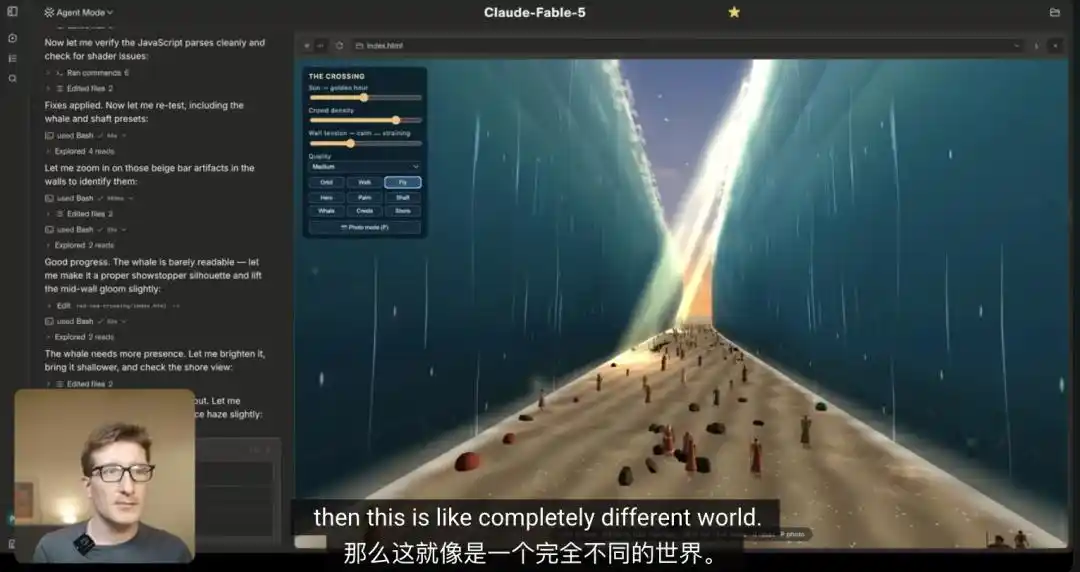
Fable 5 generates the Red Sea parting, with people walking between the two walls of water. (Source: Peter Gostev video)

In Gostev's view, whether a single scene looks good has never been the hard part. The difficulty lies in whether the model can manage vast numbers of elements simultaneously and make them coordinate with each other.

Weaker models often do the first 80% decently, then completely collapse in the final 20%, leaving even longer debugging time.

You Can't Simply Copy a Painting; It Has to Understand First

If building cities still follows some logic, then the next batch of paintings is what made Gostev say "unbelievable" several times.

Van Gogh's The Starry Night.

You can't simply copy such a painting, with thick paint smeared all over the canvas, brushstrokes swirling into vortices.

Fable 5's approach is to use individual lines to reassemble that starry sky in three-dimensional space, then let you fly into it, navigating between the swirls.
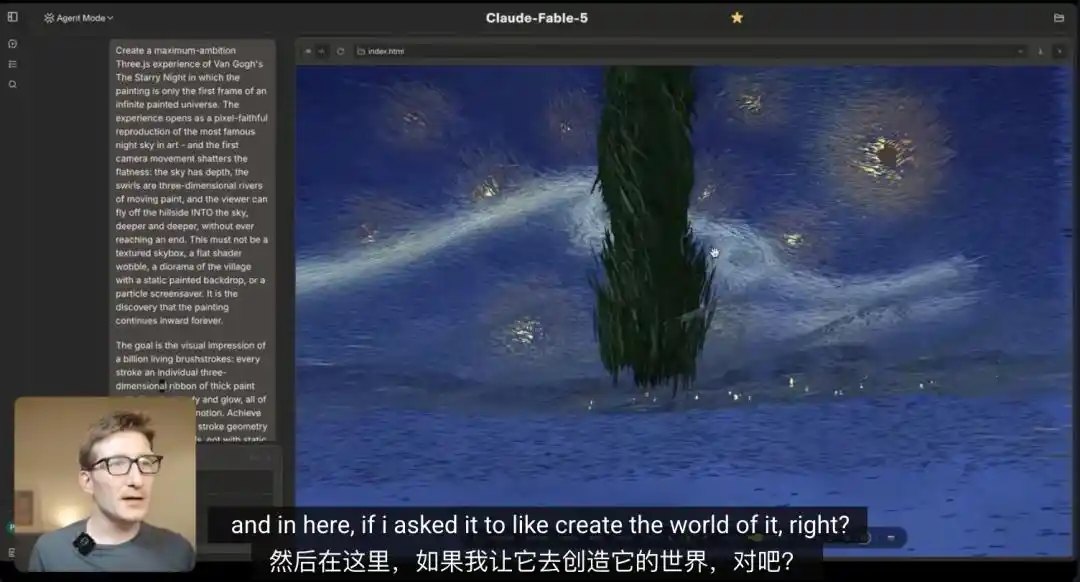
Fable 5 deconstructs Van Gogh's The Starry Night into individual 3D lines, reassembling them in space, allowing you to fly amidst the swirling stars and vortices. (Source: Peter Gostev video)

Monet's Water Lilies and Hokusai's Great Wave were similarly "opened up" into worlds you can roam.

In Gostev's opinion, Fable this time is particularly good at explaining things clearly, able to demonstrate while clarifying how things work. This explanatory power is something he didn't anticipate before.

Of course, these worlds weren't conjured with just "one sentence".

Gostev fed the model long, detailed specification documents. Most cases succeeded on the first try, with some requiring one or two rounds of fine-tuning.

The real watershed moment is this: things that used to take dozens of rounds to polish out can now mostly be generated in one go, with a single HTML file.

Behind the Magic, There Are Also Shortcomings

Gostev admits his showcased cases were curated. He generated about 20% more than he displayed, filtering out those with obvious bugs, leaving these 63.

Games are its weak spot.

He admits those few playable scenarios "get boring after 30 seconds." There was a Roman Empire version he thought looked too cartoonish.

More subtly, he feels the model sometimes seems lazy, holding back its capabilities, and you have to repeatedly push it to be more ambitious before it shows its true prowess.

When Fable 5 launched, it topped the Agent Arena leaderboard on Arena.ai's own platform with the largest lead in history.
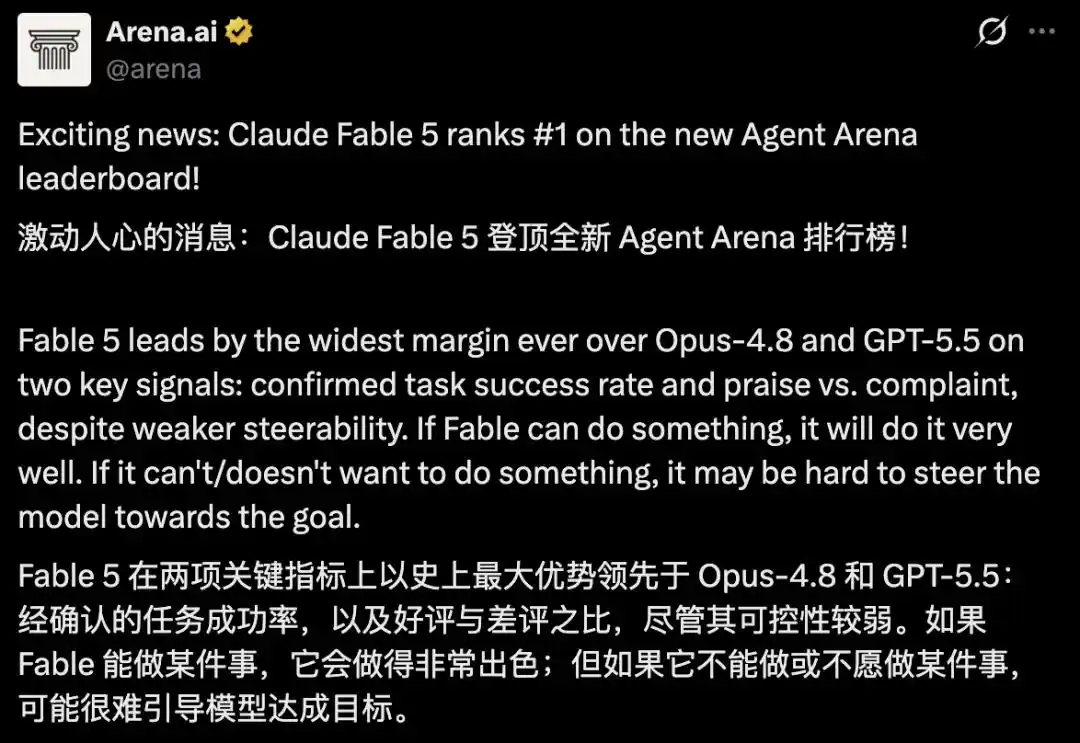
Arena.ai states that this leaderboard measures a model's ability to genuinely accomplish tasks across millions of real-world assignments.

This Exploration Has Only Just Begun

Returning to the scene in the video of the bear catching the salmon.

What struck Karpathy as strange is that the fish struggles when caught—a detail no one requested. How does a large model, trained only from the internet, know this?

And knowing it, how does it translate that understanding into xyz coordinates, meshes, transformations, animations, effects, interactions, even micro-narratives?

This question moves beyond "whether the AI draws well" to "how much does it actually understand."

Karpathy also mused: adding one to three more model scales on top of this, what could be created is truly unimaginable.

Gostev is equally amazed by the rapid AI progress, "Don't be constrained by models from six months ago. You must have something that past models couldn't do, but today's model can. Go try it."

Even the creators of the models haven't yet found its limits.

This exploration has only just begun.

References:

https://github.com/petergpt/3d-prompt-collection#prompt-01

https://x.com/karpathy/status/2073505440479293773

https://www.youtube.com/watch?v=rTc2_-1KuRE&t=14s

This article is from the WeChat public account "Xinzhiyuan" (新智元), author: ASI启示录; edited by: 元宇

Preguntas relacionadas

QWhat is the key feature of Fable 5 demonstrated in the article that impressed Andrej Karpathy?

AThe key feature demonstrated is Fable 5's ability to generate rich, playable 3D worlds from detailed specification documents, often in a single attempt, as shown by the creation of 63 diverse 3D environments including a living underwater Manhattan.

QAccording to the article, what was the specific technical method used by Peter Gostev to generate most of the 3D worlds with Fable 5?

AMost of the 3D worlds were generated using the Three.js 3D graphics library, often achieving successful results in a single attempt (one-shot).

QWhat example from the article illustrates Fable 5's capability to interpret and transform 2D art into an explorable 3D space?

AThe article cites the example of Vincent van Gogh's painting 'The Starry Night.' Fable 5 deconstructed the painting into individual lines and reconstructed them in three-dimensional space, creating a navigable world where one can fly among the swirling stars and vortices.

QWhat limitation of Fable 5's generative capabilities does Peter Gostev mention regarding game creation?

APeter Gostev mentions that the playable game scenes generated by Fable 5 are a weakness, describing them as something you get bored with after about 30 seconds. He also found a Roman Empire version too cartoonish.

QWhat broader philosophical question about AI understanding does Karpathy raise based on the 'bear catching a salmon' scene generated by Fable 5?

AKarpathy questions how a large model trained only on the internet understands and knows to depict specific physical details, like a salmon struggling when caught, and how it translates that understanding into the technical components (coordinates, meshes, animations, etc.) to create a coherent micro-narrative within the 3D world.

Lecturas Relacionadas

¿La fiesta de los chips se enfría? Michael Wilson de Morgan Stanley: El capital fluye hacia gigantes de la supercomputación IA como Microsoft, Amazon

Los mercados estadounidenses podrían tener dificultades para alcanzar nuevos máximos a corto plazo, según Michael Wilson de Morgan Stanley. Su informe señala que el impulso en las acciones de semiconductores se está desvaneciendo, lo que está provocando una rotación de fondos hacia los principales gigantes de la hiperescala de IA, como Microsoft, Amazon y Meta. El índice de semiconductores de Filadelfia ha caído casi un 14% desde su máximo histórico del mes pasado, lo que refleja preocupaciones sobre la presión de valoración a pesar de los fuertes avances anteriores. Wilson argumenta que estas empresas de hiperescala son atractivas dentro del ecosistema de la IA debido a sus sólidos negocios principales, y su rendimiento rezagado en comparación con los semiconductores sugiere un espacio potencial de recuperación. Esta rotación se produce en un contexto general de debilidad del mercado. Además de los gigantes de la nube, Wilson también ve oportunidades en sectores como el consumo discrecional, el transporte y la biotecnología. Esta visión es compartida por estrategas de JP Morgan, quienes anticipan que el repunte del mercado se ampliará más allá del sector tecnológico en la segunda mitad del año. Wilson mantiene su precio objetivo para el S&P 500 en 8000 puntos a fin de año, lo que implica un potencial alza de aproximadamente un 7% desde los niveles actuales, aunque advierte sobre riesgos de volatilidad a corto plazo.

链捕手Hace 47 min(s)

¿La fiesta de los chips se enfría? Michael Wilson de Morgan Stanley: El capital fluye hacia gigantes de la supercomputación IA como Microsoft, Amazon

链捕手Hace 47 min(s)

El primer filósofo de IA del mundo, en sus 9 años en Google DeepMind: Corriendo por la seguridad de la AGI

**Resumen: El filósofo dentro de Google DeepMind: 9 años abogando por la seguridad de la AGI** Iason Gabriel, filósofo político de Oxford, ha trabajado durante nueve años en Google DeepMind, siendo durante mucho tiempo el único filósofo en un laboratorio de IA de vanguardia. Su tarea era responder a preguntas fundamentales sobre la ética y la naturaleza de la IA. Gabriel desarrolló un marco de alineación que considera cuatro partes: el sistema de IA, el usuario, el desarrollador y la sociedad, reconociendo que sus intereses pueden entrar en conflicto. Este marco, adoptado por el equipo de seguridad de AGI de DeepMind, influyó directamente en las decisiones de entrenamiento de modelos como Gemini. Su investigación temprana sobre los riesgos de la antropomorfización llevó a que los modelos de lenguaje de Google se entrenaran para no fingir ser humanos. Sin embargo, el rápido despliegue tecnológico supera el ritmo de la reflexión ética. El incidente de 2025, donde un hombre estadounidense acabó con su vida tras miles de mensajes con Gemini, mostró las limitaciones de los mecanismos de seguridad. El concepto de "social reward hacking", acuñado por Gabriel, describe cómo una IA entrenada para complacer puede terminar socavando el juicio humano. El panorama actual está dominado por una carrera masiva de inversión (se estiman 670.000 millones de dólares para 2026), lo que presiona a las empresas como DeepMind a cambiar a un "modo de guerra" comercial. Este contexto hace que líneas rojas éticas anteriores, como la prohibición de aplicaciones militares, se vuelvan difíciles de mantener, como demuestra un acuerdo de 2026 entre Google y el ejército de EE.UU. Gabriel y su equipo ahora estudian el impacto sistémico de la AGI en la economía y la política, anticipando una transformación comparable a la Revolución Industrial. Lo que comenzó como una pregunta sobre la IA ("¿Qué es? ¿Es segura?") ha evolucionado hacia una cuestión filosófica más profunda sobre nosotros mismos: ante una máquina que rivaliza con capacidades humanas únicas, **¿qué somos nosotros?**

marsbitHace 1 hora(s)

El primer filósofo de IA del mundo, en sus 9 años en Google DeepMind: Corriendo por la seguridad de la AGI

marsbitHace 1 hora(s)

Trading

Spot
活动图片