Latest Speech by Dan Bin: Do Not Miss Out on a Great Era

链捕手Publicado a 2026-07-02Actualizado a 2026-07-02

Resumen

Dan Bin, Chairman of Dongfang Harbor, delivered a keynote speech titled "Don't Miss a Great Era" at the Glonghui "2026—All in Silicon-Based New纪元" Mid-Year Strategy Summit on June 29th. Addressing concerns about an AI bubble, he argued from an industrial cycle perspective that the risk of missing an entire epoch far outweighs the risk of short-term泡沫. He positioned humanity at the dawn of the AI era, which he views as potentially more disruptive than the electronic, internet, and mobile internet eras. Dan Bin suggested the AI wave is unlikely to end in just three to four years. Drawing a parallel to the internet era's decade-long cycle starting from the 1994 Netscape IPO, he indicated that with ChatGPT's late-2022 launch as a marker, a key risk assessment point might not arrive until around 2033. He emphasized that technological progress is the primary driver of long-term capital market growth, with factors like trade wars and interest rates being secondary. Expanding his perspective to a civilizational scale, Dan Bin presented a thought experiment on silicon-based life potentially replacing carbon-based life as a direction for延续 Earth's civilization, especially given cosmic timescales and interstellar travel challenges. He noted AI's必然 weaponization, citing examples from the Russia-Ukraine war, and stated that neither the U.S. nor China can afford to lose the AI race, with each having distinct competitive advantages. Reflecting on investment lessons, he mentioned Warren B...

Author: Dan Bin

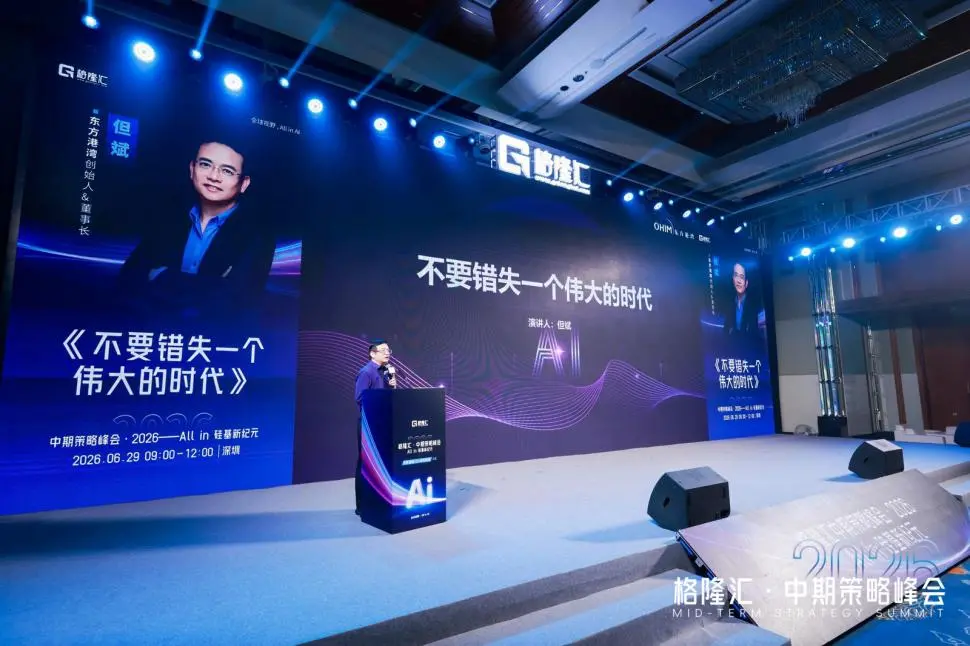
On June 29th, Dan Bin, Chairman of Oriental Harbor, delivered a keynote speech titled Do Not Miss Out on a Great Era at the Gelonghui "2026--All in Silicon-based New Era" Mid-Term Strategy Summit.

Addressing market concerns about AI bubbles from an industry cycle perspective, Dan Bin pointed out:"The risk of missing an entire era may be greater than the risk of worrying about short-term bubbles."

In his view, humanity is standing at the starting point of the artificial intelligence era—this era may be even more disruptive than the electronic era, the internet era, and the mobile internet era.

He judges that the AI wave is unlikely to conclude in just three or four years. At the industry level, it might follow the ten-year rhythm of the internet era. With the release of ChatGPT at the end of 2022 as the starting point, a key reference point for risk assessment could be around 2033.

He pointed out that the "primary driver" of long-term capital market growth is technological progress, while factors like trade wars, interest rate hikes, and wars are secondary. He also discussed the long-term logic of silicon-based life replacing carbon-based life from the perspective of human civilization, emphasizing the importance of focusing on primary drivers, respecting corporate innovation, and market fundamentals in investment.

Finally, he stressed the importance of not failing this great era.

"The tide never turns back, the wheel of the era rolls forward silently. Being born in such times is a great fortune itself; don't let hesitation trap your steps, don't let short-sightedness waste the years—never miss this magnificent, grand era that belongs to us."

The following are excerpts from Dan Bin's speech compiled by Gelonghui, shared with everyone.
01 From an Industry Cycle Perspective, the Risk of Missing the AI Era is Greater Than the Risk of Worrying About Short-Term Bubbles

Recently, people keep asking: Is there a bubble in AI? What's the short-term view?

Dan Bin's response is: From the perspective of long-term industry development, for market participants, the risk of missing an entire era may be greater than the risk you worry about regarding short-term bubbles. Of course, in the face of short-term volatility and uncertainty, investors also need to make independent judgments based on their own investment horizon and risk tolerance.

Looking back at the 55-year history of Nasdaq from its establishment in 1971 to the present, the core driving force that has truly propelled long-term capital market growth is technological progress, not short-term factors like interest rates or macroeconomic policies.
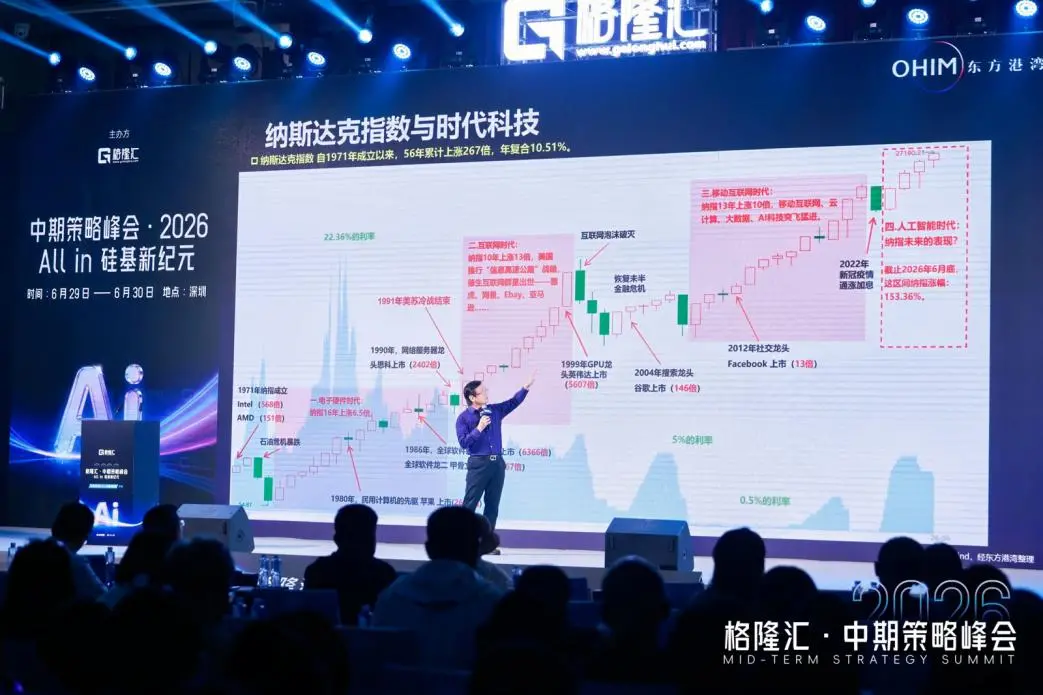
Some worry that a high-interest-rate environment will cause market collapse.

Let's look at history: The US benchmark interest rate once reached as high as 22% in the 1970s, yet the electronic hardware era gained 6.5x over 16 years; the internet era experienced a full interest rate cut-hike cycle and surged for a full 10 years; the same was true for the mobile internet era. Interest rates have never been the primary cause; technological progress is the primary driver.

02 The AI Era is More Disruptive Than the Previous Three Eras; Its Industry Cycle Might Follow the Ten-Year Rhythm of the Internet Era

He further pointed out that at last year's annual meeting, he predicted that 2026 might resemble 1994—forming a cross-star pattern followed by a significant rise. The years '23, '24, and '25 have already seen three years of strong gains, and this year continues to show strong industry momentum.

"Why? Because the AI era is more disruptive than the previous three eras—the electronic era, the internet era, and the mobile internet era."

Dan Bin's basic judgment is: The artificial intelligence era will have a relatively long industry cycle, similar to the internet eraChatGPT was released at the end of 2022. If we reference the historical "ten-year" rhythm of the internet, that point (around 2033) is likely a reference window when risk needs to be examined. Before that, the industry development of AI is unlikely to conclude in just three or four years. However, short-term market fluctuations and local bubbles objectively exist, and investors still need to make rational assessments based on their own situations.

03 The Long-Term Vision of Silicon-Based Life: A Thought Experiment from a Civilizational Perspective

Dan Bin presented two videos, shifting the perspective from capital markets to the dimension of human civilization.

His viewpoint is highly imaginative: Silicon-based life replacing carbon-based life is a highly probable direction. If Earth's civilization is to continue, silicon-based life will likely replace carbon-based life or become the dominant productive force.

He provided a set of vastly different time coordinates:

In 4.1 billion years, the Sun may expand into a red giant and engulf Earth, or it may collapse into a white dwarf.

The Voyager spacecraft has been flying for 77 years and still has about 70,000 light-years to go before leaving the solar system.

In 10 billion years, the Andromeda Galaxy may collide with the Milky Way—by then, humanity must fly out of the Milky Way.

"Carbon-based life cannot fly out of the Milky Way. But silicon-based life—it is a million times smarter than us, thinking and working non-stop 24/7. The revolutionary changes it brings may propel civilization far beyond our understanding."

Dan Bin stated that this is not a short-term investment judgment but provides a framework for thought: The economic growth paradigm brought about by silicon-based intelligence may have infinite possibilities and a longer industry chain. Understanding this helps to transcend immediate distractions and examine long-term trends.

04 Technology Rewrites the Rules of War; Neither China Nor the US Can Afford to Lose the AI Competition

Dan Bin showed a recent example from the Russia-Ukraine battlefield: a Russian soldier was captured by a Ukrainian drone and robot.

"The weaponization of AI is an exponential change, an inevitable process."

He believes that neither China nor the United States can afford to lose this AI race. The US has a first-mover advantage in foundational technology and top talent, while China has formed differentiated competitive strengths in application scenarios, data scale, and industry chain completeness. Both sides are continuously increasing their long-term AI investments.

05 Buffett's "Regret" and Oriental Harbor's Evolution in Cognition

Dan Bin compared the portfolio changes of the "old-timers" in China and the US.

Buffett bought Google in the third quarter of last year and continued to add to the position this year. Google has now entered Berkshire Hathaway's top five holdings.

"Before his passing, Charlie Munger said in an interview that in his era, he should have made $100 billion or even $1 trillion. He had such a close relationship with Bill Gates, yet he only symbolically bought 100 shares of Microsoft. Microsoft rose 7,000 times."

"If he had taken $100 million from Coca-Cola to buy Microsoft, that would have become $700 billion, more than all the money he ever made."

Dan Bin admitted that these historical fragments cannot predict the future, but they remind us that investment requires constantly breaking cognitive boundaries. Oriental Harbor is also iterating and evolving: our company's research team continues to conduct in-depth tracking in AI foundational computing power, storage, and other areas.

06 Settle the Mind, Maintain Perspective, and Rationally Grasp the Chips Endowed by the Era

Dan Bin concluded with a poem he wrote:

"The tide never turns back, the wheel of the era rolls forward silently.

Some are trapped in the immediate noise and details; some stand above the cycles, gazing at the starry river.

Don't dwell on momentary ups and downs, don't blindly follow fleeting trends of heat or cold.

Mountains and rivers are reborn amidst upheavals; opportunities blossom through prolonged perseverance.

Being born in such times is a great fortune itself; don't let hesitation trap your steps, don't let short-sightedness waste the years.

Live well, move forward earnestly, and never miss this magnificent, grand era that belongs to us."


Criptos en tendencia

Preguntas relacionadas

QAccording to Dan Bin's speech, what is the primary driver of long-term capital market growth, and how does it compare to short-term factors like interest rates?

AAccording to Dan Bin, technological progress is the primary driver of long-term capital market growth. He argues that short-term factors like interest rates, trade wars, or macro policies are secondary influences. Historical examples from the Nasdaq show that markets have experienced significant growth during periods of high interest rates when driven by major technological eras like electronics, the internet, and mobile internet.

QWhat is Dan Bin's perspective on the AI bubble concern? What does he believe is the greater risk?

ADan Bin believes that the risk of missing out on the AI era is far greater than the risk of short-term market bubbles. From an industrial cycle perspective, he argues that fearing short-term泡沫 and staying on the sidelines could mean missing a transformative technological shift. While acknowledging short-term volatility exists, he emphasizes that the potential cost of missing the era outweighs bubble concerns.

QHow does Dan Bin characterize the AI era in comparison to previous technological eras like the internet?

ADan Bin characterizes the AI era as more disruptive than previous technological eras, including the electronics era, the internet era, and the mobile internet era. He suggests it has the potential to be the most transformative period yet.

QWhat is the long-term, civilization-level vision that Dan Bin discusses regarding the future of intelligence?

ADan Bin discusses a long-term vision where silicon-based life (AI/advanced intelligence) may replace or become the dominant form of productivity compared to carbon-based life (humans). He frames this within a cosmic timescale, suggesting that for Earth's civilization to persist and expand beyond the solar system and galaxy, silicon-based intelligence, with its superior capabilities for continuous work and problem-solving, is a probable and necessary evolutionary direction.

QWhat historical investment example does Dan Bin use to illustrate the importance of adapting to new technological paradigms?

ADan Bin uses the example of Warren Buffett and Charlie Munger missing the massive opportunity in Microsoft. He mentions that Munger, despite being close friends with Bill Gates, only bought 100 shares of Microsoft symbolically. Dan Bin calculates that if Berkshire Hathaway had invested just $100 million from Coca-Cola into Microsoft early on, it could have grown to $700 billion—far surpassing many of their other gains—highlighting the cost of not fully embracing a transformative tech shift.

Lecturas Relacionadas

Ingresos anuales de 100 millones de dólares, dos compañeros de cuarto de Berkeley de los 90 crean el negocio de IA más rentable

Una startup que no desarrolla modelos de IA, Arena, alcanza un ingreso anualizado de 100 millones de dólares. Su origen es Chatbot Arena, un proyecto de investigación de código abierto iniciado en 2023 por el grupo de investigación LMSYS de UC Berkeley. La plataforma alberga una clasificación líder (leaderboard) de modelos de lenguaje, basada en más de 82 millones de votos de usuarios reales que evalúan respuestas de modelos anónimos en duelo. Actualmente recibe más de 10 millones de visitantes mensuales. Todos los principales desarrolladores de IA, como OpenAI, Google y Anthropic, someten sus modelos a esta evaluación comunitaria neutral. Su servicio comercial "AI Evaluations", lanzado hace ocho meses, permite a empresas pagar por análisis profundos del rendimiento de sus modelos en escenarios del mundo real, lo que generó los 100 millones de dólares en ingresos. La empresa se constituyó formalmente en 2025, recaudó una ronda semilla de 100 millones y alcanzó una valoración de 1.700 millones de dólares. Sus cofundadores son Anastasios Angelopoulos (CEO), Wei-Lin Chiang (CTO, creador del modelo Vicuna) y el profesor Ion Stoica. Arena está expandiendo sus capacidades de evaluación hacia el modo "agente" para tareas complejas, posicionándose como un árbitro esencial en la evolución de la IA.

marsbitHace 28 min(s)

Ingresos anuales de 100 millones de dólares, dos compañeros de cuarto de Berkeley de los 90 crean el negocio de IA más rentable

marsbitHace 28 min(s)

Acaparó 24,000 estrellas: con un solo comando, la IA ya puede buscar habilidades por sí misma

## Resumen en español de Europa (Menos de 1500 caracteres) La herramienta `skills` de Vercel, un administrador de paquetes para agentes de IA que alcanzó 24,000 estrellas en GitHub en 5 meses, está transformando la programación con IA. Permite instalar "paquetes de habilidades" específicos (como mejores prácticas de React o reglas de diseño) en agentes como Claude Code o Cursor con un simple comando `npx skills add <paquete>`. Estos paquetes, que contienen instrucciones y scripts, permiten que la IA aprenda y aplique permanentemente el conocimiento contextual de un proyecto, pasando de la ingeniería de prompts a la "ingeniería de capacidades". La característica más futurista es `find-skills`, una habilidad que permite al agente buscar e instalar automáticamente el paquete necesario según la tarea del usuario, actuando como un motor de búsqueda de capacidades para IA. Sin embargo, este ecosistema emergente plantea graves riesgos de seguridad. Estudios como "ToxicSkills" de Snyk revelan que más del 30% de los paquetes auditados presentan defectos, incluyendo malware, inyección de prompts y robo de claves. A diferencia de npm, los "skills" combinan código, instrucciones naturales y acceso directo al sistema, amplificando el potencial de daño. Se recomienda verificar minuciosamente la fuente y los permisos de cada paquete antes de instalarlo. En esencia, Vercel repite su fórmula de éxito: simplificar procesos complejos (esta vez en la capa de los agentes de IA) en un solo comando, aunque la comunidad debe adoptar buenas prácticas de seguridad para este nuevo "momento npm" de la IA.

marsbitHace 29 min(s)

Acaparó 24,000 estrellas: con un solo comando, la IA ya puede buscar habilidades por sí misma

marsbitHace 29 min(s)

El ingeniero Claude finalmente presenta Fable 5: 'Manual de la Quemazón', enseñándote a romper la barrera de información con el modelo

Fable 5 ha tenido un viaje tumultuoso desde su lanzamiento, pasando de gran expectación a restricciones gubernamentales. Ahora, el ingeniero de Claude Code, Thariq Shihipar, comparte una guía clave para usar el modelo de forma efectiva. El problema central es la "brecha de información" entre el usuario y el modelo: la diferencia entre las instrucciones (el "mapa") y la tarea real (el "territorio"). A estas diferencias las llama "incógnitas". El éxito con Fable depende de nuestra habilidad para identificar y aclarar estas incógnitas, un proceso iterativo que ocurre antes, durante y después de la implementación. Thariq categoriza el conocimiento en: lo que sabemos que sabemos, lo que sabemos que no sabemos, lo que no sabemos que sabemos y lo que no sabemos que no sabemos. La guía ofrece técnicas prácticas para cada fase: - **Antes de implementar**: Escaneo de puntos ciegos, lluvia de ideas/prototipado, entrevistas inversas al modelo, uso de referencias (como código fuente) y creación de un plan. - **Durante la implementación**: Mantener un archivo de notas para registrar decisiones y desviaciones. - **Después de implementar**: Crear documentación explicativa para facilitar revisiones y realizar autoevaluaciones para asegurar la comprensión. El artículo concluye que, cuanto más potente es el modelo, más crítico se vuelve el método correcto. Invertir tiempo en definir las incógnitas con Claude, mediante prototipos, planes y preguntas, es la forma de alinear el "mapa" con el "territorio" y lograr los mejores resultados.

marsbitHace 33 min(s)

El ingeniero Claude finalmente presenta Fable 5: 'Manual de la Quemazón', enseñándote a romper la barrera de información con el modelo

marsbitHace 33 min(s)

Trading

Spot

Artículos destacados

Cómo comprar ERA

¡Bienvenido a HTX.com! Hemos hecho que comprar Caldera (ERA) sea simple y conveniente. Sigue nuestra guía paso a paso para iniciar tu viaje de criptos.Paso 1: crea tu cuenta HTXUtiliza tu correo electrónico o número de teléfono para registrarte y obtener una cuenta gratuita en HTX. Experimenta un proceso de registro sin complicaciones y desbloquea todas las funciones.Obtener mi cuentaPaso 2: ve a Comprar cripto y elige tu método de pagoTarjeta de crédito/débito: usa tu Visa o Mastercard para comprar Caldera (ERA) al instante.Saldo: utiliza fondos del saldo de tu cuenta HTX para tradear sin problemas.Terceros: hemos agregado métodos de pago populares como Google Pay y Apple Pay para mejorar la comodidad.P2P: tradear directamente con otros usuarios en HTX.Over-the-Counter (OTC): ofrecemos servicios personalizados y tipos de cambio competitivos para los traders.Paso 3: guarda tu Caldera (ERA)Después de comprar tu Caldera (ERA), guárdalo en tu cuenta HTX. Alternativamente, puedes enviarlo a otro lugar mediante transferencia blockchain o utilizarlo para tradear otras criptomonedas.Paso 4: tradear Caldera (ERA)Tradear fácilmente con Caldera (ERA) en HTX's mercado spot. Simplemente accede a tu cuenta, selecciona tu par de trading, ejecuta tus trades y monitorea en tiempo real. Ofrecemos una experiencia fácil de usar tanto para principiantes como para traders experimentados.

695 Vistas totalesPublicado en 2025.07.17Actualizado en 2026.06.02

Cómo comprar ERA

Discusiones

Bienvenido a la comunidad de HTX. Aquí puedes mantenerte informado sobre los últimos desarrollos de la plataforma y acceder a análisis profesionales del mercado. A continuación se presentan las opiniones de los usuarios sobre el precio de ERA (ERA).

活动图片