Glue Finance Founder: ETH Has Entered a Phase of Non-Consensus, an Inflection Point Is Coming

marsbitPublicado a 2026-06-26Actualizado a 2026-06-26

Resumen

"Glue Finance founder argues Ethereum's current price underperformance stems from its 'unfinished machine' status. Despite record usage and settlement value in 2026, ETH remains below its 2021 peak because the protocol's continued development creates a dependency on the Ethereum Foundation for guidance and fixes. Key issues include centralized L2 sequencers, governance-based freezes (as seen with Arbitrum), state bloat, a vulnerable public mempool, and looming quantum computing threats. This 'dependency discount' prevents ETH from accruing the 'ossification premium' that markets award to immutable, trustless systems like Bitcoin. The author, a self-described Ethereum maximalist, rejects two flawed escape paths: a 'war mode' shift towards centralization for speed (which would sacrifice Ethereum's core value), or simply replacing the EF with another governing body. The only solution is the 'Manhattan Plan' or 'Lean Ethereum': a concerted, accelerated effort to complete and then *freeze* the protocol's neutral core. This involves finalizing critical upgrades in consensus (Lean Consensus), scaling (targeting 1 trillion gas/sec), quantum resistance (leanXMSS signatures), and full ZK-provable execution. The goal is to pass the 'walk-away test'—where Ethereum could run forever, neutrally, without the EF. Success would transform Ethereum into the first programmable, quantum-resistant, immutable global settlement layer, flipping its current discount into a unique 'eternity premium' ...

Author:@LaLiLuLeL0x

Compiled by: Jiahuan, ChainCatcher

The debate about the stewards is just a distraction. Ethereum truly wins when it no longer needs any stewards, when its core is frozen and beyond the reach of the EF, Ethlabs, or any future successors. This is its "Manhattan Project," and it's progressing quite well.

It's mid-2026, and the data doesn't add up. Ethereum is settling more value than ever, hosting the vast majority of stablecoins, tokenized funds, and DeFi. Yet ETH trades around $1,750, down about 57% from the 2025 highs and still below the peak set in 2021.

Five years have passed, a full technical transformation is complete, yet the asset price lags behind its past. Something must be wrong, and the comforting explanations about macroeconomics, the Fed, and capital rotation to Bitcoin don't get to the root of it.

The real explanation is more brutal, and that's the whole reason I'm writing this. Ethereum is a running but unfinished machine. It runs, it's decentralized, it never goes down. But it's full of half-built, in-progress, promised-not-delivered features.

Especially after the Merge and the rollup-centric roadmap, it feels less like a finished network and more like a long-term promise, credibly neutral and decentralized on paper, but every upgrade quietly adds a new pile of problems that must be solved for that promise to fully materialize, and each pile ultimately lands on the same small group of people to clean up.

An unfinished machine needs mechanics. So, while Ethereum is formally independent, with no single entity in control, in practice it still indirectly depends on the goodwill of the Ethereum Foundation to keep building and steering.

The market isn't mispricing Ethereum's usage. The market is pricing this dependency. And the project to finally fix this has a name: Lean Ethereum, also known as Ethereum's Manhattan Project.

Let me break this down step by step, because I know it will make many people angry. But I believe this hits exactly on the reality, the real challenge Ethereum faces today in leadership and at the protocol level. Remember, I'm an Ethereum maximalist. I'm not here to spread FUD, I'm here to keep the conversation pointed in the right direction. I have my view. Let me have the chance to make it clear.

1. The State of the Machine

Look honestly at where Ethereum is.

The L2 bet has lost half of what matters. The rollup-centric roadmap was supposed to scale without losing decentralization. Years later, every major L2 still runs a centralized sequencer—a single operator ordering transactions, which can censor, extract value, or simply go down, like Linea pausing in 2024 or Base going offline in 2025.

Out of dozens of rollups, almost none have passed the first stage of maturity according to L2Beat's own metrics, let alone the second stage of full trustlessness.

We did this to ourselves.

The only viable defense for centralized sequencers was always the escape hatch. Even if the operator censors you or shuts down entirely, the rollup should let you force your transaction from L1 and withdraw your assets back to Ethereum without anyone's permission.

This guarantee is why centralized sequencers were tolerated in the first place: the keys to the chain are never in your hands, but the exit always is.

Yet, the exit proved conditional. In April 2026, after the Kelp DAO bridge was drained of roughly $292 million, Arbitrum's Security Council—twelve elected members—used emergency powers to step in and forcibly move 30,766 ETH (about $71 million) from the attacker's address into a governance-controlled wallet.

Freezing a thief's loot might sound like the system working, and perhaps it is. But see what this proves. A small council can proactively seize and freeze funds on Arbitrum, meaning your assets there are at their discretion. If a power can stop a hacker, it can stop anyone, including under a subpoena or government pressure.

The escape hatch saves you only if no one holding privileged keys decides otherwise. The irony writes itself: the moment the on-chain freeze went into effect, a U.S. court pierced straight through Arbitrum's supposedly "decentralized" governance, ordering the DAO not to move the funds at all. So much for unstoppable.

The base layer itself carries open wounds that may never heal. State bloat keeps increasing the data every node must store. The mempool is worse.

Because pending transactions are stored publicly, using the public mempool has become a frontrunning death spiral: the moment you broadcast a transaction, it's seen, sandwiched, tailgated before it confirms, a permanent tax where bots extract value from regular users simply for seeing order flow first.

The fix, encrypted mempools, has been discussed and drafted for years, still not live. These aren't rare edge cases. They are core properties for anything claiming to be a neutral settlement layer, and they remain tagged as "under construction."

Quantum computing is no longer sci-fi without a date. Vitalik's 2026 cryptography roadmap names four parts of Ethereum that could be broken by a quantum computer, with the threat model including "record now, decrypt later"—an adversary records encrypted data today to decrypt it when the hardware arrives.

This is a countdown, and the clock is ticking.

Against this backdrop, one faction wants Ethereum to respond by going into war mode. Get aggressive, play nice with institutions on their terms, relax the decentralization standards that slow everything down, get faster, more centralized, to compete on throughput with Solana and pump the price.

This sounds ambitious. It's actually surrender.

Because if Ethereum trades away the neutrality that makes it different, it doesn't beat Solana, it just becomes a slower Solana.

The best outcome for the war-mode route is Ethereum falling to Solana's valuation, because that's what the market pays for a fast chain that gave up credible neutrality. You cannot win the monetary premium by becoming something that never had one.

2. Why ETH Isn't at $10K

So here's the answer to the question every ETH holder has been agonizing over.

The reason ETH isn't at five figures, or even holding its old highs while the underlying network keeps growing, isn't a lack of usage. Its usage is overwhelming. The reason is the machine isn't finished, and an unfinished machine is unreliable, can't be counted on to stand alone.

Think about what a global settlement layer really needs to promise. Not speed. Not features. It must promise the ground won't move under you, that you can settle a billion dollars on it today, and tomorrow the rules are the same, and no one can unilaterally change them.

Ethereum can't make that promise yet, because Ethereum is still under construction, and the act of construction is the act of change. Scaling isn't done. L2 decentralization isn't done. The consensus layer is a five-year-old design waiting to be replaced.

Quantum resistance is a roadmap, not delivered fact. Every unfinished gap is a place where the protocol still needs to change, and every change must be decided by someone.

That someone is the Ethereum Foundation. It's not a conspiracy; it's because they're the ones who can finish the unfinished machine.

The market sees this clearly. The market will not pay an eternal premium to a chain that obviously still needs its founders to complete and steer it. A settlement layer dependent on mechanics is not a settlement layer. It's just a nice machine with a service contract. That's what $1,750 is pricing. Dependency.

I argued the bullish side in "The Rigidity Premium": the market pays for eternity, and the chain that becomes most immutable wins the monetary prize. This is the other side of the same coin. Ethereum hasn't earned that premium because it hasn't become immutable. It's not set; not set needs management, and needing management gets a discount.

3. Everyone Is Exhausted

An unfinished machine has a cost, one that never shows up in price, only felt by the people building here themselves. Everyone building on Ethereum is exhausted, and the exhaustion at every layer is the same: the ground keeps moving under them, so you can't build anything lasting on top of it.

Start with L2s. They can't fully decentralize because they're stuck waiting for the next standard, the next blob upgrade, the next interoperability layer, the next account abstraction model, and the next thing the base layer is about to change. So they keep the keys.

As of 2026, no major rollup has reached Stage 2 on L2Beat's scale; Arbitrum and Optimism are both stuck at Stage 1, meaning a Security Council holding upgrade keys remains a core trust point, a multisig that can rewrite bridges or shut down proofs.

Everyone says it's the price of early days. But early days never end because the base is unpredictable, so centralization never leaves.

One layer up, Dapps have the same exhaustion. They're forced to deploy on every L2 simultaneously—Arbitrum, Optimism, Base, ZK-chains, etc.—maintaining a dozen deployment instances, fragmenting liquidity, and trusting cross-chain bridges that are themselves attack surfaces.

Because the base is uncertain, they keep their contracts upgradeable, holding admin keys, proxies, and pause switches, the very escape hatches that rob contracts of credible neutrality.

The dream was to write immutable code that no one, not even the author, could change. The reality is uncertainty forces every serious team to set an upgrade key, because releasing something truly frozen on an unfrozen base is a bet most developers can't afford.

Client teams aren't having it any better.

Browser vendors, which ultimately compete on performance and features, spend their time rewriting the deepest internals of the protocol to digest the next hard fork, with two major upgrades per year now and a full consensus layer rewrite queued up. They're not maintaining a set standard; they're stuck in migration mode, rewriting the base over and over instead of building on top of it.

The Foundation sees the symptom and wants to fix it with a schedule: set a predictable cadence of two forks per year, advertise it like iOS or Android release cycles, clearly aimed at reducing developer uncertainty. It helps you plan, but it doesn't cure. Predictable churn is still churn.

And this is the part that should unsettle you more: it's the people who came for the promise who should be most alarmed.

This endless, "always under construction" state quietly kills the decentralization dream from the top down. You cannot build a credibly neutral, immutable, and hands-off application on a base that is neither immutable nor hands-off itself.

Mutability at the base forces mutability from the bottom up: upgrade keys on rollups, admin keys on Dapps, migration mode on clients. The unfinished machine forces everyone building on it to keep a mechanic too. And a mechanic is a master key, the absolute opposite of what we all came here to build.

4. Two Wrong Escape Routes

There are two tempting ways out here, and both are traps.

The first is the war mode mentioned above. Going centralized to compete is to erase the only trait worth paying for. Dead end.

The second route is subtler and more tempting for those who care: decide the problem is the Foundation, and either replace it with a better one or go to war with Vitalik.

This is also wrong, it misreads the situation completely. The Ethereum Foundation and Vitalik today are a gift. For a decade, they have stewarded Ethereum, staying neutral when they didn't have to. I'm not writing this against them. I'm grateful they exist.

But some things gratitude can't fix. Relying on good stewards is not the same as needing no stewards. Even a perfect Foundation is a single point of trust, it won't last forever, it's made of people, and people change.

The EF of 2035 will not be the EF of 2025. A Foundation that stays neutral today could be captured, pressured, bought, or simply succeeded by worse people tomorrow.

Nobody wants the credible neutrality of a global settlement layer dependent on the continued goodwill of the EF, Ethlabs, or whoever holds the wheel next.

The whole point of crypto is not having to trust the people in charge.

Ethereum needs about $30 million a year to keep its client teams and researchers running. These researchers are underpaid relative to their market value, something the ecosystem itself acknowledges, making their teams more vulnerable to being scooped up.

New funders are crowding into the vacuum. Ethlabs launched in June 2026, founded by five former EF researchers, backed by BitMine, SharpLink, and Joe Lubin, with a public mission to make Ethereum the settlement layer of the global economy. They may be entirely well-intentioned and specifically channel funds through an independent manager to protect neutrality. But that's not the point.

The point is structural: when neutral stewards exit and capital fills the void, neutrality is no longer anchored in an institution that wants nothing; it starts relying on actors who inherently want something.

The sharper conflict is already visible, like a live proposal to let 51% of stake weight vote to reallocate validator rewards, with critics calling it a governance capture machine outright, because the people who would receive that money are the ones designing the system.

Replacing one steward with another doesn't solve anything. It just renames the single point of trust.

5. The Hands-Off Test

There is a clear way to see through the whole problem, and this is the core test of the entire argument.

Ask a question. If the Ethereum Foundation and Vitalik collectively walked away tomorrow, could Ethereum keep running, unchanged and credibly neutral, forever?
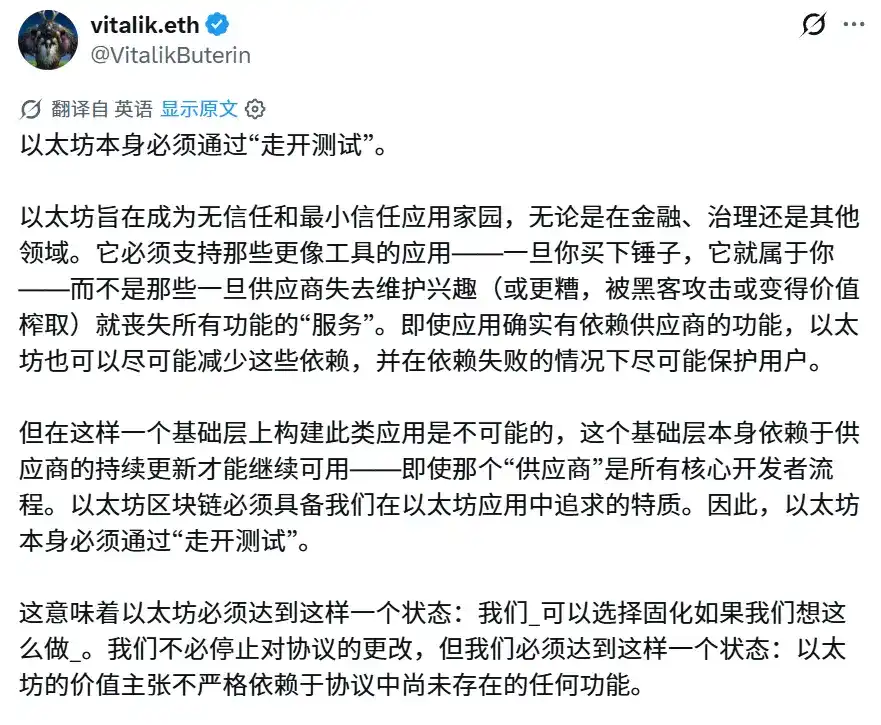
Be honest, the answer today is no. The machine isn't done, it would stall if hands-off; and its current neutrality is held by social consensus, promises kept by good people, not enforced by mechanisms.

Vitalik himself defined credible neutrality as requiring transparent rules, equal application, open participation, and difficult to change. Ethereum does the first three, fails on the fourth.

Its rules are still easy to change, just via a small off-chain process: an EIP proposal, a weekly All Core Devs call, rough consensus among about 150 core devs spread across ~11 organizations, and a handful of client teams. No enforced rules.

6. The Only Solution

The fix isn't a better foundation. It's to finish the machine, then freeze the parts that make it credibly neutral, put the base layer into maintenance mode, so that Ethereum finally passes the hands-off test on its own.

Once the neutral core is frozen, the dependency dissolves. Then, the Ethereum Foundation can do the healthiest thing a steward can: become optional.

It can partner with a dozen new entities, shrink to a research lab, hand work to competing teams, even fade away, and none of it would threaten the network, because the part that defines Ethereum's neutrality can no longer be changed by anyone, captured or well-meaning. You can't manipulate what can't move. You can't capture what's done.

This makes the order non-negotiable, because the goal here isn't anti-capitalism, it's the opposite.

Private capital flooding into Ethereum research, entities like Ethlabs delivering tangible value rather than grant-driven busywork, is one of the healthiest things that can happen in this ecosystem, and I hope there is more of it.

But you can't put capitalism into a state of nature where nothing stops you from harming, stealing, or tearing up contracts. A free market without an underlying rule of law doesn't bring prosperity, it unleashes the worst of human nature tied to money.

Capitalism built on rules is a gift, unmoored it's a predator.

Protocols are the same. First freeze the parts that make Ethereum safe and credibly neutral, set the fundamental rules in stone, then open the doors to private capital, let a hundred well-funded teams compete to build everything on top of it.

If you reverse the order, invite capital in before freezing the neutral core, you just get a Solana competitor valued at one-sixth of ETH's price today.

As an ETH maximalist, I don't enjoy writing what comes next, but it's the central truth of everything. Ethereum's endgame is its own Bitcoinization. Become as immutable as Bitcoin, win the eternity premium the market will actually pay for, and do the one thing Bitcoin never can: cross the finish line with full programmability.

Bitcoin froze by accident and neglect, ending up a rock that does nothing.

Ethereum has the chance to freeze proactively, selectively, and end up the trusted neutral settlement layer for the entire tokenized economy. Same eternity. Much larger prize. That's the whole bullish case, and it demands rigidity before war mode.

7. The Manhattan Project

Lean Ethereum is the path to finishing and freezing the machine, and that's why I keep invoking that grandest historical metaphor. When a field bundles its hardest problems into a single, concentrated, deadline-driven, existential push, that's a Manhattan Project. And that's what's happening.

It bundles the protocol's four hardest problems into one decisive plan, targeting a single bound-together hard fork rather than a decade of dribbles.

Rigidity. The consensus layer is being rebuilt from the ground up as Lean Consensus, work once called Beam Chain, with 3-slot finality, ~12-second finality, and 4-second block times. Justin Drake's term for this strategy is rigidity accelerationism: bundle every difficult change into a single leap to get the layer into maintenance mode as fast as possible. Build once, then freeze.

Scaling. The target is 1 trillion gas per second on L1, ~10,000 TPS at the base layer, millions at L2, achieved through ZK verification and data availability based on blobs and PeerDAS, not scaling blocks on centralized hardware. The pace is 3x, then 10x, then 100x.

Quantum Resistance. Validator BLS signatures will be replaced with leanXMSS, a quantum-secure hash-based scheme, with a STARK aggregation engine compressing the results ~250x. User accounts get signature agility via account abstraction, so wallets can opt into post-quantum protection themselves without waiting for the whole chain. Target readiness ~2029.

ZK. Make the entire chain provable, letting anyone cheaply verify consensus with a succinct proof, while the execution layer is rebuilt around a ZK-friendly virtual machine. SNARK-friendly hash-based signatures are the key hinge merging quantum resistance and provability.

And this plan heals the two specific wounds mentioned at the start.

Statelessness. State bloat is the ever-growing full state copy each node must carry, slowly squeezing out home validators, the first wound. Statelessness cuts it: validators no longer store the whole state, they verify each block with compact proofs, turning the node-running burden from storage back into cheap compute, keeping the validator set wide and decentralized.

Native Rollups. The L2 mess is the other wound, and the EXECUTE precompile in EIP-8079 is the fix. Native rollups no longer run their own proofs, governance, security councils; they hand their blocks back to Ethereum for direct verification, inheriting L1 security, upgrades, and quantum resistance for free.

No hackable multisigs, no upgrade keys to hold. The centralization trap rollups are forced into disappears: you're not re-implementing Ethereum, you become part of Ethereum, and you rigidify the day Ethereum rigidifies.

Synchronous Composability. Better, it recaptures what fragmentation stole. With a shared execution layer and Ethereum-level ordering, rollups become atomically composable: a transaction can hit several rollups and L1 in the same block, either all succeed or all fail, just like smart contracts on a single chain.

No cross-chain bridges, no routing, no doubting which chain you're on. Liquidity merges into a whole, Ethereum feels like one computer regardless of how many rollups run on it. It needs real-time proofs, still racing to production, but that's the finish line.

The work is already moving. The Fusaka upgrade shipped with PeerDAS and the first substantive step of the scaling plan, the post-quantum effort has a public home at pq.ethereum.org with its replacement signature scheme designated, new client teams forming around Lean Consensus.

The hard, decisive parts—the consensus layer rewrite, the quantum migration, and the final freeze—lie ahead, with the next forks Glamsterdam and Hegotá scheduled in 2026, targeting full readiness by the end of the decade. That part is still counting down.

The original Manhattan Project not only ended the bloodiest war in history, it remade the world order around the nation that got there first.

Lean Ethereum aims for finality on the same scale. Not to win the blockchain race, but to end it. The day Ethereum freezes its neutral core, passes the hands-off test, and can no longer be steered by anyone, the race for the world's base layer is over.

Bitcoin has already shown what the market will pay for a rigid rock that does nothing, over a trillion dollars just for eternity.

And the world has never priced a rigid rock that's also the settlement layer for the global economy, because it's never existed.

Lean Ethereum is the plan to build exactly that. Complete it, and Ethereum not only flips Bitcoin, it hits a number no model can yet derive, and transcends Bitcoin entirely, because it finally has the one thing Bitcoin has, eternity, plus the one thing Bitcoin gave up, programmability.

That's why it can't be a decade of gentle incrementalism. It's a race between two clocks.

The first is the rigidity clock: how fast Lean Ethereum finishes the machine and freezes the neutral core. The second is the capture clock: how fast funding vacuums, corporate-stewardship-in-all-but-name filling EF's empty chairs, the war-mode faction pushing centralization, and the quantum deadline harden into actual problems. Every year Ethereum stays unfinished is another year of window to be captured, pressured, or simply left dependent on whoever happens to hold the wheel.

8. Two Endings

So, without doomsaying or blind cheering, here's where Ethereum really stands.

Complete the Manhattan Project, freeze the base, pass the hands-off test, and Ethereum becomes the world's first rigid, quantum-resistant, credibly neutral global economic settlement layer, a settlement layer that needs no foundation, no founder, no permission to stay neutral.

At that moment, the dependency discount crushing the price reverses into an eternity premium, a revaluation with no comp, no ceiling.

If it stalls, or lets the war-mode faction trade neutrality for speed, Ethereum at best becomes a slower Solana, at worst an untrustworthy, manipulable, forever-mutable chain, a thing drifting at the whim of funders, and the premium it chased evaporates forever.

I'm long because I believe it can do it. But anyone telling you the outcome is guaranteed has skipped the hardest chapter. Finish the machine, freeze it, graduate from needing anyone at the wheel. That's the whole game right now.

Criptos en tendencia

Lecturas Relacionadas

VELVET se estanca en $2—¿Qué tan profunda podría ser la actual corrección?

VELVET se ha mantenido en una tendencia alcista, impulsado por la noticia de su asociación con Aerodrome Finance, llegando a superar brevemente la resistencia psicológica de los 2 dólares el 29 de junio. Sin embargo, su impulso ha disminuido, con una corrección del 11.5% en las últimas 24 horas y un volumen de trading diario reducido en un 27.1%. El análisis técnico muestra señales mixtas. La estructura diaria sigue siendo bajista a pesar de la corrección anterior, y mientras el Indicador de Balance de Volumen (OBV) muestra presión compradora, el Índice de Flujo de Capital (CMF) indica salidas significativas de capital. Esto sugiere una presión distributiva a corto plazo, aunque el volumen comprador general se mantiene alto. Para los traders, el ratio riesgo-recompensa no es favorable para posiciones largas en este momento. No hay garantía de que la tendencia alcista haya concluido, pero los indicadores de futuros (Open Interest en descenso, CVD spot estable y tasa de funding neutral) apuntan a un momentum bajista a corto plazo. Los alcistas podrían intentar recuperar el soporte de 2 dólares, mientras que la media móvil de 20 días en 0.75 dólares se perfila como un nivel de soporte dinámico clave en caso de una mayor corrección. En resumen, VELVET no logró consolidar los 2 dólares como soporte y se encuentra en un retroceso. La evidencia sugiere que esta es una distribución controlada a corto plazo, no una toma de ganancias masiva, pero la profundidad de la corrección actual sigue siendo incierta.

ambcryptoHace 33 min(s)

VELVET se estanca en $2—¿Qué tan profunda podría ser la actual corrección?

ambcryptoHace 33 min(s)

¿Hay una próxima ronda en los juegos Web3? Repaso de un veterano: en el momento de mayor auge, al menos tienes que vender la mitad

**Resumen de la entrevista a "赚钱小鸡", un jugador veterano de juegos Web3** El jugador experimentado "赚钱小鸡" comparte su recorrido en los juegos Web3, desde proyectos exitosos como Mobox, StepN y Seraph hasta pérdidas significativas en otros. Destaca que lo que inicialmente atrae a los jugadores es la posibilidad de ganar dinero, pero también la profundidad de los mecanismos del juego y la satisfacción de investigarlos. **Puntos clave:** 1. **Relación entre jugadores, proyectos y grandes inversores:** Existe una dinámica de conflicto donde los intereses de los desarrolladores y los grandes holders a menudo perjudican a los jugadores comunes. 2. **Errores comunes:** Calcular el periodo de retorno de la inversión durante el pico de popularidad, lo que lleva a sobrevalorar activos que luego se devalúan. 3. **El mayor problema de los juegos Web3:** Muchos carecen de una base sólida como juegos; priorizan el modelo económico sobre la jugabilidad, atrayendo principalmente a personas que buscan ganancias rápidas en lugar de jugadores reales. 4. **Consejos para nuevos jugadores:** No se recomienda entrar sin experiencia, ya que el riesgo es alto. En su lugar, sugiere invertir cuando un activo está en mínimos y existe potencial de crecimiento, pero vender al menos la mitad cuando el proyecto alcanza su máxima popularidad. 5. **Visión de futuro:** Los juegos Web3 exitosos probablemente provendrán de estudios tradicionales, combinando IPs consolidados, jugabilidad sólida y sistemas de activos NFT, atrayendo tanto a jugadores tradicionales como a los de la cadena. En resumen, "赚钱小鸡" cree que aún habrá oportunidades en el sector, pero estas dependerán de proyectos más maduros y sostenibles, alejados del modelo especulativo actual.

marsbitHace 1 hora(s)

¿Hay una próxima ronda en los juegos Web3? Repaso de un veterano: en el momento de mayor auge, al menos tienes que vender la mitad

marsbitHace 1 hora(s)

Los ganadores más ocultos de la IA

**Los ganadores más ocultos de la IA: materiales esenciales en la revolución de los chips** La fiebre de la IA no solo beneficia a las grandes tecnológicas, sino también a empresas tradicionales con productos especializados clave en la cadena de suministro de semiconductores. **TOTO**, conocida por sus baños, es líder en cerámica de alta precisión para semiconductores. Su componente crucial, el "portador electrostático" de cerámica, es indispensable en procesos avanzados de fabricación de chips (como EUV y NAND 3D). Aunque esta división representa solo el 9% de sus ingresos, aporta el 54% de las utilidades, con un margen del 43%. Su ventaja radica en décadas de know-how y una fuerte relación con el gigante Lam Research. Otros casos similares en Japón son: * **Nittobo**: Una empresa textil de 128 años que domina el 90% del suministro global de "T-glass", una fibra de vidrio esencial para sustratos de empaquetado avanzado de chips de IA. * **Ajinomoto**: El principal productor mundial de glutamato, cuya división de películas aislantes ABF (Ajinomoto Build-up Film) tiene una cuota de mercado del 80-95% y un margen superior al 50%. En el mercado chino (A-shares), la narrativa combina esta escasez global con la **sustitución de importaciones**. Empresas como **Zhongci Electronic** (cerámica) y **Honghe Technology** (telas electrónicas de alta gama) están avanzando en la producción local de estos materiales críticos, con un fuerte crecimiento en ingresos y valoración. La conclusión clave es que, en la era de la IA, algunos de los **cuellos de botella y oportunidades de mayor rentabilidad** se encuentran en materiales especializados, tradicionales y difíciles de fabricar, donde unas pocas empresas poseen décadas de ventaja tecnológica y de producción. El mercado está reevaluando lentamente estas "empresas tradicionales" que se han convertido en proveedores esenciales para la industria más avanzada.

marsbitHace 1 hora(s)

Los ganadores más ocultos de la IA

marsbitHace 1 hora(s)

Trading

Spot

Artículos destacados

Qué es ETH 2.0

ETH 2.0: Una Nueva Era para Ethereum Introducción ETH 2.0, conocido ampliamente como Ethereum 2.0, marca una actualización monumental de la blockchain de Ethereum. Esta transición no es solo un cambio de imagen; busca mejorar fundamentalmente la escalabilidad, seguridad y sostenibilidad de la red. Con un cambio del mecanismo de consenso intensivo en energía Prueba de Trabajo (PoW) a una Prueba de Participación (PoS) más eficiente, ETH 2.0 promete un enfoque transformador para el ecosistema de blockchain. ¿Qué es ETH 2.0? ETH 2.0 es un conjunto de actualizaciones distintivas e interconectadas centradas en optimizar las capacidades y el rendimiento de Ethereum. La remodelación está diseñada para abordar desafíos críticos que el mecanismo de Ethereum existente ha enfrentado, particularmente en relación con la velocidad de transacción y la congestión de la red. Objetivos de ETH 2.0 Los objetivos principales de ETH 2.0 giran en torno a mejorar tres aspectos fundamentales: Escalabilidad: Con el objetivo de mejorar significativamente la cantidad de transacciones que la red puede manejar por segundo, ETH 2.0 busca superar la actual limitación de aproximadamente 15 transacciones por segundo, potencialmente alcanzando miles. Seguridad: Las medidas de seguridad mejoradas son fundamentales para ETH 2.0, particularmente a través de una mayor resistencia contra ciberataques y la preservación del ethos descentralizado de Ethereum. Sostenibilidad: El nuevo mecanismo de PoS está diseñado no solo para mejorar la eficiencia, sino también para reducir drásticamente el consumo de energía, alineando el marco operativo de Ethereum con consideraciones medioambientales. ¿Quién es el Creador de ETH 2.0? La creación de ETH 2.0 se puede atribuir a la Fundación Ethereum. Esta organización sin fines de lucro, que desempeña un papel crucial en el apoyo al desarrollo de Ethereum, está liderada por el notable cofundador Vitalik Buterin. Su visión de un Ethereum más escalable y sostenible ha sido la fuerza impulsora detrás de esta actualización, involucrando contribuciones de una comunidad global de desarrolladores y entusiastas dedicados a mejorar el protocolo. ¿Quiénes son los Inversores de ETH 2.0? Aunque los detalles sobre los inversores de ETH 2.0 no se han hecho públicos, se sabe que la Fundación Ethereum recibe apoyo de varias organizaciones e individuos en el ámbito de blockchain y tecnología. Estos socios incluyen firmas de capital de riesgo, empresas tecnológicas y organizaciones filantrópicas que comparten un interés mutuo en apoyar el desarrollo de tecnologías descentralizadas e infraestructura de blockchain. ¿Cómo Funciona ETH 2.0? ETH 2.0 es notable por introducir una serie de características clave que lo diferencian de su predecesor. Prueba de Participación (PoS) La transición a un mecanismo de consenso PoS es uno de los cambios más destacados de ETH 2.0. A diferencia de PoW, que depende de la minería intensiva en energía para la verificación de transacciones, PoS permite a los usuarios validar transacciones y crear nuevos bloques de acuerdo con la cantidad de ETH que apuestan en la red. Esto conduce a una mayor eficiencia energética, reduciendo el consumo en aproximadamente un 99.95%, convirtiendo Ethereum 2.0 en una alternativa considerablemente más ecológica. Cadenas Shard Las cadenas shard son otra innovación crítica de ETH 2.0. Estas cadenas más pequeñas operan en paralelo con la cadena principal de Ethereum, lo que permite procesar múltiples transacciones simultáneamente. Este enfoque mejora la capacidad general de la red, abordando las preocupaciones de escalabilidad que han plagado a Ethereum. Cadena Beacon En el núcleo de ETH 2.0 se encuentra la Cadena Beacon, que coordina la red y gestiona el protocolo PoS. Actúa como una especie de organizador: supervisa a los validadores, asegura que los shards permanezcan conectados a la red y monitorea la salud general del ecosistema blockchain. Cronología de ETH 2.0 El viaje de ETH 2.0 ha estado marcado por varios hitos clave que trazan la evolución de esta significativa actualización: Diciembre 2020: El lanzamiento de la Cadena Beacon marcó la introducción de PoS, preparando el escenario para la migración a ETH 2.0. Septiembre 2022: La finalización de “La Fusión” representa un momento pivotal donde la red Ethereum transicionó exitosamente de un marco PoW a un marco PoS, anunciando una nueva era para Ethereum. 2023: Se espera el lanzamiento de cadenas shard con el fin de mejorar aún más la escalabilidad de la red Ethereum, consolidando ETH 2.0 como una plataforma robusta para aplicaciones y servicios descentralizados. Características Clave y Beneficios Escalabilidad Mejorada Una de las ventajas más significativas de ETH 2.0 es su escalabilidad mejorada. La combinación de PoS y cadenas shard permite a la red expandir su capacidad, permitiendo acomodar un volumen de transacciones muy mayor en comparación con el sistema legado. Eficiencia Energética La implementación de PoS representa un gran paso hacia la eficiencia energética en la tecnología blockchain. Al reducir drásticamente el consumo de energía, ETH 2.0 no solo reduce los costos operativos, sino que también se alinea más estrechamente con los objetivos globales de sostenibilidad. Seguridad Mejorada Los mecanismos actualizados de ETH 2.0 contribuyen a una mayor seguridad en toda la red. El despliegue de PoS, junto con medidas de control innovadoras establecidas a través de las cadenas shard y la Cadena Beacon, asegura un mayor grado de protección contra posibles amenazas. Costos Más Bajos para los Usuarios A medida que la escalabilidad mejora, los efectos sobre los costos de transacción también serán evidentes. Se espera que la mayor capacidad y la reducción de la congestión se traduzcan en tarifas más bajas para los usuarios, haciendo de Ethereum una opción más accesible para transacciones diarias. Conclusión ETH 2.0 marca una evolución significativa en el ecosistema de la blockchain de Ethereum. Al abordar cuestiones clave como la escalabilidad, el consumo de energía, la eficiencia en las transacciones y la seguridad en general, la importancia de esta actualización no puede subestimarse. El cambio a Prueba de Participación, la introducción de cadenas shard y el trabajo fundamental de la Cadena Beacon son indicativos de un futuro donde Ethereum puede satisfacer las crecientes demandas del mercado descentralizado. En una industria impulsada por la innovación y el progreso, ETH 2.0 se erige como un testimonio de las capacidades de la tecnología blockchain para allanar el camino hacia una economía digital más sostenible y eficiente.

251 Vistas totalesPublicado en 2024.04.04Actualizado en 2024.12.03

Qué es ETH 2.0

Qué es ETH 3.0

ETH3.0 y $eth 3.0: Un Examen en Profundidad del Futuro de Ethereum Introducción En el paisaje en rápida evolución de las criptomonedas y la tecnología blockchain, ETH3.0, a menudo denotado como $eth 3.0, ha emergido como un tema de considerable interés y especulación. El término abarca dos conceptos principales que merecen clarificación: Ethereum 3.0: Esto representa una posible actualización futura destinada a aumentar las capacidades de la blockchain de Ethereum existente, centrándose particularmente en mejorar la escalabilidad y el rendimiento. ETH3.0 Meme Token: Este proyecto de criptomoneda distinto busca aprovechar la blockchain de Ethereum para crear un ecosistema centrado en memes, promoviendo la participación dentro de la comunidad de criptomonedas. Entender estos aspectos de ETH3.0 es esencial no solo para los entusiastas de las criptomonedas, sino también para aquellos que observan tendencias tecnológicas más amplias en el espacio digital. ¿Qué es ETH3.0? Ethereum 3.0 Ethereum 3.0 se presenta como una actualización propuesta a la red Ethereum ya establecida, que ha sido la columna vertebral de muchas aplicaciones descentralizadas (dApps) y contratos inteligentes desde su inicio. Las mejoras previstas se concentran principalmente en la escalabilidad, integrando tecnologías avanzadas como el sharding y las pruebas de conocimiento cero (zk-proofs). Estas innovaciones tecnológicas tienen como objetivo facilitar un número sin precedentes de transacciones por segundo (TPS), que podría alcanzar millones, abordando así una de las limitaciones más significativas que enfrenta la tecnología blockchain actual. La mejora no es meramente técnica, sino también estratégica; está destinada a preparar la red Ethereum para una adopción y utilidad generalizada en un futuro marcado por una mayor demanda de soluciones descentralizadas. ETH3.0 Meme Token En contraste con Ethereum 3.0, el ETH3.0 Meme Token se aventura en un dominio más ligero y juguetón al combinar la cultura de memes de internet con la dinámica de las criptomonedas. Este proyecto permite a los usuarios comprar, vender e intercambiar memes en la blockchain de Ethereum, proporcionando una plataforma que fomenta la participación comunitaria a través de la creatividad y los intereses compartidos. El ETH3.0 Meme Token tiene como objetivo demostrar cómo la tecnología blockchain puede intersecarse con la cultura digital, creando casos de uso que son tanto entretenidos como financieramente viables. ¿Quién es el Creador de ETH3.0? Ethereum 3.0 La iniciativa hacia Ethereum 3.0 es impulsada principalmente por un consorcio de desarrolladores e investigadores dentro de la comunidad Ethereum, destacando a Justin Drake. Conocido por sus ideas y contribuciones a la evolución de Ethereum, Drake ha sido una figura prominente en las discusiones sobre la transición de Ethereum a una nueva capa de consenso, conocida como la “Beam Chain.” Este enfoque colaborativo en el desarrollo significa que Ethereum 3.0 no es el producto de un creador singular, sino más bien una manifestación de la ingenio colectivo centrado en avanzar en la tecnología blockchain. ETH3.0 Meme Token Los detalles sobre el creador del ETH3.0 Meme Token son actualmente indetectables. La naturaleza de los tokens de memes a menudo conduce a una estructura más descentralizada y guiada por la comunidad, lo que podría explicar la falta de atribución específica. Esto se alinea con la ética de la mayor comunidad cripto, donde la innovación a menudo surge de esfuerzos colaborativos en lugar de individuales. ¿Quiénes son los Inversores de ETH3.0? Ethereum 3.0 El apoyo a Ethereum 3.0 proviene principalmente de la Fundación Ethereum junto a una entusiasta comunidad de desarrolladores e inversores. Esta asociación fundacional proporciona un grado significativo de legitimidad y mejora la perspectiva de implementación exitosa, ya que aprovecha la confianza y la credibilidad construidas a lo largo de años de operaciones de la red. En el clima cambiante de las criptomonedas, el apoyo de la comunidad juega un papel crucial en impulsar el desarrollo y la adopción, posicionando a Ethereum 3.0 como un serio competidor para los futuros avances en blockchain. ETH3.0 Meme Token Si bien las fuentes actualmente disponibles no brindan información explícita sobre las fundaciones de inversión u organizaciones que respaldan el ETH3.0 Meme Token, es indicativo del modelo de financiamiento típico para los tokens de memes, que a menudo se basa en el apoyo de base y la participación comunitaria. Los inversores en tales proyectos suelen consistir en individuos motivados por el potencial de innovación impulsada por la comunidad y el espíritu de cooperación que se encuentra en la comunidad cripto. ¿Cómo Funciona ETH3.0? Ethereum 3.0 Las características distintivas de Ethereum 3.0 radican en su propuesta implementación de la tecnología de sharding y zk-proof. El sharding es un método de particionamiento de la blockchain en partes más pequeñas y manejables o “shards,” que pueden procesar transacciones de manera concurrente en lugar de secuencial. Esta descentralización del procesamiento ayuda a prevenir la congestión y asegura que la red se mantenga receptiva incluso bajo una carga pesada. La tecnología de prueba de conocimiento cero (zk-proof) añade otra capa de sofisticación al permitir la validación de transacciones sin revelar los datos subyacentes involucrados. Este aspecto no solo mejora la privacidad, sino que también aumenta la eficiencia general de la red. También se habla de incorporar una Máquina Virtual de Ethereum de conocimiento cero (zkEVM) en esta actualización, ampliando aún más las capacidades y la utilidad de la red. ETH3.0 Meme Token El ETH3.0 Meme Token se distingue al capitalizar sobre la popularidad de la cultura de memes. Establece un mercado para que los usuarios participen en el intercambio de memes, no solo por entretenimiento sino también por el potencial de ganancia económica. Al integrar características como staking, provisión de liquidez y mecanismos de gobernanza, el proyecto fomenta un entorno que incentiva la interacción y participación de la comunidad. Al ofrecer una mezcla única de entretenimiento y oportunidad económica, el ETH3.0 Meme Token tiene como objetivo atraer a una audiencia diversa, desde entusiastas de las criptomonedas hasta conocedores de memes casuales. Cronología de ETH3.0 Ethereum 3.0 11 de noviembre de 2024: Justin Drake insinúa la próxima actualización ETH 3.0, centrada en las mejoras de escalabilidad. Este anuncio significa el inicio de discusiones formales sobre la futura arquitectura de Ethereum. 12 de noviembre de 2024: Se espera que la propuesta anticipada para Ethereum 3.0 sea revelada en Devcon en Bangkok, estableciendo el escenario para comentarios más amplios de la comunidad y potenciales próximos pasos en el desarrollo. ETH3.0 Meme Token 21 de marzo de 2024: El ETH3.0 Meme Token se lista oficialmente en CoinMarketCap, marcando su incursión en el dominio público de las criptomonedas y aumentando la visibilidad de su ecosistema basado en memes. Puntos Clave En conclusión, Ethereum 3.0 representa una evolución significativa dentro de la red Ethereum, enfocándose en superar limitaciones relacionadas con la escalabilidad y el rendimiento a través de tecnologías avanzadas. Sus actualizaciones propuestas reflejan un enfoque proactivo hacia las futuras demandas y la usabilidad. Por otro lado, el ETH3.0 Meme Token encapsula la esencia de la cultura impulsada por la comunidad en el espacio de las criptomonedas, aprovechando la cultura de memes para crear plataformas atractivas que fomenten la creatividad y participación de los usuarios. Entender los distintos propósitos y funcionalidades de ETH3.0 y $eth 3.0 es fundamental para cualquier persona interesada en los desarrollos en curso dentro del espacio cripto. Con ambas iniciativas abriendo caminos únicos, subrayan colectivamente la naturaleza dinámica y multifacética de la innovación blockchain.

253 Vistas totalesPublicado en 2024.04.04Actualizado en 2024.12.03

Qué es ETH 3.0

Cómo comprar ETH

¡Bienvenido a HTX.com! Hemos hecho que comprar Ethereum (ETH) sea simple y conveniente. Sigue nuestra guía paso a paso para iniciar tu viaje de criptos.Paso 1: crea tu cuenta HTXUtiliza tu correo electrónico o número de teléfono para registrarte y obtener una cuenta gratuita en HTX. Experimenta un proceso de registro sin complicaciones y desbloquea todas las funciones.Obtener mi cuentaPaso 2: ve a Comprar cripto y elige tu método de pagoTarjeta de crédito/débito: usa tu Visa o Mastercard para comprar Ethereum (ETH) al instante.Saldo: utiliza fondos del saldo de tu cuenta HTX para tradear sin problemas.Terceros: hemos agregado métodos de pago populares como Google Pay y Apple Pay para mejorar la comodidad.P2P: tradear directamente con otros usuarios en HTX.Over-the-Counter (OTC): ofrecemos servicios personalizados y tipos de cambio competitivos para los traders.Paso 3: guarda tu Ethereum (ETH)Después de comprar tu Ethereum (ETH), guárdalo en tu cuenta HTX. Alternativamente, puedes enviarlo a otro lugar mediante transferencia blockchain o utilizarlo para tradear otras criptomonedas.Paso 4: tradear Ethereum (ETH)Tradear fácilmente con Ethereum (ETH) en HTX's mercado spot. Simplemente accede a tu cuenta, selecciona tu par de trading, ejecuta tus trades y monitorea en tiempo real. Ofrecemos una experiencia fácil de usar tanto para principiantes como para traders experimentados.

5.0k Vistas totalesPublicado en 2024.12.10Actualizado en 2026.06.02

Cómo comprar ETH

Discusiones

Bienvenido a la comunidad de HTX. Aquí puedes mantenerte informado sobre los últimos desarrollos de la plataforma y acceder a análisis profesionales del mercado. A continuación se presentan las opiniones de los usuarios sobre el precio de ETH (ETH).

活动图片