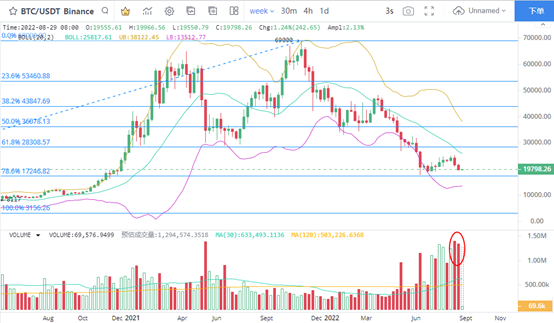
1. BTC fell for two consecutive weeks
The weekly K-line chart of BTC shows that with the continuous expansion of the decline for two consecutive weeks, the trading volume has continued to have a clear amplification signal, indicating that BTC has a large short-term selling pressure and is seeking a new supporting price. At the point, the BTC in the early stage can reach as low as US $17622, while the support line corresponding to the typical Fibonacci 78.6% is at US $17246. Therefore, even if BTC really falls below US $17622, it may not effectively fall below US $17246. However, judging from the trend of price operation, the direction of expanding the decline in the near future is intensified.
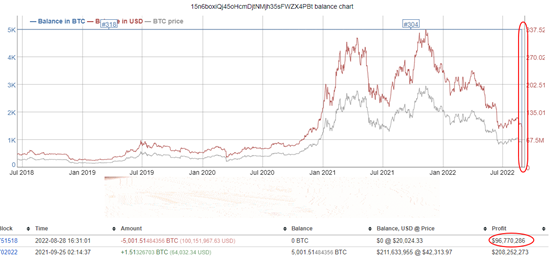
2. Giant whale clearance 5000 BTC
Before the BTC price fell, the trend of BTC giant whale has attracted the attention of investors. In fact, even when the BTC reached the low level within the year, the long-term cash holding giant whale still made transfers or transactions. At 16:31 on August 28, the short-term clearing of Jujing with 5000 coins was a transfer, and all BTCs in the account were transferred out. The giant whale has a long holding time. It has held BTC since the end of 2013. Until the transfer is completed, there has never been any sign of how to transfer out. Up to
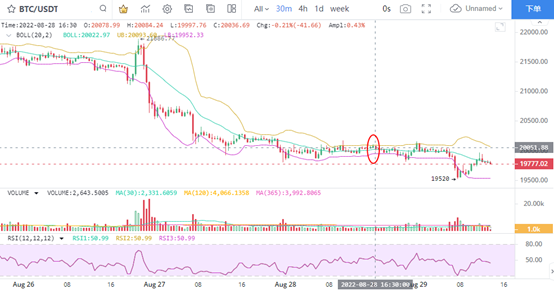
From the BTC price performance after the transfer out of BTC, BTC soon reached the short-term low of $19520. After the range decline expanded, the Bollinger line expansion trend continued. BTC is below the middle rail of the brin line, and there are obvious signs of further expansion of the decline.
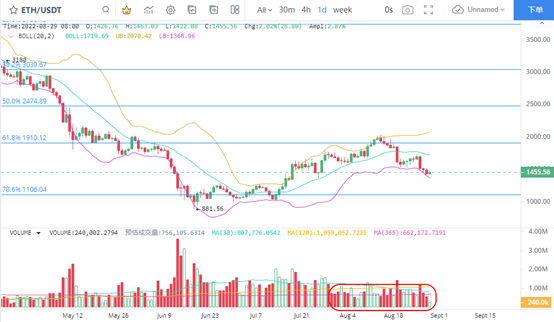
3. Eth remains weak
The contraction of eth trading volume began on July 30, and the trading volume in the next range remained low, which was significantly lower than the trading volume performance from June 11 to July 29. According to this judgment, ETH signs into the contraction adjustment stage, and the market is in a relatively weak downward trend. In the same period, after the ETH price retreated from the middle rail of the brin line, it is strengthening the decline performance on the basis of the obvious expansion of the decline. Therefore, it is expected that a new low at the point will be possible.
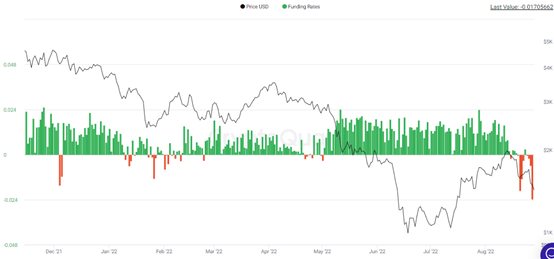
4. Eth financing interest rate significantly retreated
The financing interest rate of eth has remained above 0 for a long time, reaching 0.012 to 0.024 in the last four months. Since August 22, the financing interest rate has started to decline significantly, with a minimum of 0.026. Based on this, it is judged that investors have actively sold eth, which has significantly reduced the financing interest rate to below 0. At the third stage, the acquisition of eth is relatively easy, especially for investors who are prepared to buy at a low price. Therefore, when dealing with market fluctuations, we should mainly buy at a low price in the near future.