The 800V Voltage Standard Championed by Nvidia: Which Infrastructure Providers Stand to Benefit?

marsbitPublicado a 2026-06-15Actualizado a 2026-06-15

Resumen

NVIDIA is actively promoting the 800VDC architecture as a key direction for its next-generation AI factories and high-power racks, particularly for the upcoming Rubin and Kyber platforms. The primary driver is the rapidly increasing power density of AI racks, with designs like GB200/GB300 NVL72 reaching 120-140kW and future systems potentially hitting 180-220kW. At such high power levels, traditional low-voltage power delivery becomes inefficient due to massive current, leading to significant copper use, cable bulk, heat, and power loss. The 800VDC standard aims to increase efficiency by transmitting power at higher voltage and lower current to the rack before stepping it down locally for GPUs. NVIDIA claims this can improve efficiency by up to 5%, reduce total cost of ownership (TCO) by up to 30%, and cut copper usage by approximately 45%. This shift redefines infrastructure roles, pushing power engineering to the forefront alongside GPU performance. Key beneficiaries and ecosystem partners highlighted include: 1. **Power Infrastructure Providers:** Companies like Vertiv, Schneider Electric, Delta Electronics (台达电), and Korean firms LS Electric and HD Hyundai Electric are involved in designing next-gen AI factory power distribution, rack power supplies, and backup systems. 2. **Power Semiconductors:** Suppliers of SiC/GaN devices, such as Infineon and STMicroelectronics, are better suited for high-voltage, high-efficiency conversion in this new architecture. 3. **Connec...

TL;DR

Over the past few years, the star of AI infrastructure has been the GPU. Those who secured more H100s or B200s had a stronger supply of computing power. But as we move into the Rubin and subsequent platforms, investors need to look one level deeper: Can the GPUs fit into the rack? Can the rack receive stable power? Can the heat be dissipated? Can the systems be fully loaded and tested before leaving the factory?

This is precisely why 800VDC is now being discussed in the market. Since 2025, Nvidia has consistently and publicly advocated for 800VDC architecture, incorporating it into the design direction for next-generation AI factories and high-power racks. On the surface, this is a shift in voltage specification from traditional low voltage to high-voltage DC. Looking deeper, AI servers are no longer just assemblies of boards and chips; they are increasingly resembling power engineering projects.

Ordinary investors can think of it this way: a full rack of AI servers is like a small building with extremely high electricity consumption. Past power delivery methods could still support racks of several dozen or even a hundred kilowatts. But as power continues to increase, the problem is no longer just "how many GPUs to buy," but rather how to deliver the electricity, how to dissipate the heat, and how to run the machines at full load continuously before they leave the factory.

High-Power Racks Are Approaching the Limits of Low-Voltage Power Supply

The starting point for this change is the rapid rise in AI rack power. Traditional server racks might only consume a few to tens of kilowatts. With Nvidia's GB200/GB300 generation, whole-rack power has entered the hundred-kilowatt range. According to Tom’s Hardware, the GB200/GB300 NVL72 consumes approximately 120-140kW.

Power density could climb further post-Rubin. Some supply chain and industry estimates suggest the Rubin NVL72 might reach approximately 180-220kW. This range is not officially confirmed by Nvidia and should still be considered third-party estimates, but the direction is clear: leading-edge AI racks are becoming higher-density power consumption units.

The power issue can be explained by a formula: Power equals Voltage multiplied by Current. To deliver the same 600kW of power, if the voltage is lower, a larger current is required. A larger current necessitates thicker cables and busbars, causes more severe heat generation, and leads to higher power loss in the lines.

Traditional low-voltage power supply is like using a very thick water pipe to slowly move a large volume of water. It works, but the pipe gets thicker, heavier, and takes up more space. Rack space, which should be reserved for GPUs, memory, networking, and cooling structures, gets crowded out by power shelves, cables, and busbars. At power levels of several hundred kilowatts and beyond, continuing to rely on low-voltage, high-current systems becomes increasingly uneconomical.
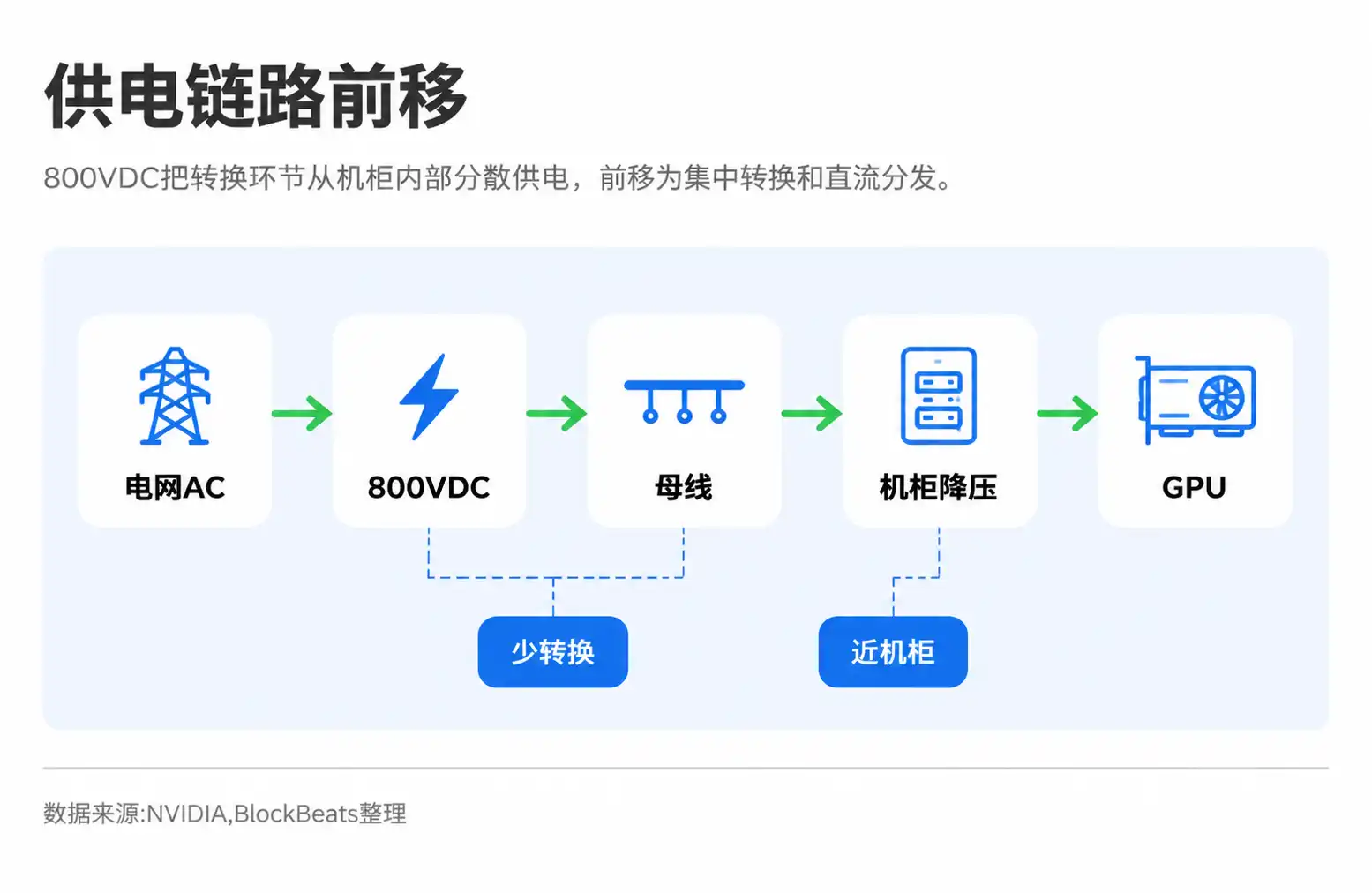
The idea behind 800VDC is to increase the voltage, deliver power more efficiently to the vicinity of the rack, and then step it down locally for use by the GPUs. It's akin to increasing water pressure to use narrower pipes to deliver the same amount of water. Nvidia's official materials state that 800VDC can reduce current, copper usage, cable volume, and conversion stages, potentially increasing efficiency by up to 5% and improving TCO by up to 30%. Some third-party and partner calculations also mention that copper usage could drop by about 45%, with actual benefits depending on the data center and rack integration methods.
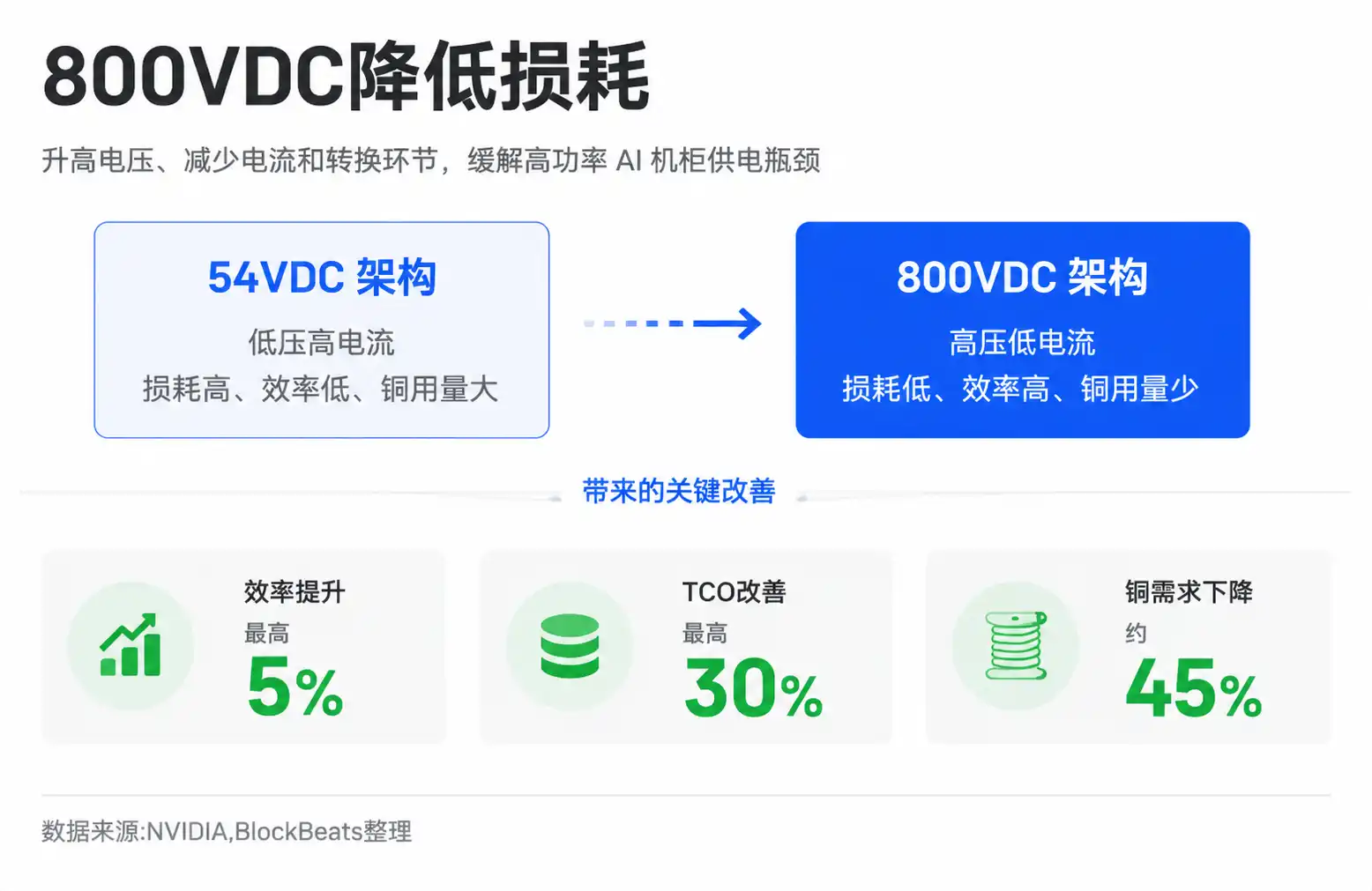
This isn't just about saving copper. For Nvidia, the core value of 800VDC is to enable continued increases in compute density for next-generation AI racks. Low-voltage systems aren't unusable, but in the highest-density AI factories, they are beginning to approach engineering limits.

Nvidia Redefines Infrastructure Roles with Reference Architecture

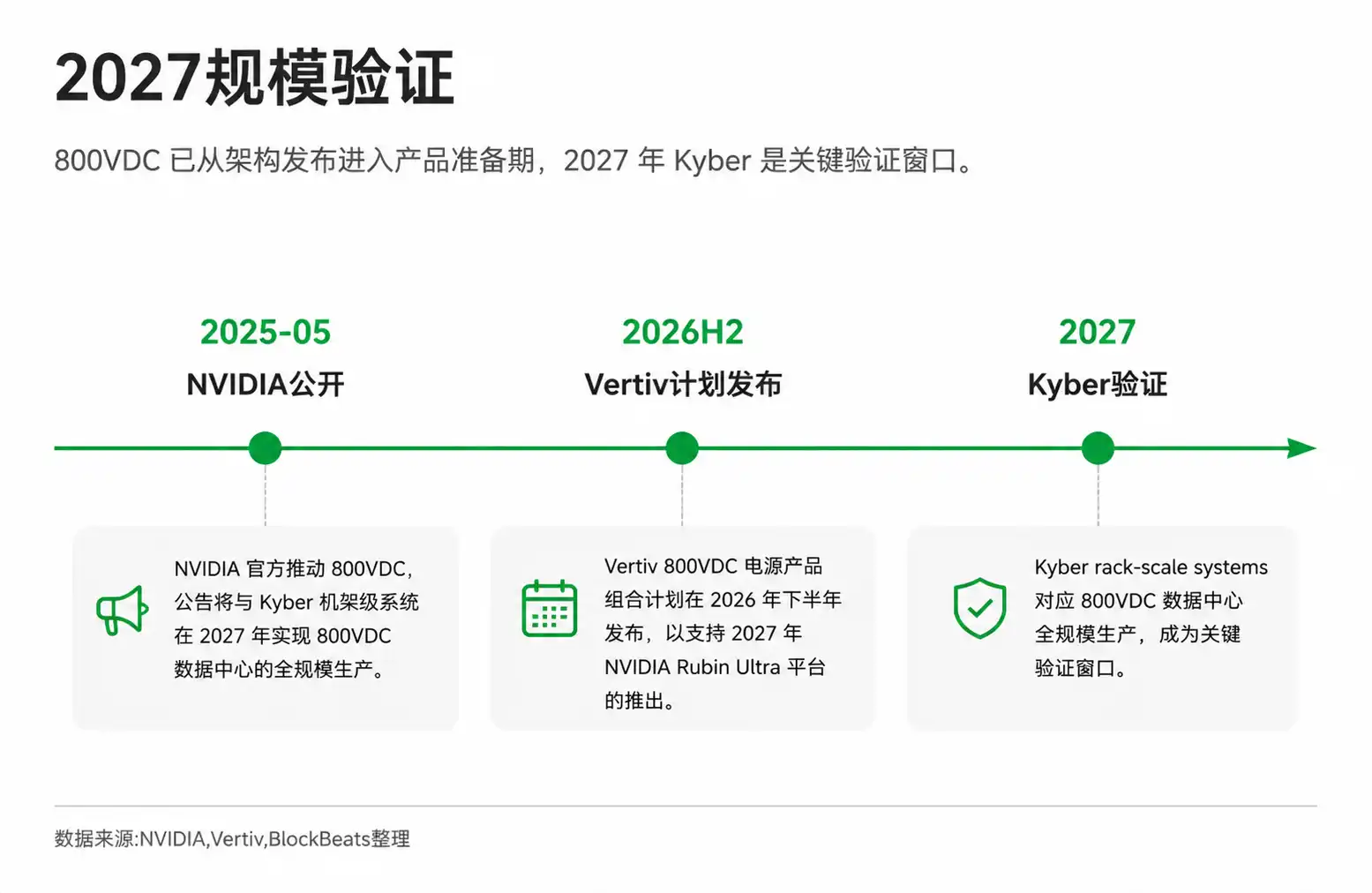
What's significant about Nvidia is not just proposing a voltage solution, but using a reference architecture to redefine the division of labor within the ecosystem. Since 2025, Nvidia has publicly introduced the 800VDC architecture multiple times, showcasing its design direction for high-power systems like Rubin and Kyber racks in technical blogs and at forums like OCP.

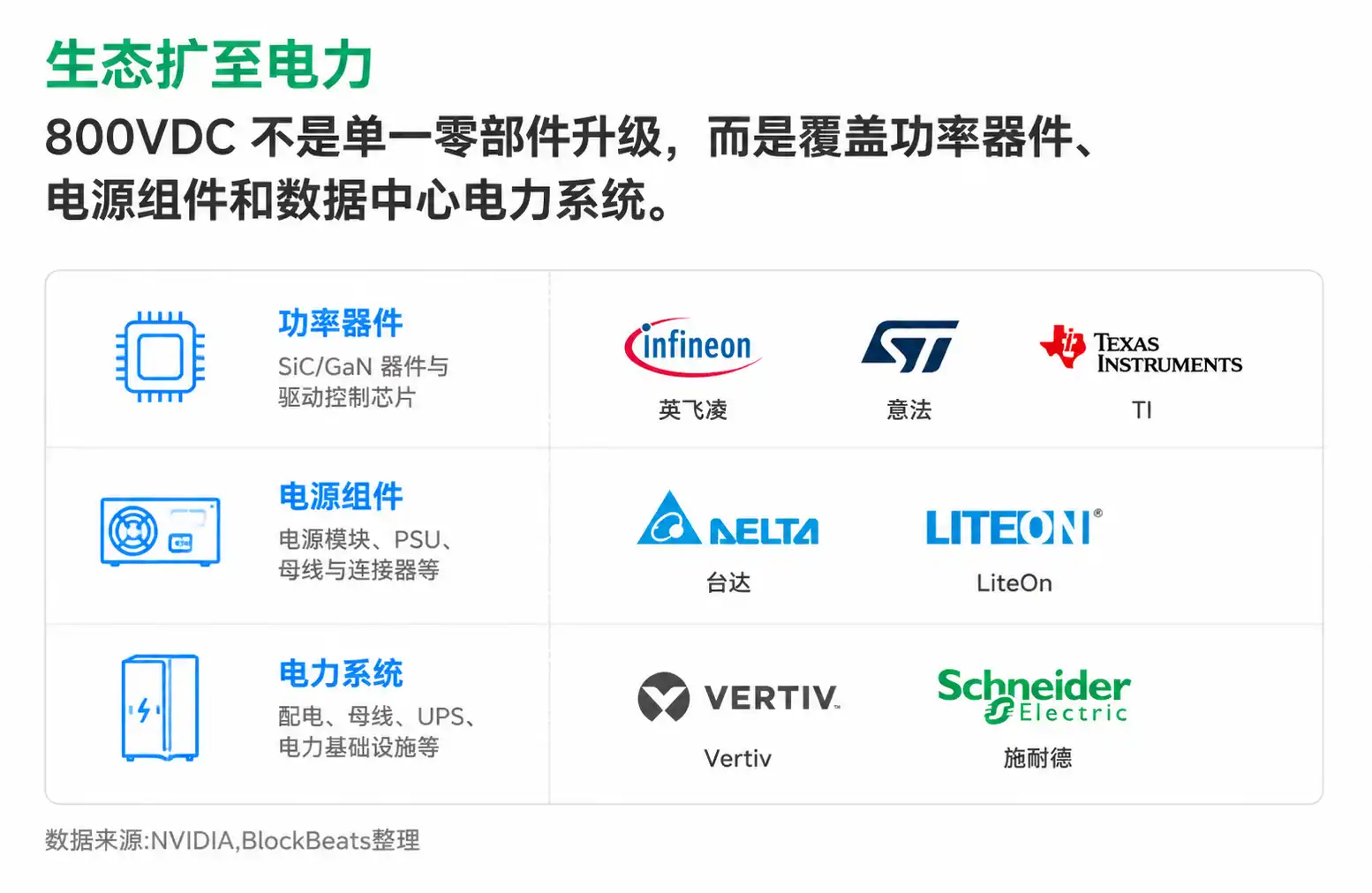
According to Nvidia's official blog, its 800VDC ecosystem partners include Delta Electronics, Schneider Electric, Vertiv, Infineon, STMicroelectronics, as well as companies like ABB, Eaton, GE Vernova, Hitachi Energy, Siemens, Navitas, and Texas Instruments. It's more accurate to describe this as ecosystem collaboration and adaptation, not to be directly interpreted as confirmed orders.
800VDC involves not a single component upgrade, but a change across an entire chain: from data center power distribution and rack power supplies to backup batteries, power devices, connectors, and whole-rack integration. Previously, power conversion might have been distributed across multiple stages like UPS, PDU, server PSUs, and motherboard power delivery. Under a high-voltage DC architecture, power is delivered closer to the rack, then stepped down by modules within or near the GPU.
The weighting within the value chain will also shift accordingly. In the traditional server era, investors focused more on GPUs, CPUs, memory, and system integrators. In the era of high-power AI racks, power shelves, busbars, connectors, power semiconductors, liquid cooling systems, and whole-rack validation capabilities are all becoming part of the delivery capability.

Boundaries must also be clarified. 800VDC is more like an important reference architecture for leading-edge, high-density AI factories, not a standard that all data centers will immediately switch to. Many existing data centers will continue using traditional AC or hybrid architectures. New projects will also adopt it in layers based on power density, cost, owner willingness to retrofit, and safety regulations. What the market is truly trading on is not that everything will switch to 800V this year, but that the infrastructure rules for the highest-density AI racks post-2027 are changing.

Power Supplies, Connectors, Liquid Cooling, and Whole-Rack Testing Move to the Forefront

From an investment perspective, the most direct impact of 800VDC is bringing infrastructure segments that were previously in the background to the forefront.

The first category is power infrastructure companies, such as Vertiv, Schneider Electric, Delta Electronics, and some South Korean and Taiwanese power equipment manufacturers. They are not just selling traditional data center power equipment; they need to participate in the design of power distribution, rack power supply, backup batteries, and high-voltage DC systems for the new generation of AI factories. According to Asia Business Daily, Nvidia has communicated with South Korean power equipment companies like LS Electric, HD Hyundai Electric, and Hyosung regarding 800VDC data center infrastructure. This report is based on industry insider information and should not be equated with confirmed orders, but it illustrates that power equipment providers are being included in the AI factory ecosystem.

The second category is power devices, namely next-generation power switches like SiC/GaN (Silicon Carbide/Gallium Nitride). These are better suited than traditional silicon devices for high-voltage, high-frequency, high-efficiency scenarios. They were often discussed in the context of electric vehicles, charging piles, and industrial power supplies, but are now spilling over into AI data centers. Companies like Infineon and STMicroelectronics are therefore coming into investors' view. However, the benefits for power semiconductors also depend on specific designs, supply share, pricing, and yield, and cannot be simply equated to "800VDC concept stocks."

The third category is connection and mechanical structures, including busbars, power busways, high-voltage connectors, high-end backplanes, and some thick-copper, multi-layer PCBs. When voltage increases and current decreases, copper loss pressure eases, but requirements for insulation, safety, connection reliability, and structural design become higher. Low-end copper materials do not inherently benefit; what's truly valuable are connection and power delivery materials that can adapt to high-power, high-reliability racks.

The fourth category is liquid cooling and whole-rack ODM. As power increases, heat dissipation is no longer a secondary issue. For servers to run stably in customer data centers, they must undergo whole-rack level testing before leaving the factory, including power supply, cooling, networking, and GPU full-load stability. Whole-rack deliverers like Dell, Wiwynn, and Wistron are competing not just on assembly efficiency, but also on whether they have sufficient power, space, liquid cooling testing, and system tuning capabilities.

Design Direction is Clear, but Delivery Capability Requires Real-World Testing

Nvidia has provided a clear technical direction, but supply chain execution won't automatically be smooth. The tension here is precisely what investors need to track.

Independent supply chain analyst Dan Nystedt has recently cited Taiwanese media and industry information multiple times: AI server ODM revenues are strong, Rubin-related production preparations are advancing, but components, power infrastructure, and whole-rack burn-in testing (full-load aging tests) are becoming real constraints. Burn-in can be understood as stress testing of servers before they leave the factory. The power supply, cooling, and system stability of a whole rack of GPUs running at full load for extended periods must all pass together.

If a single rack requires continuous power at the 100-200kW level, the testing facility itself needs power and cooling capacity approaching that of a small data center. Such supply chain signals cannot be written as the industry already commonly having its own power generation, nor can they be directly interpreted as power supply having replaced GPUs as the biggest bottleneck. It's more of a reminder: Delivery in the Rubin era is not just about GPU arrival and motherboard assembly, but about power, liquid cooling, testing, and whole-rack stability all being in place simultaneously.

The logic behind the revaluation of some ODMs, power equipment, and liquid cooling companies is also here. Their value doesn't just come from participating in AI servers, but from their ability to reliably deliver high-power racks to cloud providers. In the future, if everyone gets the same Nvidia reference design, what truly differentiates them might be testing facilities, power capacity, liquid cooling debugging experience, and delivery yield.

For AI cloud providers like CoreWeave and Nebius, 800VDC is not a direct component-benefit logic, but a variable affecting capital expenditure efficiency and deployment speed. Whether high-density racks can be deployed on time impacts computing power delivery, depreciation schedules, and revenue realization. High-speed interconnect or optical module chains, like those involving Marvell or Lumentum, belong more to a parallel logic of AI cluster expansion and should not be confused with direct beneficiaries of 800VDC.

2027 to See Kyber Racks and Order Fulfillment

The direction of 800VDC is much clearer than a year ago: Nvidia is officially promoting it, partners are adapting, physical constraints exist, and leading-edge high-density AI factories need more efficient power delivery. But it is still in the preparation and early deployment window. Nvidia officially states that full-scale production for 800VDC will correspond with the 2027 Kyber rack-scale systems; true validation will depend on whether subsequent products and customer projects materialize.

What's most worth watching next is not whether a company mentions "AI power" in its announcements, but whether it has clearly entered into 800VDC-related products, customer validation, and order fulfillment. Whether ODMs disclose stronger whole-rack testing capabilities, the reliability of liquid cooling systems under prolonged full load, and whether data center owners are willing to retrofit power distribution and safety regulations for high-voltage DC architecture will all influence the rhythm of this trade.

If Rubin-related racks ramp up smoothly and 800VDC component orders move from samples and validation to volume procurement, the market will continue to increase the weighting placed on power supply, liquid cooling, connectors, and whole-rack delivery capabilities. Conversely, if power consumption configurations are lower than expected, customers adopt more conservative hybrid architectures, or testing power and liquid cooling reliability slow down delivery, the 800VDC trade will also shift from directional judgment back to verifying orders and timing. GPUs remain the core, but post-Rubin, the ability to stably deliver a whole rack of high-power systems is beginning to become a variable in asset pricing.

Preguntas relacionadas

QAccording to the article, why is NVIDIA promoting the 800VDC standard for future AI infrastructure?

ANVIDIA is promoting the 800VDC standard because the power requirements of high-density AI server racks are pushing the limits of traditional low-voltage power delivery. By moving to higher voltage, 800VDC can deliver the same power with lower current, which reduces copper usage, cable size, and power loss, improves efficiency, and allows for continued increases in computing density within a rack.

QWhat are the four main categories of infrastructure companies that the article suggests are brought to the forefront due to the 800VDC push?

AThe four main categories are: 1) Power infrastructure companies (e.g., Vertiv, Schneider Electric, Delta Electronics) involved in design for new AI factories; 2) Power semiconductor companies (e.g., Infineon, STMicroelectronics) producing SiC/GaN devices for efficient high-voltage switching; 3) Connector and structural companies handling busbars, high-voltage connectors, and specialized PCBs; and 4) Liquid cooling and rack-level ODM companies responsible for full rack integration and pre-deployment burn-in testing.

QWhat new challenge for server manufacturers (ODMs) does the article highlight in relation to high-power AI racks like those for Rubin?

AThe article highlights that delivering high-power AI racks requires new capabilities beyond assembly. A key challenge is conducting full rack-level burn-in testing, where an entire rack of GPUs is run at full load for an extended period. This requires the ODM to have access to substantial electrical power and advanced cooling (like liquid cooling) in their testing facilities to ensure system stability before shipment.

QWhat is the key timeline that the article associates with the full-scale production of 800VDC architecture?

AAccording to the article, NVIDIA states that full-scale production for the 800VDC architecture is aligned with the launch of the "Kyber rack-scale systems," which is expected in 2027. True validation will depend on the subsequent product rollouts and customer project implementations.

QHow does the article caution investors about interpreting the list of NVIDIA's 800VDC ecosystem partners?

AThe article cautions that the list of NVIDIA's 800VDC ecosystem partners (including companies like Delta, Schneider, Vertiv, Infineon, etc.) represents collaboration and design adaptation, and should not be directly interpreted as confirmed orders already being placed. The market's focus should shift to tracking which companies secure concrete orders, pass customer validation, and demonstrate actual delivery capabilities.

Lecturas Relacionadas

AGI no es el destino final: nuevo estudio de DeepMind afirma que el verdadero progreso de la IA apenas comienza al avanzar hacia una ASI

El documento de DeepMind plantea que la Inteligencia Artificial General (AGI) no será el punto final del desarrollo de la IA, sino un paso hacia una Inteligencia Artificial Superintendente (ASI) que supere colectivamente a los mejores equipos de expertos humanos. El informe explora cuatro posibles caminos hacia la ASI: 1) escalar recursos (cómputo, modelos, datos), 2) avances algorítmicos o nuevos paradigmas, 3) mejora recursiva automática de los sistemas, y 4) la coordinación de múltiples agentes de AGI para crear una inteligencia colectiva. También identifica cuellos de botella clave, como el límite de los datos de alta calidad generados por humanos, las presiones sobre recursos económicos y naturales, las posibles limitaciones de los paradigmas actuales de redes neuronales, la creciente dificultad de la investigación, las "barreras de abstracción" para descubrir nuevos conceptos fundamentales, y los factores de gobernanza y aceptación social. El documento destaca la necesidad urgente de desarrollar nuevos marcos de evaluación, ya que las métricas basadas en el rendimiento humano quedarán obsoletas una vez alcanzada la AGI. Finalmente, concluye que el progreso hacia la ASI es incierto y estará sujeto a restricciones físicas y prácticas, requiriendo un esfuerzo de investigación multidisciplinar global para monitorear y guiar su desarrollo.

marsbitHace 38 min(s)

AGI no es el destino final: nuevo estudio de DeepMind afirma que el verdadero progreso de la IA apenas comienza al avanzar hacia una ASI

marsbitHace 38 min(s)

Entrevista al Director de Estrategia Digital de Morgan Stanley: No es imposible que Bitcoin alcance un millón de dólares, pero espero que sea más lento

Aunque el Bitcoin podría alcanzar un millón de dólares, una ejecutiva de Morgan Stanley prefiere una subida más lenta y sostenible. Amy Oldenburg, responsable de estrategia de activos digitales del banco, analiza la evolución del criptoactivo desde sus raíces en mercados emergentes, donde la descentralización ofrecía una alternativa vital a sistemas financieros frágiles o corruptos. Explica por qué grandes instituciones como Morgan Stanley, sujeta a estrictas normas bancarias, han tardado en adoptar el Bitcoin de lleno. A pesar del récord de demanda de su ETF de Bitcoin (MSBT), señala que muchos asesores financieros aún son reticentes a recomendarlo, en parte por su volatilidad y la falta de educación. Oldenburg cree que el próximo gran impulso para el Bitcoin podría no venir de un producto nuevo, sino quizás de una crisis que fracture el sistema tradicional, demostrando el valor de un activo descentralizado e inmutable. Mientras tanto, espera una adopción gradual, con más participantes educándose poco a poco. Reconoce la tensión entre el ideal criptoanarquista de auto-custodia y la comodidad que ofrecen los productos institucionales como los ETP, pero subraya la importancia crucial de entender las diferencias entre tener exposición al precio y poseer Bitcoin directamente. En definitiva, Oldenburg ve un largo camino por delante para los activos digitales, con el Bitcoin jugando un papel fundamental en un ecosistema financiero futuro más diverso y tecnológicamente avanzado.

marsbitHace 1 hora(s)

Entrevista al Director de Estrategia Digital de Morgan Stanley: No es imposible que Bitcoin alcance un millón de dólares, pero espero que sea más lento

marsbitHace 1 hora(s)

¿Ya no bastan los 'Siete Magníficos'? SpaceX cotiza, los minoristas compran masivamente y Wall Street presenta los 'Diez Gigantes de la IA y la Tecnología'

El debut en bolsa de SpaceX, que captó 1.170 millones de dólares de inversores minoristas en su primer día y representó el 56% de sus compras totales en EE.UU., ha reavivado el debate sobre la redefinición de los grandes valores tecnológicos. La firma de investigación Vanda propone sustituir el conocido grupo de "Las Siete Magníficas" por un nuevo concepto: los "FAB 10" (Frontier AI & Big Tech 10). Esta lista ampliada incluiría, además de las siete gigantes tradicionales, a SpaceX, OpenAI y Anthropic, estas dos últimas aún no cotizadas pero con expectativas de salir a bolsa este año con valoraciones billonarias. El informe argumenta que estas diez empresas representan colectivamente la dirección de la industria tecnológica y de IA para la próxima década. No es la única propuesta; Bank of America tiene su propia lista "AI Big 10", que incluye a fabricantes de semiconductores como Broadcom, AMD y Micron, mostrando una apuesta diferente por los motores físicos de la IA frente a los modelos de software y la exploración espacial. Vanda advierte de que el fervor por SpaceX podría estar desviando capital de otros sectores tecnológicos calientes, como los semiconductores. Además, señala que las elevadas valoraciones del sector, ejemplificadas por los 1,75 billones de dólares de SpaceX, presentan signos de burbuja, dejando abierta la cuestión de cuánto durará este optimismo en el mercado.

marsbitHace 1 hora(s)

¿Ya no bastan los 'Siete Magníficos'? SpaceX cotiza, los minoristas compran masivamente y Wall Street presenta los 'Diez Gigantes de la IA y la Tecnología'

marsbitHace 1 hora(s)

Las transacciones de fusiones y adquisiciones en el mercado de criptomonedas están inusualmente activas

El mercado de criptomonedas está experimentando una actividad inusualmente alta en fusiones y adquisiciones (M&A), alcanzando aproximadamente el 42% del total de transacciones de mercado primario este mes, su nivel más alto histórico. Esta tendencia no refleja un ciclo de expansión, sino más bien la contracción del mercado de financiación, que ha pasado de unas 100 rondas mensuales a unas 50, haciendo que las adquisiciones se conviertan en la forma más estable de transacción. Empresas líderes como Coinbase, Kraken, Ripple y MoonPay están aprovechando esta situación para adquirir equipos, licencias y tecnología a costes más bajos y con mayor poder de negociación. Las adquisiciones se centran en cuatro áreas principales: infraestructura de negociación (ej. Coinbase adquiriendo Deribit), pagos y stablecoins (ej. Ripple y MoonPay expandiéndose), licencias de cumplimiento normativo, y emisión/distribución de activos (ej. adquisiciones relacionadas con RWA y tokenización). Este cambio está reescribiendo la lógica de salida del mercado primario, ofreciendo a los proyectos una vía de rentabilidad alternativa al mero lanzamiento de tokens, basada en el valor real de sus productos y capacidades estratégicas. Sin embargo, también señala una creciente centralización del sector, donde unos pocos grandes actores consolidan su control sobre licencias, liquidez e infraestructura clave, elevando las barreras de entrada para nuevos emprendedores y alejándose del ideal inicial de apertura y descentralización.

链捕手Hace 1 hora(s)

Las transacciones de fusiones y adquisiciones en el mercado de criptomonedas están inusualmente activas

链捕手Hace 1 hora(s)

Trading

Spot
Futuros

Artículos destacados

Cómo comprar T

¡Bienvenido a HTX.com! Hemos hecho que comprar Threshold Network Token (T) sea simple y conveniente. Sigue nuestra guía paso a paso para iniciar tu viaje de criptos.Paso 1: crea tu cuenta HTXUtiliza tu correo electrónico o número de teléfono para registrarte y obtener una cuenta gratuita en HTX. Experimenta un proceso de registro sin complicaciones y desbloquea todas las funciones.Obtener mi cuentaPaso 2: ve a Comprar cripto y elige tu método de pagoTarjeta de crédito/débito: usa tu Visa o Mastercard para comprar Threshold Network Token (T) al instante.Saldo: utiliza fondos del saldo de tu cuenta HTX para tradear sin problemas.Terceros: hemos agregado métodos de pago populares como Google Pay y Apple Pay para mejorar la comodidad.P2P: tradear directamente con otros usuarios en HTX.Over-the-Counter (OTC): ofrecemos servicios personalizados y tipos de cambio competitivos para los traders.Paso 3: guarda tu Threshold Network Token (T)Después de comprar tu Threshold Network Token (T), guárdalo en tu cuenta HTX. Alternativamente, puedes enviarlo a otro lugar mediante transferencia blockchain o utilizarlo para tradear otras criptomonedas.Paso 4: tradear Threshold Network Token (T)Tradear fácilmente con Threshold Network Token (T) en HTX's mercado spot. Simplemente accede a tu cuenta, selecciona tu par de trading, ejecuta tus trades y monitorea en tiempo real. Ofrecemos una experiencia fácil de usar tanto para principiantes como para traders experimentados.

569 Vistas totalesPublicado en 2024.12.10Actualizado en 2026.06.02

Cómo comprar T

Discusiones

Bienvenido a la comunidad de HTX. Aquí puedes mantenerte informado sobre los últimos desarrollos de la plataforma y acceder a análisis profesionales del mercado. A continuación se presentan las opiniones de los usuarios sobre el precio de T (T).

活动图片