Ending 'Subsidized Growth': The Logic of Ultimate Capital Efficiency Behind Berachain's 'Fiscal' Reform

marsbitPublicado a 2026-03-10Actualizado a 2026-03-10

Resumen

Berachain has implemented a major reform of its Proof-of-Liquidity (PoL) mechanism, reducing the annual inflation rate of its non-transferable governance token $BGT from 8% to 5%—a 46% cut in emissions. This move, described as a "fiscal reform," signals the end of the initial subsidy-driven growth phase and a shift toward a more capital-efficient economic model. The update also involves removing around 200 underperforming reward vaults and introducing stricter, performance-based criteria for vault eligibility. Key tokens in the PoL system include $BERA (gas token), $HONEY (native stablecoin), and $BGT (governance token). The reforms aim to enhance the value and utility of $BGT by directing incentives toward protocols that demonstrate real user activity, sustainable demand, and measurable contributions to the ecosystem—such as boosting transaction volume or deepening liquidity. This restructuring is designed to prioritize quality over quantity, encouraging projects with stronger product-market fit and business models. By making $BGT emissions more scarce and targeted, Berachain aims to build a self-sustaining economy where incentives function as productive capital rather than subsidies, ultimately supporting long-term growth and value creation for token holders.

Author: Black Mario

Recently, Berachain's PoL mechanism underwent a reform, reducing the annual inflation rate of $BGT from 8% to 5% (an active cut of approximately 46% in emissions), while clearing a series of "ghost vaults" and updating the vault access standards. This move has been hailed by the community as a sovereign fiscal reform.

This seems to signal that Berachain is officially ending the subsidy era of its cold start, and through ultimate "capital efficiency" and a "business closed-loop," it is beginning to build a mature economic system with higher ROI certainty.

The Logical Evolution from Cold Start Strategy to Sovereign Value Return

In traditional PoS systems, security is directly tied to the scale of staking, and "staking coins equals participation in governance" is the core logic. Focusing on the PoL (Proof-of-Liquidity) mechanism itself, it is a highly complex financial engineering design that binds network security, governance power, and ecological liquidity together with liquidity as the core element, attempting to redefine the internal power distribution and incentive flow within a public chain.

The operation of the PoL system relies on three types of tokens with clear functions and mutual checks and balances.

  • $BERA (Fuel Base): The operating fuel of the system, carrying basic security functions, is the asset foundation of the entire Berachain.
  • $HONEY (Value Scale): An over-collateralized native stablecoin, serving as the financial settlement medium within the ecosystem, ensuring the stability of on-chain economic activities.
  • $BGT (Governance Hub): As a non-transferable soul-bound token, $BGT is the soul of the PoL system. It deeply binds governance rights with "real ecological contributions." Holding and delegating $BGT means mastering the distribution rights of network incentive routing.

Validators, by receiving delegated $BGT, can dynamically influence which Reward Vaults the incentives flow to. This is not only a symbol of power but also the most critical value lever in Berachain's sovereign economic system.

In the early stages of the mainnet launch, Berachain adopted a high inflation model of approximately 8%–10%. As a typical cold start strategy, it successfully achieved primitive accumulation of liquidity in the short term and verified the实战 resilience of the PoL mechanism.

However, as the ecosystem matures, some potential issues have emerged:

  • The high-yield environment in the early stage attracted a large amount of highly sensitive capital. While this capital completed the task of attracting funds during the cold start phase, its contribution to long-term retention and commercial co-building still has room for optimization.
  • Some vaults in the ecosystem are operating inefficiently, and there are even some self-circulating distribution paths. This, to some extent, disperses the precious $BGT budget and fails to fully transform into long-term stickiness of the ecosystem.
  • Sustained high emission rates have somewhat affected the marginal value of $BGT as a sovereign asset. For long-term builders, optimizing the inflation structure is an inevitable choice to protect their long-term rights and enhance the network's risk resistance.

If the PoL incentive mechanism eventually evolves into a pure operating cost, no matter how good the short-term data looks, the long-term value of the entire ecosystem will face limitations. Incentives should not be just subsidies, nor should they be indiscriminate airdrops. Instead, they should be regarded as productive capital capable of generating ROI. Every unit of $BGT emission should be exchanged for sustainable transactions, user retention, and real cash flow potential. This is perhaps the true meaning behind the slogan "Bera Builds Businesses."

Under this consensus, this reform aimed at "eliminating the false and retaining the true" and重构 sovereign fiscal efficiency officially kicked off at the beginning of the new year 2026.

Berachain's "Fiscal" Reform

$BGT Emission Optimization: Anchoring the Long-Term Value Coordinates of the Ecosystem

In fact, in any mature economy, adjustments in monetary policy often signal a qualitative change in the growth logic. Berachain's reduction of the annual $BGT inflation rate from about 8% to 5% is essentially a key step towards "value sovereignty."
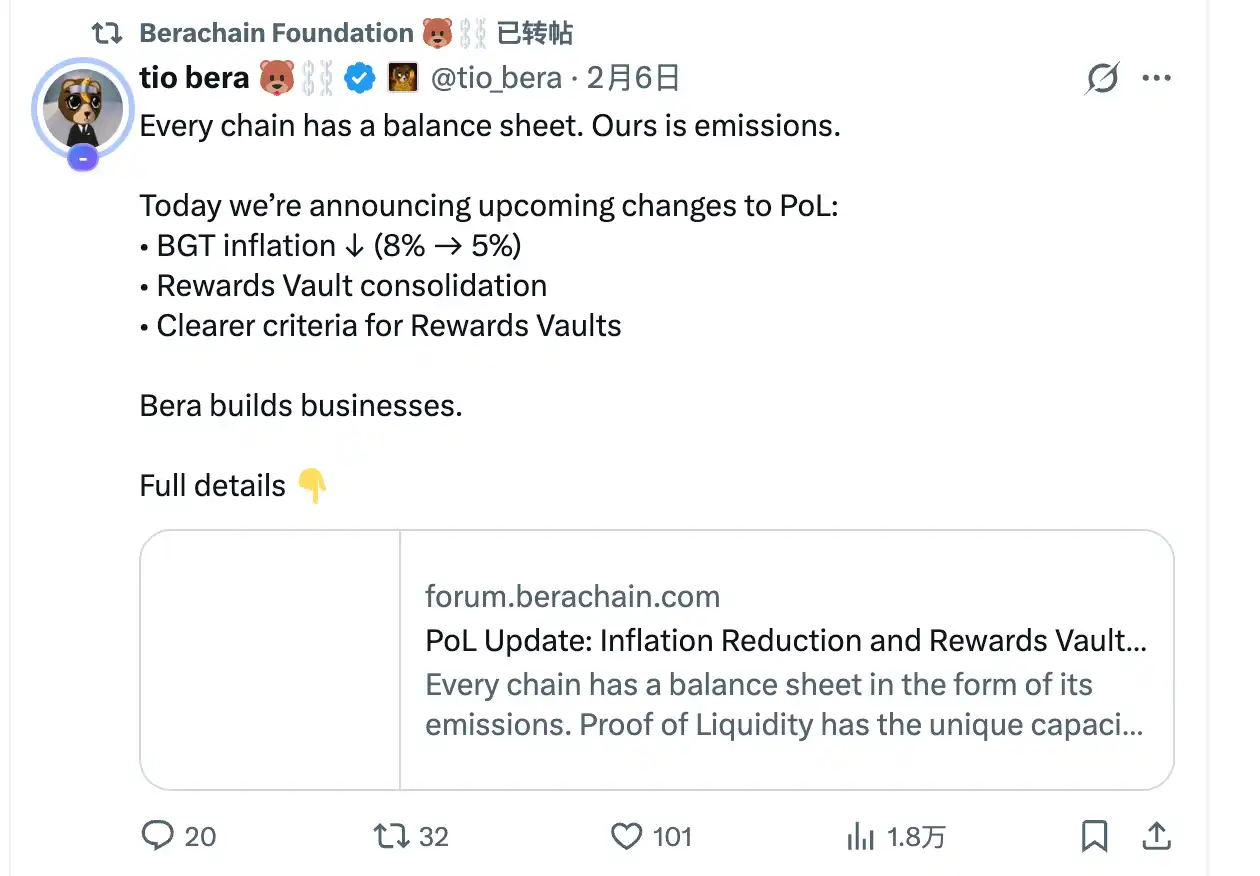
We see that the earlier 8% inflation rate was more like an "expansionary credit" for the ecosystem's startup phase, successfully completing the primitive accumulation of liquidity in the short term. Now, reducing PoL-related emissions by approximately 46% (reward rate reduced from 1.2 to 0.65) not only reflects its precise control over the current ecosystem's carrying capacity and incentive efficiency but also embodies a refinement of liquidity management:

That is, while maintaining the stability of the network security base rate, by moderately tightening new emissions, ensuring that every $BGT injected into the ecosystem gains a higher value anchor.

For $BGT, a governance asset with the attributes of a soul-bound token, scarcity is the core pillar for exercising its引流 power. As the emission rate slows, the marginal dilution pressure faced by holders and delegators is significantly reduced. This "active balance sheet reduction" directly strengthens the hard currency属性 of $BGT as a core governance asset, further promoting the rebalancing of value capture:

Of course, if we observe the development paths of Ethereum or various top L1s, a steady decline in the inflation rate is often the entry ticket to the "golden maturity period." Berachain's turn at this moment actually sends a clear signal that the ecosystem has already achieved stability driven by "endogenous growth" and no longer relies solely on scale expansion.

Then, as the total incentive becomes more precious, protocols within the ecosystem will spontaneously initiate an efficiency competition.

This "tight" incentive budget is actually creating higher溢价 space for high-quality protocols. Under the new economic model, $BGT emission rights will flow more to those "high-productivity protocols" that can generate real interactions and have a deep user base.

Reward Vault Integration—Ecological Value Sedimentation from "Scale Expansion" to "Quality and Depth"

If inflation reduction is a "balance sheet reduction" at the macro level, then the further integration of reward vaults is a precise drip irrigation targeting micro-efficiency within the ecosystem.

The Berachain Foundation stated in its latest tweet that the ecosystem plans to remove about 200 reward vaults with low operational efficiency. Of course, the plan itself is not simply a negation of early projects but more of a resource rebalancing expected after the Berachain ecosystem enters a specific stage.

In fact, during the cold start phase, a wide distribution of vaults helps探测 different market demands. When the ecosystem enters maturity, withdrawing incentive resources from长期闲置 or functionally overlapping pools and re-injecting them into core protocols with real trading activity is an inevitable choice to enhance the network's overall competitiveness.

Similarly, with the integration, Berachain immediately enacted more rigorous and dynamic vault access standards. This means that future incentive distribution will no longer be based on the first-come-first-served inertia of the early days but will更多的是 based on a multi-dimensional KPI evaluation system. Some potential standards may include:

  • Sustained Demand: Examining whether the protocol has generated real transaction volume and user interaction, not just static沉淀 of funds.
  • External Incentive Coordination: Encouraging protocol parties to use their own resources and external financing to form a synergy with $BGT emissions, jointly energizing the ecosystem.
  • Verifiable Contribution: Every unit of incentive emission must be transformed into an observable network effect, such as the depth of $HONEY liquidity or the value回流 of transaction fees.

By clearing some self-circulating or inefficient incentive paths, Berachain is actually making room for growth for teams with real product strength. This process of "discarding the dross and selecting the essential" aims to end models that rely solely on system subsidies for survival,转而扶持 business entities with independent profitability capabilities.

This is also perhaps the embodiment of the "Bera Builds Businesses" vision: the incentive mechanism is no longer an indiscriminate温床 but a precise capital accelerator. Projects筛选ed through this mechanism will have stronger risk resistance and commercial value, thereby providing $BGT holders with more确定性 value support in the fierce L1 competition.

Evolution is the Only Way Out

This major reform of Berachain's PoL marks the ecosystem's official paradigm shift towards a "mature L1 with real output." By optimizing emission efficiency, the ecosystem is彻底重构 $BGT emissions into productive capital with ROI certainty. While pushing the network towards the ultimate capital efficiency interval, it is also anchoring a more solid value signal for $BGT and $BERA holders.

Under the new pilot mechanism, incentives are endowed with precise引流 properties: every unit of injected liquidity will激发超额 real transaction fees, interest income, or ecological溢价 at the protocol layer, thereby constructing a positive value closed-loop of "incentive cost < protocol收益".

This "1 > 1 capital alchemy" is a public chain-level active asset management system,正在 transforming every bit of inflation into KPIs that drive commercial prosperity, fundamentally locking in the return of Berachain's long-term sovereign value, and establishing a leading position towards real economic growth and business闭环 in the highly homogeneous L1 track.

Thus, "Bera Builds Businesses" is also transforming from a grand narrative into a precise financial engine.


Criptos en tendencia

Preguntas relacionadas

QWhat is the core change in Berachain's PoL mechanism as described in the article?

AThe core change is a reduction in the annual inflation rate of $BGT from 8% to 5%, which is an active cut of approximately 46% in emissions.

QWhat are the three tokens in the PoL system and their primary functions?

AThe three tokens are: $BERA (the gas token and base for security), $HONEY (an over-collateralized native stablecoin for financial settlement), and $BGT (a non-transferable soulbound token that serves as the governance hub, binding governance power to 'real contributions' to the ecosystem).

QWhat was the main purpose of the high inflation model (8-10%) used by Berachain at its mainnet launch?

AIt was a cold-start strategy designed to achieve the primitive accumulation of liquidity in the short term and validate the practical resilience of the PoL mechanism.

QWhat are some of the new potential criteria for a vault to gain access to incentives after the reform?

APotential criteria include: Sustainable Demand (real transaction volume and user interaction), Coordination with External Incentives (using the protocol's own resources and external financing alongside $BGT emissions), and Verifiable Contribution (converting each unit of incentive into observable network effects like $HONEY liquidity depth or fee value回流).

QHow does the article characterize the ultimate goal of Berachain's incentive mechanism after this reform?

AThe goal is to transform the incentive mechanism from a blanket subsidy into a precise capital accelerator, ensuring every unit of $BGT emission is productive capital with a high certainty of ROI, ultimately building a positive value closed-loop where 'incentive cost

Lecturas Relacionadas

Director ejecutivo de HIVE: Los GPU para IA generan 10 veces más ingresos por hora que las granjas de minería

El CEO de HIVE Digital Technologies, Frank Holmes, ha presentado datos que demuestran que su clúster de 504 GPUs Nvidia B200, utilizado para infraestructura de IA, genera aproximadamente 2.90 dólares por hora por GPU. En contraste, sus operaciones de minería de Bitcoin producen solo unos 0.12 dólares por hora, una diferencia de más de 20 veces en este indicador clave. Esta brecha de rentabilidad fundamenta la estrategia de HIVE: priorizar inversiones en el negocio de IA, de mayores ingresos, mientras mantiene sus significativas operaciones mineras. En el año fiscal 2026, HIVE alcanzó una tasa de hash promedio de 22.2 EH/s y minó 2,885 BTC. Los ingresos totales fueron de 297.8 millones de dólares, con un crecimiento del 158%. Su división de IA/HPC, BUZZ, contribuyó con 19.5 millones. La compañía está construyendo un ambicioso centro de datos de IA de 320 MW en Toronto, que albergará más de 100,000 GPUs y se espera que genere unos 360 millones de dólares en ingresos recurrentes anuales una vez operativo a finales de 2027. HIVE no está sola en esta transición; otras mineras como MARA, Hut 8 y Terawulf también están redirigiendo recursos energéticos hacia contratos de IA/HPC debido a la mayor rentabilidad y a la presión en los márgenes de la minería de Bitcoin. El objetivo inmediato de HIVE es multiplicar por diez sus ingresos anuales por IA/HPC.

cryptonews.ruHace 1 hora(s)

Director ejecutivo de HIVE: Los GPU para IA generan 10 veces más ingresos por hora que las granjas de minería

cryptonews.ruHace 1 hora(s)

"Cada día sin reglas claras es una pérdida de capital": Grayscale se dirige al Senado por la Ley CLARITY

La empresa Grayscale Investments, la mayor plataforma de inversión en activos digitales del mundo, ha instado públicamente al liderazgo del Senado de EE.UU. a llevar a votación el proyecto de ley CLARITY Act antes del receso parlamentario de agosto. En una carta abierta, el director jurídico de Grayscale, Craig Salm, pidió a los líderes del Senado que actúen, subrayando que la industria cripto estadounidense ha operado durante años sin un marco regulatorio integral, en un entorno de "regulación mediante aplicación coercitiva". El CLARITY Act, resultado de meses de trabajo bipartidista, busca establecer reglas claras para el mercado, definir las jurisdicciones de los reguladores CFTC y SEC, y reforzar la competitividad de EE.UU. Grayscale advierte que cada día de retraso provoca la fuga de talento, innovación y capital hacia jurisdicciones como Singapur o Abu Dabi, que ya cuentan con marcos regulatorios definidos. La aprobación de la ley también permitiría un mayor desarrollo de fondos cotizados (ETF) y otros productos de inversión regulados en criptoactivos. El proyecto ya ha sido aprobado por el Comité Bancario y debatido en audiencias. Grayscale reconoce la agenda cargada del Senado, pero solicita urgentemente una votación previa al receso de agosto para proporcionar la certeza regulatoria que el sector demanda. La petición se produce en medio de un intenso debate político sobre el proyecto. Aunque ha recibido apoyo, también enfrenta críticas de algunos reguladores estatales, como la Fiscal General de Nueva York, que teme que limite la capacidad para combatir fraudes, y de bancos importantes que pieren normas más estrictas para los stablecoins.

cryptonews.ruHace 1 hora(s)

"Cada día sin reglas claras es una pérdida de capital": Grayscale se dirige al Senado por la Ley CLARITY

cryptonews.ruHace 1 hora(s)

Grayscale cree que la llegada de 3.000 bóvedas on-chain con activos por valor de más de 7.000 millones de dólares será el próximo gran avance en el ámbito de las criptomonedas

Las stablecoins y los activos tokenizados ya han comenzado a transformar el sistema financiero tradicional. Ahora, Grayscale prevé que los "vaults" o almacenes en cadena de bloques serán la próxima innovación criptográfica en alcanzar la corriente principal. Estos vaults agrupan fondos de inversores y los asignan a estrategias generadoras de rentabilidad, administradas por gestores profesionales llamados curadores. Su estructura se asemeja a las Obligaciones de Crédito Colateralizado (CLO) tradicionales, pero con una diferencia clave: utilizan contratos inteligentes en redes como Ethereum, Base y Solana en lugar de intermediarios. Esto ofrece transparencia en tiempo real, puede reducir costos administrativos y aumentar la liquidez. Actualmente, el mercado es pequeño: más de 3,000 vaults mantienen activos por unos $7 mil millones, gestionados por 57 curadores, con un 79% en estrategias de stablecoins. En comparación, el mercado global de CLO ronda los $1.5 billones. El principal obstáculo para el crecimiento es la incertidumbre regulatoria, especialmente en EE.UU., donde la discreción de los curadores podría atraer la atención de los reguladores. A pesar de esto, Grayscale cree que los vaults tienen un potencial significativo para convertirse en productos de inversión principales para activos digitales, siempre que la industria logre combinar la eficiencia de los contratos inteligentes con el cumplimiento de los estándares financieros tradicionales.

cryptonews.ruHace 1 hora(s)

Grayscale cree que la llegada de 3.000 bóvedas on-chain con activos por valor de más de 7.000 millones de dólares será el próximo gran avance en el ámbito de las criptomonedas

cryptonews.ruHace 1 hora(s)

Trading

Spot

Artículos destacados

Cómo comprar POL

¡Bienvenido a HTX.com! Hemos hecho que comprar Polygon Ecosystem Token (POL) sea simple y conveniente. Sigue nuestra guía paso a paso para iniciar tu viaje de criptos.Paso 1: crea tu cuenta HTXUtiliza tu correo electrónico o número de teléfono para registrarte y obtener una cuenta gratuita en HTX. Experimenta un proceso de registro sin complicaciones y desbloquea todas las funciones.Obtener mi cuentaPaso 2: ve a Comprar cripto y elige tu método de pagoTarjeta de crédito/débito: usa tu Visa o Mastercard para comprar Polygon Ecosystem Token (POL) al instante.Saldo: utiliza fondos del saldo de tu cuenta HTX para tradear sin problemas.Terceros: hemos agregado métodos de pago populares como Google Pay y Apple Pay para mejorar la comodidad.P2P: tradear directamente con otros usuarios en HTX.Over-the-Counter (OTC): ofrecemos servicios personalizados y tipos de cambio competitivos para los traders.Paso 3: guarda tu Polygon Ecosystem Token (POL)Después de comprar tu Polygon Ecosystem Token (POL), guárdalo en tu cuenta HTX. Alternativamente, puedes enviarlo a otro lugar mediante transferencia blockchain o utilizarlo para tradear otras criptomonedas.Paso 4: tradear Polygon Ecosystem Token (POL)Tradear fácilmente con Polygon Ecosystem Token (POL) en HTX's mercado spot. Simplemente accede a tu cuenta, selecciona tu par de trading, ejecuta tus trades y monitorea en tiempo real. Ofrecemos una experiencia fácil de usar tanto para principiantes como para traders experimentados.

489 Vistas totalesPublicado en 2024.12.11Actualizado en 2026.06.02

Cómo comprar POL

Discusiones

Bienvenido a la comunidad de HTX. Aquí puedes mantenerte informado sobre los últimos desarrollos de la plataforma y acceder a análisis profesionales del mercado. A continuación se presentan las opiniones de los usuarios sobre el precio de POL (POL).

活动图片