Abstract
Despite the bloodbath in the crypto market that has taken place over the last three months, platforms in both the Web3 and Web2 spaces have acquired or expanded NFT tools into their services. This report aims to explore their plans regarding these tools and how they will affect the future of NFTs. The following events will be discussed:
1. Uniswap and OpenSea’s acquisition of Genie and Gem respectively
2. eBay’s acquisition of KnownOrigin
3. Shopify’s New NFT Storefront
Uniswap will integrate NFT trading functions into its web app and its platform starting this fall, generating additional revenue by cross-selling NFT products to its 170,000 monthly active users. With Uniswap’s existing userbase and reputation, it stands to become a strong competitor to OpenSea. This competition will benefit NFT consumers by keeping transaction costs low while creating a robust platform with great functionality. It is expected that Uniswap will provide flexibility and liquidity to the NFT trading process. Multi-coin payments and NFT liquidity pools are expected to become the norm for NFT trading.
eBay’s acquisition of KnownOrign will bring cryptocurrency and NFTs to eBay’s more than 150 million monthly active users. eBay’s existing UI interface and payment system will lower the barriers to entry of NFTs for both creators and collectors, while also allowing NFTs to be sold and purchased using fiat currency. We expect to see eBay start with digitalizing sports trading cards and launching exclusive trading card NFT collections to appeal to its large userbase of trading card enthusiasts, which accounted for US$1 billion of sales each quarter on its platform in 2021.
With Shopify’s GM shop providing token-gated storefront services for NFT projects, we expect to see many NFT projects turn into fully established brands. Shopify and eBay will play important roles in driving mass adoption for NFTs, lowering the barriers to entry, and simplifying crypto payments for the public.
1. Uniswap Acquires Genie – Some Underlying Issues
Why Uniswap Wants an NFT platform
NFTs have become one of the main uses of cryptocurrency, and integrating them into Uniswap will bring enormous cross-selling opportunities and further strengthen Uniswap’s position as a decentralized exchange (DEX). NFTs have consumerized blockchain technology, and play a crucial role in onboarding the next wave of Web3 users. As of June, there were 375,000 unique NFT traders and 369,000 unique DEX traders. Uniswap will integrate Genie into their web app and offer ERC-20 tokens and NFTs to both groups of traders in a single platform interface.
Genie’s Current Issue
Genie, founded in 2021, is the first NFT market aggregator. An NFT aggregator consolidates all listings of NFTs across multiple marketplaces into a single unified catalogue, saving users the trouble of browsing and locating their desired NFTs on all marketplaces. Moreover, aggregators allow batch trading of NFTs from different collections and across different marketplaces in a single transaction, saving time and more importantly, gas fees. Genie is underperforming substantially in terms of active users and transaction volume compared to its competitor Gem.
Key Statistics of Genie
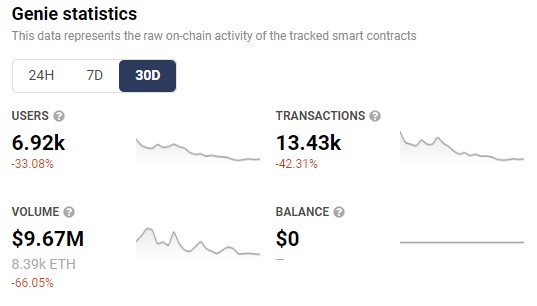
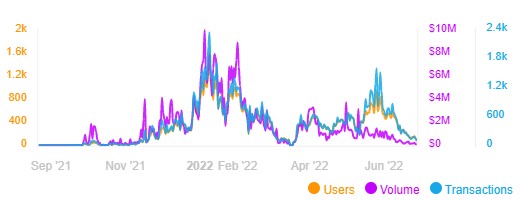
Figure 1: Statistics of On-chain Activity related with Genie (Source: Dappradar)
Despite first-mover advantage, Genie is losing users to Gem. In the last 30 days, Genie only had 6,920 users, a 1.21ETH transaction volume per user, and 1.94 transactions per user. Genie was the leading NFT market aggregator in early January but was quickly overtaken by Gem in February due to it being incompatible with the LooksRare marketplace.
Key Statistics of Gem
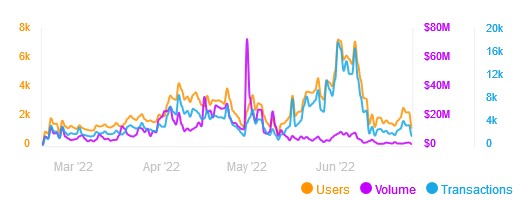
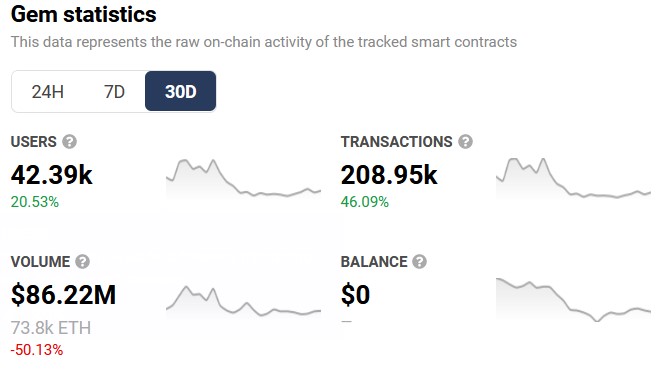
Figure 2: Statistics of On-chain Activity related to Gem (Source: Dappradar)

Figure 3: Key Metrics of Gem and Genie (Source: Dappradar, Dune @sohwak)
Gem has around six times the number of users and nine times the volume of Genie. Users of Gem also registered more transactions and larger volumes, indicating that Gem’s userbase has a higher percentage of whales and experienced traders.
Importance of Compatibility
The main reason for Genie’s lag behind Gem is the former’s failure to quickly support newly-launched NFT platforms. The perfect timing of Gem’s launch and its monopolistic compatibility with LooksRare’s platform just ten days after the latter was launched in January allowed Gem to quickly attract Genie’s users. Genie, on the other hand, was incompatible with LooksRare’s platform until April.
Looking at Figure 4, we can see that in late January, Gem quickly took over Genie for market share of total NFT trades with its monopolistic support for LooksRare. Although Genie finally integrated LooksRare in April, this only led to a small rebound in number of daily users. Genie was again behind in the compatibility game when another new NFT marketplace, X2Y2 launched in February. Gem became compatible with X2Y2 in March, while Genie became compatible two months later in May.
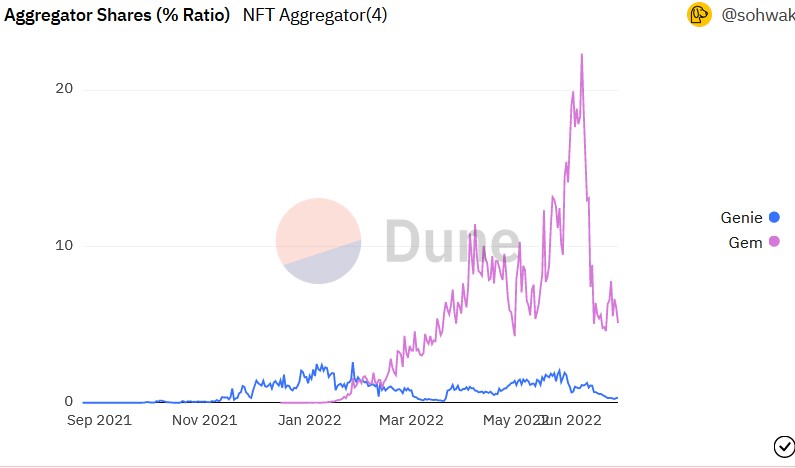
Figure 4: Aggregator Shares in total NFT trades (Source: Dune @sohwk)
2. The Future of NFT Trading is about Compatibility, Flexibility, Liquidity
Compatibility
As more NFT marketplaces emerge, the need for market aggregators to consolidate all listings across marketplaces into a single interface will be higher than ever. It is crucial for market aggregators to attain compatibility with new marketplaces as soon as possible. Gem’s quick response and effort to integrate with new marketplaces allowed it easily overtake Genie. Having a dedicated development team working on marketplace compatibility should be Uniswap’s priority after its acquisition of Genie.
Flexibility
One of the issues with trading NFTs is that most marketplaces only take ETH as payment. Being the largest decentralized exchange, Uniswap is expected to solve this issue by accepting any cryptocurrencies as payment, and even allowing NFTs to be listed and priced in several types of tokens across blockchains at the same time, providing buyers with flexibility and convenience. Marketplace Aggregator Gem is already accepting all ERC-20 tokens as payment.
Liquidity
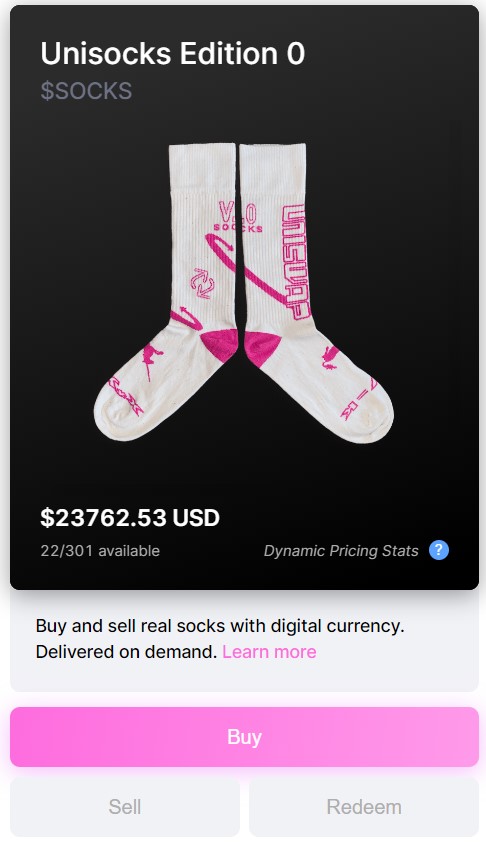
Figure 5: Screenshot of the Unisocks Exchange (Source: Uniswap)
Liquidity has been a major problem for NFTs because each listed NFT requires a unique buyer in order to be bought off a marketplace. NFT liquidity pools will help solve this problem by allowing users to trade directly with the liquidity pool 24/7 without the need to find an actual buyer. Uniswap has already been exploring the concept of an NFT liquidity pool with its Unisocks NFT. The Unisocks are redeemable ERC-20 tokens that can be burned to claim physical copies of actual socks. A total of 500 Unisocks was created and deposited into a liquidity pool with 35ETH, allowing socks to be bought and sold at any time. In the future, it will not be surprising to see more fungible physical or digital goods traded as redeemable ERC-20 tokens using Uniswap’s NFT liquidity pools. For example, limited edition luxury products, signed trading cards, event tickets, etc.
3. OpenSea Vs Uniswap
With Uniswap’s existing userbase and reputation as the most widely-used DEX, it stands to become a strong competitor to OpenSea if Uniswap’s NFT integration turns out to be a success. Competition among NFT trading platforms concerns transaction fees, functionality, and stability. This competition will benefit NFT consumers by keeping transaction costs low and creating robust trading platforms with great functionalities.
Genie’s competitor Gem was acquired by OpenSea a month ago. Opensea plans to keep Gem as a separate brand and platform and integrate Gem’s aggregator functions into OpenSea as a pro feature for experienced traders. It would not be surprising if this pro feature provides incentives for frequent traders with large transaction volumes to trade on OpenSea. For example, an incentive could be a reduction in platform transaction fees.
4. Traditional E-commerce Platforms Embraces NFT integration
Ebay and KnownOrigin
Digital art marketplace KnownOrigin, which was launched in 2018 and targets digital art artists and collectors, was acquired by eBay. Although being one of the oldest NFT marketplaces, it fails to attract users. The platform only has around 5000 total traders and a volume of $7.8M. In the last 30 days, there were only 164 users with a 3.14ETH volume. Currently, KnownOrigin is a quiet marketplace with little userbase and volume.
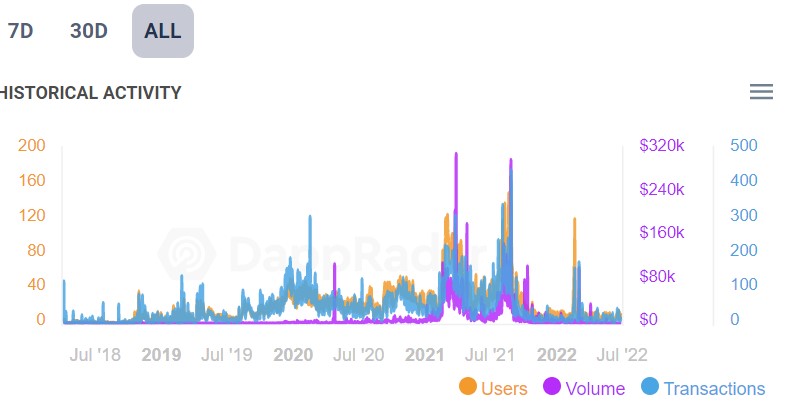
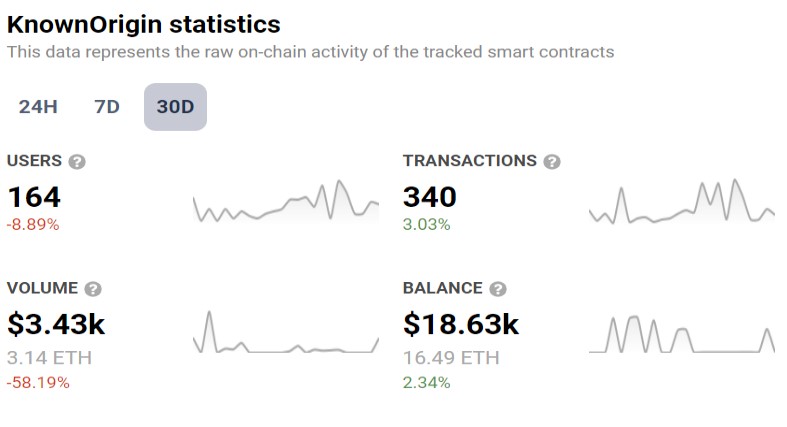
Figure 6: Statistics for On-chain Activity Related to Gem (Source: Dappradar)
What to Expect from Ebay?
Ebay is a traditional E-commerce platform that facilitates both business-to-consumer and consumer-to-consumer sales. It is the go-to platform for trading hard-to-find, niche collectibles such as sports trading cards, collectible game cards, antique coins, and collectible toys. Acquiring digital art NFT platform KnownOrigin will allow eBay to add digital collectibles trading to their platform. It is expected that eBay will utilize KnownOrign’s platform to further strengthen its niche in collectibles trading. Ebay will bring cryptocurrency and NFTs to its 150million+ active users and lower the barriers to entry for NFTs for both creators and collectors. It is expected that eBay will launch its own exclusive NFT collections on their website. The collection will very likely take the form of sport trading cards, appealing to its large userbase of card traders. As of 2021, the gross merchandise value (GMV) of total cards sold on the Ebay platform was around US$1 billion per quarter. With the addition of an NFT marketplace, eBay will strengthen its position as the leading marketplace for niche, trading card collectibles.
Shopify’s GM Shop
Instead of acquiring an NFT marketplace like eBay, Shopify launched its own online storefront platform “GM shop” that targets existing NFT projects. It is expected that many NFT projects will turn into well-known lifestyle brands in the future thanks to Shopify’s NFT storefront and its fiat payment system for blockchain transactions.
GM shop helps NFT projects to set up token-gated storefronts both online and offline, with crypto payment systems powered by both fiat and cryptocurrencies. Shopify also provides NFT projects with services to turn them into actual businesses by helping them to develop merchandise from scratch.
In addition to the online storefront, GM shop also simplifies the minting and trading process of NFTs through Shopify’s payment system. It leaves the complicated blockchain transactions to Shopify’s end, allowing consumers to use fiat currency only for NFT trades and mints and then claiming their NFTs via email using their wallets.
Conclusion
In the near future, we will see more traditional -commerce platforms integrating NFTs into their stores. To compete with existing marketplaces, they would offer certain niches and exclusive NFT collections on their platforms to build a loyal customer base. eBay’s acquisition of KnownOrigin indicates its intention to create a rare collectibles marketplace, focusing on artists, trading cards and communities, which is aligned with eBay’s position in traditional peer to peer e-commerce.
As newer NFT platforms emerge, the need for NFTs market aggregators to consolidate listings and bundle trade across platforms and collections will grow. With the recent acquisitions, OpenSea and Uniswap have positioned themselves to be the leading trading platforms in the NFT space. If Uniswap’s NFT market proves successful, it will become a strong competitor to OpenSea. Moreover, competition between marketplaces will lead to more benefits for NFT traders as platforms compete on fees, user experiences and reward incentives.