Hoskinson Urges Cardano Unity Ahead Of Pivotal 2026 Roadmap

bitcoinistPublicado a 2025-11-28Actualizado a 2025-11-28

Resumen

Cardano founder Charles Hoskinson used a Thanksgiving livestream on November 27 to call for a reset of relations between the...

Trusted Editorial content, reviewed by leading industry experts and seasoned editors. Ad Disclosure

Cardano founder Charles Hoskinson used a Thanksgiving livestream on November 27 to call for a reset of relations between the network’s core institutions and to frame 2026 as a decisive year for the ecosystem.

He acknowledged a bruising year marked by a contentious “social fork” and, more recently, a soft fork and long-chain reorganization. “Everyone has grievances and we all have sins as well, myself included,” he said. “For my part in all these things, I am sorry.”

Cardano Eyes 2026 Reset With Hoskinson’s Call For Cohesion

Hoskinson admitted that his own “rigid and principled” style and public anger over disagreements have sometimes made things worse, and warned that “in disunity and division this ecosystem cannot succeed regardless of philosophical differences.” He pledged to stop relitigating past disputes with the Cardano Foundation and focus instead on “the new governance structure moving forward.”

He tied that reset to a joint governance push by five institutions: IOG, the Cardano Foundation, EMURGO, Intersect and the Midnight Foundation. He credited “Philip [Pon] from EMURGO and Fahmi [Syed] from the Midnight Foundation and Jack [Briggs] from Intersect” for convening talks on “how all five entities […] can work better together for the greater good of the Cardano ecosystem,” and said the community should expect coordinated proposals, including a “critical integrations” budget for missing core infrastructure ahead of 2026.

Hoskinson also rejected characterizations of this week’s soft fork as a systemic failure, calling it “a demonstration of the strengths of Cardano as a whole.” Its Nakamoto-style proof-of-stake and “remarkable protocol engineering,” he argued, allowed the network to “organically recover without significant disruption or loss,” with genesis and infrastructure preserved.

Drawing an analogy to Bitcoin’s history of orphaned blocks, he argued that temporary chain splits are “a feature, not a bug,” because they create “internal resilience” that lets the network “recover to the longest chain over time.” The incident, he said, reminded him that “no matter how big the fork, there is a way for two chains to become one.”

Looking forward, Hoskinson cast 2026 as the key execution window for Cardano’s roadmap. He highlighted Hydra’s emerging DeFi use cases, “amazing innovations like Starstream,” the commercialization of the Midnight ecosystem and the opening of “completely new markets” through Bitcoin DeFi.

Realizing that vision, he said, requires a coordinated effort from “the young new ones like the Midnight Foundation,” groups “with a lot of collaboration but dissonance like Intersect,” infrastructure players such as Pragma and “the old guard” at IOG and the Cardano Foundation, alongside the wider community.

The speech also drew a sharper ideological line between what he described as two philosophies that will shape crypto over the next five years. One, in his telling, seeks to “rebuild Wall Street, make it a little faster, better, and cheaper” while preserving the same control structures and middlemen. The other, rooted in the cypherpunk tradition and Satoshi Nakamoto’s design, insists that “no entity should be so powerful that they get to decide your freedom of association, commerce and expression.”

Hoskinson positioned Cardano, Midnight and Bitcoin within the latter camp. “We’re the good guys,” he said. “Every day we wake up and we fight for every person to have a seat at the table […] they have a right to be there by the fact that they are human.” If the ecosystem can translate that ethos into unified governance and shared infrastructure, he argued, “this time next year, we will be 10 times stronger than we are today.”

Notably, the livestream came after the first joint governance proposal from Intersect, IOG, Emurgo, Cardano Foundation and the Midnight Foundation. Intersect wrote via X: “The Critical Integrations Budget – now on-chain – reflects several weeks of collaboration among the core entities, with last week’s mainnet incident highlighting the strength of that coordination. The Budget Info Action is now available for DReps and the six Constitutional Committee members to consider and vote on.”

At press time, ADA traded at $0.42.
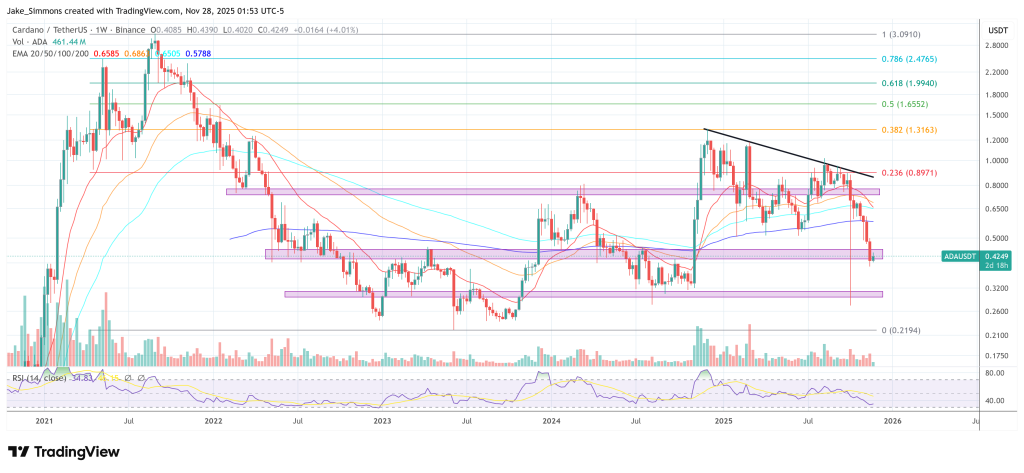
Cardano price
ADA remains at key support zone, 1-week chart | Source: ADAUSDT on TradingView.com
Featured image from YouTube, chart from TradingView.com
Editorial Process for bitcoinist is centered on delivering thoroughly researched, accurate, and unbiased content. We uphold strict sourcing standards, and each page undergoes diligent review by our team of top technology experts and seasoned editors. This process ensures the integrity, relevance, and value of our content for our readers.

Jake Simmons has been a Bitcoin enthusiast since 2016. Ever since he heard about Bitcoin, he has been studying the topic every day and trying to share his knowledge with others. His goal is to contribute to Bitcoin's financial revolution, which will replace the fiat money system. Besides BTC and crypto, Jake studied Business Informatics at a university. After graduation in 2017, he has been working in the blockchain and crypto sector. You can follow Jake on Twitter at @realJakeSimmons.

Criptos en tendencia

Lecturas Relacionadas

Aave se va, el TVL se desploma, ¿dónde está el ancla de valoración de MegaETH?

**Resumen en español:** Según datos de DefiLlama, el TVL (valor total bloqueado) de MegaETH experimentó una fuerte volatilidad del 9 al 10 de julio, cayendo cerca del 60% en 24 horas y evaporando aproximadamente el 70% desde su pico en mayo. El protocolo principal Aave V3 retiró el 80% de su liquidez. El precio de MEGA cayó a alrededor de $0.048, con una capitalización de mercado de unos $54 millones y un FDV (valor totalmente diluido) de unos $4.8 mil millones. Una vez considerada una de las nuevas cadenas más prometedoras, MegaETH alcanzó un TVL de $245 millones en mayo. Sin embargo, su ecosistema dependía en gran medida de un solo protocolo (Aave) y de estrategias de aprovechamiento cíclicas con stablecoins como USDe. Cuando los rendimientos de estas estrategias disminuyeron, los fondos se retiraron rápidamente, revelando una discrepancia entre la valoración y los fundamentos reales de la cadena. Existen tres desajustes clave: 1. **Valoración vs. Uso real:** El FDV de $4.7 mil millones contrasta con unos ingresos protocolarios anualizados de solo ~$10 millones y unas 2,600 direcciones activas diarias. 2. **Narrativa vs. Calidad del ecosistema:** A pesar de su narrativa DeFi, la mayor parte de los ingresos proviene de un juego de cartas (Monster), no de protocolos financieros. El volumen de trading en DEX y contratos perpetuos es bajo. 3. **Expectativas a corto vs. largo plazo:** El TVL inicial fue impulsado por incentivos y arbitraje, no por demanda orgánica. Proyectos como Uniswap han visto evaporarse casi por completo su TVL en la cadena. La caída de MEGA refleja una tendencia más amplia en la que el mercado reduce la prima por el TVL contable y las narrativas, exigiendo en su lugar un soporte de valor más claro basado en transacciones reales, ingresos y un ecosistema sólido. Aunque la caída ya es significativa, una recuperación sostenida probablemente requerirá que el equipo transforme la liquidez a corto plazo en un uso y un desarrollo ecológico real y tangible, más allá de los posibles rebotes por sentimiento del mercado.

marsbitHace 35 min(s)

Aave se va, el TVL se desploma, ¿dónde está el ancla de valoración de MegaETH?

marsbitHace 35 min(s)

Trading

Spot

Artículos destacados

Cómo comprar ADA

¡Bienvenido a HTX.com! Hemos hecho que comprar Cardano (ADA) sea simple y conveniente. Sigue nuestra guía paso a paso para iniciar tu viaje de criptos.Paso 1: crea tu cuenta HTXUtiliza tu correo electrónico o número de teléfono para registrarte y obtener una cuenta gratuita en HTX. Experimenta un proceso de registro sin complicaciones y desbloquea todas las funciones.Obtener mi cuentaPaso 2: ve a Comprar cripto y elige tu método de pagoTarjeta de crédito/débito: usa tu Visa o Mastercard para comprar Cardano (ADA) al instante.Saldo: utiliza fondos del saldo de tu cuenta HTX para tradear sin problemas.Terceros: hemos agregado métodos de pago populares como Google Pay y Apple Pay para mejorar la comodidad.P2P: tradear directamente con otros usuarios en HTX.Over-the-Counter (OTC): ofrecemos servicios personalizados y tipos de cambio competitivos para los traders.Paso 3: guarda tu Cardano (ADA)Después de comprar tu Cardano (ADA), guárdalo en tu cuenta HTX. Alternativamente, puedes enviarlo a otro lugar mediante transferencia blockchain o utilizarlo para tradear otras criptomonedas.Paso 4: tradear Cardano (ADA)Tradear fácilmente con Cardano (ADA) en HTX's mercado spot. Simplemente accede a tu cuenta, selecciona tu par de trading, ejecuta tus trades y monitorea en tiempo real. Ofrecemos una experiencia fácil de usar tanto para principiantes como para traders experimentados.

1.9k Vistas totalesPublicado en 2024.12.10Actualizado en 2026.06.02

Cómo comprar ADA

Discusiones

Bienvenido a la comunidad de HTX. Aquí puedes mantenerte informado sobre los últimos desarrollos de la plataforma y acceder a análisis profesionales del mercado. A continuación se presentan las opiniones de los usuarios sobre el precio de ADA (ADA).

活动图片