Nasdaq CEO Shows 3 Ways Blockchain Could Change Finance Forever: Best Wallet Token Amps Up

bitcoinistPublicado a 2025-11-05Actualizado a 2025-11-05

Resumen

Quick Facts: ➡️ Nasdaq’s CEO says blockchain can fix settlement and market plumbing. Wallets become the access layer for that...

Trusted Editorial content, reviewed by leading industry experts and seasoned editors. Ad Disclosure

Quick Facts:

  • ➡️ Nasdaq’s CEO says blockchain can fix settlement and market plumbing. Wallets become the access layer for that shift and need strong security and UX.
  • ➡️ Best Wallet uses Fireblocks MPC-CMP, supports multiple chains, and bundles a DEX aggregator, staking, and presale access to turn a wallet into a full crypto hub.
  • ➡️ $BEST presale shows momentum with a live price of $0.025895 and more than $16.8M raised. Tokens are payable via crypto or card with token claims post presale.
  • ➡️ Staking runs during the presale with dynamic rewards from an 8% pool, aiming to reward longer-term holders rather than short-term speculation.

Nasdaq chief Adena Friedman recently outlined three ways blockchain could upgrade global finance. Her message focused on how distributed ledgers can improve post-trade settlement, support tokenized assets, and streamline market infrastructure.

During her conversation with Ripple’s Monica Long, Friedman’s takeaway was simple. Capital markets are moving toward on-chain rails that need secure user access and intuitive wallets to reach scale.

Mobile crypto wallets sit at the top of that stack. They are the gateway to tokenized securities, DeFi liquidity, and on-chain payments. If exchanges and brokers bring issuance and settlement on chain, consumers will need mobile wallets that are both secure and easy to use.

That is why wallet UX and security architecture are fast becoming competitive moats.

Best Wallet Token ($BEST) is positioned for this shift with a mobile-first, non-custodial wallet that integrates Fireblocks MPC-CMP security, a decentralized exchange (DEX) aggregator, and a presale portal for trusted launches. The native $BEST token underpins reduced fees, staking, and governance.

As regulated markets lean into tokenization, the best crypto wallets will be those that combine enterprise-grade security with simple cross-chain action.

And Best Wallet is designed to capture the growing market with tangible holder perks, live staking during presale, and a product roadmap that expands utility beyond storage into swaps, cards, and curated presale access.

Best Wallet Token ($BEST) — Mobile First MPC Wallet With Perks

Best Wallet is a non-custodial, multi-chain wallet built around Fireblocks MPC-CMP technology. MPC removes single points of failure by splitting keys across secure computation, while the app layers biometric login and a mobile-native UX.

The wallet supports cross-chain swaps through an integrated DEX aggregator, which provides access to all major blockchains. Read our Best Wallet review for more on this game-changing crypto app.
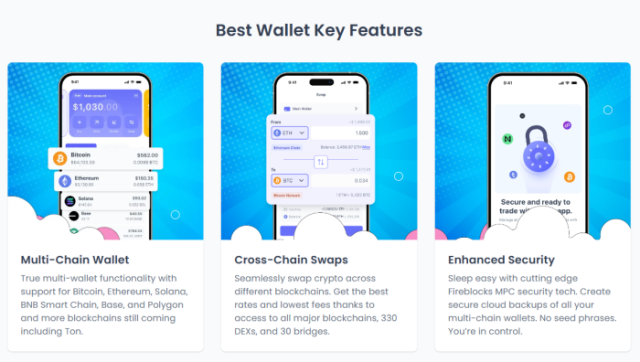
Best Wallet’s key features.

The wallet’s native token, $BEST, is now on presale with a visible raise and price tracker. At the current stage shown on the sale page, $BEST is priced at $0.025895 with more than $16.8M collected. Buyers can use $ETH, $BNB, $USDT, $USDC, or a card, and claiming will be available at the end of the presale window.

🛒 Learn how to buy $BEST here.

Utility is the core pitch rather than hype. Holding $BEST reduces fees inside the Best Wallet ecosystem, grants early access to curated presales via the ‘Upcoming Tokens’ portal, and provides governance decision rights, including what new chains and features to add to the ecosystem.

A staking pool is already available during the sale. Rewards are dynamic and funded from an 8% allocation of the total supply, which aligns incentives with long-term usage rather than short airdrops.

Token design details are straightforward. The total supply is 10B $BEST and the whitepaper outlines allocations for development, marketing, airdrops, staking rewards, exchange liquidity, community rewards, and treasury.

The contract is an ERC-20 on Ethereum and has been audited by Coinsult.

The product suite goes beyond a wallet. Over 330 DEXs and 30 bridges are embedded for same-chain and cross-chain swaps. A Best Card is also in development to enable spending $BTC, $ETH, and other major cryptos, with cashback for $BEST token holders.

The roadmap also includes a browser extension, portfolio tools, an NFT gallery, market analytics, and trading features like limit orders and DCA. The approach is to turn the wallet into a daily driver while keeping custody with the user.

For presale participants, two factors stand out. First is the ‘earn while you wait’ design. That’s because staking during presale lets early users compound exposure rather than sitting idle.

Second is the demand signal. Our $BEST price prediction suggests that the token could reach $0.62 by 2026, marking a 2,290% gain, if demand for secure wallets keeps pace with crypto adoption rates.

A multi-million-dollar raise at this early stage demonstrates traction for a wallet narrative that benefits from traditional finance’s shift toward crypto. That is the same structural change Nasdaq’s leadership is signaling.

Secure $BEST now. The presale ends November 28.

This is informational content only, not financial advice. Do your own research and consider risks. Crypto assets can lose value quickly.

Authored by Bogdan Patru, Bitcoinist: https://bitcoinist.com/best-wallet-token-presale-mpc-security-staking-benefits-best

Editorial Process for bitcoinist is centered on delivering thoroughly researched, accurate, and unbiased content. We uphold strict sourcing standards, and each page undergoes diligent review by our team of top technology experts and seasoned editors. This process ensures the integrity, relevance, and value of our content for our readers.

As a crypto writer, Bogdan’s responsibilities are split between researching and writing articles and entertaining the team with his humor bordering on the politically incorrect, an aspiring Bill Burr, if you will. Thanks to his 12+ years of writing experience in just as many fields, including tech, cybersecurity, modelling, fitness, crypto, and other topics-that-shall-not-be-named, he's become a genuine asset to the team. While his position as a senior writer at PrivacyAffairs thought him valuable lessons about the power of self-management, his entire writing career was and is an exercise in self-improvement. Now, he's ready to sink his teeth into crypto and teach people how to take control of their own money on the blockchain. With fiat as an eternally devaluing currency, Bitcoin and altcoins seem like the best-fitting alternative for Bogdan. Bogdan’s biggest professional accomplishment, aside from securing a position as a main writer for Bitcoinist, was his 5-year run as a writing manager at Blackwood Productions, where he coordinated a team of four writers. During that time, he learned the value of teamwork and that of creating a working environment that breeds efficiency, positivity, and friendship.

Lecturas Relacionadas

La paradoja de la automatización: cuanto más fuerte sea la IA, más ocupados estaremos

El artículo "La Paradoja de la Automatización: Cuanto más fuerte es la IA, más ocupados estamos los humanos" desafía la narrativa predominante de que la IA eliminará puestos de trabajo de cuello blanco. Basándose en la experiencia de la empresa Every, que utiliza extensamente agentes de IA, el autor argumenta que, si bien la automatización asume tareas repetitivas (como codificación básica, servicio al cliente o redacción de borradores), no reduce la carga laboral humana. En cambio, reorganiza el trabajo: los humanos pasan de ser ejecutores a ser diseñadores de marcos, supervisores de calidad, tomadores de decisiones y solucionadores de problemas complejos en tiempo real. La IA commoditiza habilidades humanas del "ayer", haciendo que la producción genérica sea abundante y barata. Esto genera una homogeneización que, a su vez, incrementa la demanda de diferenciación, juicio contextual y adaptación a situaciones específicas del presente—competencias exclusivamente humanas. Por lo tanto, los expertos no desaparecen; su rol se vuelve más crucial para mantener estándares, diseñar sistemas y abordar lo que la IA no puede: definir qué vale la pena hacer y por qué. El artículo también critica la interpretación de los benchmarks de IA. Estos miden el desempeño dentro de un "marco" o prompt específico diseñado por humanos. A medida que la IA domina un marco, los humanos desplazan la meta hacia marcos más complejos, creando una brecha perpetua (una "paradoja de Zenón" de la IA). Incluso una IA general (AGI), al carecer de intencionalidad y estar alineada con objetivos humanos, seguiría necesitando un "delimitador" humano. La conclusión es que el futuro del trabajo no es la sustitución, sino una colaboración donde la IA amplifica las capacidades humanas, haciendo que el juicio, la creatividad y la definición de propósito sean más valiosos que nunca.

marsbitHace 1 hora(s)

La paradoja de la automatización: cuanto más fuerte sea la IA, más ocupados estaremos

marsbitHace 1 hora(s)

a16z: 7 gráficos para entender cómo la tokenización está cambiando la naturaleza de los activos

El tokenizado de activos, a menudo denominado "Activos del Mundo Real" (RWA), está transformando la forma, liquidez y arquitectura del sistema financiero. Con un mercado que superó los 30.000 millones de dólares (excluyendo stablecoins), ha crecido más de 10 veces en menos de dos años. Los bonos del Tesoro de EE.UU. son el principal motor, ofreciendo a los inversores activos generadores de ingresos en formato digital. El panorama actual muestra una alta concentración: los bonos y las materias primas (especialmente el oro, que domina esta categoría) representan alrededor de dos tercios del mercado. Ethereum sigue siendo la cadena de bloques principal, aunque los activos se distribuyen en múltiples ecosistemas. Un hallazgo clave es que la mayoría de los activos tokenizados aún carecen de "componibilidad". Solo el 5% de los bonos tokenizados se utilizan en protocolos DeFi, ya que muchos son meros registros digitales de activos fuera de cadena. En cambio, activos como los tokens de reaseguro muestran una alta adopción en aplicaciones nativas de cadena. Las proyecciones para 2030 varían entre 2 y 30 billones de dólares, lo que indica un enorme potencial de crecimiento frente al tamaño actual. El desafío futuro radica en llevar a cadena partes más complejas del sistema financiero e integrar estos activos de manera profunda en una infraestructura financiera nativa de internet y componible.

链捕手Hace 2 hora(s)

a16z: 7 gráficos para entender cómo la tokenización está cambiando la naturaleza de los activos

链捕手Hace 2 hora(s)

a16z: 7 gráficos para entender cómo la tokenización está cambiando la naturaleza de los activos

Los activos tokenizados, a menudo denominados "activos del mundo real" (RWA), están transformando la forma, liquidez y estructura del sistema financiero. Su capitalización de mercado supera actualmente los 340.000 millones de dólares, un crecimiento de 10 veces en menos de dos años, impulsado por bonos del Tesoro de EE. UU., que son el principal motor. Otras categorías como materias primas (principalmente oro), créditos respaldados por activos y finanzas especializadas también muestran un crecimiento significativo. Ethereum alberga más de la mitad de estos activos, seguido de otras cadenas como BNB Chain y Solana, lo que refleja un ecosistema distribuido. Sin embargo, un desafío clave es la falta de "componibilidad": la mayoría de los activos tokenizados, especialmente los de gran valor como bonos y oro, se utilizan principalmente para tenencia y transferencia en cadena, con solo un pequeño porcentaje integrado en protocolos DeFi para su uso combinado. En contraste, activos más nicho, como los de reaseguro, presentan una alta tasa de uso en cadena. Las proyecciones a largo plazo para 2030 varían entre 2 y 30 billones de dólares, lo que indica un enorme potencial de crecimiento desde los niveles actuales, que aún representan una fracción mínima de los mercados financieros globales. El futuro del sector dependerá de tokenizar activos más complejos e integrarlos profundamente en una infraestructura financiera nativa de Internet y verdaderamente combinable.

Odaily星球日报Hace 2 hora(s)

a16z: 7 gráficos para entender cómo la tokenización está cambiando la naturaleza de los activos

Odaily星球日报Hace 2 hora(s)

Trading

Spot
Futuros
活动图片