7 XRP ETFs Draw Close To Their Decision Deadlines With The SEC – Here Are The Dates

bitcoinistPublicado a 2025-09-30Actualizado a 2025-09-30

Resumen

The race to launch XRP ETFs in the US is reaching a critical stage, with several issuers awaiting final decisions...

Trusted Editorial content, reviewed by leading industry experts and seasoned editors. Ad Disclosure

The race to launch XRP ETFs in the US is reaching a critical stage, with several issuers awaiting final decisions from the Securities and Exchange Commission (SEC). Multiple applications, filed by some of the world’s largest asset managers, are already approaching strict approval deadlines in October. 

SEC Faces Wave Of XRP ETF Deadlines In October

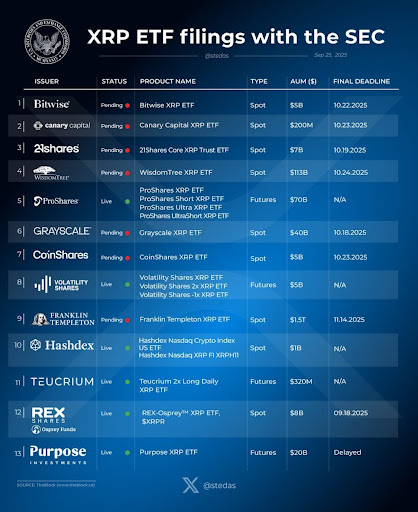
According to a recent update from crypto analyst Stedas, seven XRP ETF applications are now pending with the US SEC. These filings represent a mix of major institutional players and crypto-focused firms, all seeking to secure a first-mover advantage in what could be one of the most competitive markets for digital asset ETFs. 

The earliest deadline falls on October 18, when the SEC must issue a decision on Grayscale’s XRP ETF application, which seeks to leverage the firm’s $40 billion Assets Under Management (AUM). Just a day later, 21Shares will face its own deadline on October 19, with a proposal for its Core XRP Trust ETF backed by $7 billion AUM. Bitwise, another well-known crypto asset manager, will follow on October 20 with its ETF filing and a $5 billion AUM.

CoinShares is expected to enter the spotlight on October 23, with its $5 billion product pending SEC judgement. On the same day, Canary Capital, a smaller but equally ambitious issuer with $200 million in AUM, will also face a final ruling. WisdomTree, with an eye-watering $113 billion AUM, rounds out the October deadlines on October 24, as the SEC decides the fate of its proposed XRP ETF. 
XRP
Source: Chart from Stedas on X

Notably, Franklin Templeton, which oversees approximately $1.5 trillion in assets, will not face its deadline until November 14, giving the firm slightly more runway than its October competitors. Collectively, these ETF applications highlight the broader institutional demand for XRP-based investment vehicles. 

Although REX-Shares and Osprey Funds were the first to launch an XRP ETF in the US, they did so in a collective bundle with the Dogecoin ETF. Furthermore, future-based products from companies such as ProShares, Volatility Shares, and Purpose Investments, among other issuers, are already live. 

Could A US Government Shutdown Affect The Funds Decision Dates?

While October promises to be a decisive month for the funds, concerns have been raised over whether a potential US government shutdown could disrupt the timeline of these products. Funding for the US government is set to expire at the end of Tuesday, September 30, unless an agreement is reached between Republicans and Democrats on a new spending bill. If no deal is signed, the country will enter its first government shutdown in almost seven years. 

The US SEC, as a federal agency, would not be immune to a potential government shutdown. While no official reports have confirmed whether a shutdown would impact the regulator’s ability to decide on XRP ETFs in October, the SEC’s Operations Plan, dated August 7, indicates that such an event would leave it running on a skeletal staff. This would severely restrict its capacity to review corporate filings, investigate misconduct, and oversee markets.

XRP
XRP trading at $2.87 on the 1D chart | Source: XRPUSDT on Tradingview.com
Featured image from Getty Images, chart from Tradingview.com
Editorial Process for bitcoinist is centered on delivering thoroughly researched, accurate, and unbiased content. We uphold strict sourcing standards, and each page undergoes diligent review by our team of top technology experts and seasoned editors. This process ensures the integrity, relevance, and value of our content for our readers.

Scott Matherson is a leading crypto writer at Bitcoinist, who possesses a sharp analytical mind and a deep understanding of the digital currency landscape. Scott has earned a reputation for delivering thought-provoking and well-researched articles that resonate with both newcomers and seasoned crypto enthusiasts. Outside of his writing, Scott is passionate about promoting crypto literacy and often works to educate the public on the potential of blockchain.

Lecturas Relacionadas

Justin Sun declara la guerra a una altcoin: 'Congela los activos de los usuarios mediante una función oculta'

Justin Sun acusa a World Liberty Financial de incorporar funciones de "puerta trasera" en su stablecoin USD1, que permitirían congelar o destruir los activos de los usuarios en cualquier momento. Según Sun, su equipo legal logró que las demandas se mantengan en un tribunal federal público de California, en lugar de pasar a un arbitraje privado. Durante el proceso legal, Sun afirma haber descubierto que USD1 posee mecanismos de autorización similares, lo que representa un riesgo significativo para los usuarios, especialmente dentro de las estructuras centralizadas de los stablecoins. También advierte que World Liberty Financial podría haber estado dispuesta a utilizar estas facultades contra los tenedores de sus tokens WLFI en el pasado. Otra preocupación planteada por Sun es la solvencia financiera de la compañía. Sostiene que las reservas colaterales de USD1, valoradas en aproximadamente 4 mil millones de dólares, pertenecen a los usuarios del stablecoin y no podrían utilizarse para cubrir posibles demandas judiciales contra la empresa, que podrían alcanzar cientos de millones de dólares. Sun afirma no haber visto evidencia de que World Liberty Financial tenga capital suficiente para cumplir con posibles fallos judiciales u otras obligaciones, más allá de las reservas de garantía. Por ello, Justin Sun insta a los inversores a ejercer "extrema precaución". Hasta el momento, World Liberty Financial no se ha pronunciado oficialmente sobre estas acusaciones, por lo que las afirmaciones de Sun permanecen como alegaciones no verificadas.

cryptonews.ruHace 34 min(s)

Justin Sun declara la guerra a una altcoin: 'Congela los activos de los usuarios mediante una función oculta'

cryptonews.ruHace 34 min(s)

Informe de Grayscale: Privacidad Financiera en la Era de la IA, ¿Por qué Zcash No Debe Ser Pasado por Alto?

**Informe de Grayscale: La privacidad financiera en la era de la IA, ¿por qué no se debe ignorar a Zcash?** La privacidad es un componente clave del dinero. La adopción de stablecoins y la IA están impulsando una nueva ola de atención sobre la privacidad financiera. Zcash es una criptomoneda descentralizada que, a diferencia del transparente Bitcoin, incorpora transacciones blindadas opcionales que ocultan remitente, destinatario y monto mediante pruebas de conocimiento cero, sin comprometer la validez. La necesidad de privacidad es generalizada para individuos y empresas. Zcash ofrece un camino único como capa base con privacidad opcional, a diferencia de las soluciones basadas en mezcladoras o las cadenas con privacidad por defecto como Monero. Su evolución, con actualizaciones como Sapling y Orchard, ha mejorado drásticamente la usabilidad. El volumen de ZEC en el grupo blindado alcanzó un máximo histórico, representando el 25% de la oferta circulante. Con una capitalización de mercado que representa solo el 0.6% del sector de las criptomonedas consideradas "dinero digital", la valoración actual de ZEC parece no reflejar el valor potencial de la privacidad si esta se revalora como un atributo monetario central, no marginal. Los riesgos incluyen la evolución regulatoria, la gestión de grupos blindados heredados y la ejecución de futuras actualizaciones técnicas clave como Tachyon para la escalabilidad.

marsbitHace 3 hora(s)

Informe de Grayscale: Privacidad Financiera en la Era de la IA, ¿Por qué Zcash No Debe Ser Pasado por Alto?

marsbitHace 3 hora(s)

Trading

Spot
活动图片