Bitcoin Supply Flows From Giants To Mid-Sized Holders – Details

bitcoinistPublicado a 2025-09-10Actualizado a 2025-09-10

Resumen

Bitcoin is beginning to show signs of renewed bullish energy, with the price testing the $113,000 resistance level after weeks...

Trusted Editorial content, reviewed by leading industry experts and seasoned editors. Ad Disclosure

Bitcoin is beginning to show signs of renewed bullish energy, with the price testing the $113,000 resistance level after weeks of mixed sentiment. The move comes as many altcoins are gaining strength, suggesting that the broader crypto market is preparing for decisive action. The next few days are set to be crucial, as investors eagerly await the upcoming US Federal Reserve meeting, where speculation is building around a potential interest rate cut. Any monetary policy shift from the Fed could significantly impact liquidity flows into Bitcoin and risk assets.

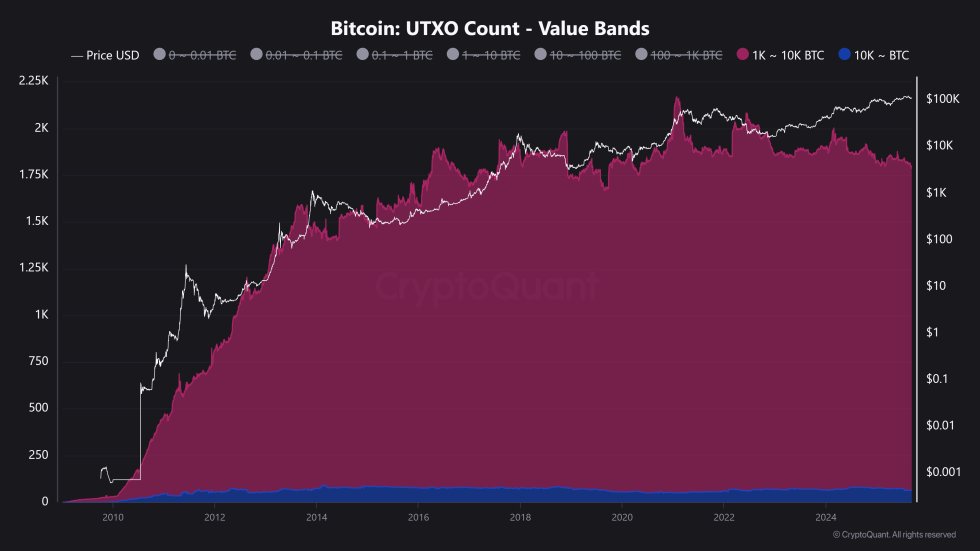
At the same time, the structure of Bitcoin’s investor base is changing. According to top analyst Maartunn, the number of addresses holding more than 1,000 BTC has been declining rapidly in this cycle. Meanwhile, addresses holding between 100 and 1,000 BTC are on the rise. This shift highlights a redistribution of supply, where large entities appear to be reducing exposure while smaller but still significant players increase their holdings.

Bitcoin Supply Shift: From Big Fish To Medium Players

Maartunn explains that the current “Big Fish Down, Medium Players Up” dynamic highlights a fundamental shift in Bitcoin’s ownership structure. This transition reflects a supply redistribution, where massive concentrations of Bitcoin in the hands of a few whales are giving way to medium-sized players, many of whom are linked to ETF custody wallets and institutional investment structures.
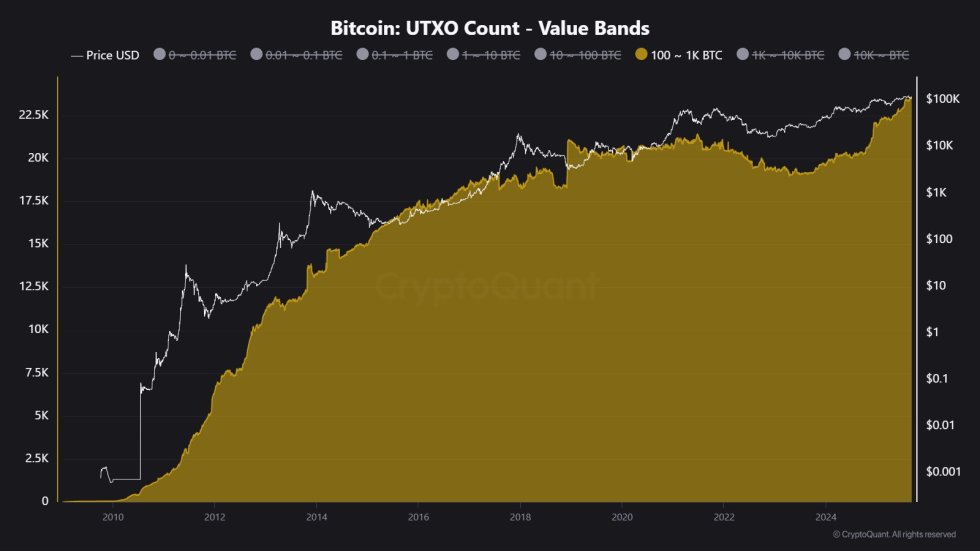
Bitcoin UTXO Count Value Bands 100-1K BTC | Source: Maartunn
Bitcoin UTXO Count Value Bands (100-1K BTC) | Source: Maartunn
Bitcoin UTXO Count Value Bands 1K - 10K BTC | Source: Maartunn
Bitcoin UTXO Count Value Bands (1K-10K BTC) | Source: Maartunn

This development carries major implications for the market. When Bitcoin is concentrated in fewer hands, price action can be vulnerable to abrupt swings triggered by large single-entity decisions. By contrast, supply spread across more medium players tends to create a more resilient and liquid market structure, less prone to outsized shocks. ETF custody wallets, in particular, represent a more transparent, regulated, and demand-driven form of holding, aligning Bitcoin closer with traditional financial infrastructure.

Unlike previous cycles, institutional involvement is now playing a decisive role. From ETFs in the US to treasury strategies in Japan, institutional adoption has reshaped how Bitcoin supply is absorbed after each rally. Instead of chaotic peaks followed by sharp drawdowns, the market now shows stretched-out tops and segmented distribution phases.

This structural evolution could mark a turning point for Bitcoin, where long-term sustainability increasingly outweighs speculative frenzy, setting the stage for a more mature bull market cycle.

Price Action Reveals Growing Momentum

Bitcoin (BTC) is showing signs of recovery after weeks of volatility, currently trading around $112,902 on the 12-hour chart. The price has managed to reclaim momentum following a bounce from the $110K support, but it now faces a critical resistance test. The chart highlights BTC pressing against the 50-day moving average (blue line), which sits just above the current price. A clean break above this level would strengthen the bullish case and potentially open the door toward the $115K–$117K range.
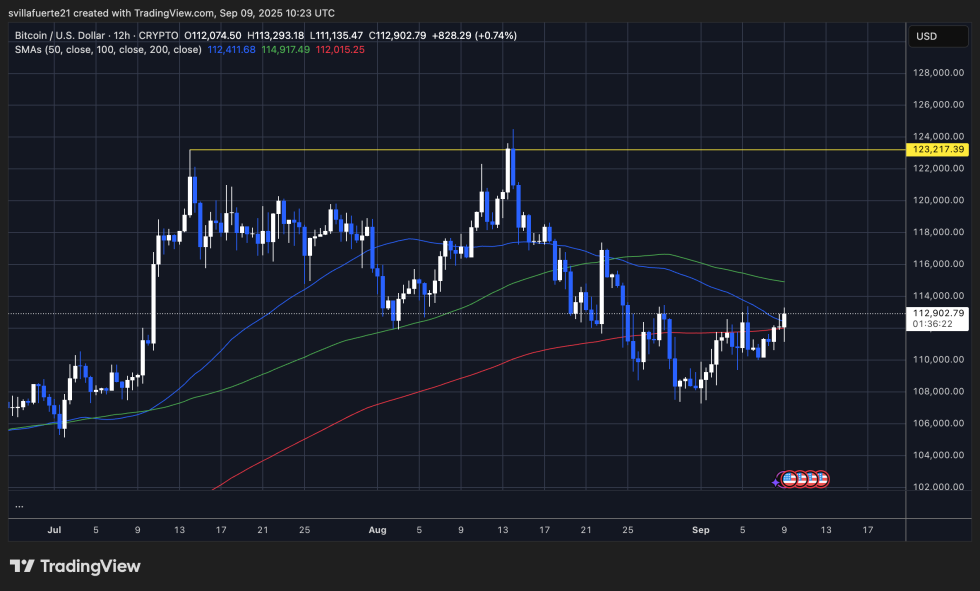
BTC testing short-term resistance | Source: BTCUSDT chart on TradingView

On the downside, the 200-day moving average (red line) remains intact near $112K, providing short-term support. This convergence of moving averages creates a narrow trading zone, meaning that the next decisive move could trigger a larger breakout. The ultimate resistance remains at $123,217, the local high marked in August.

Failure to sustain above $112K could result in another pullback toward $110K. On the flip side, a breakout with strong momentum above $115K could confirm a renewed rally. The market remains highly sensitive to macroeconomic signals, particularly the upcoming Federal Reserve decision, which could drive volatility in the coming days.

Featured image from Dall-E, chart from TradingView

Editorial Process for bitcoinist is centered on delivering thoroughly researched, accurate, and unbiased content. We uphold strict sourcing standards, and each page undergoes diligent review by our team of top technology experts and seasoned editors. This process ensures the integrity, relevance, and value of our content for our readers.

Sebastian's journey into the world of crypto began four years ago, driven by a fascination with the potential of blockchain technology to revolutionize financial systems. His initial exploration focused on understanding the intricacies of various crypto projects, particularly those focused on building innovative financial solutions. Through countless hours of research and learning, Sebastian developed a deep understanding of the underlying technologies, market dynamics, and potential applications of cryptocurrencies. As his knowledge grew, Sebastian felt compelled to share his insights with others. He began actively contributing to online discussions on platforms like X and LinkedIn, focusing on fintech and crypto-related content. His goal was to expose valuable trends and insights to a wider audience, fostering a deeper understanding of the rapidly evolving crypto landscape. Sebastian's contributions quickly gained recognition, and he became a trusted voice in the online crypto community. To further enhance his expertise, Sebastian pursued a UC Berkeley Fintech: Frameworks, Applications, and Strategies certification. This rigorous program equipped him with valuable skills and knowledge regarding Financial Technology, bridging the gap between traditional finance (TradFi) and decentralized finance (DeFi). The certification deepened his understanding of the broader financial landscape and its intersection with blockchain technology. Sebastian's passion for finance and writing is evident in his work. He enjoys delving into financial research, analyzing market trends, and exploring the latest developments in the crypto space. In his spare time, Sebastian can often be found immersed in charts, studying 10-K forms, or engaging in thought-provoking discussions about the future of finance. Sebastian's journey as a crypto analyst and investor has been marked by a relentless pursuit of knowledge and a dedication to sharing his insights. His ability to navigate the complex world of crypto, combined with his passion for financial research and communication, makes him a valuable asset to the industry. As the crypto landscape continues to evolve, Sebastian remains at the forefront, providing valuable insights and contributing to the growth of this revolutionary technology.

Lecturas Relacionadas

Mercados de capital de Internet 2026: Transición estructural en Estados Unidos y ventana estratégica para las instituciones asiáticas

El mercado de capitales de Internet en 2026: La transición estructural en EE.UU. y la ventana estratégica para las instituciones asiáticas La industria cripto está entrando en la fase de formación de industria, impulsada por un marco regulatorio más claro en EE.UU. (como la Ley GENIUS para stablecoins) y la adopción institucional acelerada. El resultado final previsto es el "Mercado de Capitales de Internet" (ICM), una reconstrucción de los mercados de capital donde la emisión, negociación y liquidación de activos ocurre en una cadena pública única, eliminando intermediarios y costos de tiempo como los retrasos en la liquidación (T+0). Solana emerge como la red que materializa este concepto, combinando una base técnica probada (alta capacidad, bajas tarifas), prácticas institucionales (ej. J.P. Morgan, State Street, Citi) y un diseño regulatorio proactivo. Los casos de uso institucional se desarrollan en cuatro áreas clave: 1) Banca y mercados de capitales (ej. gestión de fondos y emisión de deuda en cadena), 2) Pagos y stablecoins (ree diseñando sistemas de remesas y liquidación), 3) Tokenización de activos del mundo real (ej. oro, crédito privado) y 4) Difusión de infraestructura, creando efectos de red. La elección de Solana por parte de las instituciones se basa en requisitos técnicos críticos: economía de liquidación, cumplimiento programable (estándar Token-2022), estabilidad y la opción de soberanía operativa (Contra). Para las instituciones financieras asiáticas, la ventana estratégica está abierta. El camino pragmático es ser "seguidores rápidos", adoptando infraestructuras y referencias regulatorias validadas en EE.UU. La ejecución debe calibrarse según la preparación regulatoria local: fase ejecutable (ej. Singapur, Hong Kong), fase de transición (ej. Corea del Sur) o fase exploratoria. El intervalo actual, donde los casos están verificados pero los estándares no están solidificados, es una oportunidad. La variable ya no es "si" entrar, sino el orden y el punto de entrada.

marsbitHace 37 min(s)

Mercados de capital de Internet 2026: Transición estructural en Estados Unidos y ventana estratégica para las instituciones asiáticas

marsbitHace 37 min(s)

Trading

Spot
活动图片