$HYPER Predicted to Jump 2390% Viral Presale Nears $14M

bitcoinistPublicado a 2025-09-04Actualizado a 2025-09-04

Resumen

Imagine a world where the internet was stuck in the 1990s, with dial-up speeds, clunky websites, and no streaming video....

Trusted Editorial content, reviewed by leading industry experts and seasoned editors. Ad Disclosure

Imagine a world where the internet was stuck in the 1990s, with dial-up speeds, clunky websites, and no streaming video.

That’s where Bitcoin is today when it comes to speed and scalability. While it’s the GOAT of crypto and a fortress of value, its core design is rooted in a different era. At a sluggish seven transactions per second (TPS), it’s a far cry from modern needs. Think about it: a single Taylor Swift concert ticket sale would bring the entire network to its knees.

This is about utility and speed, though. Bitcoin’s limited programming capabilities mean it’s sort of like a fancy spreadsheet for keeping track of who owns what. You can’t build complex apps or the DeFi systems of the future on it.

This bottleneck has created an opening, a massive need for a solution that can take Bitcoin from being ‘digital gold’ to the foundation of a supercharged digital economy. And here to heed the call is Bitcoin Hyper ($HYPER).

The Genius of Bitcoin Hyper ($HYPER): Supercharging the King

Bitcoin Hyper ($HYPER) is a project that isn’t trying to dethrone Bitcoin. Instead, it’s building a turbocharger for it. It’s the difference between a dial-up modem and a fiber-optic connection.

Bitcoin Hyper is a Layer-2 scaling solution that borrows the best of both worlds: the garrisonesque security of $BTC and the mind-blowing speed and programmability of the Solana Virtual Machine (SVM).
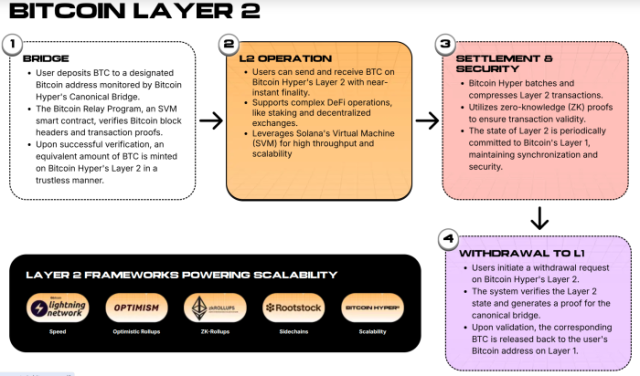
Bitcoin Hyper Layer-2 explanation.

How exactly does this happen? First, you use the Canonical Bridge, a secure two-way tunnel, to move your $BTC from the main chain to this new network. Your real Bitcoin doesn’t actually move; it’s locked in a secure location, and a wrapped version is created on Bitcoin Hyper, ready for use.

Once your wrapped Bitcoin is on the Hyper network, the SVM takes over. This is the powerful engine that enables the creation of dApps, DeFi protocols, and even new tokens and NFTs.

The SVM allows for extremely fast smart contract execution, something that’s not available on the main Bitcoin network. In a nutshell, Bitcoin Hyper ($HYPER) gives Bitcoin the programmability of Solana while keeping the core security of its original blockchain.

The native $HYPER token powers this new ecosystem, used for everything from transaction fees to network governance.

The Hype is Real: A Presale for the History Books

You know a project’s onto something when it’s moments away from hitting the $14M mark in its ongoing presale. It shows that the market wants what Bitcoin Hyper is selling. The financial side is simple: the presale price is a fraction of what the token is expected to be worth when it hits public exchanges.

Bitcoin Hyper promo post on X.

In our ‘Bitcoin Hyper ($HYPER) Price Prediction’, we think there’s a chance $HYPER could make it to the lofty heights of $0.32 by the end of 2025. If you invested today, that would give a staggering 2390% ROI, and who doesn’t want that!

This creates a powerful incentive for early birds. Plus, there are high-yield staking rewards currently sitting at 79% for those who commit to the long-term vision. It’s a classic case of supply and demand, with the demand being off the charts.

Get your $HYPER today while it’s still at $0.012855.

Why This One Hits Different: A Hybrid Revolution

This is a category-defining innovation. Unlike the other networks that primarily focus on payments, Bitcoin Hyper is building a complete, programmable ecosystem. It’s taking Bitcoin’s reputation and combining it with the developer-friendly, high-performance environment of Solana.

This hybrid approach makes it unique. It’s the best of both worlds. The project’s strategy is brilliant; it appeals to a technical crowd with its robust architecture while attracting a broader market with its vision and branding.

This combination of a solid foundation and viral marketing is why it’s standing out in a crowded space. It’s little wonder the big players have also been circling the presale. August alone saw two whales buys of $161.3K and $100.6K.

Don’t miss your chance to buy $Hyper at its current early-bird price. Want to find out how? We’ll take you through each step in our How to Buy Bitcoin Hyper ($HYPER) guide.

Hype vs. Reality

Bitcoin Hyper ($HYPER) is an exciting project, no doubt. It makes Bitcoin relevant again, and if it succeeds, it can unlock a tidal wave of new value for the OG digital gold. $HYPER’s presale success is hard to ignore.

But remember this is crypto. The hype is real, but so is the risk. Before you dive in, do your own research, and only invest what you feel comfortable losing. This isn’t financial advice, and while you may see a good return, you may also see yourself losing it all.

Authored by Ben Wallis, Bitcoinist – https://bitcoinist.com/bitcoin-hyper-predicted-to-jump-2390-presale-raises-13-7m 

Editorial Process for bitcoinist is centered on delivering thoroughly researched, accurate, and unbiased content. We uphold strict sourcing standards, and each page undergoes diligent review by our team of top technology experts and seasoned editors. This process ensures the integrity, relevance, and value of our content for our readers.

Ben is a freelance writer specializing in crypto developments (mainly altcoins) and the intricate ways global economics shape the digital asset space. His B.Ed. in Education provides a unique foundation for his writing, enabling him to distill complex crypto concepts and market shifts into clear, digestible insights. This skill is key to helping readers adapt and apply their understanding to the ever-evolving world of crypto investment. Passionate about making crypto accessible, Ben crafts content designed to educate a broad audience, from current market events to the essential foundational knowledge that underpins them. His goal is to empower readers through understanding. When he’s not immersed in crypto analysis and breaking down complex topics, Ben is an avid Pokémon fan and enjoys all things Disney.

Lecturas Relacionadas

Diálogo con el fundador de 42 Macro: La "rana hervida a fuego lento" de la Fed y la economía en K

Fuente: "Anthony Pompliano" Organizado por: Felix, PANews En el podcast "Anthony Pompliano", Darius Dale, fundador de 42 Macro, analizó la política monetaria de la Fed, la economía en forma de K y la inflación. Calificó al nuevo presidente de la Fed, Kevin Warsh, como un "halcón con apariencia de paloma", quien posiblemente endurezca la política monetaria en los próximos trimestres para luego poder relajarla. Dale destacó que las expectativas de inflación no predicen resultados futuros; los verdaderos impulsores son factores monetarios y políticos, como el gasto deficitario y la monetización de deuda. Señaló que la Fed no alcanzará su objetivo del 2% de inflación y que su estrategia es una "cocción lenta" (financial repression) para evitar problemas de estabilidad. Sobre la economía en forma de K, explicó que mientras las familias en la parte superior poseen unos 12 billones de dólares en efectivo y consumen intensamente, las de la parte inferior enfrentan tasas de morosidad récord en créditos. Advirtió que quienes no inviertan en activos quedarán rezagados debido al "efecto Cantillón", que transfiere riqueza a los primeros receptores del dinero nuevo. Respecto al mercado bursátil, mencionó que los inversores están trasladando capital de las "siete grandes" tecnológicas hacia empresas más amplias de IA, pero alertó sobre el riesgo de burbuja en los gastos de capital. Finalmente, compartió su experiencia personal sobre la división económica y social, subrayando que todas las personas, independientemente de su origen, buscan dignidad y seguridad para sus familias.

marsbitHace 1 hora(s)

Diálogo con el fundador de 42 Macro: La "rana hervida a fuego lento" de la Fed y la economía en K

marsbitHace 1 hora(s)

Los ocho padres del Transformer, ¿dónde están ahora?

Ocho investigadores de Google Brain revolucionaron la IA en 2017 con el artículo “Attention Is All You Need”, presentando la arquitectura Transformer. Nueve años después, los ocho autores originales han dejado Google, trazando caminos divergentes en la industria. Noam Shazeer, cofundador de Character.AI y clave en el mecanismo de atención, regresó brevemente a Google DeepMind antes de unirse recientemente a OpenAI. Ashish Vaswani, co-diseñador del modelo, fundó Essential AI, aunque hay rumores de que su equipo podría integrarse en Nvidia. Niki Parmar, después de cofundar Adept AI y Essential AI, ahora trabaja en Anthropic. Jakob Uszkoreit, quien propuso la idea central, fundó Inceptive, aplicando la IA al diseño de moléculas de ARN. Llion Jones, tras una larga carrera en Google, cofundó Sakana AI en Tokio, explorando modelos colaborativos inspirados en la naturaleza. Aidan N. Gomez, el más joven del grupo, fundó Cohere, centrada en soluciones empresariales de IA. Łukasz Kaiser, con un trasfondo teórico, es investigador clave en OpenAI, contribuyendo a modelos como GPT-4 y o1. Illia Polosukhin, co-diseñador del Transformer, es cofundador del protocolo blockchain NEAR. A pesar de sus trayectorias distintas —desde biotecnología y blockchain hasta laboratorios de IA—, comparten una creencia: Transformer no es el punto final. Siguen explorando activamente la próxima arquitectura que supere claramente al actual pilar de la IA moderna.

marsbitHace 1 hora(s)

Los ocho padres del Transformer, ¿dónde están ahora?

marsbitHace 1 hora(s)

Respuesta nacional al cálculo espacial: usar fotones es más eficiente, Musk y Huang Renxun dan demasiadas vueltas

La carrera por la computación espacial se ha convertido en una verdadera competencia de armamentos tecnológicos. Figuras como Elon Musk y Jensen Huang han destacado el potencial de la inteligencia artificial y la computación en órbita. Sin embargo, los desafíos en el espacio son extremos: radiación cósmica, disipación de calor en el vacío y limitaciones energéticas severas. Aquí es donde la computación fotónica, que utiliza fotones en lugar de electrones, emerge como una solución prometedora. Sus ventajas son clave para el entorno espacial: es inherentemente resistente a la radiación, genera muy poco calor y consume menos energía. Esto permite empaquetar más potencia de cálculo en un satélite con el mismo peso y recursos, superando las limitaciones de los chips electrónicos tradicionales. Aunque la tecnología fotónica para IA, especialmente en tareas de inferencia, aún debe superar retos de integración y estabilidad mecánica para los lanzamientos espaciales, su trayectoria es distinta. No depende de la miniaturización extrema de los transistores, sino de escalar el uso de propiedades de la luz como la longitud de onda. En una carrera donde la computación electrónica se acerca a límites físicos, la vía "óptica" podría ser la carta decisiva para desplegar de forma eficiente y sostenible la capacidad de cálculo en el espacio.

marsbitHace 2 hora(s)

Respuesta nacional al cálculo espacial: usar fotones es más eficiente, Musk y Huang Renxun dan demasiadas vueltas

marsbitHace 2 hora(s)

Trading

Spot
活动图片