Global Crypto Adoption 2025: Chainalysis Reveals Which Countries Are Winning

bitcoinistPublicado a 2025-09-04Actualizado a 2025-09-04

Resumen

Chainalysis has released its sixth annual Global Crypto Adoption Index, naming India the world’s top market for grassroots crypto adoption...

Trusted Editorial content, reviewed by leading industry experts and seasoned editors. Ad Disclosure

Chainalysis has released its sixth annual Global Crypto Adoption Index, naming India the world’s top market for grassroots crypto adoption in 2025, with the United States in second place, followed by Pakistan, Vietnam and Brazil. Published on September 2, 2025 as an excerpt from the forthcoming Geography of Cryptocurrency Report, the study blends on-chain and off-chain data to rank 151 countries by how widely and intensively ordinary people and institutions are using crypto, rather than by headline market capitalization alone.

Global Crypto Adoption Report 2025

At the heart of the ranking is a composite score built from four sub-indices: on-chain value received by centralized services; retail-sized on-chain value received by centralized services; on-chain value received by DeFi protocols; and institutional-sized on-chain value received by centralized services. Chainalysis says it ranks each country across these pillars, weights the results by factors such as population and purchasing power, and then takes a geometric mean to produce a normalized 0–1 score. The firm emphasizes scale, noting that its inputs encompass “hundreds of millions of cryptocurrency transactions and more than 13 billion web visits,” while acknowledging web-traffic-based geolocation limits.

Methodologically, 2025 marks a notable pivot. Chainalysis “removed the retail decentralized finance (DeFi) sub-index” after concluding it over-weighted a “relatively niche behavior,” and added a new institutional activity lens capturing transfers over $1 million, reflecting the post-ETF surge in professional participation. The aim, the firm writes, is a “fuller view of global crypto engagement, capturing both bottom-up (retail) and top-down (institutional) activity.”

The headline table underscores Asia’s weight. India sits first overall and first across all four underlying categories; Pakistan and Vietnam join it in the global top four, while Brazil rounds out the top five. Nigeria, Indonesia, Ukraine and the Philippines rank sixth through ninth, with the Russian Federation at ten and the United Kingdom at eleven. Notably, Ethiopia and Yemen enter the top twenty at twelfth and sixteenth, respectively, while Japan ranks nineteenth and Argentina twentieth. Chainalysis attributes the regional momentum to a surge in both centralized and decentralized usage across major APAC markets.
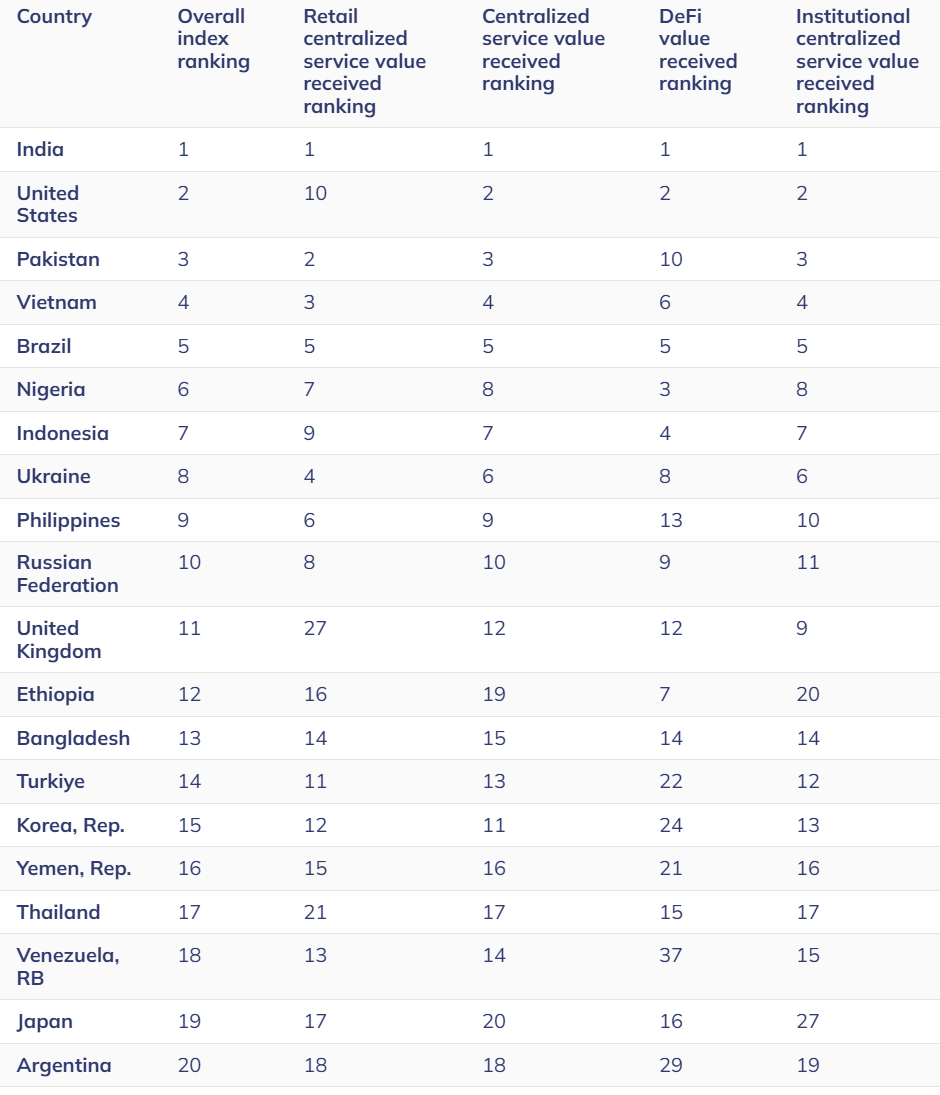
Global crypto adoption index 2025
Global crypto adoption index 2025 | Source: Chainalysis

Regional flow data deepen that picture. Over the twelve months to June 2025, APAC’s on-chain value received jumped 69% year over year—from roughly $1.4 trillion to $2.36 trillion—making it the fastest-growing region. Latin America followed at 63% growth and Sub-Saharan Africa at 52%. In absolute terms, Europe and North America still dominate, receiving about $2.6 trillion and $2.2 trillion respectively over the period; North America’s activity grew 49% amid renewed institutional participation, while Europe rose 42%. MENA expanded by 33%.

A population-adjusted cut of the index tells a different story, highlighting where crypto has penetrated most deeply relative to country size. On that basis, Eastern Europe is ascendant: Ukraine ranks first, Moldova second and Georgia third, ahead of Jordan and Hong Kong SAR. Chainalysis links the region’s leadership to economic uncertainty, distrust in banks, and high technical literacy that make crypto attractive for wealth preservation and cross-border transfers. Vietnam again appears near the top in this view, underscoring its broad-based retail engagement.
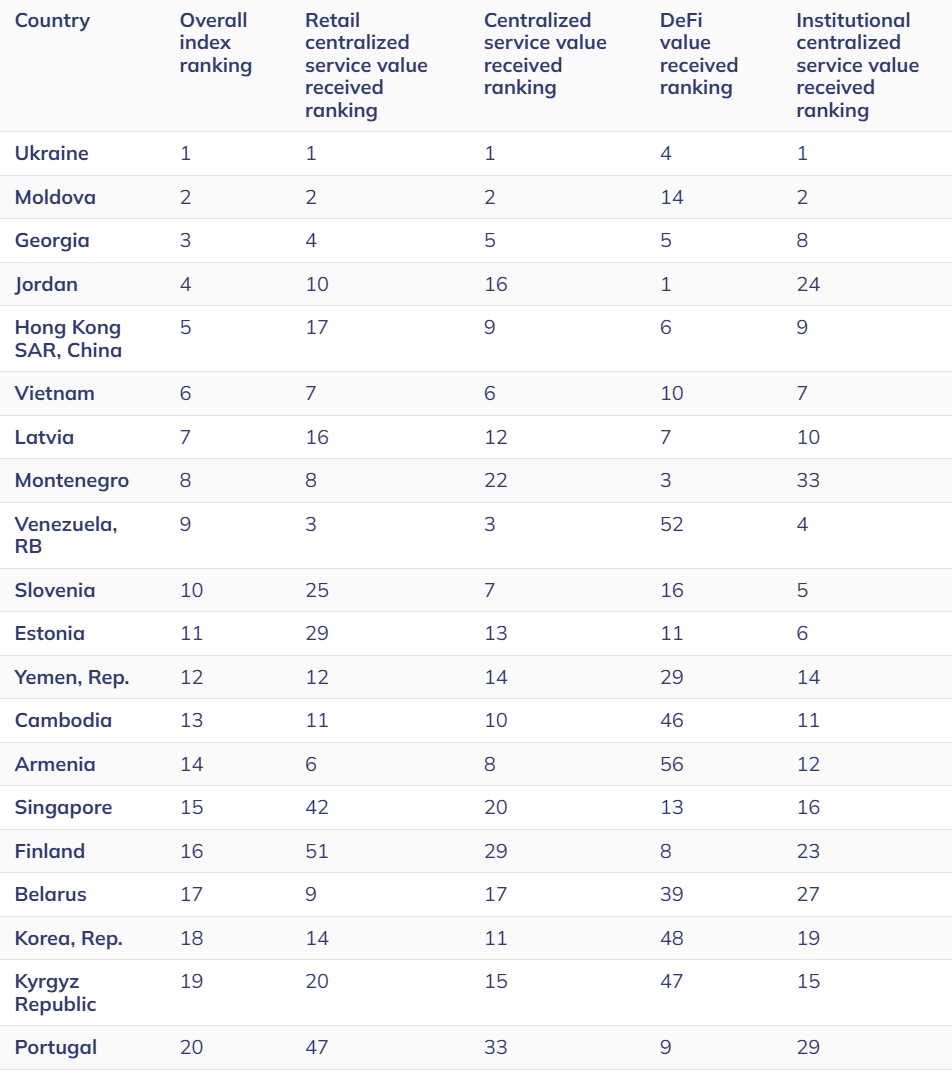
Global crypto adoption index 2025 adjusted by population
Global crypto adoption index 2025 adjusted by population | Source: Chainalysis

Stablecoins remain the connective tissue of global crypto commerce. Chainalysis finds that USDT and USDC continue to dwarf peers in transaction volume, with USDT processing over $1 trillion per month between June 2024 and June 2025 and USDC ranging roughly from $1.24 trillion to $3.29 trillion monthly, even as newer, more regulated or regionally tailored tokens accelerate. EURC’s monthly volume, for example, rose from about $47 million to more than $7.5 billion over the period, while PYUSD climbed from roughly $783 million to $3.95 billion.

The firm situates these flows within shifting rulesets—MiCA’s stablecoin regime in the EU and US legislative momentum exemplified by the GENIUS Act—alongside expanding merchant rails from payments giants and card-linked integrations by major crypto platforms.

Crucially, the report analyzes the fiat “on-ramp” into crypto across centralized exchanges. “Bitcoin leads by a wide margin,” Chainalysis writes, accounting for over $4.6 trillion in fiat purchase volume from July 2024 to June 2025—more than double Layer-1 tokens ex-BTC and ETH (about $3.8 trillion), with stablecoins at $1.3 trillion and altcoins around $540 billion. The United States is the largest national on-ramp at more than $4.2 trillion, followed by South Korea above $1 trillion and the European Union just under $500 billion; Bitcoin’s share of fiat inflow is especially pronounced in the UK and EU at roughly 47% and 45%.

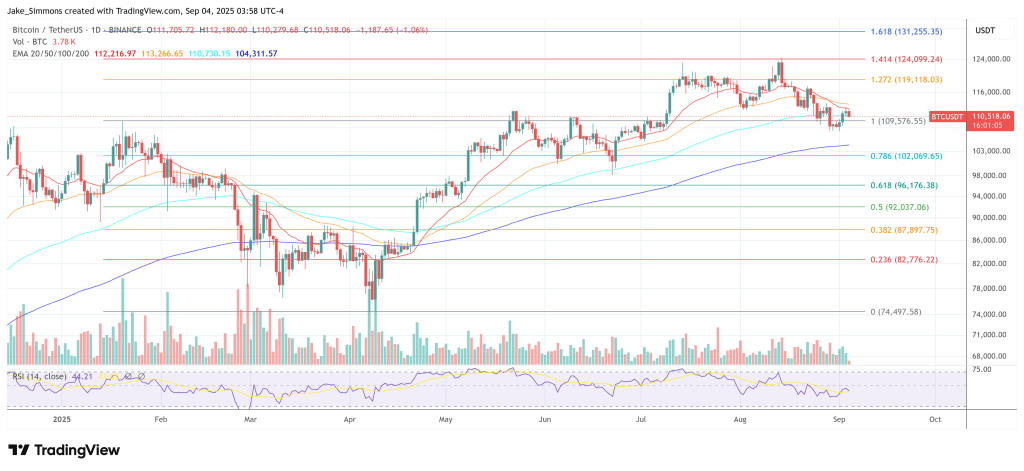
At press time, Bitcoin traded at $110,518.
Bitcoin price
BTC falls below the EMA100 again, 1-day chart | Source: BTCUSDT on TradingView.com
Featured image created with DALL.E, chart from TradingView.com
Editorial Process for bitcoinist is centered on delivering thoroughly researched, accurate, and unbiased content. We uphold strict sourcing standards, and each page undergoes diligent review by our team of top technology experts and seasoned editors. This process ensures the integrity, relevance, and value of our content for our readers.

Jake Simmons has been a Bitcoin enthusiast since 2016. Ever since he heard about Bitcoin, he has been studying the topic every day and trying to share his knowledge with others. His goal is to contribute to Bitcoin's financial revolution, which will replace the fiat money system. Besides BTC and crypto, Jake studied Business Informatics at a university. After graduation in 2017, he has been working in the blockchain and crypto sector. You can follow Jake on Twitter at @realJakeSimmons.

Lecturas Relacionadas

Un grupo de ingenieros de Suzhou alcanzan la libertad financiera inesperadamente

Un equipo de ingenieros en Suzhou obtiene una riqueza inesperada tras la salida a bolsa de su empresa, Lianxun Instruments. La compañía, líder en instrumentos de prueba para comunicaciones ópticas, ha visto su valor multiplicarse por 30 en solo dos meses desde su IPO en abril, alcanzando un precio por acción superior a 2.000 yuanes y una capitalización de mercado de más de 230.000 millones de yuanes (unos 230.000 millones de euros). Este espectacular aumento ha generado una fortuna colectiva de más de 36.000 millones de yuanes (3.600 millones de euros) para casi un centenar de empleados, principalmente ingenieros y talento técnico, a través de tres plataformas de participación accionarial. Fundada en 2017 por tres expertos en óptica y comunicaciones, la empresa ha crecido rápidamente desarrollando equipos de prueba de alta gama. Su éxito se atribuye a la fuerte demanda de potencia de cálculo para la IA y a tener como clientes a gigantes globales del sector. El caso ilustra una nueva tendencia de creación de riqueza en China, impulsada por la tecnología y que recompensa a los profesionales técnicos, a diferencia de las olas anteriores centradas en internet o bienes raíces. Inversores como el capital estatal de Suzhou han obtenido rendimientos extraordinarios. Historias similares se repiten en otras empresas tecnológicas chinas del sector de la IA y los semiconductores, que están generando una nueva ola de millonarios entre sus ingenieros e investigadores.

marsbitHace 1 min(s)

Un grupo de ingenieros de Suzhou alcanzan la libertad financiera inesperadamente

marsbitHace 1 min(s)

El artículo más 'peligroso' del año de NVIDIA: El código auto-reproductor de la IA, evolución y mejora ilimitadas

NVIDIA, junto con la Universidad de Cambridge, ha publicado un artículo titulado "Red Queen Gödel Machine" (RQGM), considerado por muchos como uno de los más arriesgados del año. El sistema implementa un mecanismo de "Recursive Self-Improvement" (RSI) donde una IA no solo escribe y prueba su propio código, eliminando las versiones fallidas, sino que también evoluciona y crea evaluadores ("examinadores") más estrictos para juzgar sus mejoras posteriores. Este ciclo de mejora mutua y acelerada entre el agente y su evaluador, inspirado en la "Hipótesis de la Reina Roja" (correr para permanecer en el mismo lugar), rompe con el límite de 20 años de la "Máquina de Gödel" original, que requería una demostración matemática previa a cualquier autocambio. En pruebas prácticas, el RQGM superó a los métodos anteriores (SOTA) en tareas como generación de código (mejorando la tasa de aprobación y reduciendo costos computacionales), escritura de artículos académicos (duplicando la tasa de aceptación simulada) y resolución de problemas matemáticos complejos. Además, logró corregir el sesgo de los LLMs que prefieren contenido generado por IA frente al humano, igualando la aceptación manteniendo alta precisión. El hallazgo aviva las predicciones, como la de Jack Clark de Anthropic, que estima un 60% de probabilidad de que surja una IA altamente autónoma y auto-evolutiva para finales de 2028. El artículo concluye que cuando una IA empieza a diseñar sus propios criterios de evaluación y a impulsarse recursivamente hacia sus límites, se acerca a un punto donde podría redefinir autónomamente la inteligencia, acortando de forma exponencial el camino hacia una Superinteligencia Artificial (ASI).

marsbitHace 27 min(s)

El artículo más 'peligroso' del año de NVIDIA: El código auto-reproductor de la IA, evolución y mejora ilimitadas

marsbitHace 27 min(s)

Diálogo con el fundador de 42 Macro: La "rana hervida a fuego lento" de la Fed y la economía en K

Fuente: "Anthony Pompliano" Organizado por: Felix, PANews En el podcast "Anthony Pompliano", Darius Dale, fundador de 42 Macro, analizó la política monetaria de la Fed, la economía en forma de K y la inflación. Calificó al nuevo presidente de la Fed, Kevin Warsh, como un "halcón con apariencia de paloma", quien posiblemente endurezca la política monetaria en los próximos trimestres para luego poder relajarla. Dale destacó que las expectativas de inflación no predicen resultados futuros; los verdaderos impulsores son factores monetarios y políticos, como el gasto deficitario y la monetización de deuda. Señaló que la Fed no alcanzará su objetivo del 2% de inflación y que su estrategia es una "cocción lenta" (financial repression) para evitar problemas de estabilidad. Sobre la economía en forma de K, explicó que mientras las familias en la parte superior poseen unos 12 billones de dólares en efectivo y consumen intensamente, las de la parte inferior enfrentan tasas de morosidad récord en créditos. Advirtió que quienes no inviertan en activos quedarán rezagados debido al "efecto Cantillón", que transfiere riqueza a los primeros receptores del dinero nuevo. Respecto al mercado bursátil, mencionó que los inversores están trasladando capital de las "siete grandes" tecnológicas hacia empresas más amplias de IA, pero alertó sobre el riesgo de burbuja en los gastos de capital. Finalmente, compartió su experiencia personal sobre la división económica y social, subrayando que todas las personas, independientemente de su origen, buscan dignidad y seguridad para sus familias.

marsbitHace 2 hora(s)

Diálogo con el fundador de 42 Macro: La "rana hervida a fuego lento" de la Fed y la economía en K

marsbitHace 2 hora(s)

Trading

Spot
活动图片